
The AutoWeek issue dated April 13, 1987, carried a cover line no Mustang owner was ready for: "Exclusive: The '89 Mustang." The car in Christopher Sawyer's story drove its front wheels and sat on Mazda underpinnings. Inside Ford it carried the code ST-16, and it was being developed as the next Mustang. It did reach showrooms, in 1988, but as the 1989 Ford Probe. How the Ford Probe Mustang plan came apart is one of the stranger near misses in the pony car's history, and one of the few times the people who bought these cars changed what Ford built.
Car Features
6 min read
The Front-Drive Mustang That Became the Probe
In 1987 Ford planned a front-drive, Mazda-based car as the 1989 Mustang. How the enthusiast backlash turned it into the Ford Probe instead.
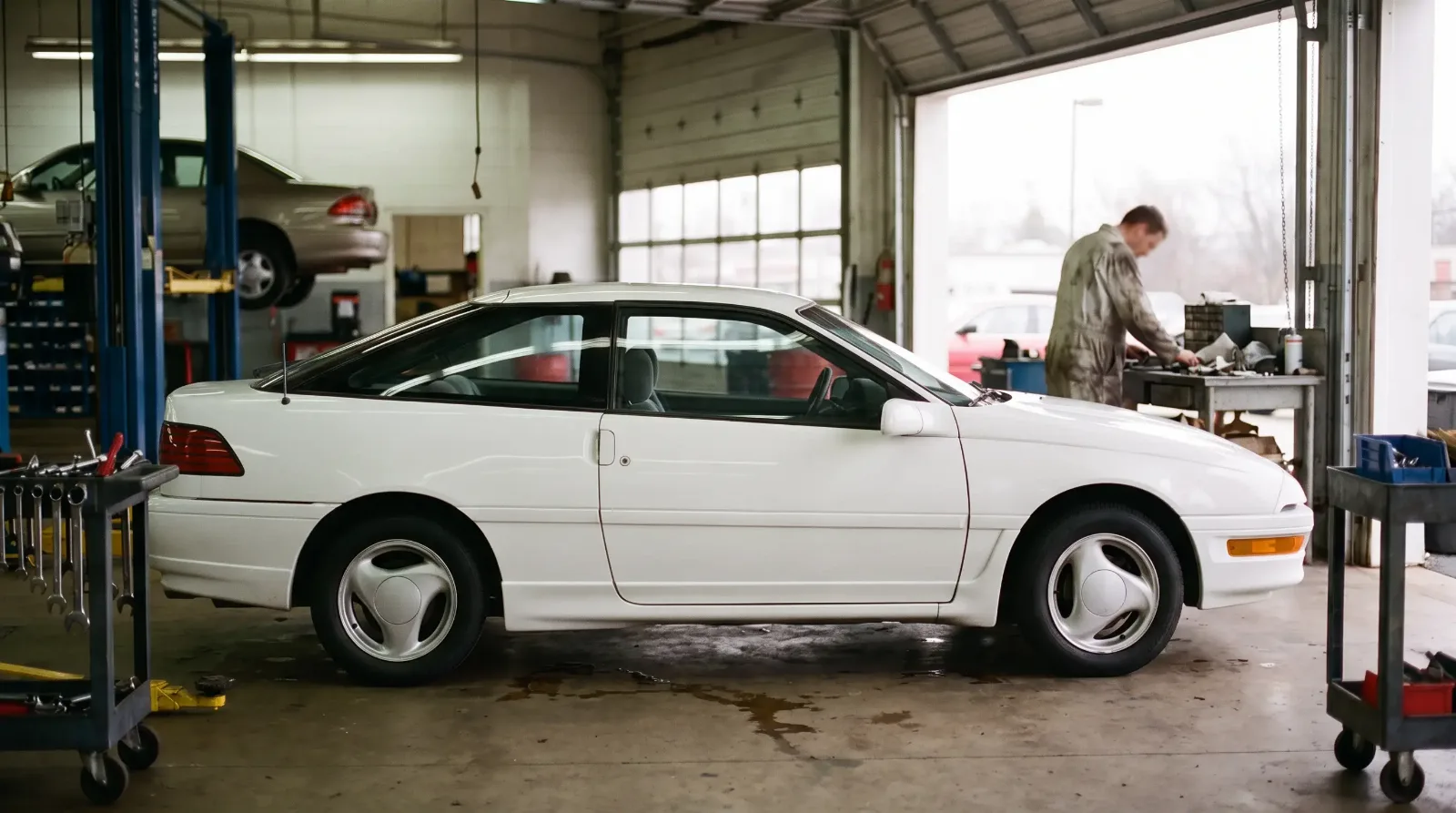
To see why the reaction ran so hot, you have to picture what the Mustang was in 1987. If you need the background, our Fox Body Mustang story covers the whole run. The short version: the Fox had been the Mustang since the 1979 model year, and by 1987 it had finally turned into the car its owners wanted.
The car Ford was replacing
The 1987 Mustang got the aero nose, a new dash, and a 5.0 HO V8 rated at 225 hp and 300 lb-ft. In a plain LX body, the 5.0 package listed at $1,885. That combination, light, cheap and quick, was turning up at drag strips, in police fleets and on Friday night cruises all over the country. It is the car people now call the LX sleeper, and in 1987 it was the hottest thing a working kid could finance.
It also rode on a platform that dated to the 1978 Fairmont. From inside Ford, that looked like a problem to solve. A front-drive car shared with Mazda's 626 and MX-6 would mean a modern platform without paying for one from scratch. Ford had scheduled exactly that car to carry the Mustang name for 1989. On a spreadsheet the logic held. In a parking lot full of 5.0s it did not.
"No Japanese Mustang, please"
The loudest voice belonged to Donald Farr, editor of Mustang Monthly. In his June 1987 editorial he asked readers to write to Ford chairman and chief executive Donald Petersen, and he boiled the request down to four words: "No Japanese Mustang, please." Enthusiasts had a name for the car by then, too. They called it the Mazdastang.
The letters came. How many is harder to pin down. Accounts run from thousands to hundreds of thousands, and the bigger figure has grown in the retelling. That is typical of Mustang lore. The tidy version says the mail alone killed the plan and saved the rear-drive car. The record is messier than that, and there's more on that here. What nobody disputes is that the reaction was loud, it was organized by the enthusiast press, and it landed on desks at Ford while the decision was still open.
As I read it, the objection was never really about Mazda's engineering. It was about the idea that a Mustang could be anything a product planner wanted it to be, as long as the badge fit. Rear drive and a V8 were the parts of the car they considered non-negotiable.
Why the Ford Probe Mustang lost the pony
In 1987 Alex Trotman, then head of Ford's North American operations and later the company's chief executive, ruled that ST-16 was not a Mustang. It would be sold as the Probe. He was not alone inside the company. Bob Rewey, general manager of Ford Division, pushed to reverse the plan to call the front-drive car a Mustang, and he later became one of the internal backers of the rear-drive car that followed. John Coletti, the engineer who would lead the skunkworks behind the 1994 Mustang, went on record saying he would rather see the Mustang name die than put it on the Probe.
So the Probe launched in 1988 as a 1989 model, on Mazda's GD platform, built at the Mazda plant in Flat Rock, Michigan. It sold well right away. Ford built 162,889 of them for 1989. The Mustang did not go anywhere. The Fox carried on, and Ford built 209,769 Mustangs for the same model year.
| 1989 model year | Ford Probe (ST-16) | Ford Mustang (Fox) |
|---|---|---|
| Drive wheels | Front | Rear |
| Platform | Mazda GD, shared with the 626 and MX-6 | Fox, in use since the 1978 Fairmont |
| Built at | Mazda plant, Flat Rock, Michigan | Dearborn, Michigan |
| V8 available | No | Yes, 5.0 HO, 225 hp |
| Model-year production | 162,889 | 209,769 |
The Probe on its own terms
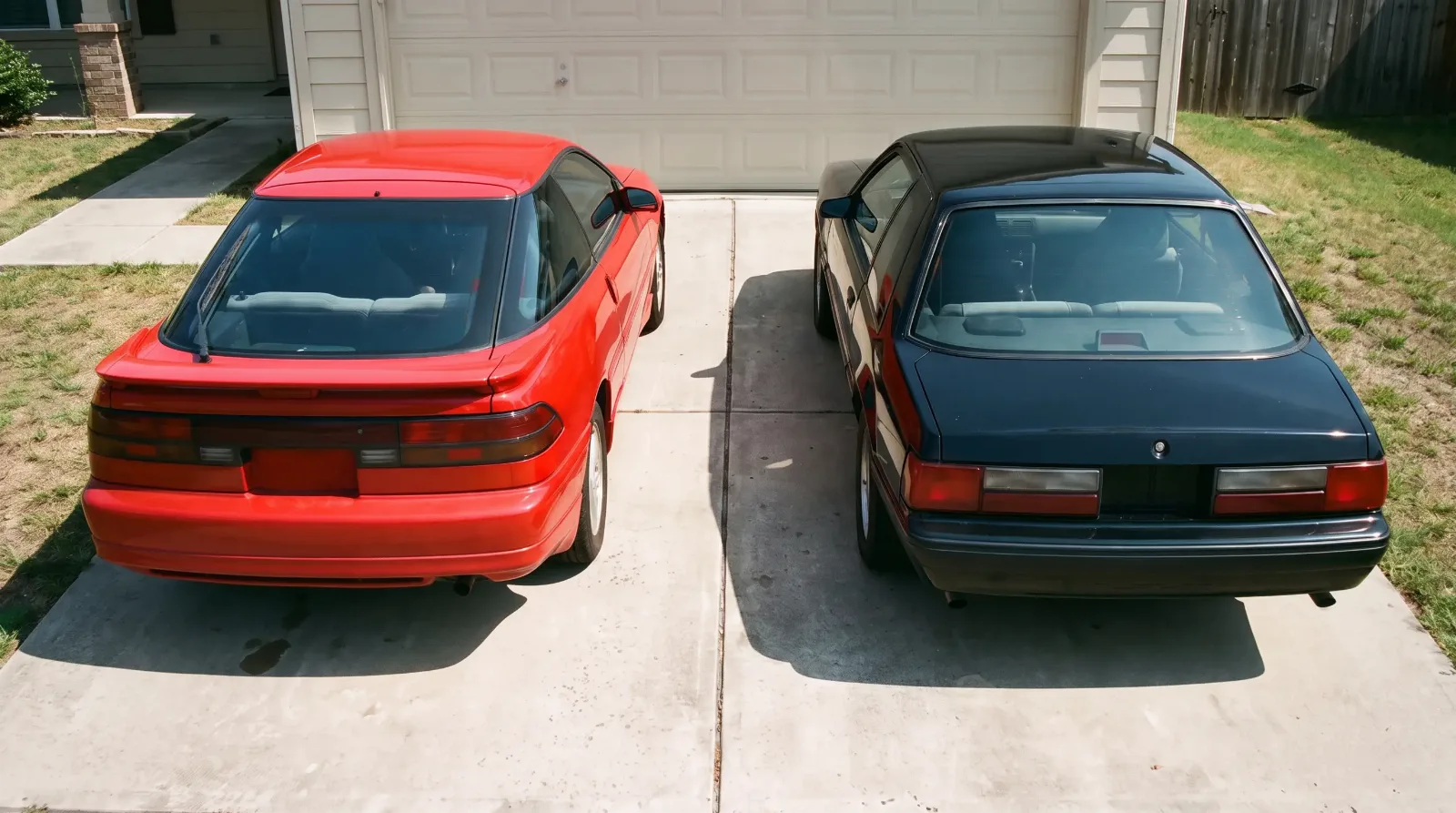
It is easy to treat the Probe as the villain of this story. That is not fair to the car. As a front-drive sport coupe it did what it was built to do, and a first-year run of more than 160,000 says plenty of buyers agreed. The name itself came from a series of Ford aerodynamic concept cars built between 1979 and 1985, which suits a car that was always more about wind tunnels than burnouts. The Probe ran through a second generation before Ford dropped it after the 1997 model year; the last one was built in June 1997.
Its real problem was the job it had first been handed. A Mustang buyer in 1987 was not shopping for a better front-drive coupe. He or she already owned the car they wanted and was afraid of losing it. Put a Probe beside an LX 5.0 at a cruise night and the argument made itself.
The Probe also left a mark on the Mustang it failed to become. When Ford's designers clinicked three themes for the 1994 car, the one nicknamed "Bruce Jenner" was faulted for looking too much like the Probe. Three years after the fight, the Probe had become the shorthand inside Ford for what a Mustang should not look like.
"Most car stories are about what a company built. This one is about what thousands of people refused to let it build, and it is the reason a 1994 GT still has its rear wheels doing the work."
Patrick Walsh
What the near miss left behind
Winning the naming fight did not guarantee the Mustang a future. The Fox stayed in production through 1993, and by 1989 Ford was again asking whether a rear-drive Mustang was worth the money. John Coletti's skunkworks, which started that year, is the reason the answer was yes. The car they delivered for 1994 rode on an updated Fox platform, kept rear drive, and kept a V8. Every one of those choices traces back to 1987, when Ford learned what Mustang owners would and would not accept.
The episode also set a pattern that held for years. Ford learned that the Mustang name carried obligations the company could not simply rewrite, and the enthusiast press learned it could move a carmaker. Neither lesson was written down anywhere, but you can see both in every Mustang that followed. For how this chapter fits into the six decades around it, start with the context.
Sources and notes
Related Reading
Have a
Ford Mustang
for Sale?
Reach thousands of serious classic car collectors across the US.
Sell It Here →
Selling a classic? Here's how: where to sell your classic car online
Are You a Classic Car Dealer?
List your full inventory and connect with targeted classic car buyers.
Join as a Dealer →

About the author
Patrick Walsh
Automotive journalist covering classic car shows, events, and the enthusiast community across North America.
Related Listings - Ford Mustang
Comments
Be the first to comment on this article.