
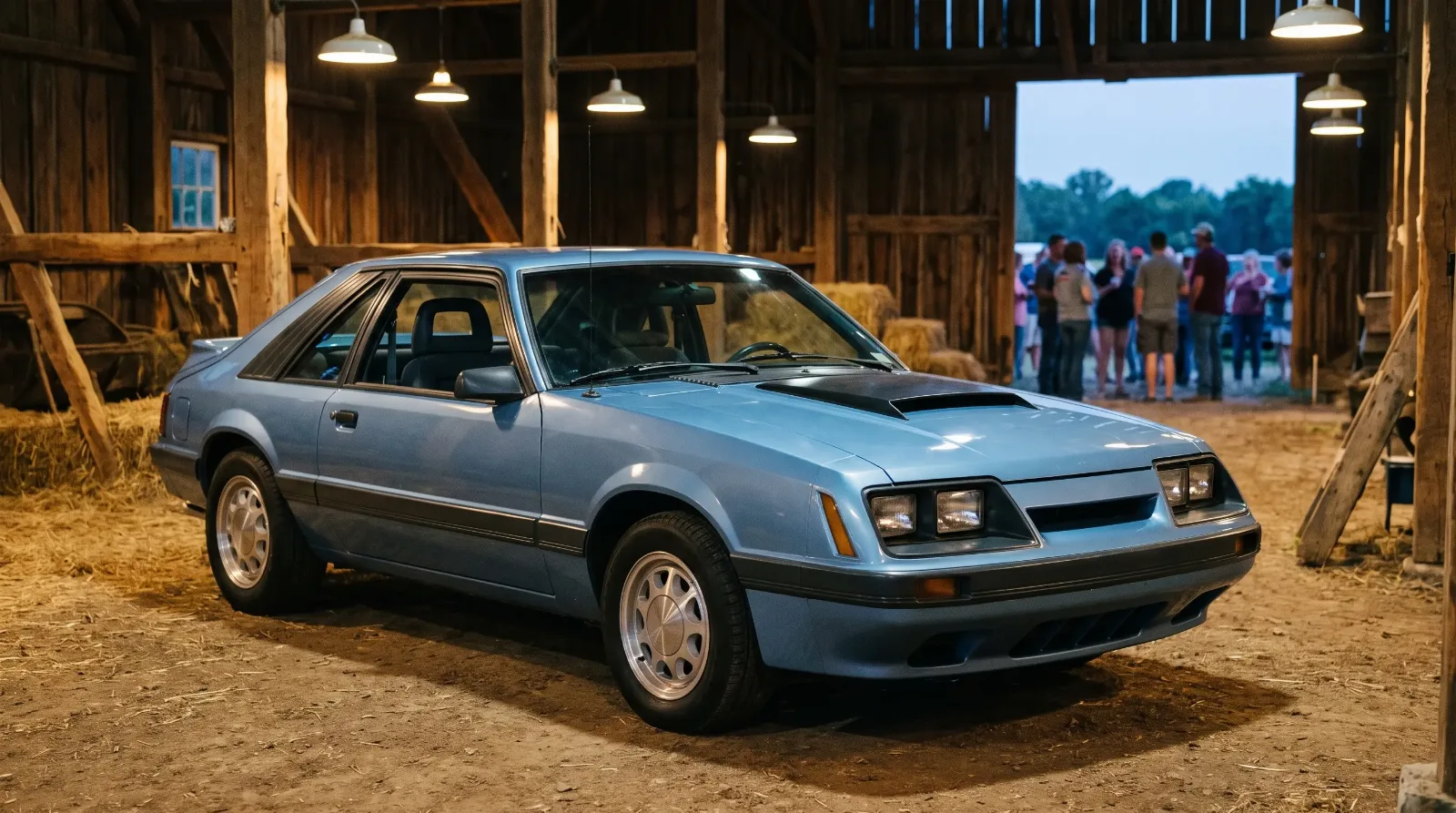
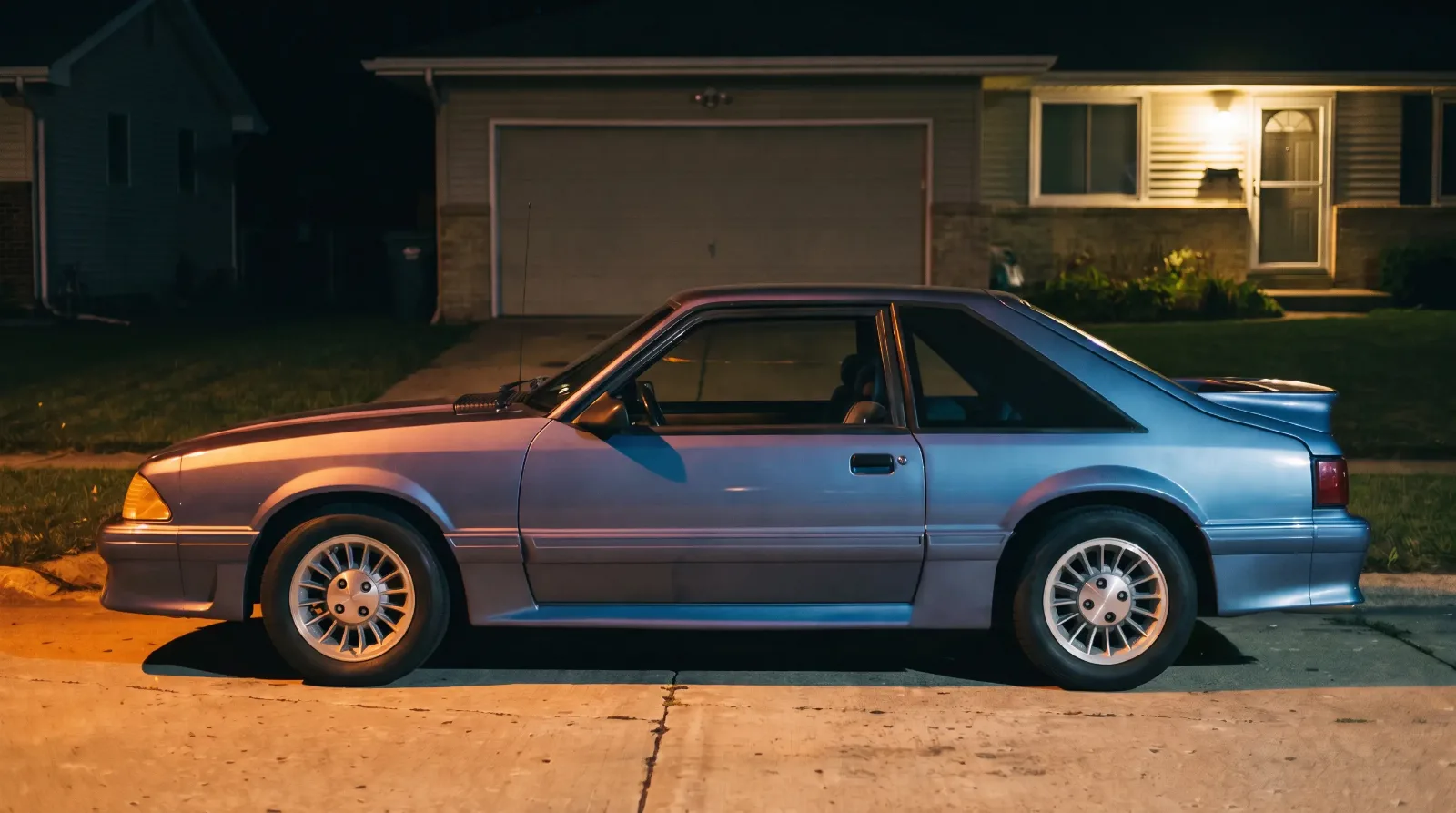
Every Fox body Mustang argument eventually comes down to the nose. On one side you have the four-eye cars, 1979 through 1986, with four rectangular sealed-beam headlamps looking out of the front end. On the other you have the aero cars, 1987 through 1993, with flush composite lamps and a smooth nose that followed the SVO. The four eye vs aero Fox body split is the cleanest line in the whole fifteen-year run, and it is about a lot more than lights.
Car Features
7 min read
Four-Eye vs Aero: Early and Late Fox Bodies
Four sealed beams from 1979 to 1986, a flush aero nose from 1987 to 1993. What really changed across the Fox Mustang split, and how to tell.
For the full story of the platform, start with our Fox Body history. Here we stay with the question people ask first at a show: which half is this car from, and what changed when Ford switched faces?
Four eye vs aero Fox body: where the line falls
The four-eye name is literal. From 1979 through 1986 the regular Mustang used four rectangular sealed-beam headlamps, two on each side, one pair for low beam and one for high. Owners started calling these the four-eye cars, and the name stuck well enough that parts catalogs use it today. For 1987 Ford replaced that front end with what everybody calls the aero nose: flush aerodynamic headlamps and a smoother fascia, in the style of the SVO.
There is one exception, and it trips people up. The SVO, the intercooled turbo 2.3 hatchback sold from 1984½, never had the four-eye layout. It started with single sealed beams for 1984 and 1985, then got composite aero lamps as a 1985½ model. So a 1986 SVO wears flush lamps while the 1986 GT parked next to it still has four eyes. If somebody tells you aero always means 1987 or later, that SVO is your answer.
By volume, the four-eye years are the bigger half. Ford built 369,936 Mustangs for 1979 alone, the best year of the Fox run, and the 1979 to 1986 model years add up to roughly 1.6 million cars, nearly all of them four-eyes. The aero years, 1987 to 1993, come to somewhere above 900,000 depending on whose production tables you trust, because the published figures for those years do not agree. The older face is the more common one by a wide margin.
Three faces inside the four-eye years
The four lamps stayed put from 1979 to 1986, but the nose around them changed twice, and the hardware behind it changed more.
The 1979 to 1982 cars are the original shape, credited to Jack Telnack and his team. It was a light, clean car for its day, with a drag coefficient of 0.44 for the hatchback and 0.46 for the notchback, and it came in about 200 lb lighter than the Mustang II it replaced. Under the hood the early years were thin on V8. The 1979 302 made about 140 hp, and for 1980 and 1981 the only V8 was a 4.2-liter rated around 118 to 120 hp, automatic only. The 1982 GT brought the 5.0 back at 157 hp.
For 1983 the nose was reworked and the Mustang wore an exterior Blue Oval for the first time. That year also brought back the convertible, the first since 1973, and the details of how it returned are a story of their own. The 5.0 went to 175 hp with a Holley four-barrel, and the T-5 five-speed arrived partway through the year. For 1984 the LX name replaced the GL and GLX trims.
For 1985 the nose changed again, giving up the grille for a slot intake. The 1985 GT is the last carbureted V8 Mustang, 210 hp with a roller cam on manual cars. Then 1986 is the odd one. It is still a four-eye on the outside, but it has sequential multiport fuel injection rated at 200 hp, and V8 cars got the 8.8-inch rear axle. Of all the four-eyes, the 1986 GT sits closest to the aero cars mechanically.
What 1987 changed besides the headlights
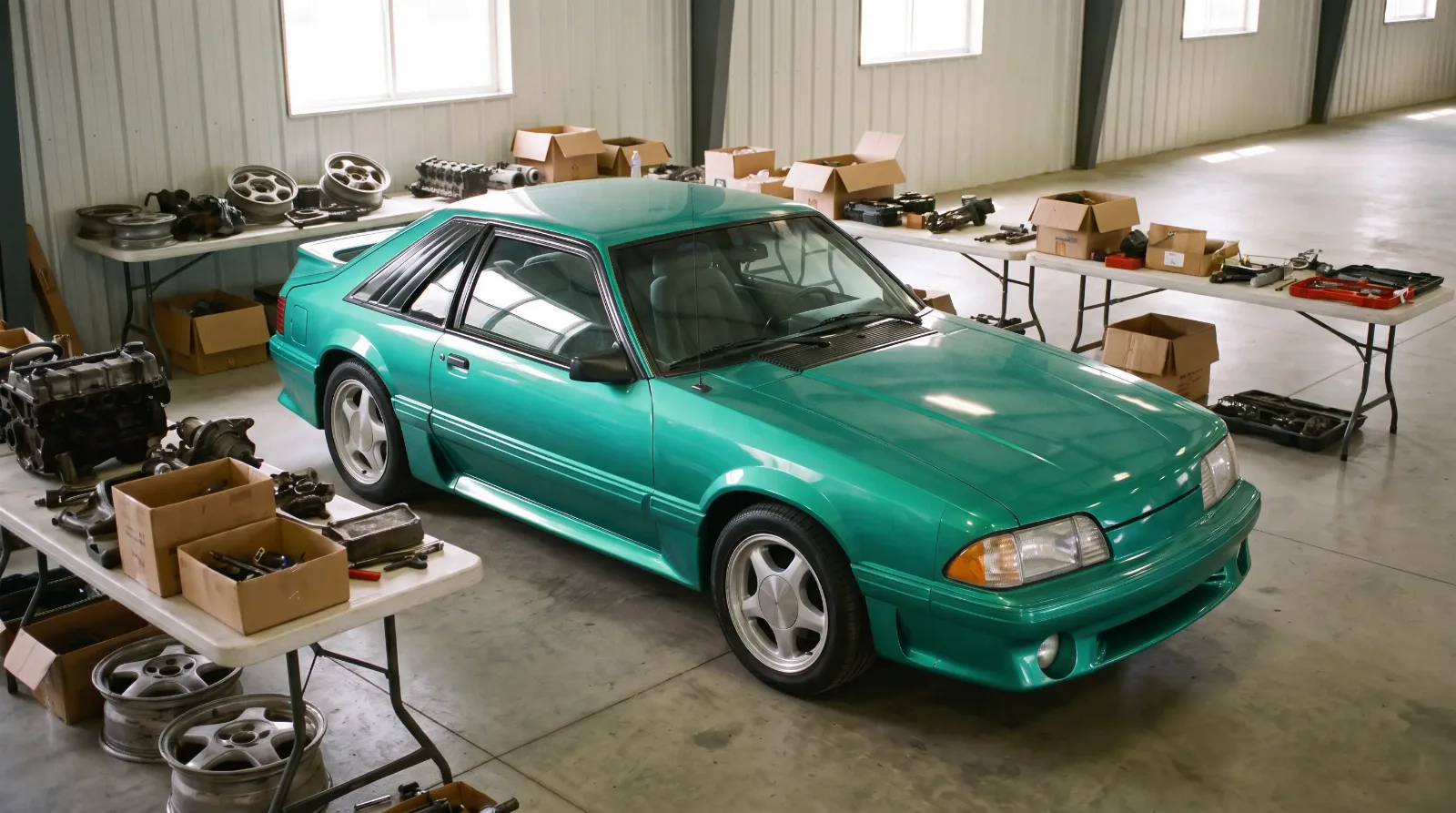
Ford announced the 1987 car in August 1986, and the nose was only the most visible part. The interior got a new dash and console. The GT picked up ground-effects skirts and louvered taillamps, the ones everybody calls cheese graters, plus 15-inch turbine-style wheels on four-lug hubs. The 5.0 went to 225 hp at 4,200 rpm and 300 lb-ft at 3,200 with E7TE heads. Most of that is covered in the 1987 facelift, so I will stick to what it means for the four-eye versus aero question.
What it means is that 1987 was a package, not a lamp change. If you are looking at a Fox with an aero nose and the early dash, or cheese-grater taillamps on a car with the old headlamps, something got swapped. Owners swap these parts both ways, and some swaps fool a quick walk-around.
After 1987 the aero cars kept changing, just more quietly. Mass-air-flow fuel injection replaced speed-density for 1989. A driver airbag became standard for 1990, and the tilt wheel went away with it. V8 cars got 16-inch five-spoke wheels for 1991. And for 1993 Ford re-rated the 5.0 to 205 hp and 275 lb-ft. The face stayed the same for seven model years. What sat behind it did not.
"People treat the headlights like the whole story. They are the label on the box. Open it up and a 1986 GT and a 1987 GT are closer than they look, while a 1985 and a 1987 are further apart than anybody guesses from the front bumper. Check the dash and the fuel system before you decide which car you are standing in front of."
Mike Sullivan
Under the skin, year by year
Lay the years side by side and the pattern is plain. The four-eye era is where the V8 came back to life, climbing from 157 hp to 210 over four model years and switching from carburetor to fuel injection. The aero era took that injected 5.0, bumped it to 225 and then mostly left it alone while Ford worked on the chassis, the interior and the safety equipment.
| Model year | Front end | Top V8 rating (net) | What else changed |
|---|---|---|---|
| 1979 | Four-eye | 302, about 140 hp | Fox Mustang launch |
| 1980 to 1981 | Four-eye | 4.2 V8, 118 to 120 hp | V8 automatic only |
| 1982 | Four-eye | 5.0 HO, 157 hp | GT returns |
| 1983 | Four-eye, reworked nose | 175 hp, Holley four-barrel | Convertible returns, T-5 mid-year |
| 1984 | Four-eye (SVO: single sealed beams) | 175 hp (four-barrel) | LX replaces GL and GLX; SVO arrives |
| 1985 | Four-eye, slot nose (SVO aero lamps from 1985½) | 210 hp | Last carbureted V8; roller cam on manual cars |
| 1986 | Four-eye | 200 hp, multiport injection | 8.8-inch rear axle on V8 cars |
| 1987 | Aero | 225 hp | New dash and console; GT skirts and louvered taillamps |
| 1989 | Aero | 225 hp | Mass-air-flow injection |
| 1990 | Aero | 225 hp | Driver airbag standard |
| 1991 | Aero | 225 hp | 16-inch five-spoke wheels on V8 cars |
| 1993 | Aero | 205 hp | 5.0 re-rated |
The early four-eyes are the light, simple cars, and the late four-eyes are where the real performance story starts. The aero cars are the most refined Fox Mustangs and the strongest in stock form. Neither half is the better car in every way, and anybody who tells you otherwise is probably selling one.
Telling them apart in the metal
The headlights are the first clue and the least reliable one, because a nose is a bolt-on job. The VIN is harder to fake. On the 17-character VIN used from the 1981 model year, the tenth character is the model year: G for 1986, H for 1987. A decoded 1989 LX 5.0, 1FABP41E4KF152360, shows a K in that spot and an E in the eighth, the engine position, for its fuel-injected 5.0. A four-eye front end on a car with an H or later in the tenth position means an aero car wearing an older face. An aero nose on a G or earlier car went the other way.
After the VIN, go inside. The 1987 dash and console are different from the four-eye interior, and from 1990 the airbag wheel is a dead giveaway. On a GT, louvered taillamps belong to 1987 and later. None of that is proof on its own, since dashes and lamps swap too, but when the VIN, the interior and the nose all agree, you know what you have. When they do not, the paperwork matters more than the parts, and that is where checking a Mustang's provenance earns its keep.
A converted car is not a bad car. Plenty of them are honest drivers that somebody updated, or backdated, because they liked the look. It just does not wear the face that matches its VIN, and anybody who cares which side of the 1987 line they own should know that before the argument starts.
Sources and notes
Related Reading
Have a
Ford Mustang
for Sale?
Reach thousands of serious classic car collectors across the US.
Sell It Here →
Selling a classic? Here's how: sell my classic car
Are You a Classic Car Dealer?
List your full inventory and connect with targeted classic car buyers.
Join as a Dealer →
#Ford Mustang
#fox body mustang
#Mustang SVO
#Mustang 5.0
#Four-Eye Mustang
#Aero Mustang
#1987 Mustang GT

About the author
Mike Sullivan
Detroit-area muscle car enthusiast and restoration specialist with three decades of hands-on experience working on American iron.
Related Listings - Ford Mustang
More in Car Features

Comments
Be the first to comment on this article.