
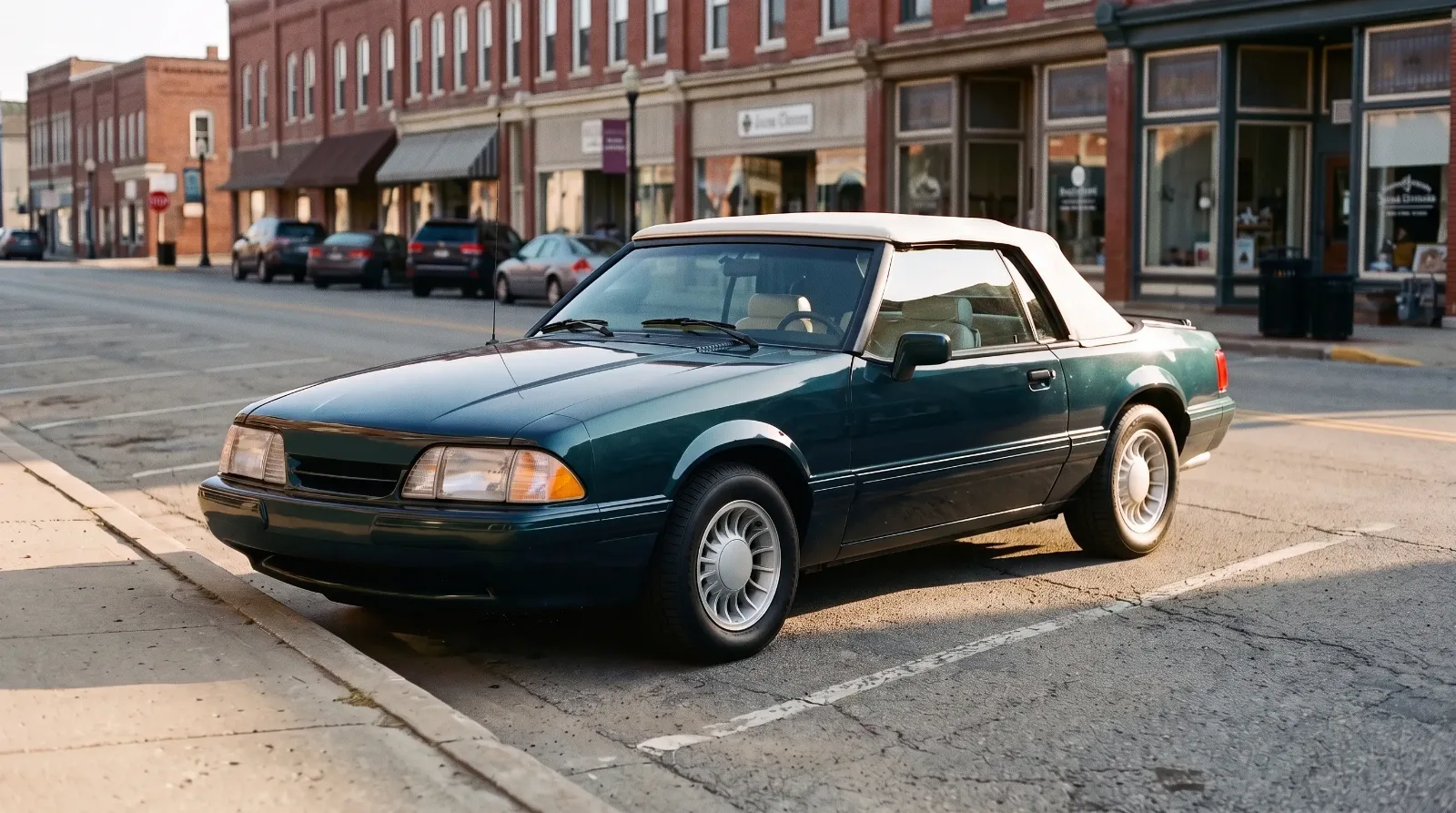
Every big Mustang show seems to have one. A green Fox convertible with a white top sits near the end of a row, and before you reach the fender somebody has already started the soft-drink story. Type "1990 7up Mustang" into a search bar and you get the same story back, told a hundred ways, with the details shifting each time. The car is real. Ford built 4,103 of them. The story around it is mostly real too, but it has picked up some extras over the years, and the paperwork is where you find out which parts hold up.
Car Features
7 min read
The 1990 "7-Up" Mustang
Ford built 4,103 Deep Emerald Green LX 5.0 convertibles for a canceled 7-Up promotion. Here is what they are and how to check one.
This piece sticks to one car and one model year. If you want the whole run from 1979 to 1993, start with the Fox Body Mustang story and come back here for the green ones.
A promotion that never happened
The short version: the cars were tied to a 7-Up promotion built around an NCAA basketball half-court shot contest, and the contest was canceled shortly before it was due to begin. Ford built the convertibles anyway, all to the same specification, and sold them to the public through dealers. The hobby kept the name of the soft drink, even though the deal it belonged to fell apart.
That much is on the record. The giveaway part holds up too: the cars were meant as prizes for the contest winners, and the usual account says 7-Up planned on about 30 of them, that only two had been built when the scheme fell through, and that none was ever awarded. Why it fell through is murkier. One story blames a falling-out over Ford's refusal to keep the green paint exclusive to 7-Up, and nobody has shown me a document that settles it. You may also hear that dealers had to discount the cars to move them. I have found nothing that backs that up, so treat it as club talk. The count and the specification, on the other hand, are well established, and those are what matter when you are standing in front of one with a checkbook.
What Ford actually built
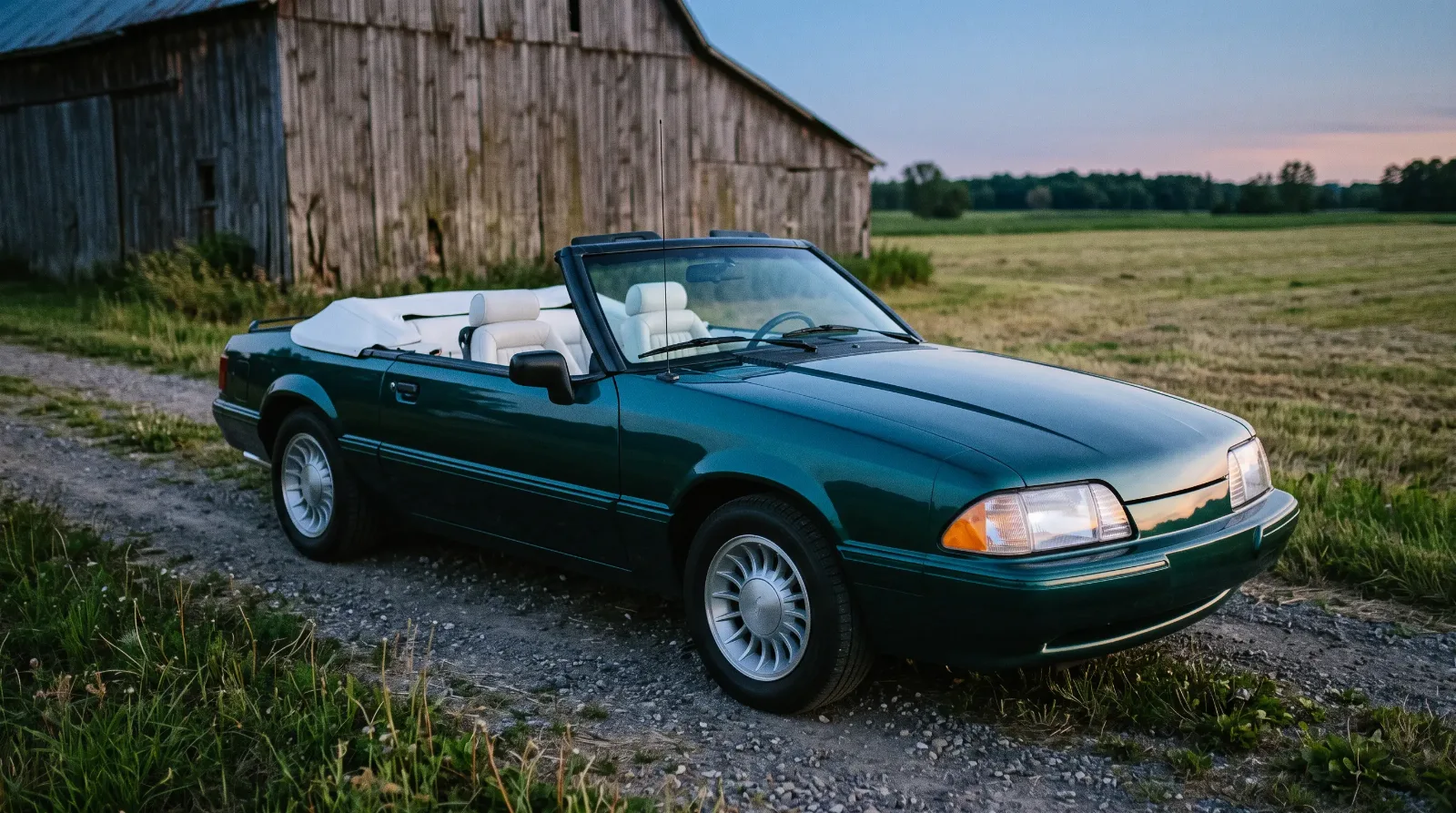
Every one of the 4,103 cars was the same basic recipe: an LX 5.0 convertible in Deep Emerald Green metallic (some paint charts list it as Deep Emerald Jewel Green) with a white power top and Oxford White leather. The interior used the GT's seats rather than the plainer LX buckets, and the car rode on 15-inch turbine wheels. Under the hood was the same 5.0 HO that made the LX 5.0 a favorite at the drag strip, rated at 225 hp and 300 lb-ft for 1987 through 1992. Nothing was added to the engine for the promotion. This was a paint, trim and seats package on a car that was already quick.
The buyers split two ways on transmissions. Ford built 2,743 with the AOD four-speed automatic and 1,360 with the T-5 five-speed manual. That ratio tells you something about the intended audience: a convertible for cruising and showing off a prize, not a car aimed at 5.0 street drag racing, even if plenty of owners later found out what a manual 5.0 could do.
| Item | 1990 "7-Up" LX 5.0 convertible |
|---|---|
| Total built | 4,103 |
| Automatic (AOD) | 2,743 |
| Manual (T-5 five-speed) | 1,360 |
| Paint | Deep Emerald Green metallic |
| Top | White |
| Interior | Oxford White leather, GT seats |
| Wheels | 15-in turbine |
| Engine | 5.0 HO V8, 225 hp, 300 lb-ft |
Where 4,103 cars sit in 1990
The 1990 model year was a quiet one for the Fox. The big news was safety: a driver airbag became standard, and the tilt steering wheel went away to make room for it. Mustang production that year came to 128,189 by body style. Set the green convertibles against that and they come to a little over 3 percent of the year's output. Rare enough to stand out in a parking lot, not so rare that you need to fly across the country to see one.
The year also carried the tail end of the 25th anniversary. Ford never built a separate anniversary model; it stamped "25th Anniversary" on the running-horse emblem on the dash of cars built between April 17, 1989 and April 17, 1990. So whether a given 7-Up car wears that emblem depends on when it was built. That is a small detail, and small details are what catch out a story that has been polished too often.
"I have heard this car described as a factory race car, a dealer giveaway and a one-year experiment. The door tag has never once agreed with all three. Read the tag first and the story second."
Wayne Coburn
Spotting a real 1990 7up Mustang
Here is the part that ends the parking-lot arguments. Nothing stops someone from painting a 1990 LX convertible green, fitting white leather and a white top, and calling it a 7-Up car. The VIN will not save you either, because Ford never gave the package its own code. What the VIN does tell you is the starting point.
On a 1990 Fox Mustang, the 10th character is the model year, and for 1990 it is L. The 11th character is the plant, and by 1990 every Fox Mustang came from Dearborn, so it should be F. The 8th character is the engine, and a 5.0 HO from 1987 to 1993 shows E there. A V6 or four-cylinder code in that spot ends the conversation. Characters 5 through 7 carry the body code, and for an LX convertible they read P44, so a genuine car starts 1FACP44E. NHTSA's decoder reads a documented five-speed 7-Up car, 1FACP44E5LF159089, as a 1990 LX convertible with the 5.0 HO, built in Dearborn.
After the VIN, go to the paper. A Marti Report is pulled from Ford's own production database and covers 1967 through 2020, so a 1990 car is in range. It lists what the car left the factory with, including paint, trim and transmission. It does not list dealer add-ons, and it does not judge condition or authenticity on its own. What it gives you is a factory record that either matches the car in front of you or does not.
Why the paperwork carries the value
A green Fox convertible without documentation is a nice 1990 LX 5.0 convertible. With a Marti Report that matches, the window sticker and the original seats and wheels still in place, it is one of 4,103, and buyers treat it that way. The difference between those two cars is a folder, not a part number.
The five-speed cars draw extra attention simply because there are fewer of them: 1,360 against 2,743 automatics. That gap is worth confirming on paper too, because a T-5 swap into an automatic car is one of the oldest tricks in the Fox world. A clutch pedal bolted in later looks the same as one Ford installed, right up until you read the factory record.
If you are shopping, keep the soft-drink story as a good conversation opener and nothing more. Buy the car the documents describe. And if you want to see how the green cars compare with the rest of the year's production, browse the 1990 Mustangs currently listed and read every door tag you can find.
Sources and notes
- Ford Mustang (third generation), Wikipedia: 7-Up edition count, transmission split, 1990 airbag
- MustangSpecs: 1990 25th Anniversary Limited Edition "7-Up" convertible
- MustangSpecs: 1990 Ford Mustang, production and specification
- MustangSpecs: the 25th Anniversary dash emblem, 1989 to 1990
- NHTSA vPIC decode of a 1990 7-Up car's VIN (1FACP44E5LF159089)
- Marti Auto Works: Marti Report coverage and contents
Related Reading
Have a
Ford Mustang
for Sale?
Reach thousands of serious classic car collectors across the US.
Sell It Here →
Selling a classic? Here's how: the best sites to sell a classic car
Are You a Classic Car Dealer?
List your full inventory and connect with targeted classic car buyers.
Join as a Dealer →
#Ford Mustang
#Mustang convertible
#fox body mustang
#Limited Edition
#LX 5.0
#1990 Mustang
#7-Up Mustang

About the author
Wayne Coburn
Longtime Corvette owner, judge and club figure who knows the cars, the records and the people behind them.
Related Listings - Ford Mustang


More in Car Features
Comments
Be the first to comment on this article.