
A Model T has no factory shocks. None. The springs take the bump and give it right back, and the car bounces until the energy runs out. The 1928 Model A changed that. Model A shock absorbers were Houdaille hydraulic units, and they are a big part of why an A rides like a car instead of a buckboard. Here is what they are, how they work, and what to look for when you are under one with a flashlight.
Car Features
7 min read
Houdaille Shocks: How the Model A Learned to Ride
The Model T had no factory shocks. The 1928 Model A got Houdaille hydraulics. How they work, how they fail, and what to check.
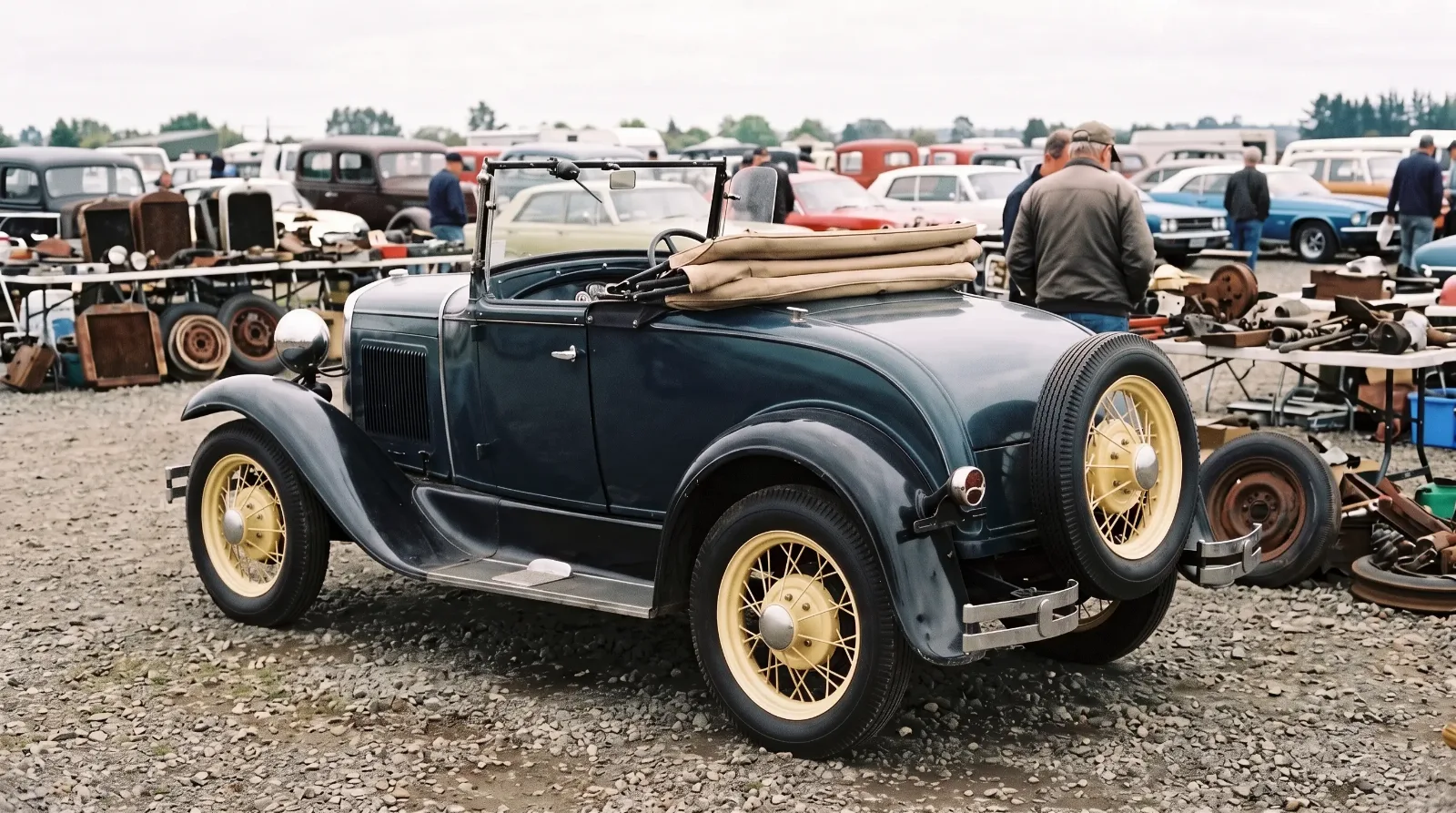
A shock where the Model T had none
Start with the springs, because the shocks only make sense next to them. Both the T and the A hang on transverse semi-elliptic leaf springs, one across the front and one across the rear. Ford kept that layout as a concept and changed nearly every part of it. If you want the full layout, see the piece on transverse springs.
A leaf spring stores energy when it flexes. Leaf friction burns off a little of it. Not much. On the T, the rest comes back as a rebound, then another, then a smaller one. On a rough road that adds up to a car that pitches and hops.
The Model A was heavier. A T weighed somewhere around 1,200 to 1,650 pounds at the curb. An A ran 2,265 to 2,465 pounds on a 103.5 inch wheelbase. More weight and more speed from a 40 horsepower engine meant more energy to manage. Springs alone were not going to do it.
Ford's answer was the Houdaille shock. Ford's own account calls the hydraulic shocks, along with the Triplex windshield, a first for Ford and "unheard of in the low-priced field." That is the important bit. Shock absorbers existed. Cheap cars just did not get them.
Who Houdaille was, and where the design came from
Say it HOO-day. Maurice Houdaille patented his hydraulic shock in 1907. Before the Model A, his shocks showed up on expensive cars: Lincoln, Pierce-Arrow. Putting the kind of shock Lincoln buyers got on a car that sold from $385 was the kind of move that made people look twice at the new Ford.
Ford stuck with the type long after the Model A. Old Cars Weekly puts it as standard on Fords through 1948. This was not a one-year experiment.
How Model A shock absorbers work
A Houdaille is a lever shock. The body bolts to the frame. A lever arm sticks out of it, and a short link runs from the end of that arm down to the axle. When the axle moves, the link swings the arm, and the arm turns a shaft inside the shock body.
Inside, the shaft carries vanes in a chamber full of oil. Turn the shaft and the vanes have to push oil out of the way. The oil can only get past through small passages and a valve. That restriction is the whole trick. Oil does not compress, and it does not like being shoved through a small hole in a hurry. So the shock resists fast motion and lets slow motion through.
That is the heart of damping. The spring decides how far the car moves. The shock decides how fast. A sharp bump gets slowed down. A slow lean in a corner gets less resistance.
Ford's spec sheet calls them double acting. That means they work in both directions: on compression, when the wheel comes up, and on rebound, when the spring tries to throw it back down. The rebound side is the one that kills the bounce a T owner knows too well.
Heat is the enemy here, as it is with every hydraulic part. All that resistance turns motion into heat in the oil. The shock body is a lump of metal that sheds it to the air. Simple. No reservoir, no hoses, nothing to plumb.
"A good Houdaille is a quiet, boring part. You notice it only when it is gone, and then you notice it on every expansion joint for the rest of the drive."
Mike Sullivan
What goes wrong after ninety-plus years
Most of these shocks are older than anyone driving the car. They fail in a few predictable ways.
Low oil. Seals dry out and weep. A shock that is low on fluid has air in the chamber, and air compresses. You get a dead spot where the arm moves with no resistance, then a thump as it picks up oil. Look for a dark, oily film on the body and the frame rail under it.
Worn shaft and bushings. Grab the arm and wiggle it side to side. It should turn on its shaft, not wobble. Slop at the shaft lets oil past the seal and lets the arm clunk.
Worn links. The link from arm to axle has ball ends. They wear. Worn links clunk on every bump and let the axle move before the shock knows about it.
Missing or wrong parts. Plenty of As have been driven for decades with a shock pulled off and never put back, or with a later unit bolted on. If originality matters to you, it matters to the judges too. The MAFCA preliminary check for an original type car lists shocks among the items it looks at.
Rebuild, replace, or leave alone
A shock that holds oil and resists evenly does not need anything. Do not fix what works. Top it off if it needs it, check the links, drive the car.
A shock that leaks or has free play needs a rebuild: new seals, and a shaft and bushings brought back to a proper fit. That is bench work, and plenty of owners send it out to someone who does nothing else. Prices vary from shop to shop, so get a figure in writing before you send a set.
Reproduction shocks exist too. For a driver, that may be the faster route. For a car headed to a judging field, an original rebuilt Houdaille is the safer bet, because the outside of the shock is what gets looked at.
Whatever you choose, do the shocks at least in axle pairs, and ideally all four at once. One fresh shock next to three tired ones gives you a car that leans one way and rebounds another.
The Houdaille did not work alone. The A also got four wheel mechanical brakes, a sliding gear transmission (for the background on that, see the three speed piece), and from 1930, smaller 19 inch wheels that lowered the car. Each change pushed the A further from the T. The shocks were the part that changed how it felt over a rough road.
The engine got the headlines in 1928, and for good reason. Doubling power to 40 horsepower is easy to sell. But power is useless if the car will not stay planted. For how that engine worked, read the engines chapter. For how the two cars fit together as a story, start with our Model T and Model A guide.
Last thing. Next time you are behind a Model A on a back road, watch the rear axle over a bump. One move up, one move down, done. That is a Houdaille doing its job.
Sources and notes
Related Reading
Have a
Ford Model A
for Sale?
Reach thousands of serious classic car collectors across the US.
Sell It Here →
Selling a classic? Here's how: compare the places to sell classic cars
Are You a Classic Car Dealer?
List your full inventory and connect with targeted classic car buyers.
Join as a Dealer →

About the author
Mike Sullivan
Detroit-area muscle car enthusiast and restoration specialist with three decades of hands-on experience working on American iron.
Related Listings - Ford Model A


More in Car Features



Comments
Be the first to comment on this article.