
Picture a drag strip parking lot on a summer Saturday in the late 1980s. Rows of hatchbacks and plain two-door coupes sit with their hoods up, a generator hums behind the tech shed, and nearly every engine bay holds the same 302. Fox body Mustang drag racing did not start in a boardroom. It started in lots like that one, with young owners who had found the cheapest V8 performance on sale in America and wanted to know whose car was quickest. For a few years the Fun Ford Weekend crowd and the kids who raced on dark roads were largely the same people.
Car Features
7 min read
Fun Ford Weekend and the 5.0 Street-Racing Scene
How fox body Mustang drag racing grew from cheap LX 5.0s and street nights into Fun Ford Weekend and an all-Ford racing culture.
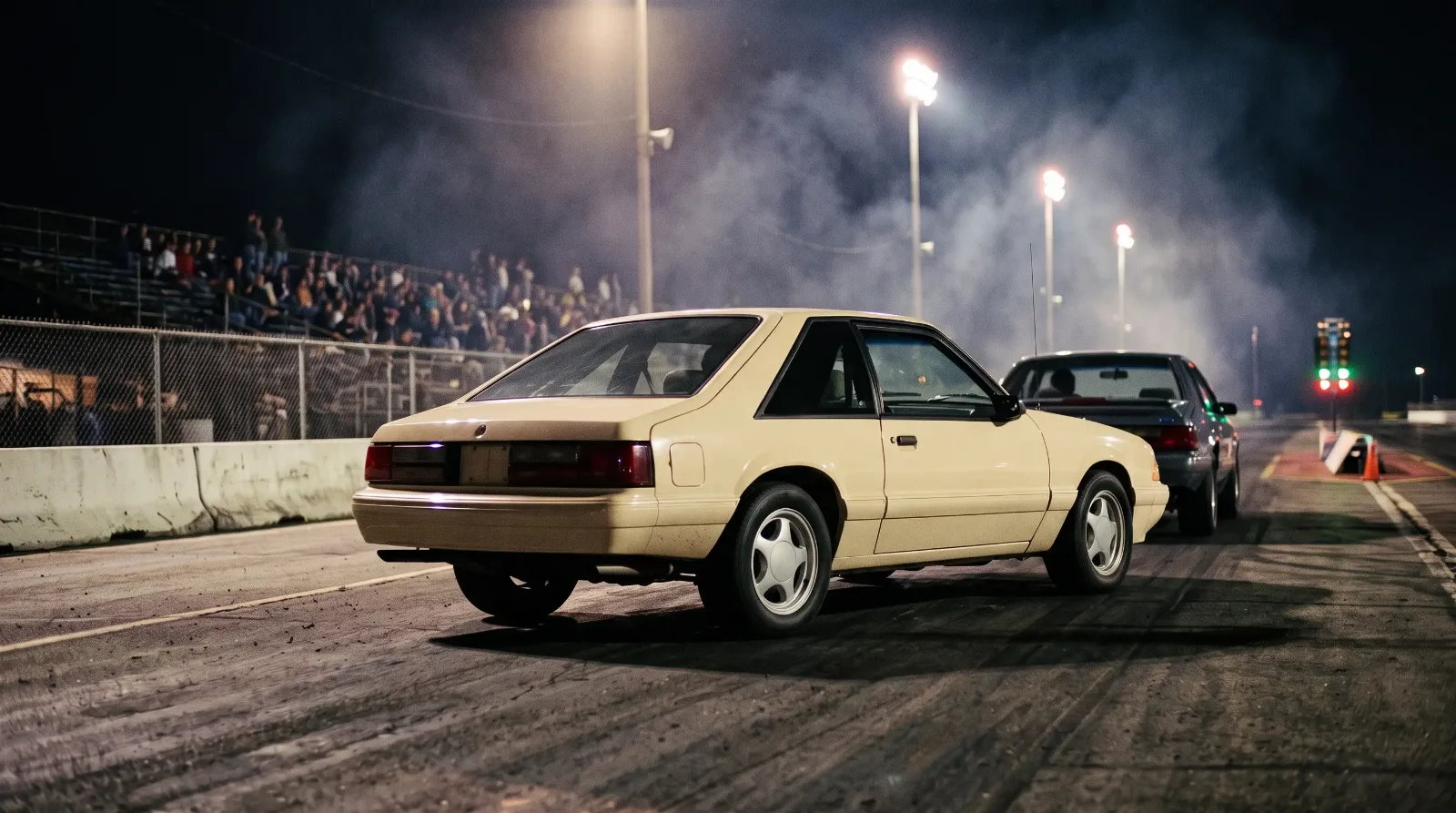
This story stays on that scene: why the 5.0 became the default drag car of its day, how the all-Ford events gave it a legal home, and what it left behind. The car's full production history, year by year, lives in the Fox Body chapter.
Why fox body Mustang drag racing started with a price tag
The crowd followed the numbers. Ford brought back a high-output 5.0 for 1982 at 157 hp. A Holley four-barrel took it to 175 hp for 1983, and the switch to multiport fuel injection for 1986 brought 200 hp. In 1987 the rating climbed to 225 hp and 300 lb-ft, and it stayed there through 1992. The engine was the same whether it sat under a GT's louvered skin or a plain LX.
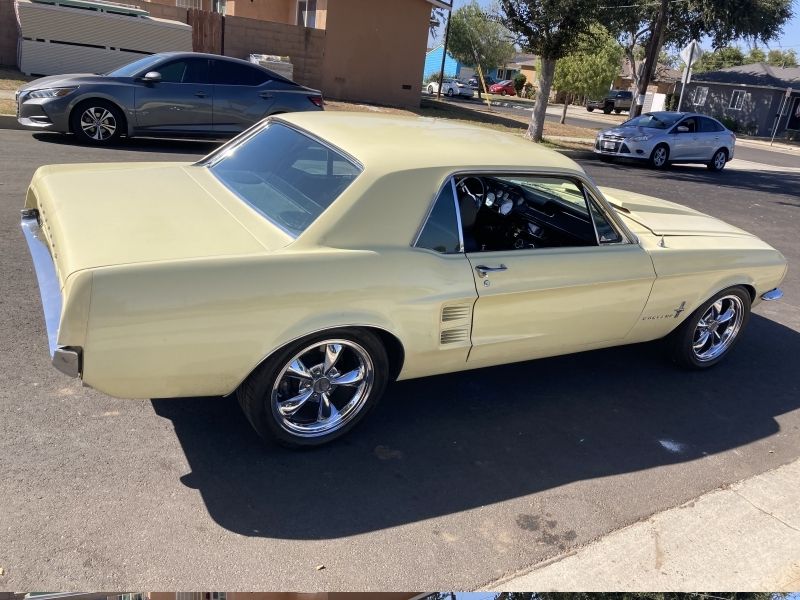
That last detail is what filled the staging lanes. In 1987 a Mustang coupe started at $8,271 and the LX 5.0 package added $1,885, so a buyer could drive home with the GT's engine for a little over $10,000 before options. MustangSpecs lists the 1987 notchback at 2,722 lb against 2,791 lb for the hatchback, and says the GT package carried about 200 lb more than an LX 5.0, though it shows no scale tickets for that last figure. To a nineteen-year-old with a paycheck and a heavy right foot, light and cheap beat stylish every time.
The parts underneath helped the story along. The T-5 five-speed arrived partway through 1983, and from 1986 every V8 Mustang rode on the 8.8-inch rear axle. Neither was glamorous. Both were the kind of thing owners leaned on hard once they bolted on sticky rear tires and started launching at the line every weekend.
Friday nights and the 5.0 on the street
Every era of American performance has had its street scene, and the Fox years were no exception. The 5.0 badge on a front fender meant something at a red light. An LX notchback with small wheels and no spoiler looked like a rental, which was exactly the appeal: you could not tell a stock one from a car with gears, headers and a set of drag radials until the light changed.
None of that was legal, and plenty of it ended badly. But it explains the culture. These were affordable new cars bought by young people, and the street was where most of them first found out what the car could do. The irony was that the police often drove the same thing. The California Highway Patrol asked for a light pursuit car in 1982 and ordered 400 notchbacks; Ford built 394, and by the end of the run nearly 15,000 Special Service Package Mustangs had gone to more than 60 agencies. That side of the car is covered in this piece.
Fun Ford Weekend and the all-Ford strip
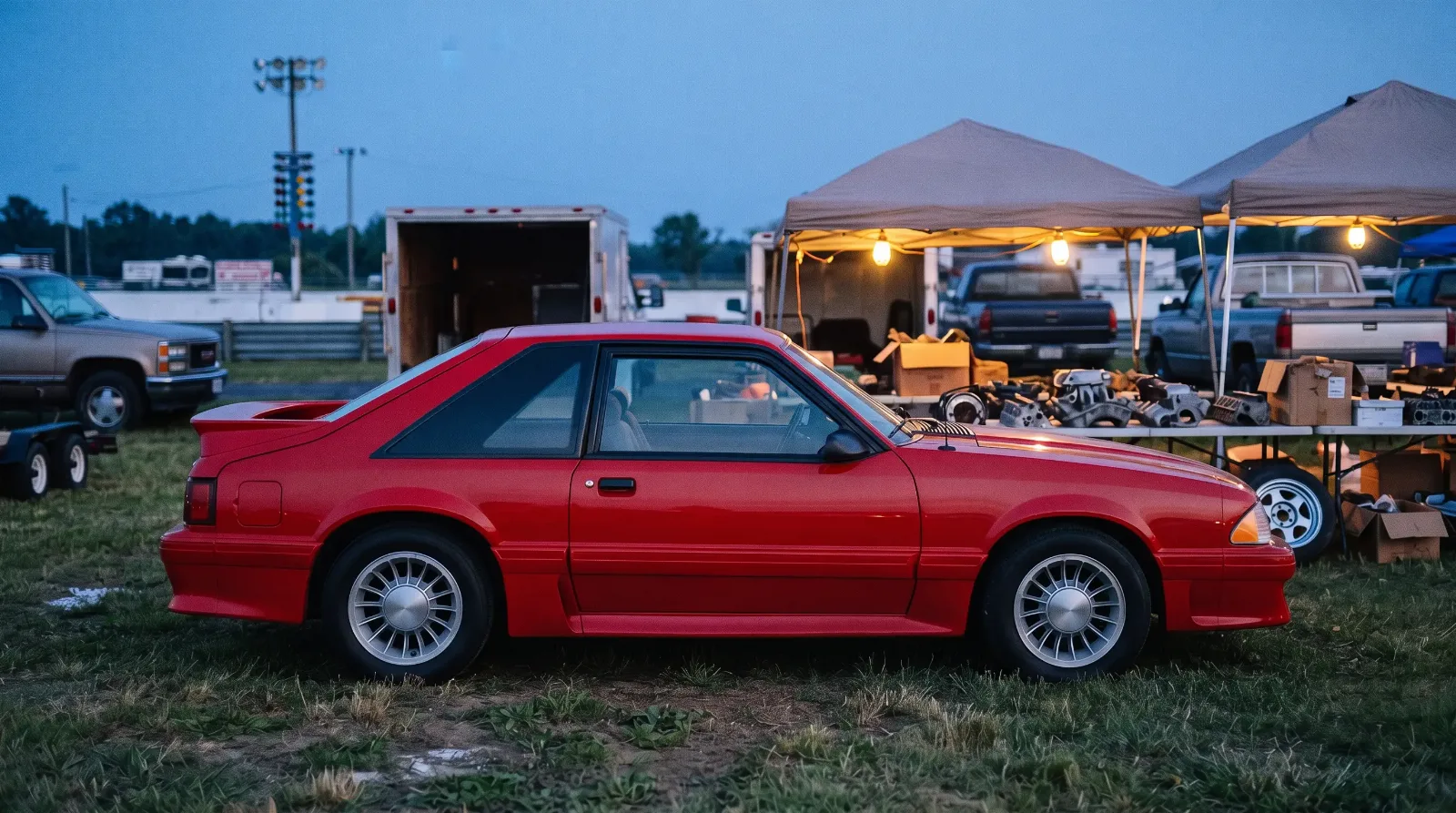
Fun Ford Weekend gave that restless energy a legal address. By FordMuscle's count the series ran from 1990 until 2008, a touring schedule of Ford-only drag racing weekends held at established strips, before a late rename to Battle of the Brands and a shutdown early in 2009. Who first organized it is a detail the sources I could open do not settle. What the events offered is easier to describe. A Ford owner could pay at the gate, pass tech, and race against other Fords instead of strangers at a Tuesday test-and-tune.
The appeal was the mix. The class lists ran from street-car classes such as True Street up to heads-up classes like Pro 5.0 and Outlaw, for cars that had been rebuilt around the strip. The pits were half the show, so a weekend there worked as a parts catalog you could touch. A guy with a stock LX could watch a car built like his run a full second quicker, then walk over and ask what was in it. Late in 1998 Steve Wolcott and James Lawrence quit their jobs to start another all-Ford series, the National Mustang Racers Association. It ran three events in 1999 and added a championship with a contingency program for 2000.
Not every Fox stayed in street trim. Some went the other direction, with narrowed rear frame sections, tubbed wheel wells and enormous rear tires, and there is a reason why Fox Bodies took over Pro Street. The strip and the show field fed each other.
"The Fox was the first Mustang that an ordinary kid could buy new, race on Saturday and drive to work on Monday. The all-Ford weekends just gave all those kids a place to meet."
Patrick Walsh
What the strip taught the aftermarket, and Ford
A scene that big creates its own economy. Owners wanted parts that bolted onto a 302 and an 8.8, and they wanted them cheap, so the Fox became a platform the way the small-block Chevy had been for the generation before. Steeda is one example: racer Dario Orlando started it in 1988 with a limited run of tuned Mustangs and a small line of performance parts. Plenty of shops and mail-order catalogs chased the same customers, and the drag strip was where their claims got tested in public, one timeslip at a time.
Ford was watching too. When SVT launched the 1993 Cobra, it used GT-40 heads, a Cobra upper intake, a unique cam, larger injectors and a 65 mm throttle body to reach 235 hp. That recipe would have looked familiar to anyone who had spent a season in the pits. The same year, Ford rerated the regular 5.0 to 205 hp and 275 lb-ft, explaining that the older figure predated the mass-airflow system. Racers already knew what their cars ran; a new number on a window sticker changed nothing at the strip.
When the scene outlived the car
The Fox run ended with the last Fox year in 1993. The 1994 SN95 that replaced it kept the old floor pan and front suspension crossmember, so a lot of what racers had learned carried straight across, but the new car was heavier and the cheap, light notchback was gone from the order form. The Fox did not leave the strip. It simply stopped being new.
That is the real legacy of the scene. The all-Ford weekends turned a commuter platform into a racing class of its own, and the cars that ran there in the 1980s are still showing up at strips and swap meets in 2026, usually with more power and fewer original parts. The wider family tree, from 1964 to the present, starts at our Mustang hub.
Sources and notes
- FordMuscle: Fun Ford Weekend returning with five events for 2011
- Horsepower and Heels: Fun Ford Weekend alumni reunion
- Drag Illustrated: how Steve Wolcott and James Lawrence started the NMRA
- MustangSpecs: 1987 Ford Mustang prices, weights and LX 5.0 package
- Steeda: 30 years and three generations, the history of Steeda
- Wikipedia: Ford Mustang (third generation)
Have a
Ford Mustang
for Sale?
Reach thousands of serious classic car collectors across the US.
Sell It Here →
Selling a classic? Here's how: the best sites to sell a classic car
Are You a Classic Car Dealer?
List your full inventory and connect with targeted classic car buyers.
Join as a Dealer →

About the author
Patrick Walsh
Automotive journalist covering classic car shows, events, and the enthusiast community across North America.
Related Listings - Ford Mustang


More in Car Features
Comments
Be the first to comment on this article.