
The k5 blazer vs bronco engine fight comes down to one fact: Chevrolet had a bigger toolbox. From 1969 the K5 Blazer could be ordered with a small block V8, and Ford's first-generation Bronco through 1977 never offered anything larger than a 302 cubic inch V8. That single gap in displacement decided a lot of arguments before they even started.
Car Features
7 min read
Engines Compared: K5 Blazer Against the Bronco
For eleven years the K5 Blazer had a bigger V8 option than the Bronco ever offered. Here is exactly how the engine gap opened, then closed, over three decades.
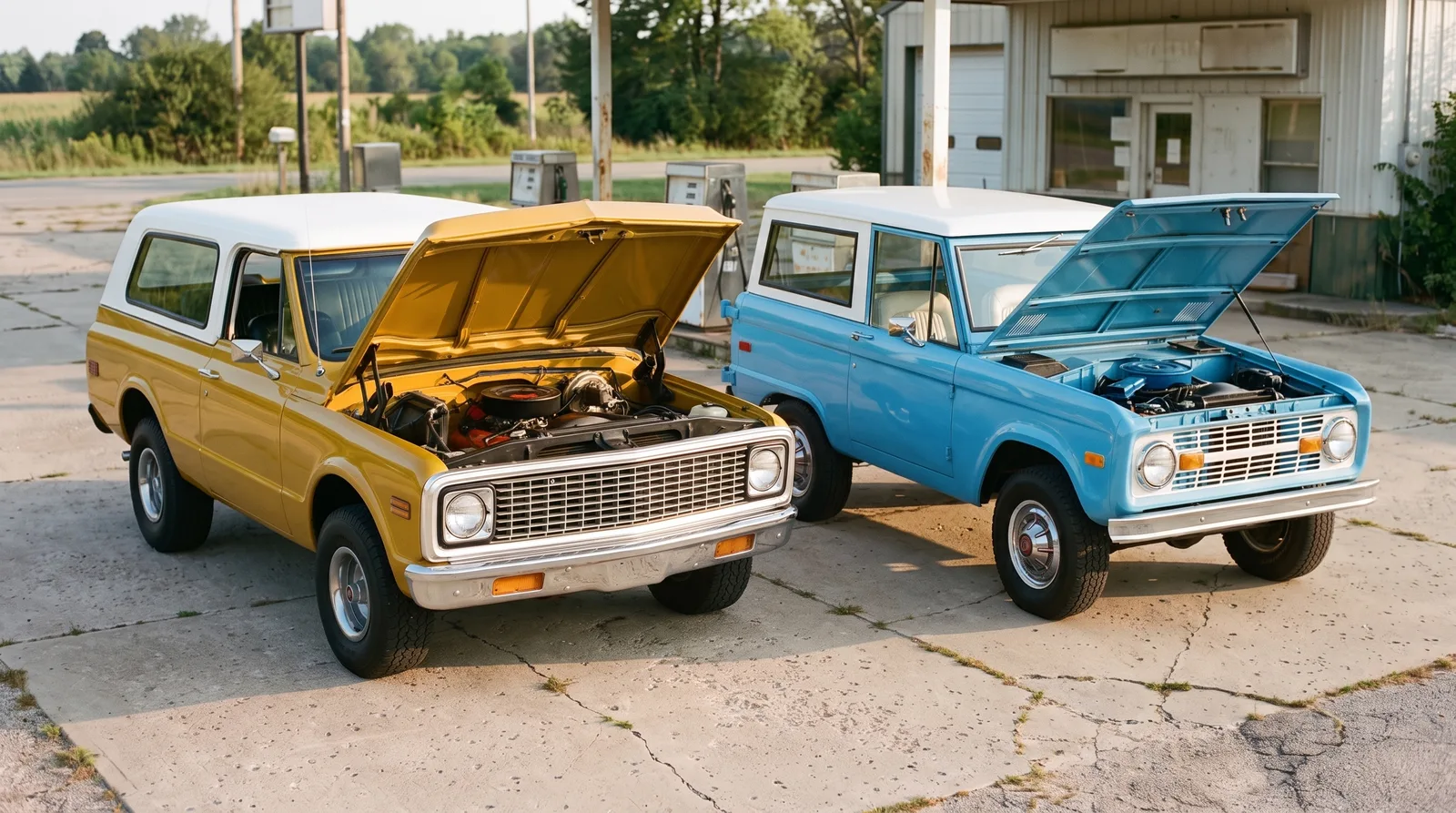
Chevrolet's 350 did the heavy lifting
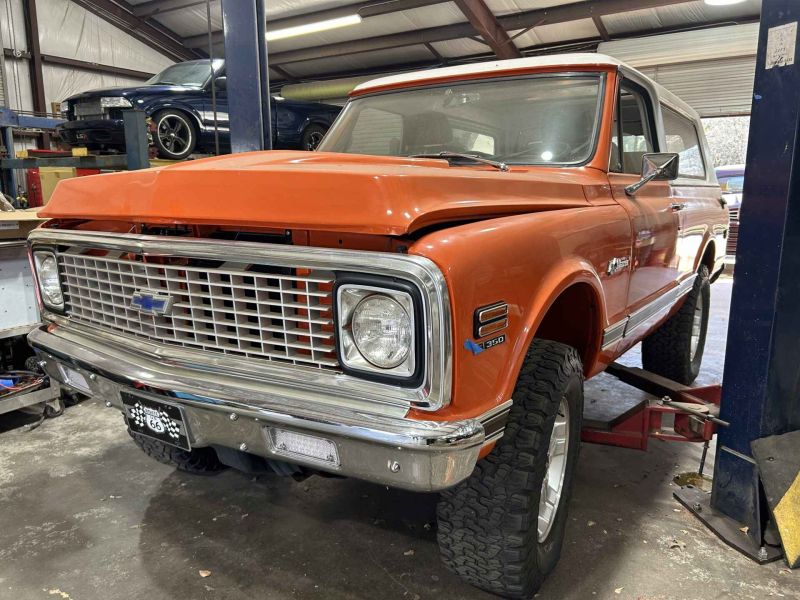
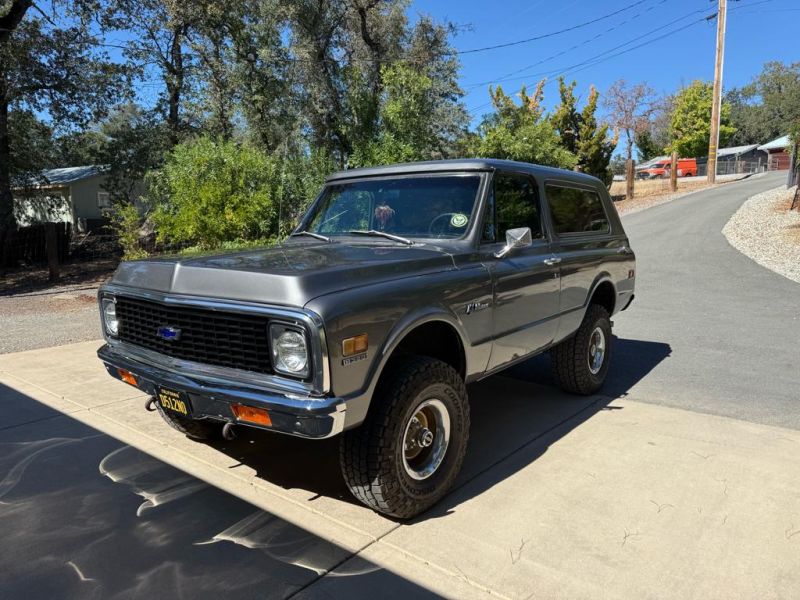
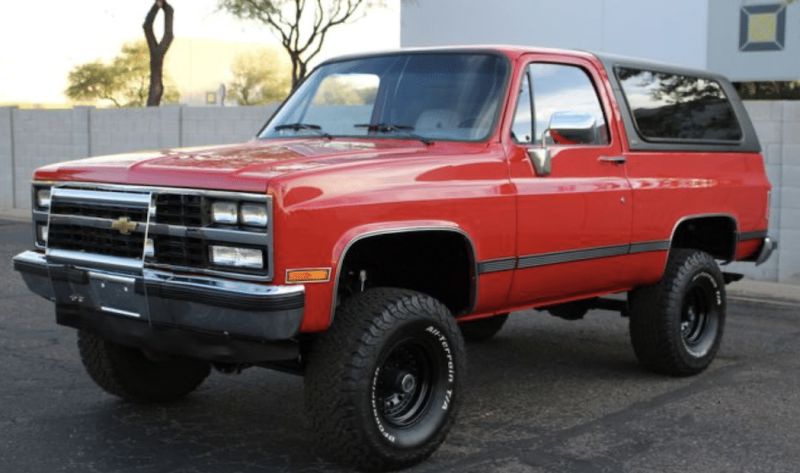
The 350 cubic inch small block became the default V8 in the K5 Blazer through most of its run, and it earned that spot by being simple, torquey, and cheap to keep alive. It was not a fast engine by modern standards, but it did not need to be. Buyers wanted a truck that could tow a boat or a trailer of hay without straining, and the 350 delivered that at a price point Chevrolet could hold across a decade and a half of production.
Ford's early Bronco topped out at a 302, a real V8 but a smaller one, and that ceiling stuck around until the compact Bronco was discontinued after 1977. Result: for eleven straight years, anyone who wanted the bigger V8 in this matchup had exactly one place to go, and it wasn't the Ford dealer. Ford buyers who wanted more muscle than the 302 offered had to look outside the Bronco lineup entirely, often toward a full-size F-Series pickup, which meant giving up the compact Bronco's trail agility just to get more displacement, a tradeoff Chevrolet never forced on its own buyers.
1978 changed the whole equation
When Ford moved the Bronco onto the full-size F-150 platform for 1978, the engine gap closed fast. The new full-size Bronco could be ordered with a 6.6-liter, 400 cubic inch V8 for the 1978 and 1979 model years (with the 351M standard), suddenly outmuscling the K5 Blazer's 350 on paper. Chevrolet answered with its own 400 cubic inch small block option in the K5 lineup, offered through the end of the decade, so the two trucks briefly traded blows at the top of their respective engine charts in the late 1970s before both companies dropped their 400s by 1980.
Torque mattered more than horsepower
Neither of these trucks was built to win a stoplight drag race, and the horsepower numbers from this era reflect that reality once emissions equipment started tightening down in the mid-1970s. What mattered was torque at low RPM, the number that actually moves a loaded trailer up a grade. Chevrolet's 350 and 400 small blocks were tuned for exactly that kind of pulling power, and so were Ford's larger V8 options once the full-size Bronco arrived. Anyone shopping this era by horsepower figures alone is reading the wrong spec. Compression ratios dropped across both brands' engine lineups as unleaded fuel requirements and emissions controls tightened through the mid to late 1970s, softening horsepower numbers on paper even as real-world drivability stayed roughly consistent for buyers who cared mostly about pulling a trailer up a grade rather than winning a magazine's acceleration test.
| Truck era | Largest available V8 | Typical use case |
|---|---|---|
| K5 Blazer, 1969-1977 | 350 cubic inch small block | Family duty, light towing |
| Bronco, 1966-1977 (compact) | 302 cubic inch | Trail use, lighter loads |
| K5 Blazer, 1978-1980 | 400 cubic inch small block | Heavier towing, work duty |
| Bronco, 1978-1979 (full-size, second gen) | 400 cubic inch V8 | Heavier towing, work duty |
What actually kept these engines running for fifty years
Parts. Chevrolet's small block V8 family became the most produced V8 engine architecture in American automotive history, and that scale means a K5 Blazer owner today can walk into almost any parts store and find what they need. Ford's V8s from this era are well supported too, but the sheer volume of small block Chevy production gives the K5 Blazer a slight edge in day to day ownership cost, even against a Bronco with a comparable size engine. Reliability on paper is one thing. Reliability measured by how fast you can get back on the road is another, and that's where Chevrolet wins this argument more often than not. A cracked exhaust manifold or a worn water pump on a K5 Blazer is often a same-day fix from a local parts counter, while the equivalent repair on a less common Ford V8 variant can mean a longer wait for the correct part to ship in.
For the full rivalry behind these numbers, where this started lays out how Chevrolet and Ford fought for full-size SUV buyers across three decades, not just under the hood.
"Bigger V8 doesn't win. Cheaper part on the shelf wins. That's the whole engine story right there."
- Dan Reeves
Transmission and transfer case choices shaped how the power got used
An engine number on a spec sheet only tells part of the story, because how that power reached the ground mattered just as much to period buyers. The K5 Blazer offered a mix of manual and automatic transmissions through its run, with the three-speed automatic becoming increasingly common as buyers prioritized ease of driving over outright control. Chevrolet's part-time transfer case system was straightforward, requiring the driver to stop and manually engage four-wheel drive, a limitation shared by the Bronco through most of its history as well. Neither brand offered the kind of full-time four-wheel drive sophistication that some rivals eventually brought to this segment, which meant the engine comparison between these two trucks stayed a fairer fight than it might have been if one side had a clear driveline advantage.
Fuel economy, unsurprisingly, was never a strength for either truck in V8 form, and neither manufacturer pretended otherwise in period advertising. Buyers accepted the tradeoff because the segment was built around capability first, and both Chevrolet and Ford understood that a buyer cross-shopping these two trucks had already made peace with the fuel bill before walking onto the lot.
The bottom line on displacement
Ford's compact Bronco simply never had the engine to match the K5 Blazer until it grew into a full-size truck in 1978. After that, the two brands ran roughly even on paper, and the real difference shifted to parts cost and shop availability rather than raw cubic inches. Buyers focused on engine strength today should look past year-one marketing claims and check exactly which V8 sits under the hood of the specific truck in front of them, because the engine gap in this rivalry moved a lot over three decades, and a truck built in 1976 tells a very different engine story than one built a decade later under the same model name. Anyone ready to check real listings against these numbers can shop classic K5 Blazer listings and compare engine options truck by truck.
The short version, if you only remember one thing: displacement numbers on a brochure rarely tell the whole story, and they told an especially incomplete story in this rivalry. Chevrolet's early lead in engine size mattered less over time than its lead in parts distribution, and that is the number that actually decides how enjoyable either truck is to own fifty years later.
Sources and notes
Related Reading
Have a
Chevrolet Blazer
for Sale?
Reach thousands of serious classic car collectors across the US.
Sell It Here →
Selling a classic? Here's how: the best sites to sell a classic car
Are You a Classic Car Dealer?
List your full inventory and connect with targeted classic car buyers.
Join as a Dealer →
#small-block v8
#classic truck engines
#Ford Bronco
#K5 Blazer
#full-size SUV comparison
#Chevrolet 350

About the author
Dan Reeves
Performance engine builder from North Carolina's motorsports corridor, focused on swaps, forced induction and making real, repeatable power.
Bigger toolbox. Seriously. Chevy wins.
Agreed, and a Ramcharger 360 was sitting right there too. Nobody ever talks about that one.
Matt, I worked a lot of night shifts to pay for the 454 in my Chevelle, so no Mopar for me. But fine. A Ramcharger with a 360 is a sneaky smart buy. Parts are the catch. I swapped my own water pump in the driveway after a shift once, and the store had it on the shelf. Twenty minutes. That's the whole argument.