
Say "Jeep Cherokee" to most people today and they picture the compact XJ from the 1980s and 90s, not the truck that actually squared off against the K5 Blazer. The k5 blazer vs jeep cherokee rivalry that matters for this story is the full-size SJ Cherokee, a two-door built on the Wagoneer's platform starting in 1974, aimed directly at the same buyers Chevrolet and Ford were already fighting over. It is the forgotten fight in the full-size SUV wars of the 1970s, and forgotten does not mean unimportant.
Car Features
7 min read
K5 Blazer Versus the Full-Size Jeep Cherokee: The Forgotten Rivalry
Before the compact XJ, Jeep's full-size SJ Cherokee went head to head with the K5 Blazer using Quadra-Trac full-time four-wheel drive. Here is how they compared.
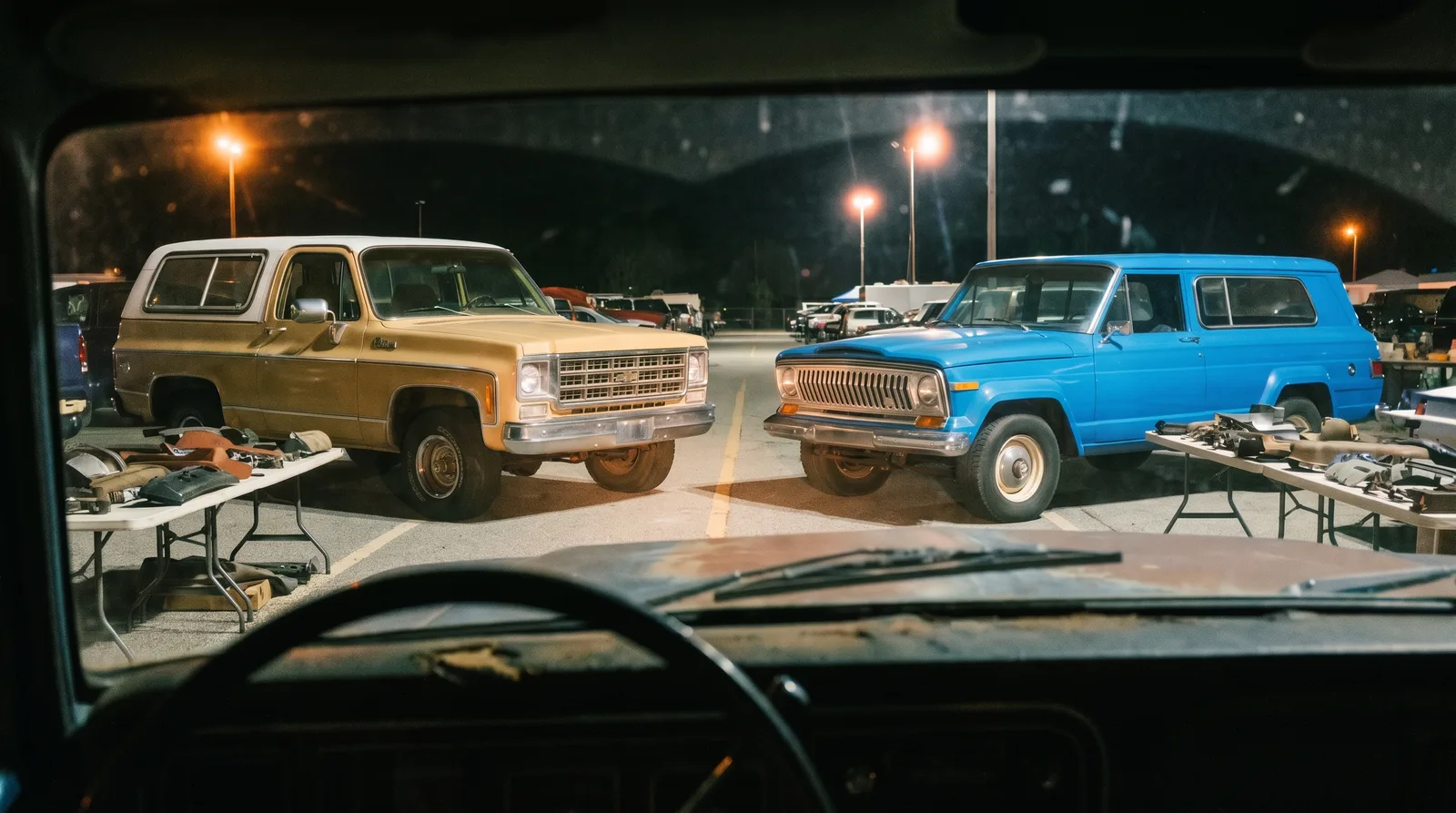
Jeep entered a fight Chevrolet was already winning
By 1974, when the SJ Cherokee launched as a sportier two-door companion to the Wagoneer, the K5 Blazer had five model years of sales momentum and a full generation change already behind it. Jeep was not chasing a new idea so much as repackaging one it already had. American Motors, which owned Jeep by that point, took the Wagoneer's proven full-size platform and gave it a more aggressive two-door body and a marketing push aimed at younger, more recreation-minded buyers, the same demographic the K5 Blazer had been quietly winning over since 1969.
The Cherokee's advantage was heritage. Jeep's name carried real weight from decades of military and civilian 4x4 use, and that badge equity let the Cherokee compete on image even when it could not compete on production volume. Chevrolet countered with sheer availability. A buyer could find a K5 Blazer at nearly any Chevrolet store in the country, while Jeep dealers were a smaller, more scattered network through much of the 1970s. Read k5 blazer vs bronco history for how that same dealer advantage played out against Chevrolet's other, bigger rival during the same period.
A genuinely different engineering approach
Where the K5 Blazer used a part-time transfer case system typical of Chevrolet's truck line, Jeep's Quadra-Trac full-time four-wheel drive system, introduced in the early 1970s, let Cherokee and Wagoneer owners run in 4x4 on dry pavement without the binding that plagued part-time systems. That was a real technical advantage, and it is one reason Jeep loyalists still argue the Cherokee was the more sophisticated truck underneath. Chevrolet's part-time system was simpler and cheaper to maintain, which mattered more to buyers who wanted a truck a local shop could service without special knowledge.
Engine choices told a similar story of two different priorities. The K5 Blazer's small block V8 lineup, especially the 350, was tuned for a balance of reliability and easy parts access. Jeep's AMC-sourced V8s, including the 360 and the later 401, leaned toward raw output, with the 401 in particular putting up a strong 215 net horsepower for a full-size 4x4 of that era, before AMC dropped the 401 after the 1978 model year. Neither engine family aged as gracefully as Chevrolet's small block once emissions equipment tightened up through the late 1970s, but the Jeep's reputation for muscle stuck.
Why the Cherokee never became the household name the Blazer did
American Motors simply did not have Chevrolet's marketing budget or production scale. The Cherokee sold in far smaller numbers across its run than the K5 Blazer did, and AMC's financial troubles through the late 1970s and into the 1980s limited how much investment the Cherokee nameplate received. Chevrolet, backed by General Motors, kept refining the K5 Blazer year over year, kept its price competitive, and kept its name in front of buyers through a truck lineup that dominated dealer lots nationwide. AMC's chronic financial pressure meant the Cherokee often went years between meaningful updates, relying on the strength of the Jeep name to carry sales that a fresher product might have earned on its own merits. Chevrolet never had to lean on nostalgia the same way, because the K5 Blazer kept receiving trim updates, engine options, and styling refreshes throughout its run that kept it feeling current to buyers shopping new.
That imbalance is part of why a related story puts the full-size Cherokee in context alongside the Blazer's other major rivals from the same era, because none of them individually matched Chevrolet's combination of scale and staying power.
Two-door versus four-door changed who bought which truck
Part of what made the SJ Cherokee distinct within Jeep's own lineup was its two-door-only configuration for most of its early run, a deliberate choice to separate it from the more family-oriented four-door Wagoneer. The K5 Blazer took a different path, staying two-door throughout its entire production life from 1969 to 1991, which meant Chevrolet never split its full-size 4x4 buyers across two body styles the way Jeep did. That decision simplified Chevrolet's marketing and manufacturing, letting every ad and every dealer conversation focus on one configuration rather than dividing attention between a sportier two-door and a more practical four-door.
Jeep eventually added a four-door Cherokee later in the SJ's run, chasing the same family buyers Chevrolet had captured with the Suburban and, indirectly, with the roomy two-door K5 Blazer. That expansion came late enough that it never fully closed the gap, but it shows Jeep recognized the same market pressure Chevrolet had been answering since the Blazer's earliest years, buyers who wanted 4x4 capability without giving up practical passenger space.
Collector interest has flipped the script somewhat
Full-size Cherokees, being rarer and carrying the Jeep name's off-road credibility, now draw serious money at auction, sometimes outpacing comparable K5 Blazers depending on trim and condition. The Quadra-Trac system, once a maintenance headache for owners without a Jeep specialist nearby, is now viewed by collectors as a genuine point of engineering pride rather than a liability.
"Nobody bought a Cherokee in 1975 because it was rare. They bought it because it was a Jeep. Forty years later, rare is exactly why people want one now."
- Patrick Walsh
The bottom line for buyers today
The K5 Blazer remains the more practical entry point into this era of full-size 4x4s, with better parts support and a deeper pool of trucks to choose from. The full-size Cherokee rewards a buyer who wants something with genuine off-road engineering credentials and does not mind hunting harder to find one. For anyone leaning toward the more available option, current K5 Blazers for sale now is a good starting point to see what condition and price actually look like on the ground before deciding which direction to go.
It is worth remembering that both trucks were fighting for the same buyer with different arguments. Chevrolet argued that scale, familiarity, and dealer support mattered most, and the sales numbers largely proved that case correct at the time. Jeep argued that heritage and genuine off-road engineering deserved a premium, and decades later, the collector market has come closer to agreeing with that case than period sales figures ever suggested it would. Neither company was wrong about what buyers valued. They were just talking to buyers at two different points in time, one shaped by immediate practicality and one shaped by nostalgia that had not fully formed yet.
Sources and notes
Related Reading
Have a
Chevrolet Blazer
for Sale?
Reach thousands of serious classic car collectors across the US.
Sell It Here →
Selling a classic? Here's how: the best sites to sell a classic car
Are You a Classic Car Dealer?
List your full inventory and connect with targeted classic car buyers.
Join as a Dealer →

About the author
Patrick Walsh
Automotive journalist covering classic car shows, events, and the enthusiast community across North America.
Related Listings - Chevrolet Blazer
Comments
Be the first to comment on this article.