
Every Camaro club has the member who walks over at a show, points at a black and white Z28 with confetti graphics down the side, and says he knows a guy who had one of the real ones, back when. Then somebody asks for the window sticker, and the story gets quieter. That is the 1993 Camaro pace car in one scene. The car is easy to recognize from fifty feet and surprisingly hard to prove from five, and the paperwork, not the paint, is what tells you whether you are looking at one of the few hundred replicas Chevrolet sold or a tribute somebody built in a weekend. This is the story of the car, the race and the folder that should come with it. For the wider run of the 1993 to 2002 cars, the generation story covers the rest.
Car Features
7 min read
The 1993 Indy 500 Pace Car Camaro
A Z28 paced the 77th Indy 500 in 1993 and Chevrolet sold a few hundred replicas for $995 extra. What the package was, how many exist and how to prove one.
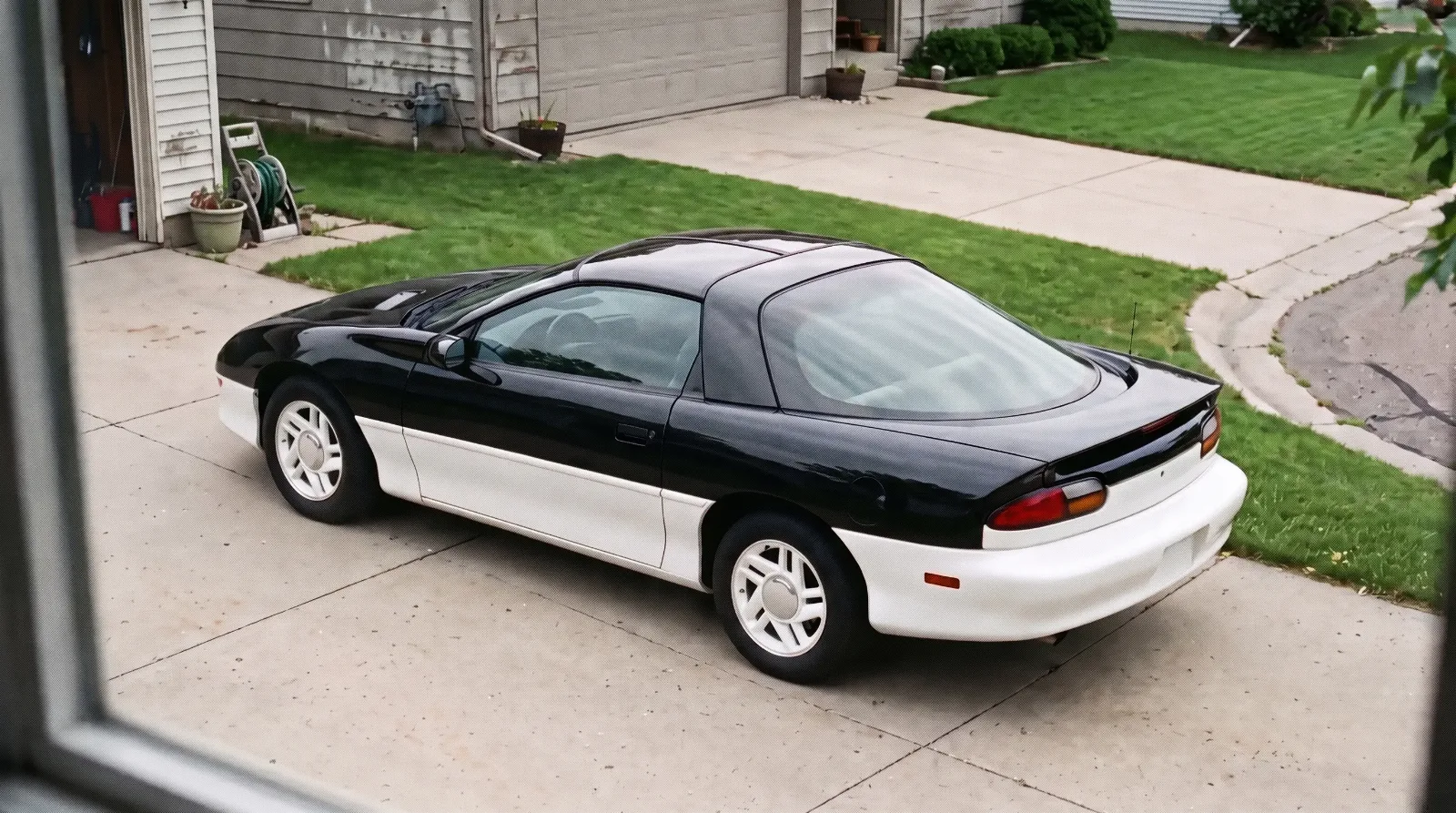
May 30, 1993: a Camaro leads the field again
The 77th Indianapolis 500 ran on May 30, 1993, and a Camaro Z28 led the field to the green. Jim Perkins was at the wheel of the pace car. Emerson Fittipaldi won the race. For the Camaro it was a return visit: this was the fourth time the car had paced Indianapolis, after 1967, 1969 and 1982.
The timing suited Chevrolet. The fourth-generation car was brand new for 1993, built in Sainte-Thérèse, Quebec, from November 1992, and the pace car job put the new shape at the front of the biggest race on the American calendar. The track and the Camaro have a longer history together than one May afternoon, and if that side of things interests you, read more here.
The car that did the pacing was a Z28, and so was every replica sold to the public. That matters for buyers. A 1993 base Camaro with a V6 and pace car graphics is not a replica in any sense Chevrolet would recognize.
What the 1993 Camaro pace car package was
Chevrolet offered the look as an extra-cost package on the Z28 for $995. Every replica was finished in Black over Arctic White, with multicolored graphics and "Indy 500" lettering on the body, white wheels and custom seats. Under the hood sat the standard Z28 engine, the 5.7-liter LT1 V8 rated at 275 hp and 325 lb-ft, the same engine family Chevrolet had introduced in the 1992 Corvette.
That is an important point, and it gets lost at shows. The pace car package was appearance and trim. It did not add power. A pace car replica runs exactly like any healthy 1993 Z28, which Car and Driver timed at 5.3 seconds to 60 mph and 14.0 seconds in the quarter mile. If you want to know more about the engine and chassis underneath the graphics, the story of the LT1 Z28 has the detail.
| 1993 Z28 Pace Car replica | What the record shows |
|---|---|
| Base car | Camaro Z28 coupe only |
| Engine | 5.7 LT1 V8, 275 hp, 325 lb-ft |
| Colors | Black over Arctic White, multicolored graphics, "Indy 500" lettering |
| Wheels and interior | White wheels, custom seats |
| Roof | T-tops, per RM Sotheby's and Motorious |
| Package price | $995 over the Z28 (Z28 coupe base $16,799) |
| Replicas built | 633 or 645, sources disagree |
| Order code | Not confirmed in the sources I have seen |
One equipment point needs care. RM Sotheby's catalogues say all the replicas were fitted with T-tops, and a Motorious sale listing says the same thing: every 1993 replica was a T-top coupe. That is two trade sources in agreement, but I have not found a factory document that backs it. It is still a useful check. T-tops went on only 3,340 of the 39,103 Camaros built for 1993, so a pace car with a solid roof deserves hard questions, while a car with T-tops has proved nothing yet.
633 or 645: the count nobody has settled
Chevrolet built 17,850 Z28s for the 1993 model year, all coupes, out of 39,103 Camaros in total. How many of those Z28s were pace car replicas depends on which book you open. Hagerty and Motorious give 633, and the 1993 color breakdown that lists Bright Red at 11,136 and Black at 9,655 shows the Black and White Pace Car combination at 633 as well. Wikipedia, citing Young's 2004 book Camaro, and an RM Sotheby's catalogue give 645. A 2018 Hagerty piece settles for "just over 600."
Twelve cars is not much of a gap, but in a run this small it is about two percent of the total, and collectors argue over less. One RM Sotheby's catalogue adds a detail: of the 645 replicas sold to the public, it says, 125 first did parade duty at the Indianapolis Motor Speedway. If that is right, the parade cars sit inside the higher figure, not on top of it, and they do nothing to explain a twelve-car gap. Until somebody turns up a primary production record, the honest answer is "about 640," with both numbers on the table.
"I have heard a dozen men tell me which number is right. Not one of them has shown me the GM paper that says so. When the count is in dispute, the folder in the glovebox is worth more than the argument at the show."
Wayne Coburn
Proving a replica is real
Here is where a pace car stops being a paint scheme and becomes a document problem. Graphics kits exist. White wheels can be painted. Seats can be swapped. Nothing on the outside of the car is hard to copy, so nothing on the outside of the car should be taken as proof.
Start with the VIN, which should decode to a 1993 Z28 with the LT1. A V6 car is out immediately. Then look for the paperwork that ties the package to that VIN: the original window sticker showing the $995 pace car line, a dealer invoice, or a build record. Because I have not been able to confirm the RPO code for the package, I would not lean on a seller's claim that a particular code on a label proves anything until you have seen that code matched to a known, documented car.
What they bring, and what that means
Values for these cars are thin on the public record. The clearest data point I have is from RM Sotheby's Auburn Fall sale in 2016, where a one-owner car described as replica no. 415, with under 600 miles, sold for $17,600. A second replica at the same sale, under 400 miles but not confirmed as actual, made $17,325. A dealer elsewhere asked $19,995 for one. None of those figures is a 2026 price, and current price guides I have checked did not return values for the pace car configuration at all.
Put those numbers next to the Z28's $16,799 base price in 1993 plus the $995 package, and the picture is plain enough. A pristine, documented, nearly unused replica brought roughly what it cost new, more than twenty years later. That is not a car that rewards speculation. It rewards the buyer who wants this specific piece of Indianapolis history and is willing to pay a little more for the right one, with the papers to match.
So if you are shopping, buy the folder first and the car second. A real replica with its window sticker and a clean VIN will always be easier to sell than a prettier car with a story nobody can back up. And when the fellow at the next show tells you he knows a guy who had one of the real ones, ask him the same question I would. Where are the papers?
Sources and notes
- Hagerty: 1993 Chevrolet Camaro production, colours, prices and the pace car package
- RM Sotheby's, Auburn Fall 2016: replica no. 415, T-tops and the 645 figure
- RM Sotheby's: 1993 Camaro Z28 pace car, the 125 parade-duty cars
- Motorious: a 1993 Camaro pace car replica, one of 633
- Wikipedia: 1993 Indianapolis 500
- Wikipedia: list of Indianapolis 500 pace cars and drivers
Related Reading
Have a
Chevrolet Camaro
for Sale?
Reach thousands of serious classic car collectors across the US.
Sell It Here →
Selling a classic? Here's how: sell my classic car
Are You a Classic Car Dealer?
List your full inventory and connect with targeted classic car buyers.
Join as a Dealer →

About the author
Wayne Coburn
Longtime Corvette owner, judge and club figure who knows the cars, the records and the people behind them.
Related Listings - Chevrolet Camaro

Comments
Be the first to comment on this article.