
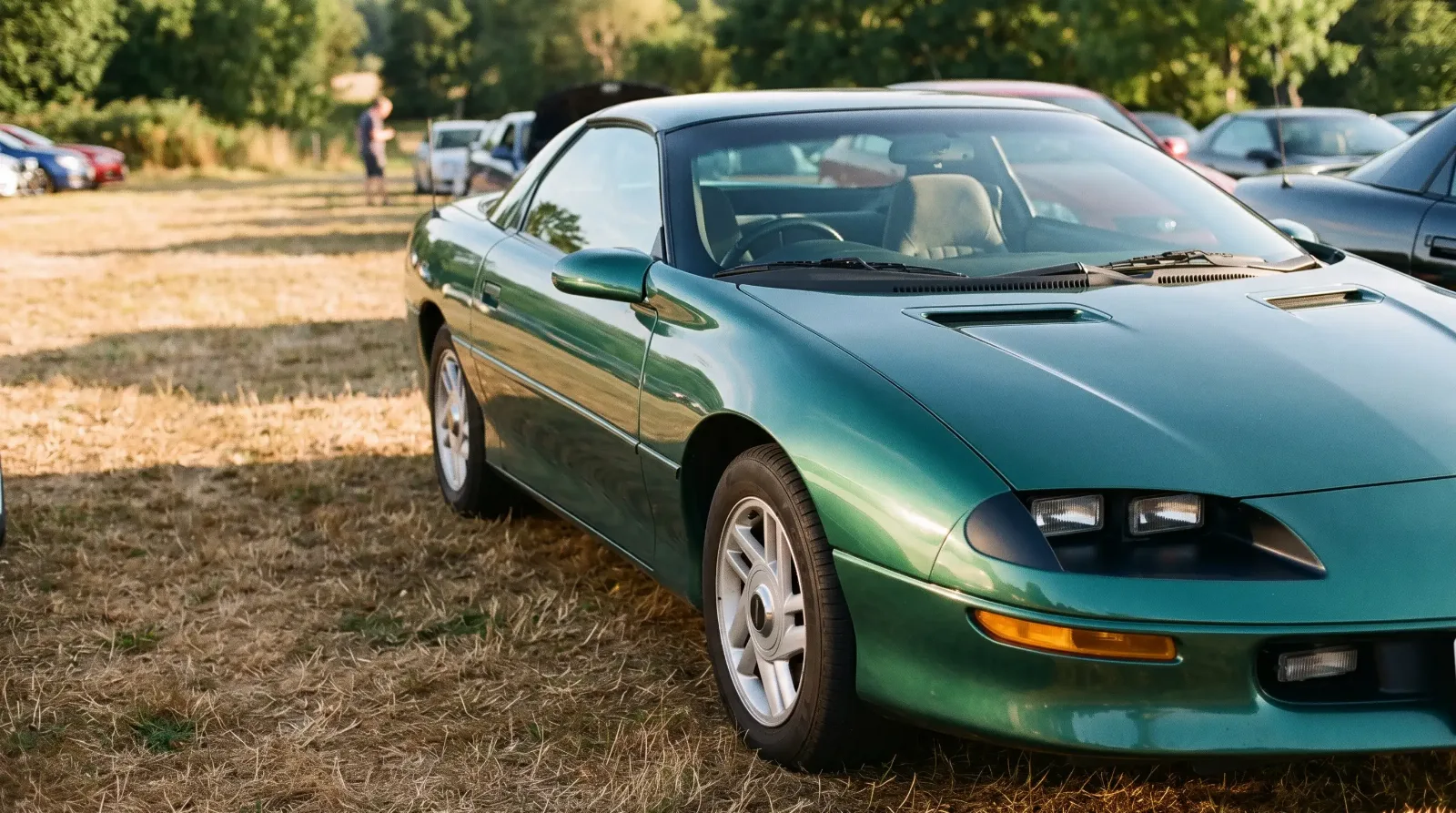
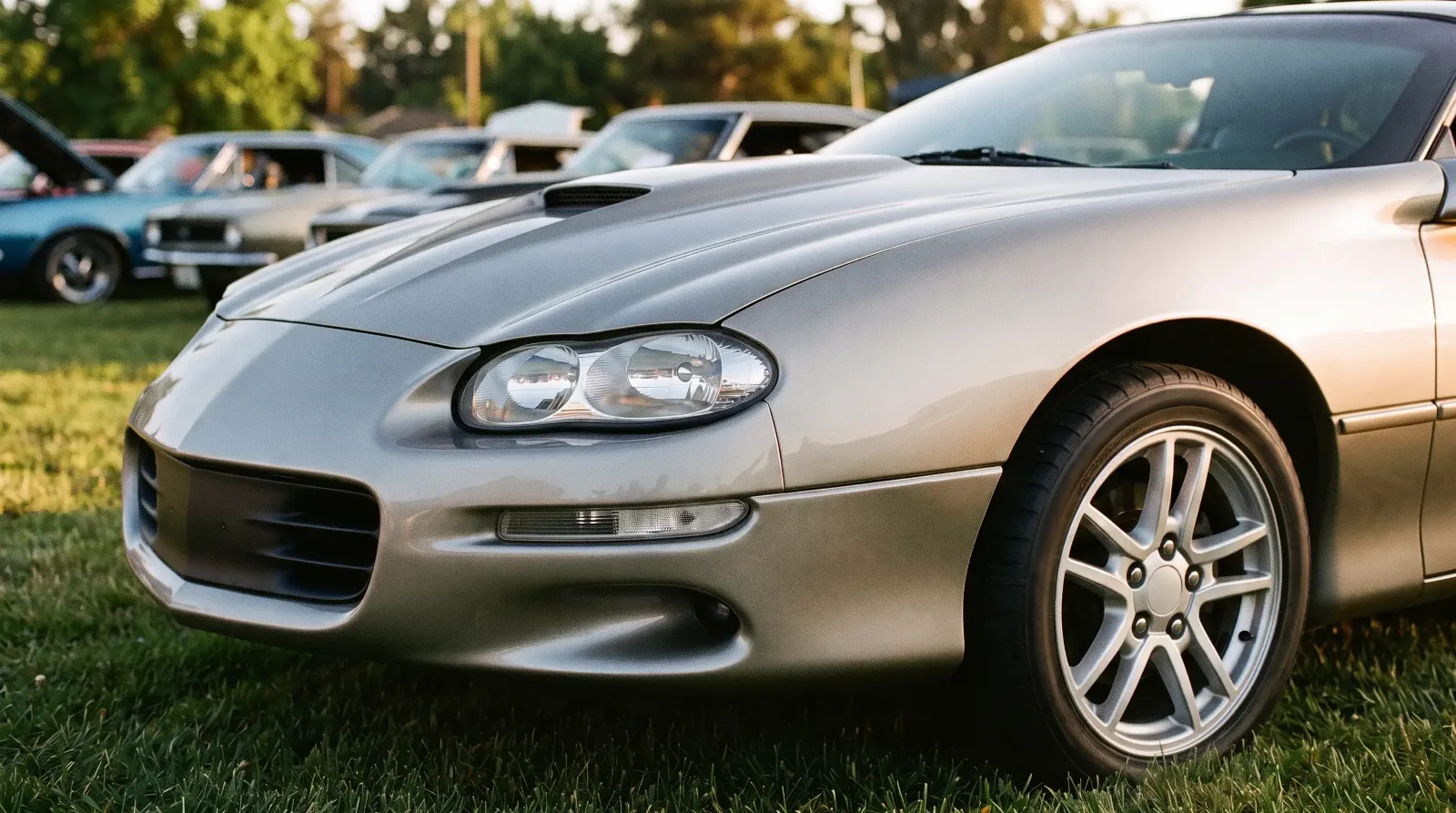
Picture a Chevrolet showroom in 1994. The new Camaro has been on sale for a year, long and low with a windshield that seems to run halfway to the rear axle. Then a second version rolls in, and someone reaches up, releases the latches and lets the roof fold away behind the seats. For the first time on this body, there is nothing between the driver and the sky. The 4th gen Camaro convertible had arrived, and it changed the car more than any engine option that year.
Car Features
6 min read
The 1994 Fourth-Gen Camaro Convertible
The 1994 Camaro convertible was built on the main Quebec line, not converted later. Trims, engines, prices, the 7,260 built and what to check now.
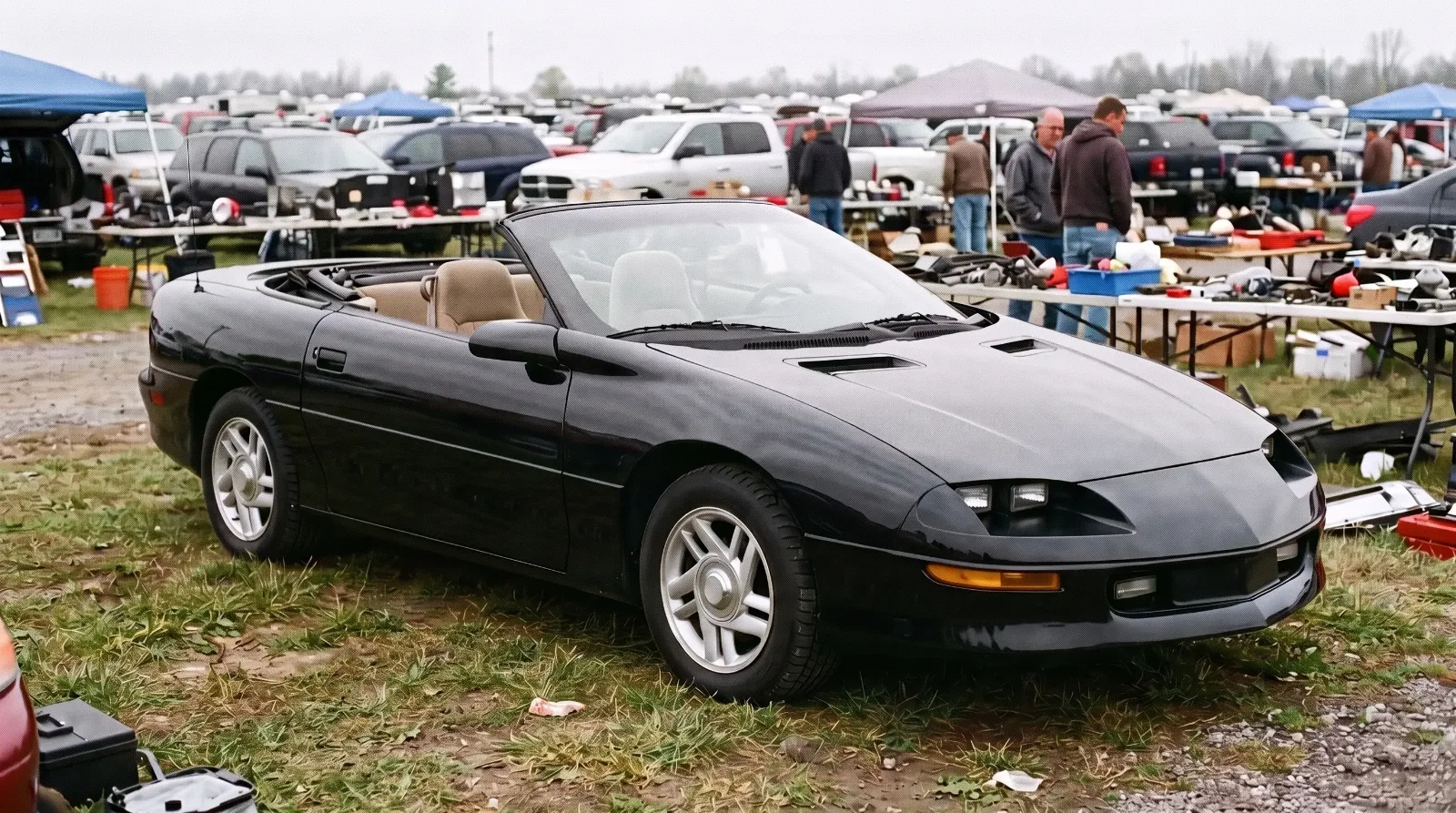
The coupe had launched for 1993 without one. For 1994 the convertible joined the range in two trims, base and Z28, and it came from a different kind of factory process than the last open Camaro had. That difference is the heart of the story, and it explains why these cars still feel finished in a way their predecessors did not.
Why the 4th gen Camaro convertible came off the main line
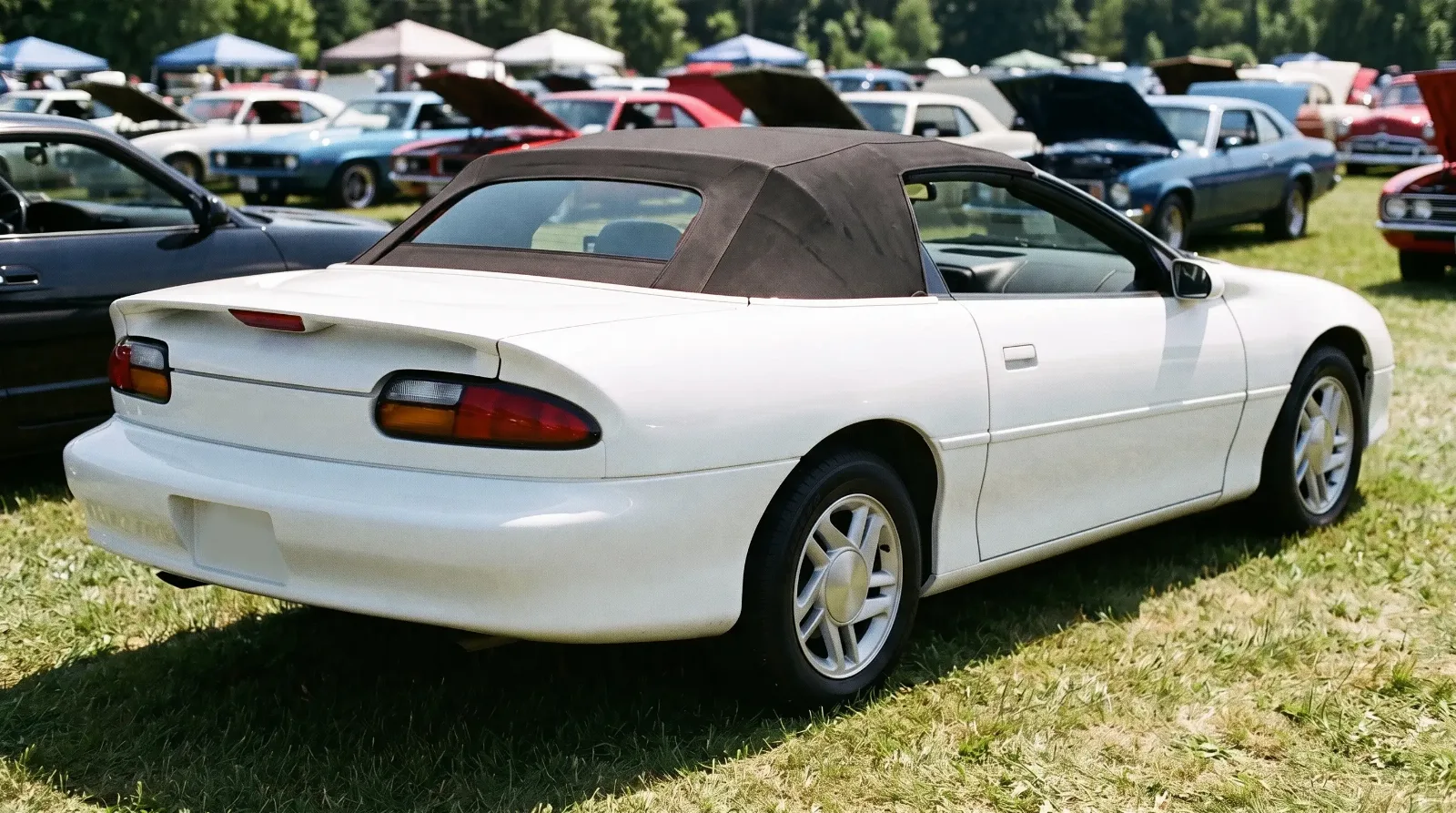
The previous open Camaro, the 1987 car, was the first Camaro convertible since 1969. It was a conversion. The American Sunroof Company took finished T-top coupes and turned them into convertibles, a sensible way to bring back the body style without retooling a plant. The result looked right from the curb. Underneath, it was a coupe that had been opened up after the fact.
The 1994 car was different from the start. It was built on the main Camaro and Firebird assembly line in Quebec, alongside the coupes, rather than finished by an outside company afterward. The top was a lined power unit, and the rear window was heated glass, not the clouded plastic that many open cars of the period still carried. Standing in the rain on a winter morning, a buyer could expect to see out the back.
That is a quiet kind of progress. Nobody bought the car for its rear window. But it told owners the convertible was a planned part of the range, not an afterthought.
What a 1994 buyer actually got
The two trims split the way the coupes did. The base convertible used the 3.4-liter L32 V6, rated at 160 hp. The Z28 used the 5.7-liter LT1 V8, 275 hp and 325 lb-ft, the engine that had arrived in the 1992 Corvette before it reached the Camaro.
The Z28 convertible listed at $22,075 and the base car at $18,745, about $5,000 more than the matching coupe. Period sources list the 4L60E four-speed automatic as the base convertible's standard transmission, where the base coupe came with a five-speed manual; a 1994 road test of the open car had the automatic too. Either way, 1994 was the year the automatic itself changed. The hydraulic 4L60 gave way to the electronically controlled 4L60E, and the engine computer became a powertrain control module. The LT1 moved from speed density to mass airflow and to sequential fuel injection.
Smaller details marked the year too. The gauge lettering turned white, where 1993 cars had yellow. Leather seating became available, at $499, and only 1,209 buyers across the whole Camaro range chose it. Remote keyless entry was new. In 1994 every convertible top was black; white and tan joined the choices from 1995.
The 1994 convertible by the numbers
Chevrolet built 119,799 Camaros for 1994, the best year the generation had seen so far. The convertible was a small slice of that, and most buyers who wanted one reached for the V8.
| 1994 convertible | Engine | Rated output | Base price | Built |
|---|---|---|---|---|
| Base | 3.4 L L32 V6 | 160 hp | $18,745 | 2,328 |
| Z28 | 5.7 L LT1 V8 | 275 hp, 325 lb-ft | $22,075 | 4,932 |
| Total | 7,260 |
Two in three 1994 convertibles were Z28s. Set against the 36,008 Z28 coupes built that year, the open car still accounts for only about one Z28 in eight. That rarity is mild rather than dramatic, but it is real, and it has held up as cars have been lost over three decades.
The car stood 52.0 inches tall with the top raised, a height it kept through 1997 before dropping to 51.8 inches for 1998.
What came after the first year
The first year was a beginning, not a peak. For 1995 the Z28 convertible alone reached 8,024 cars, listed at $23,095. That same model year the 3800 V6 joined the 3.4 partway through production, and buyers had a choice of two sixes for the first time. From 1996, the 3800 V6 became the standard base engine.
For 1996 the split was 2,994 base, 905 RS and 2,938 Z28 convertibles. For 1997 it was 4,330 base, 1,021 RS and 3,297 Z28. By 2002 the last year counted 2,750 base and 5,333 Z28 convertibles. The open car outlived every argument against it.
It was there at the very end, too. The last fourth-generation F-body built, on 27 August 2002, was a red Z28 convertible. The plant closed the next day. Somewhere in that, there is a symmetry: the body style that arrived a year late was the one that turned off the lights.
"The 1994 car was built as a convertible from the start, on the same line as the coupes. That matters more on a wet morning than it ever does on a spec sheet."
Nora Beckett
Looking at a 1994 convertible now
These are not expensive cars. A base 1994 convertible in good, number 3 condition was valued at $6,867 to $9,200 as of October 2026. That figure is for the V6 car; Z28 values were not part of the same snapshot.
The first-year identifiers are worth knowing. White gauge lettering, the 4L60E automatic and a black top all fit 1994. A white or tan top on a car sold as a 1994 is either a later replacement or a reason to look harder at the paperwork. Fourth-generation cabins were never the strong point either: used-car reviewers have long singled out the cheap plastics, and three decades of sun have not been kind, so check the dashboard and trim for cracks. On a convertible, add the top itself, the heated rear glass and the seals that keep the cabin dry.
The wider picture of the fourth-gen years tends to focus on engines, the LT1 and later the LS1. The 1994 convertible belongs in that story for a different reason. It was the year a Camaro could be ordered with nothing overhead, from the same line as every coupe, and it set the shape of every open fourth-gen car that followed.
Sources and notes
- Hagerty valuation tools: 1994 Chevrolet Camaro
- Conceptcarz: 1994 Chevrolet Camaro production and prices
- The Auto Channel: 1994 Camaro convertible road test
- Auto123: 1993 to 1997 Chevrolet Camaro pre-owned review
- Chevrolet Camaro (fourth generation), Wikipedia
- Auto123: the Boisbriand plant builds its last Z28
Related Reading
Have a
Chevrolet Camaro
for Sale?
Reach thousands of serious classic car collectors across the US.
Sell It Here →
Selling a classic? Here's how: sell my classic car
Are You a Classic Car Dealer?
List your full inventory and connect with targeted classic car buyers.
Join as a Dealer →

About the author
Nora Beckett
Automotive features writer and photographer who tells the human stories behind the cars, from show fields to cross-country road trips.
Related Listings - Chevrolet Camaro
Comments
Be the first to comment on this article.