
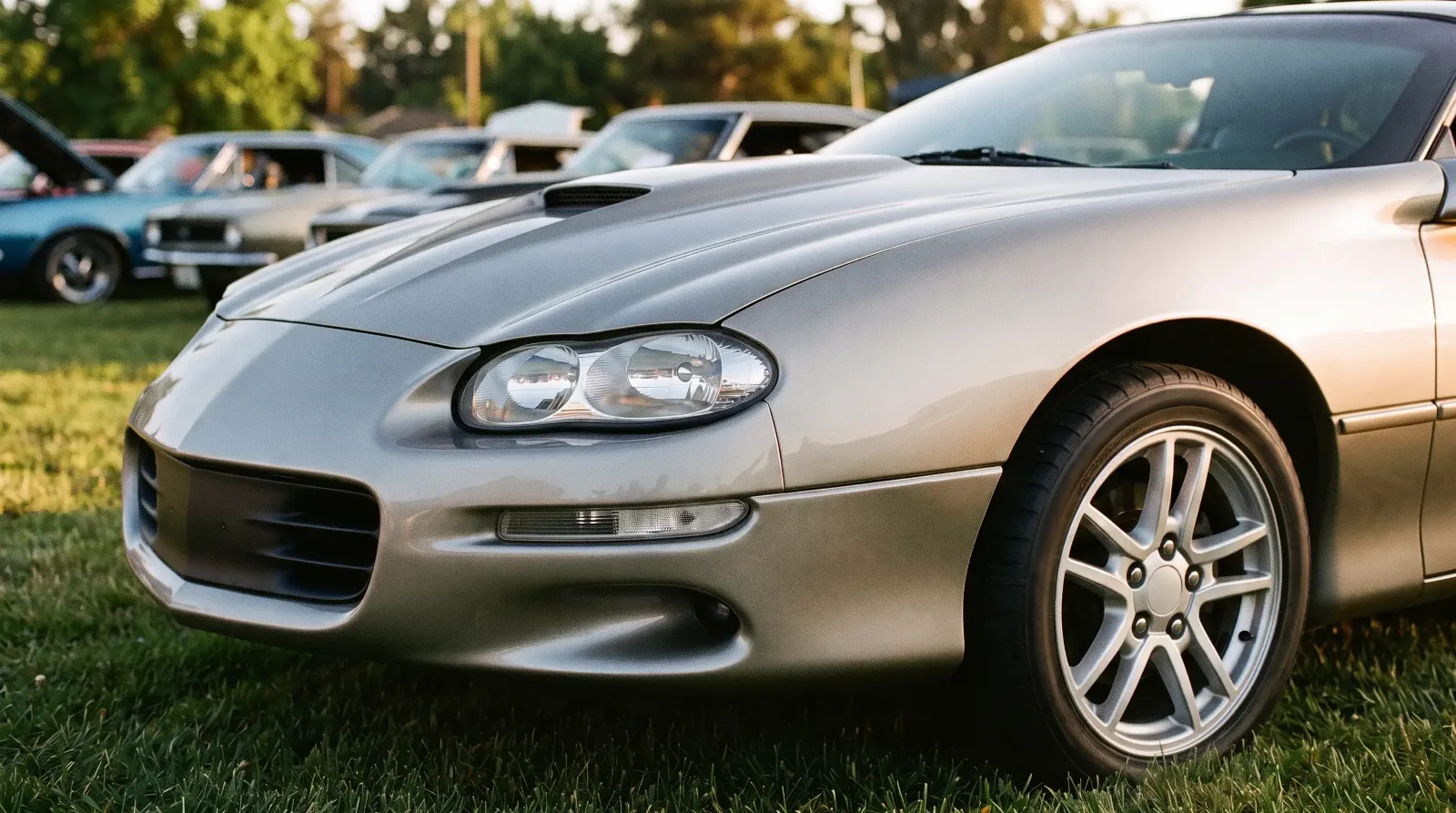
Walk any fourth-generation Camaro meet and the V8 cars get the crowd. The quiet ones parked at the end of the row are usually base coupes, and under most of those hoods sits a 3.8 liter pushrod six. That engine is the whole story of the 4th gen Camaro V6: a cheap car with a decent motor, sold to people who wanted the shape and the payment more than the time slip. From 1996 to 2002 it was the standard engine in every base Camaro. It deserves a fair look. Not a pity look.
Car Features
7 min read
The 3800 V6 Camaro: The Fourth Gen's Sensible Six (1995 to 2002)
The 3800 V6 arrived mid-1995 and powered every base Camaro from 1996 to 2002: 200 hp, 29 mpg, the Y87 and RS packages, and what breaks today.
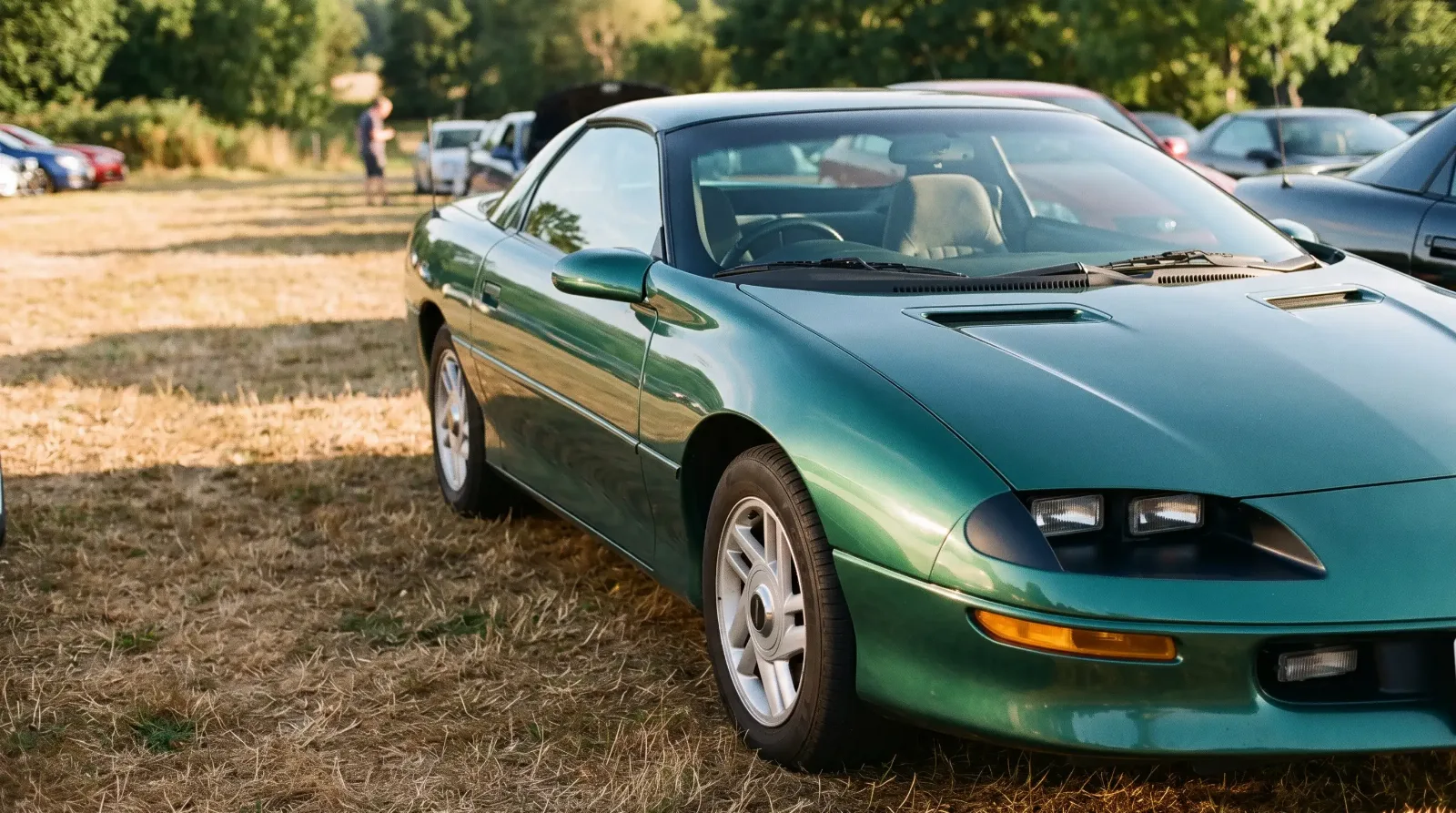
This is not the LT1 or LS1 story. The V8 cars have plenty of coverage, and the main fourth-generation history has the details on the body, the plant and the year-by-year changes. Here we stay under the hood of the car most people actually bought, and we look at what it did, what it cost and what goes wrong with it now.
From the 3.4 to the 3800 in mid-1995
The 1993 Camaro launched with a 3.4 liter (207 ci) L32 pushrod V6 rated at 160 hp. It was adequate. That is the nicest word I have for it. The 3.4 stayed in the catalog through 1995, backed by a five-speed manual or an automatic, and it moved a big, low car without ever sounding happy about it.
Partway through the 1995 model year Chevrolet added the 3800 Series II, coded L36, alongside the 3.4. For a few months a base Camaro buyer had something no Camaro buyer had been offered before: a choice of two different V6 engines. Sources do not agree on the exact timing. One dates the 3800 a year earlier, but three others put it in mid-1995 and make it standard for 1996, and that is the version I trust.
For 1996 the 3.4 was gone. The 3800 was standard in every base car, rated at 200 hp at 5,200 rpm and 225 lb-ft at 4,000 rpm from 231 cubic inches. That is 40 hp more than the engine it replaced, in the same body, for the same buyer. The 1996 base coupe listed at $14,990, and Chevrolet built 31,528 of them. The same year brought OBD-II diagnostics and dual catalytic converters across the line, so a 1996 is the first year a cheap code reader tells you much.
What 200 hp actually did on the road
The Auto Channel tested a 1996 base Camaro with the automatic. It ran 0 to 60 mph in 8.0 seconds and the quarter mile in 16.2 seconds at 84 mph. Curb weight was 3,298 lb. The EPA rated it at 19 mpg city and 29 highway. The car started at $14,990 and came out at $21,334 as tested, which tells you how fast the option sheet added up.
Now the honest part. The 1996 Z28 made 285 hp, and the SS that came back that year made 305 hp; the story of the 1996 SS return is its own chapter. Nobody bought a six-cylinder Camaro to embarrass a Z28, and nobody did. Hagerty calls V6 performance lackluster, with an exception for some SLP cars. I won't argue with that.
But eight seconds to 60 was fine for a commuter in 1996, and 29 mpg on the highway was a real number on a real window sticker. The torque is the part people forget. A pushrod six making 225 lb-ft at 4,000 rpm does not need to be wound out to merge. It pulls from low in the rev range, it idles smooth, and it does not care much about cheap gas.
Two gearboxes were offered. The manual was a Borg-Warner T-5 five-speed. The automatic was the electronic 4L60E four-speed, which had replaced the old hydraulic 4L60 for 1994. For 1999 the V6 picked up traction control, and every Camaro got a plastic 16.8 gallon fuel tank in place of the 15.5 gallon steel one used since 1982.
Y87, RS and the SLP Rally Sport: dressing up the six
Chevrolet knew the base car needed help, so it sold some. The Y87 performance package was the one that changed how the car drove. In its 1996 to 1997 form it bundled an Auburn limited-slip differential, better tires, dual exhaust tips, four-wheel disc brakes, quicker steering and a shorter axle ratio on automatic cars. It cost $400, and 8,734 buyers took it in 1996.
The RS was the other route, and it was mostly about looks: a new front fascia and side ground effects on a V6 car. The 2001 to 2002 SLP Rally Sport went further, with stripes, RS badges and the Z28 exhaust, and SLP rated the engine at 205 hp.
| Package | Years | What it added | Built |
|---|---|---|---|
| Y87 performance package | 1996 to 2001 | Auburn limited slip, better tires, dual tips, quicker steering, shorter axle on automatics | 1996: 8,734 ($400); 1997: 6,918 ($400); 2001: 1,697 ($275) |
| RS (factory) | 1996 to 1997 | New front fascia, side ground effects | 1996: 8,091 coupes, 905 convertibles; 1997: 8,154 coupes ($17,970), 1,021 convertibles |
| SLP Y3B Rally Sport | 2001 to 2002 | Stripes, RS badges, Z28 exhaust, 205 hp rating | 2001: 398 ($849); 2002: 443 |
The factory RS was dropped for 1998. If you are shopping, a Y87 car is the one to want. The limited slip and the steering do more for the drive than any badge, and the take rate fell off hard by 2001, so they are not common.
Living with a 4th gen Camaro V6 today
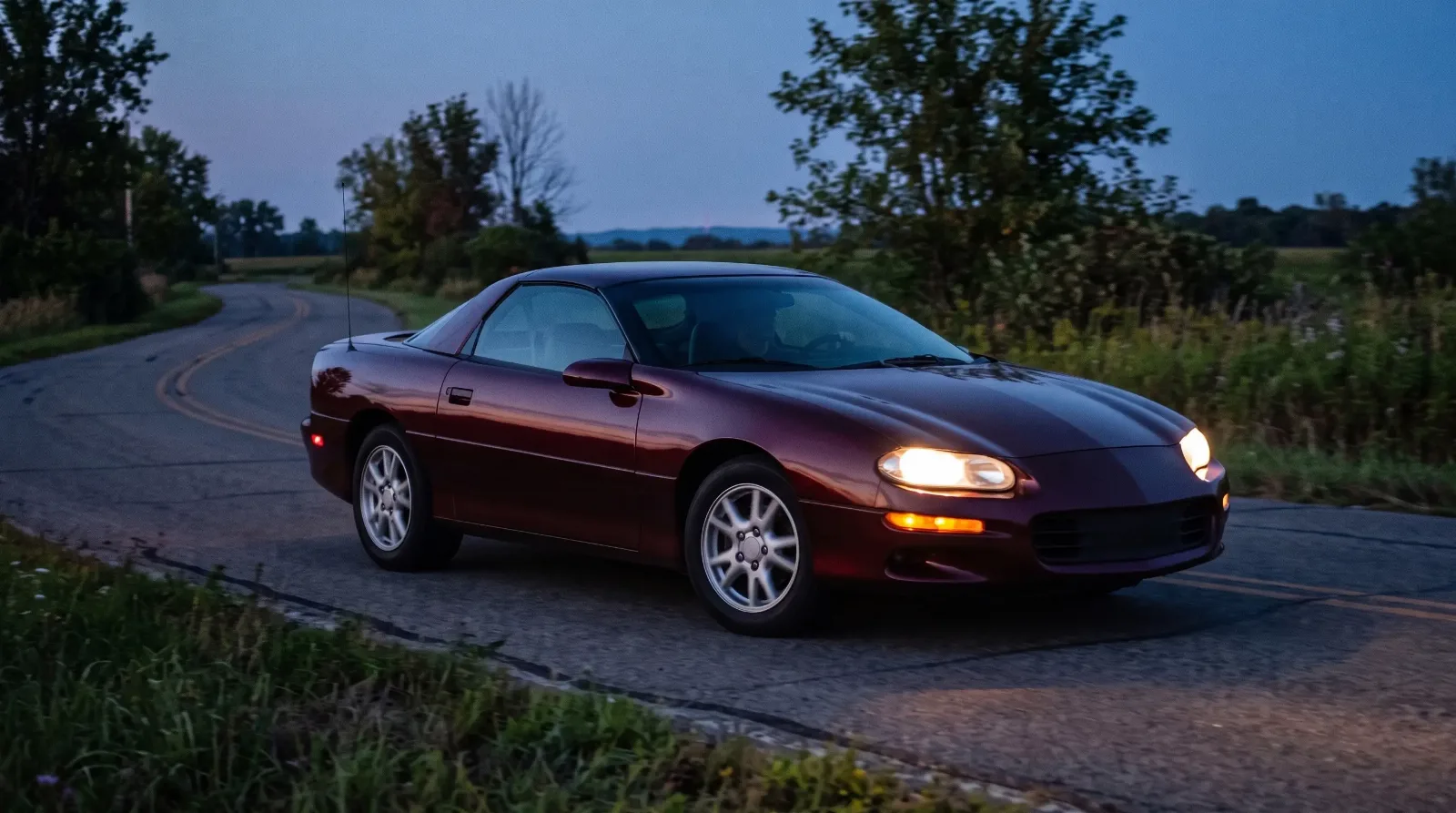
The good news first. The 3800 is generally rated as the more reliable choice in a fourth-gen Camaro. The LT1's Opti-Spark and hot-oil headaches are a V8 story. That does not make the six bulletproof. The known weak point is the intake manifold gasket, and Hagerty also lists leaking intake manifolds and head problems among the V6 car's faults. A coolant leak that nobody fixed turns into a bigger bill.
Prices are low, which is the point of the car. As of October 2026 the Hagerty Price Guide puts a #3 Good 1997 base convertible at $7,567 to $9,633 and a 2002 base convertible at $8,967 to $10,833. For comparison, a #3 Good 1993 base coupe, which means a 3.4 car, sits at $3,567 to $4,600. You are not buying an investment. You are buying a cheap, comfortable Camaro that starts every morning.
"Everybody wants the V8 until they price the V8. Find a clean 3800 car with the Y87 package and a dry intake, drive it for years, and spend the difference on tires."
Mike Sullivan
Where the six sat in the lineup
The V6 car was not a sideshow. In several years the base Camaro, which meant the V6 Camaro, outsold the V8 line outright. The numbers below come from the production records for the years where both counts are on file.
| Model year | Base engine | Base cars built | Z28 built |
|---|---|---|---|
| 1993 | 3.4 L L32, 160 hp | 21,253 coupes | 17,850 |
| 1999 | 3800, 200 hp | 23,249 coupes, 1,652 convertibles | 14,747 coupes, 2,448 convertibles |
| 2000 | 3800, 200 hp | 25,042 | 20,419 |
| 2002 | 3800, 200 hp | 16,971 | 24,805 |
By 2002 the balance had flipped toward the Z28, and the whole program was near its end. The six never got a farewell edition of its own. It just kept doing the job, the same 200 hp in the last car as in the 1996 car, while the V8s got the stripes and the headlines.
That is the fair verdict on the 3800 Camaro. It was the sensible engine in a car nobody buys for sensible reasons. Judge it on what it was meant to be, a fourth-gen body you could afford to insure and feed, and it holds up better than the hype around its V8 siblings suggests.
Sources and notes
- The Auto Channel: 1996 Chevrolet Camaro V6 road test (Tom and Bob Hagin)
- Wikipedia: Chevrolet Camaro (fourth generation)
- Hagerty valuation: 1996 Chevrolet Camaro (Y87, RS and production notes)
- Hagerty valuation: 2001 Chevrolet Camaro (SLP Rally Sport)
- Auto123: 1993 to 2002 Chevrolet Camaro pre-owned review
- Classic Industries: Camaro production numbers, 1967 to 2002
Related Reading
Have a
Chevrolet Camaro
for Sale?
Reach thousands of serious classic car collectors across the US.
Sell It Here →
Selling a classic? Here's how: where to sell your classic car online
Are You a Classic Car Dealer?
List your full inventory and connect with targeted classic car buyers.
Join as a Dealer →

About the author
Mike Sullivan
Detroit-area muscle car enthusiast and restoration specialist with three decades of hands-on experience working on American iron.
Related Listings - Chevrolet Camaro

Comments
Be the first to comment on this article.