
The 1999 Mustang GT is the car where Ford took the soft, rounded body it had launched for 1994 and put an edge on every line of it. Ford called the look New Edge. Under the new sheet metal the GT also got back the horsepower the 4.6 had been missing since 1996: 260 hp, up from 225 the year before. And every 1999 V6 and GT wore a small badge on the front fender marking 35 years since the first one went on sale.
Car Features
8 min read
The 1999 New Edge Restyle and the 35th Anniversary
For 1999 Ford put hard creases on the SN95, gave the GT 260 hp and badged every car for the 35th anniversary. What changed and why.
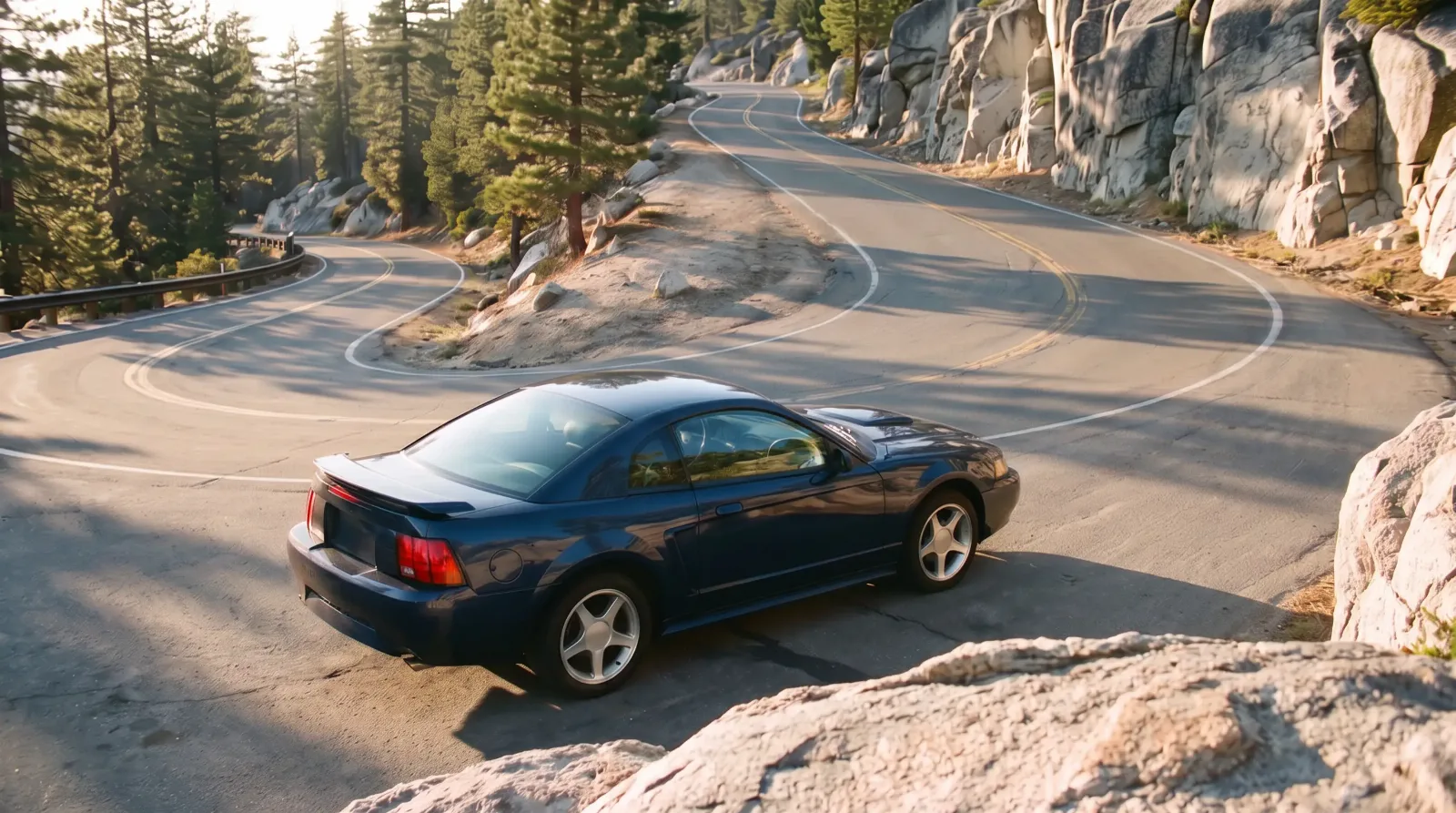
The platform, the skunkworks team and the 1994 launch belong to the story of the fourth-generation Mustang as a whole, and the 35 years leading up to it are in the full story. This piece stays on one model year: what changed for 1999, what it looks like when you stand next to the car with a body man's eye, and what the anniversary actually put on the window sticker.
What the New Edge restyle changed on the body
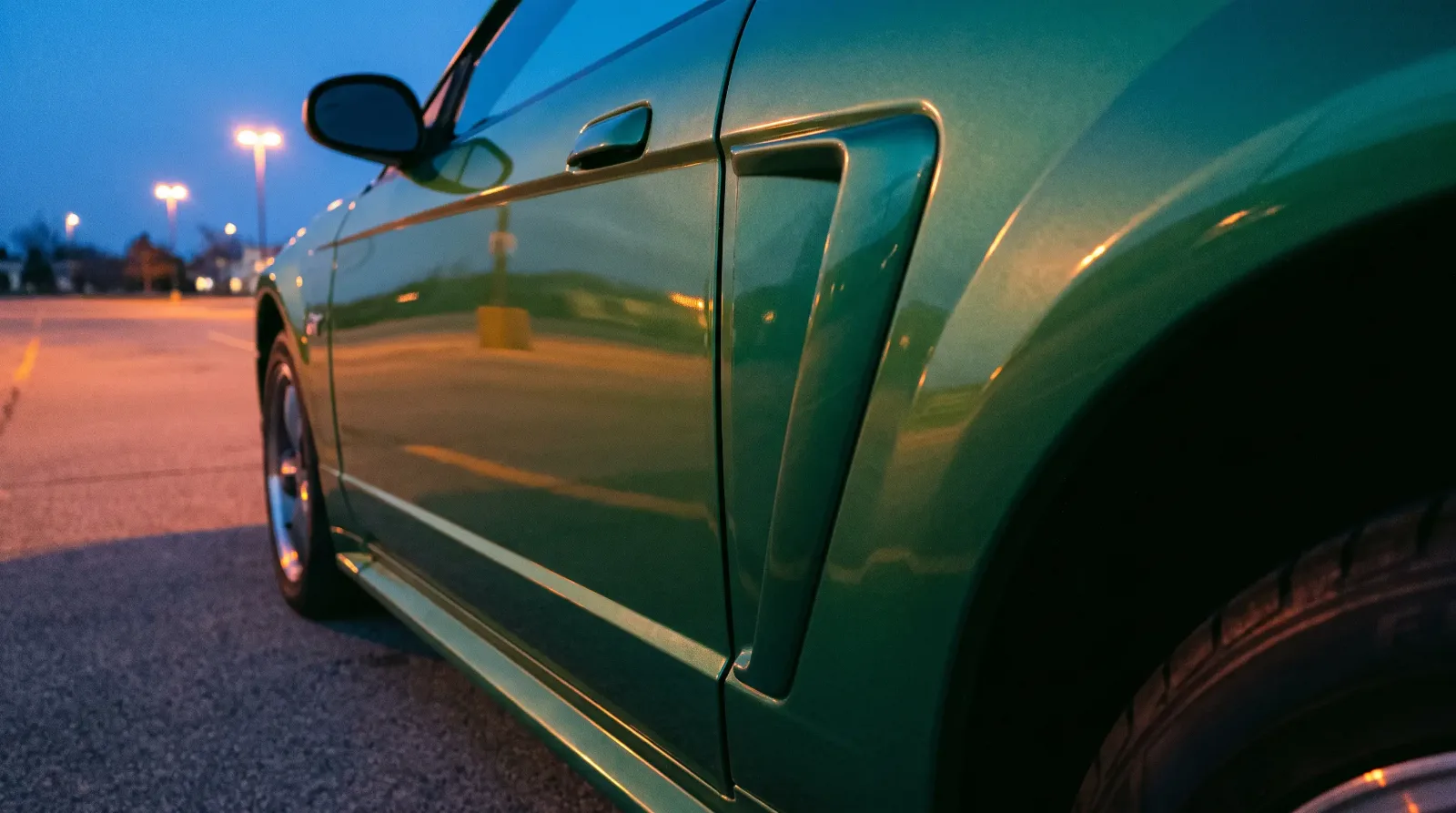
Production of the restyled car started in November 1998. The platform underneath did not change, and the wheelbase held at 101.3 inches. Nearly everything you can touch from the outside moved anyway. Ford gave the car new front and rear fascias, new headlamps, new side scoops and new taillights, and it pulled hard creases through panels that had been all curves since 1994. New Edge was Ford's company-wide design language at the time, and the Mustang wore it more convincingly than most.
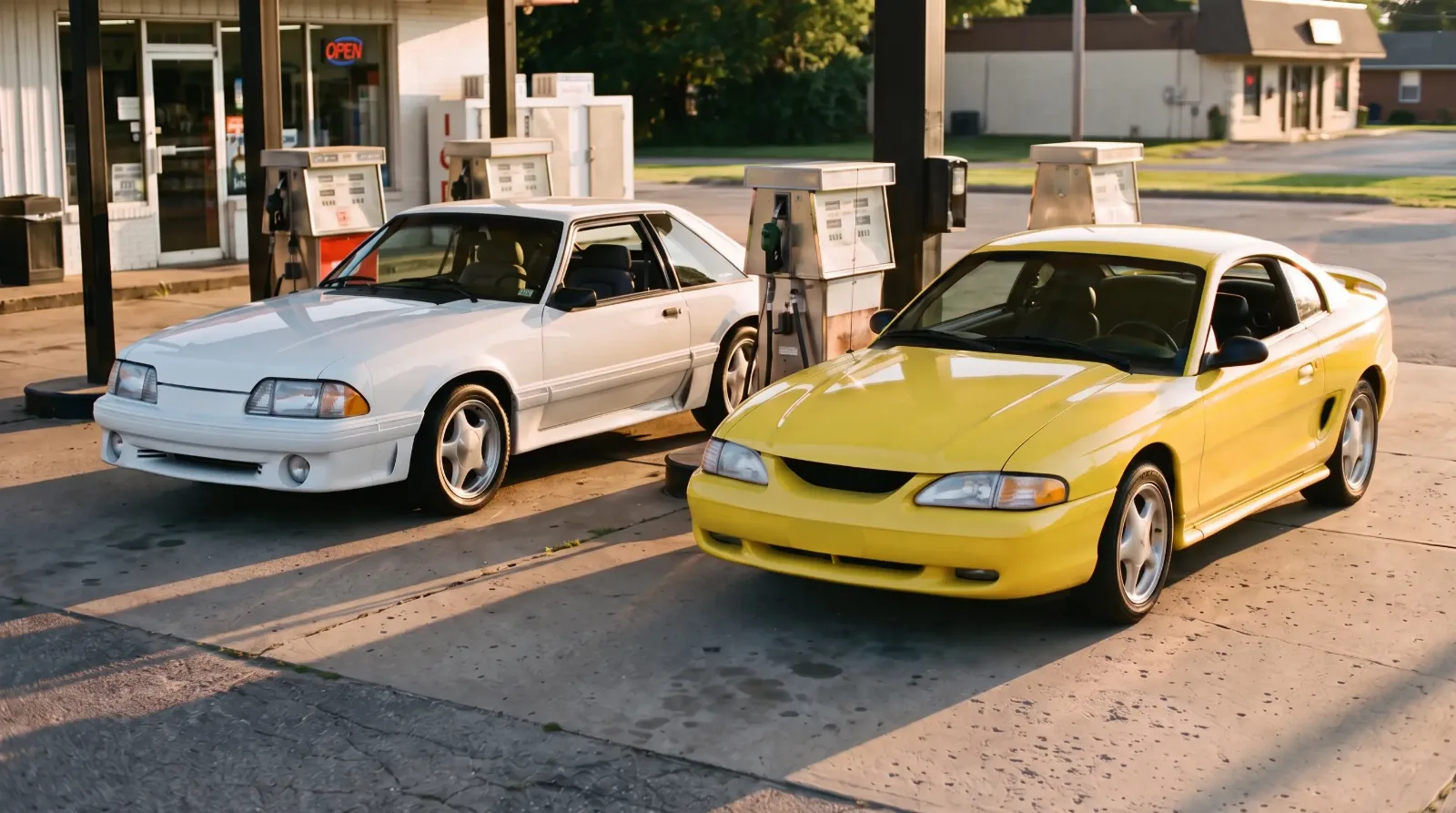
Look at the side of a 1998 and a 1999 parked nose to nose. The earlier car has a long, rolling shoulder that fades into the door. The 1999 has a crisp character line, flatter planes and a side scoop that reads as a cut in the panel rather than a soft dent pressed into it. The hood picked up definite edges. On the GT, a hood scoop appeared in the middle of it. It is not functional. It is a shape stamped into the panel, and anyone who has pulled one apart knows there is no hole under it.
The car also grew. Overall length went from 181.5 inches to 183.2, and width from 71.8 inches to 73.1, all of it in new skin over the same hard points. That is the trick of a good freshening. You cannot move the firewall or the windshield on a budget, so you move everything bolted to them and make the old structure look like a different car.
Inside Ford, the program fell under Janine Bay, the Mustang vehicle line director from 1994, who also served as chief program engineer from January 1997 to August 1998. The styling was led by Doug Gaffka, whom Ford's own biography lists as chief designer of the 1999 Mustang before he moved on to the 2002 Thunderbird.
"The 1994 car looked like it was shaped out of soap. The 1999 looks like somebody went over it with a file. Same doors, same roof, same glass, and it reads as a different animal from twenty feet away. That is what a good restyle does: you do not need new bones, you need new light on the panels."
Jim Vasquez
The 1999 Mustang GT gets its horsepower back
The body was the headline, but the engine was the better news. When the 4.6 SOHC replaced the pushrod 302 for 1996, the GT made 215 hp, exactly what the 5.0 had made, and it did not feel any quicker for the change. Ford nudged it to 225 hp at 4,750 rpm and 290 lb-ft at 3,500 for 1998. For 1999 the GT got revised cylinder heads, cams and intake, the package Ford called Performance Improved, and output jumped to 260 hp at 5,250 rpm and 302 lb-ft at 4,000.
That is 35 more horsepower than the year before and 45 more than the 1996 and 1997 cars. For the first time since the switch to the overhead-cam engine, the GT had a number worth talking about, and Ford needed one in the last pony war against Chevrolet. The V6 moved up as well, from 150 hp in 1998 to 190 hp at 5,250 rpm with 220 lb-ft at 2,750.
| Spec | 1998 Mustang | 1999 Mustang |
|---|---|---|
| GT engine | 4.6 SOHC V8 | 4.6 SOHC V8, revised heads, cams and intake |
| GT output | 225 hp @ 4,750 rpm; 290 lb-ft @ 3,500 rpm | 260 hp @ 5,250 rpm; 302 lb-ft @ 4,000 rpm |
| V6 output | 150 hp | 190 hp @ 5,250 rpm; 220 lb-ft @ 2,750 rpm |
| Wheelbase | 101.3 in | 101.3 in |
| Length | 181.5 in | 183.2 in |
| Width | 71.8 in | 73.1 in |
| GT exhaust tips | 2.75 in | 3 in |
| Rear track | Baseline | Widened 1.4 in |
| Traction control | Not offered | Added |
The SVT Cobra moved further still, to a 320 hp four-valve engine and the first independent rear suspension on a production Mustang. Owners soon found their cars were slower than the 1998 Cobra, Ford stopped sales on August 6, 1999, and the fix took a new intake manifold, engine computer parts and a new exhaust from the catalytic converters back. That episode deserves its own telling. For the regular car, the 260 hp GT was the one that changed minds.
Under the skin: what Ford fixed for 1999
The quieter changes are the ones a body man notices. The rear track went out 1.4 inches, which filled the wheel openings better and gave the car a wider stance from behind. Traction control was added for the first time. The GT's exhaust tips grew from 2.75 to 3 inches, a small thing that makes the back of the car look more serious.
The trunk lid became a composite panel instead of steel. And Ford filled the rocker panels with foam. On a unibody car that is a cheap, smart move: a hollow rocker is a drum, and a filled one is quieter and a little stiffer. The convertible, always the soft spot on this platform, got a subframe connector tying the front and rear structure together. None of this shows in a photograph. All of it shows when you lean on a fender or drive over a railroad crossing.
The 35th Anniversary badge and the Limited Edition GT
Ford marked 35 years of the Mustang in two ways. The first was simple: every 1999 V6 and GT carried a 35th Anniversary badge on each front fender. The SVT Cobra went without. The badges came off for 2000, so on an untouched car they date it to the single model year at a glance.
The second was the 35th Anniversary Limited Edition, option code 54Y, offered on the GT only at $2,695. It added a raised hood scoop with a black stripe, extended side scoops, a wing spoiler and a black honeycomb insert on the decklid. Ford built 4,628 of them: 2,318 coupes and 2,310 convertibles. Performance Red was exclusive to the package, and the color split was 1,555 Performance Red, 1,299 Black, 1,259 Silver and 515 Crystal White.
From a builder's side of the car, the package is the honest version of the GT's hood. The raised scoop and the stripe make the hood look like it means something, and the extended side scoops finish the line the New Edge stylists started. It is still trim. It is good trim.
Production, prices and the road to 2004
The published production table for the 1999 model year adds up to 133,907 cars. The V6 coupe carried the volume at 73,180, with 19,299 V6 convertibles. The GT coupe came to 17,316 plus the 2,318 Anniversary coupes, and the GT convertible to 11,389 plus 2,310 Anniversary cars. SVT built 4,040 Cobra coupes and 4,055 convertibles. Window stickers started at $16,470 for the V6 coupe and $21,070 for the V6 convertible. The GT coupe listed at $20,870 and the GT convertible at $24,870, and the Cobra ran $27,470 as a coupe and $31,470 as a convertible.
For 2000 the anniversary badges came off and the line carried on with very little change. Ford sold a GT Spring Feature Edition, 3,091 of them, and there was no regular Cobra that year: the only 2000 SVT Cobras were the 300 Cobra R cars. The model year total climbed to 215,239, so the sharp new body was clearly working in the showroom.
The New Edge shape ran well past 2000. It carried the car through 2004, and SN95 production ended on May 10 of that year. Plenty of 1999 Mustangs are still on the road, and the year is easy to spot once you know what to look for: the creases, the GT's blind hood scoop and that small anniversary badge on the fender.
Sources and notes
- Wikipedia: Ford Mustang (fourth generation), 1999 restyle and engine ratings
- MustangSpecs: 1999 Ford Mustang, changes, production and prices
- MustangSpecs: 1999 Mustang GT Limited Edition 35th Anniversary
- The Mustang Source: 1999 timeline, Limited Edition colors and fender badges
- Ford Media (archived): biography of Doug Gaffka
- Wikipedia: Ford Mustang SVT Cobra, the 1999 Cobra and its recall
Related Reading
Have a
Ford Mustang
for Sale?
Reach thousands of serious classic car collectors across the US.
Sell It Here →
Selling a classic? Here's how: compare the places to sell classic cars
Are You a Classic Car Dealer?
List your full inventory and connect with targeted classic car buyers.
Join as a Dealer →

About the author
Jim Vasquez
Southern California hot rod and custom car builder with roots in the traditional kustom kulture scene.
Related Listings - Ford Mustang

Comments
Be the first to comment on this article.