
Ford says 1,330 of the 1,850 parts in the 1994 Mustang were changed. Start there when you line up SN95 vs Fox Body, because that number cuts both ways. Roughly seven parts in ten were new. The rest, including the floor pan and the front crossmember, came off a platform that first went into production under the 1978 Ford Fairmont. So was the SN95 a new car or a reskinned Fox? Count the parts and it is mostly new. Look at the structure and it is not.
Car Features
7 min read
From Fox to SN95: What Changed Under the Skin
Ford changed 1,330 of 1,850 parts for 1994 but kept the Fox floor pan. What carried over, what was new, and what it did on the road.
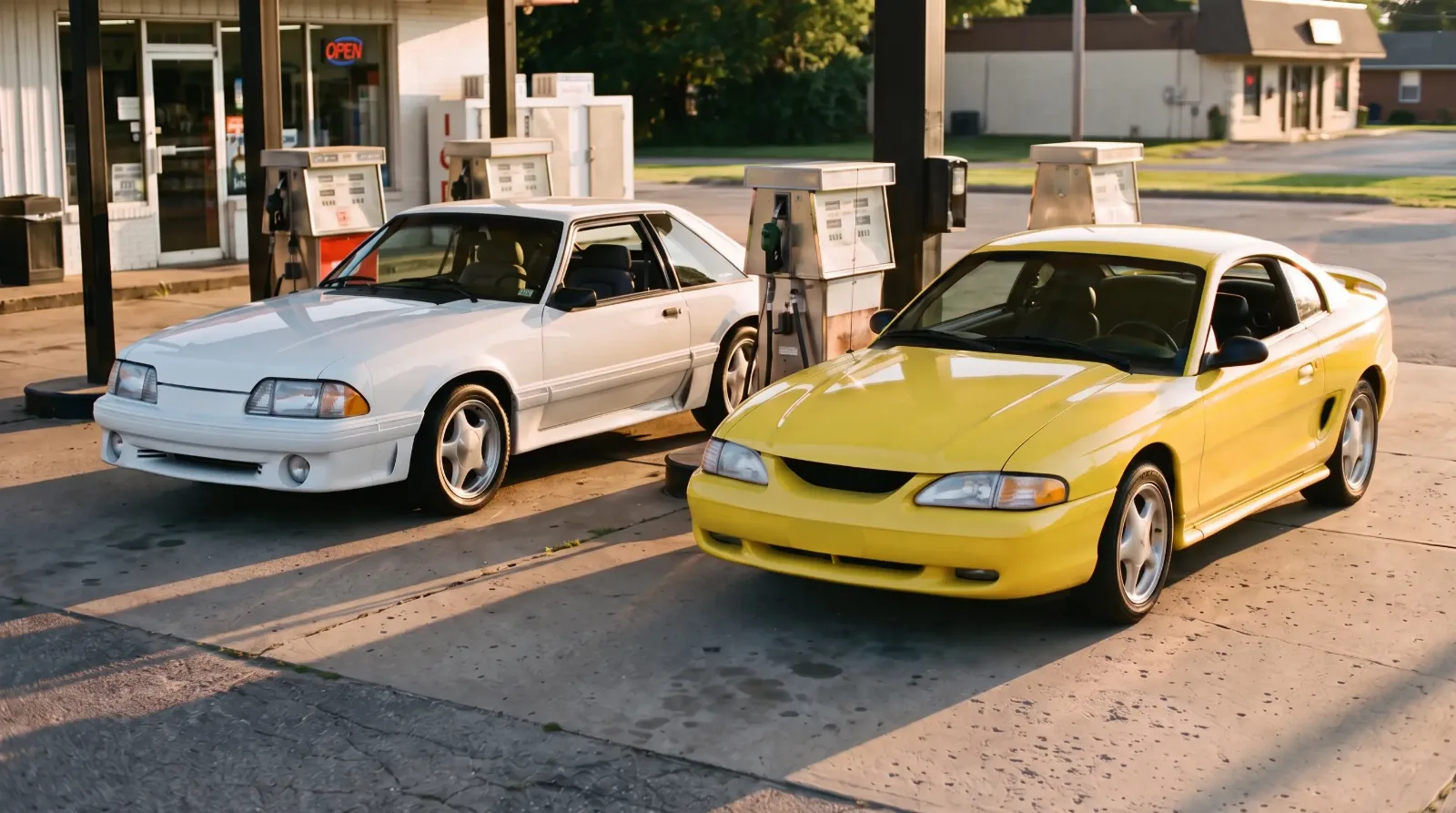
This piece stays with the hardware: platform, body, chassis and drivetrain. The program, the people and the trim levels are covered in our SN95 guide. Here it is only about what moved, what stayed, and what the changes did on the road.
What the SN95 kept from the Fox
Ford called the updated platform Fox-4, and the SN95 was the last vehicle built on any version of Fox. The floor pan and the front crossmember carried over. So did the basic recipe: engine up front, solid axle out back, rear-wheel drive. The Fox had used the 8.8-inch rear end under its V8 cars since 1986, and the SN95 kept it. The 1996 spec sheet lists a 2.73:1 standard ratio with 3.27:1 optional, and the 1994 GT launched on a 3.08:1.
The wheelbase tells you how much of the old car sat underneath. The Fox Mustang rode on 100.5 inches (some sources say 100.4). The SN95 rides on 101.3. That is less than an inch. Nobody pays for a clean-sheet chassis and ends up 0.8 inches longer between the axles. The Borg-Warner T-5 five-speed stayed as well, the same gearbox Fox V8 cars had used since it arrived in the middle of the 1983 model year, with the AOD-E four-speed automatic as the alternative. The suspension layout carried over too: MacPherson struts up front, now with longer lower control arms, and a solid rear axle located by short, angled upper arms and lower links, the same basic design aftermarket suppliers list for every Mustang from 1979 to 2004.
If you know the 1979 to 1993 car from our Fox Body story, none of this is a surprise. Ford's team had about $700 million to work with, against roughly $1 billion for most all-new cars of the period. Keeping the floor and the front crossmember was how it stayed inside that number.
Where the 1,330 new parts went
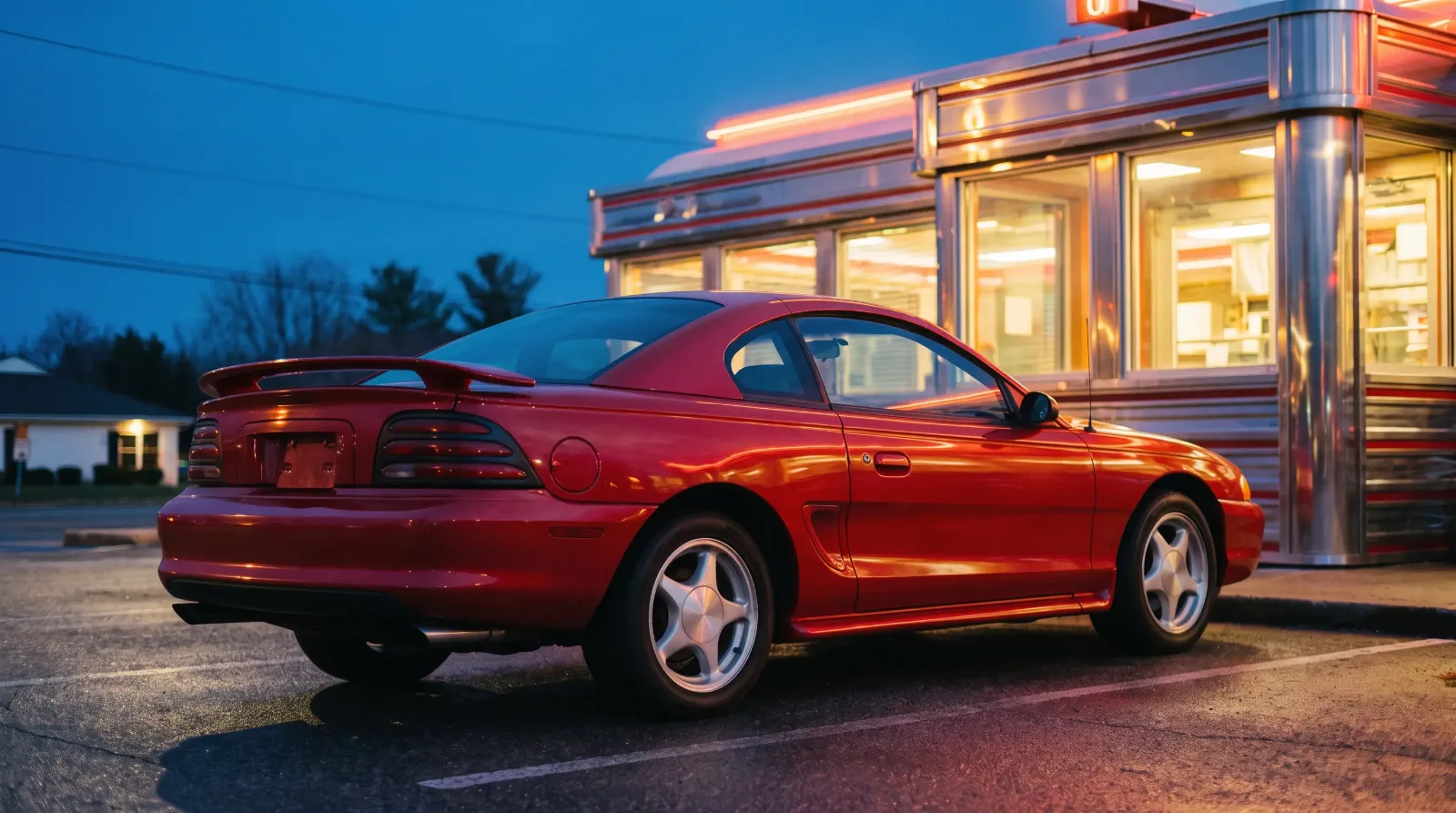
The body was the obvious one. The Fox sold as a notchback, a hatchback and a convertible. The SN95 dropped the first two and offered one fastback-style coupe plus the convertible. The styling was all new, and the car grew in the directions that matter for handling. Track width went up 3.7 inches over the 1993 car. Overall width came out at 71.8 inches, length at 181.5 inches, and the 1994 to 1996 coupe stood 52.9 inches tall.
Weight went up too, by about 300 pounds against the 1993 car. Some of that bought stiffness. Ford stiffened the chassis, and the GT got progressive-rate springs, longer control arms, new spindles and its own anti-roll bars. Bigger rocker panels, stronger roof rails and stronger joints did the work. Enthusiast forums pass around figures of 56 percent more bending stiffness and 44 percent more torsional stiffness, but I have never seen the Ford document behind those two numbers, so I do not lean on them. The direction is not in doubt. The size is.
Brakes moved forward. Four-wheel disc brakes became standard on every 1994 Mustang, a first for the car, with Bosch ABS on the options list. On the Fox, rear discs had come from the factory only on special models, the SVO and the 1993 SVT Cobra among them. Inside, a dual-cockpit dash replaced the Fox layout, and the running horse went back into the grille after a 16-year absence. That last item weighs nothing and probably sold more cars than any spindle.
SN95 vs Fox Body by the numbers
| Item | 1993 Fox | 1994 SN95 |
|---|---|---|
| Platform | Fox | Fox-4 (updated Fox, same floor pan and front crossmember) |
| Wheelbase | 100.5 in | 101.3 in |
| Body styles | Notchback, hatchback, convertible | Coupe, convertible |
| Base engine | 2.3 four, 105 hp (rating since 1991) | 3.8 V6, 145 hp, 215 lb-ft |
| V8 | 5.0 HO, 205 hp, 275 lb-ft | 5.0 HO, 215 hp, 285 lb-ft |
| Track width | Baseline | 3.7 in wider |
| Weight | Baseline | About 300 lb heavier |
| Parts changed | n/a | 1,330 of 1,850 |
| Model-year production | 114,228 | 123,198 |
Read that table the way you would read a dyno sheet. The base car gained 40 horsepower and two cylinders. The V8 gained 10 horsepower and carried about 300 extra pounds. That is not a trade that makes a car quicker in a straight line, and it did not. What the table cannot show is the stiffer structure and wider track, which is where the money went.
One caution on the V8 column. Ford rerated the 5.0 for 1993, from the 225 hp it had listed for 1987 to 1992 down to 205 hp. So the 1994 car's 10-horsepower bump is measured against a number Ford itself had just lowered. Compare an SN95 GT to a 1990 GT on paper and it looks like a downgrade. On a dyno the two engines are closer than the brochures suggest.
Engines: a new base motor and a familiar V8
The biggest powertrain change sat at the bottom of the range. The 2.3 four was gone. In its place came the 3.8 V6, rated at 145 hp at 4,000 rpm and 215 lb-ft at 2,500 rpm. For buyers who never looked at a GT, that was the real upgrade of 1994, and the six accounted for 61,216 of the 123,198 cars built that model year, about half. We cover it in the full story.
The GT kept the pushrod 5.0 HO. Ford rated it at 215 hp at 4,200 rpm and 285 lb-ft at 3,400 rpm, with the T-5 or the AOD-E behind it. Period figures put the 1994 GT at 0 to 60 mph in the high six-second range and the quarter mile at about 15 seconds. Respectable. Not a step forward from a light Fox LX 5.0, and anyone who owned both will tell you so.
The 5.0 lasted two model years in the new body. 1995 was its final year in the Mustang. For 1996 the GT switched to the 4.6-liter SOHC Modular V8, rated at the same 215 hp, with the T-45 five-speed and 4R70W automatic replacing the T-5 and AOD-E. Same number on the window sticker, different engine underneath. That swap is a separate story from the Fox-to-SN95 change, but it is worth knowing that the first two SN95 years are the only ones with the Fox-era V8.
How the SN95 drove: the handling numbers
This is where the extra weight earns its keep. Motor Trend's figures for the 1994 GT show 0.87 g on the skidpad and 66.3 mph through the slalom. The 1993 SVT Cobra posted the same 0.87 g and 64.8 mph. A regular GT, on 16-inch wheels where the base car wore 15s, matched the outgoing Cobra on grip and beat it through the cones. That is the wider track and the stiffer structure talking.
"Ten more horsepower and three hundred more pounds. On paper the SN95 GT went backward. Then it matched a Fox Cobra on the skidpad and beat it through the slalom. That tells you exactly where Ford spent the money."
Dan Reeves
Street versus track reality: a Fox 5.0 is lighter and still feels quicker off a light. The SN95 is the better car once the road bends, and the gap widened as the platform matured. For 1999 the rear track grew another 1.4 inches, traction control arrived, and the GT's 4.6 went to 260 hp with revised heads, cams and intake. That round of changes came with the New Edge restyle, and it is the version of the SN95 that finally put real distance between itself and the Fox.
So what changed under the skin? Most of the parts, a little of the wheelbase, and a lot of the stiffness. What did not change is the floor you are standing on when you open the door. Call it a heavily reworked Fox and you are right. Call it a new car and Ford's parts count backs you up.
Sources and notes
Related Reading

Have a
Ford Mustang
for Sale?
Reach thousands of serious classic car collectors across the US.
Sell It Here →
Selling a classic? Here's how: sell my classic car
Are You a Classic Car Dealer?
List your full inventory and connect with targeted classic car buyers.
Join as a Dealer →

About the author
Dan Reeves
Performance engine builder from North Carolina's motorsports corridor, focused on swaps, forced induction and making real, repeatable power.
Related Listings - Ford Mustang

Comments
Be the first to comment on this article.