
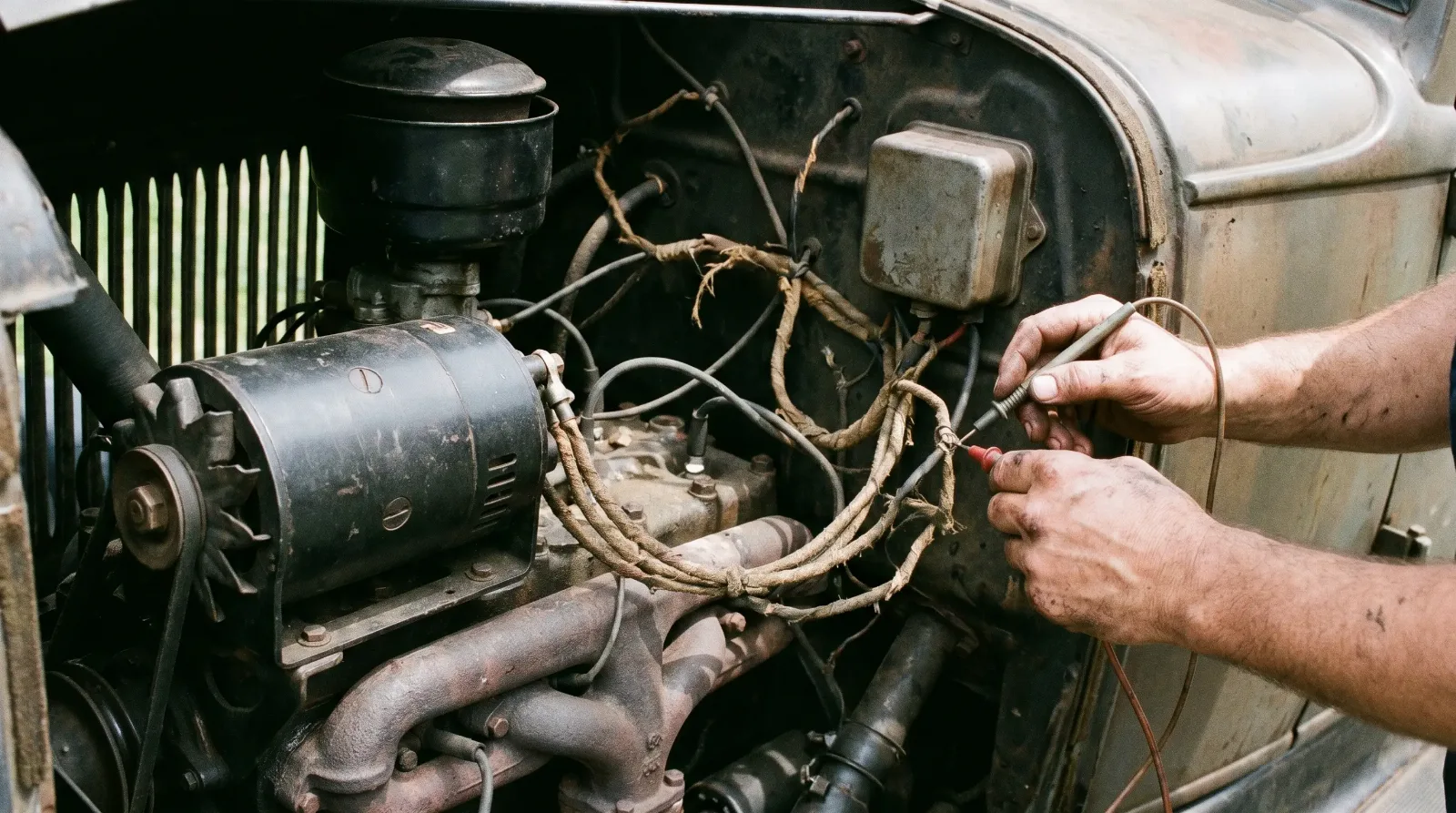
I grew up around guys who could diagnose a 6-volt electrical problem by ear, standing next to the fender listening to how the starter cranked. There was no computer to plug in and no code to read. You just knew the system, because it was simple enough to know completely. That simplicity is the whole reason these old 6-volt setups still work fine today, decades after everybody else moved to 12 volts, as long as you understand what they need and don't need.
Why 6 volts isn't the problem people think it is
Every year somebody tells me their old car "needs" a 12-volt conversion because 6-volt systems are weak or unreliable. I've heard that complaint for fifty years and it's almost never true. A properly maintained 6-volt system starts a cold engine just fine and runs the lights, the horn, and the ignition exactly like it was designed to. The problems people blame on "just being 6-volt" are almost always something else entirely: corroded connections, undersized or brittle old cable, a tired ground strap, or a generator that isn't putting out what it should.
The system draws more current at 6 volts than an equivalent 12-volt system would to do the same job, which means wire gauge, connection quality, and ground paths matter more here than they do on a modern car. That's the real difference, and it's a maintenance difference, not a design flaw.
Where these systems actually let you down
Ground connections are the number one culprit, hands down. A 6-volt system runs a lot of current through the chassis as a return path, and any corrosion at a ground strap or a body ground point creates resistance that shows up as dim lights, a slow crank, or accessories that just don't have the pep they should. I check every ground connection before I touch anything else when someone brings me a car with "electrical gremlins." Nine times out of ten that's where the problem is hiding.
After grounds, look at the cable itself. Old cloth-insulated wire gets brittle, cracks, and sometimes shorts against the frame or body without anybody noticing until something stops working entirely or, worse, starts a small fire. And don't overlook the battery terminals and cable ends. Corrosion builds up slow enough that you don't notice it happening, and then one cold morning the car just won't turn over, and everybody assumes the battery's dead when really it's a terminal that's barely making contact anymore.
"Fellas would bring cars into the shop swearing the 6-volt system was shot, and half the time all it needed was a wire brush on the ground strap and new terminal ends. People want to blame the voltage. It's almost never the voltage."
— Gary Nowak
The generator and regulator deserve real attention
Unlike a modern alternator setup, the generator and voltage regulator on these old systems need periodic hands-on maintenance, not just a check when something goes wrong. Brushes wear down and need inspection. The commutator can get dirty or scored and benefits from a light cleaning now and then. And the regulator's contact points, on the old mechanical units, need to stay clean and properly gapped or the charging rate drifts out of spec, which either undercharges the battery or cooks it with too much voltage over time.
A generator that's charging correctly and a battery that's properly maintained will keep a 6-volt system running reliably for years without drama. It's when people neglect that basic upkeep that the system starts developing a reputation it doesn't deserve.
What I tell people about jump-starting and testing
One more thing folks get wrong, and it causes real damage when they do. If you ever need to jump-start a 6-volt car, use another 6-volt source, not a modern 12-volt jump pack or another car's 12-volt battery. Feeding 12 volts into a 6-volt system, even briefly, can cook the ignition coil, damage the generator, and burn out bulbs and gauges that were never built to handle that kind of voltage. It happens more than you'd think, usually from a well-meaning friend at a car show who doesn't realize the car isn't wired the way theirs is.
The same caution applies to test equipment. A multimeter works fine regardless of voltage, but battery chargers, jump packs, and some diagnostic tools are built assuming 12-volt negative ground as the default, and using the wrong one on a positive ground 6-volt car can do damage fast. When in doubt, ask before you hook anything up, and keep a dedicated 6-volt charger with the car rather than borrowing whatever's sitting in the garage.
Keep it original if the car still wears it correctly
I'll admit I'm biased here, but a correctly maintained 6-volt system is part of what makes one of these cars feel authentic when you drive it. The lights glow the way they were meant to glow, the horn sounds the way it was meant to sound, and none of that period character survives a 12-volt swap, no matter how well it's done. If your car's original system is basically sound, my advice is almost always to maintain what's there rather than replace it with something that fights the car's own personality.
If you want the full picture on how electrical originality factors into what a car is actually worth, the 6v vintage car electrical story covers that ground in more detail. And once the electrical side is sorted, how you store the car between drives matters just as much for keeping corrosion out of these connections in the first place; a related read gets into exactly that.
Sources and notes
- Restore an Old Car - positive ground cars explained
- AutoRestorer: working with a positive ground system
- Vintage Auto Garage - 6-volt alternators and charging systems
- The H.A.M.B. forum - 6-volt positive or negative ground discussion
- Smokstak Antique Engine Community - 6V positive vs negative ground
- Yesterday's Tractors Forums - why 6 volt systems are positive ground