The dashboard as a small architectural project
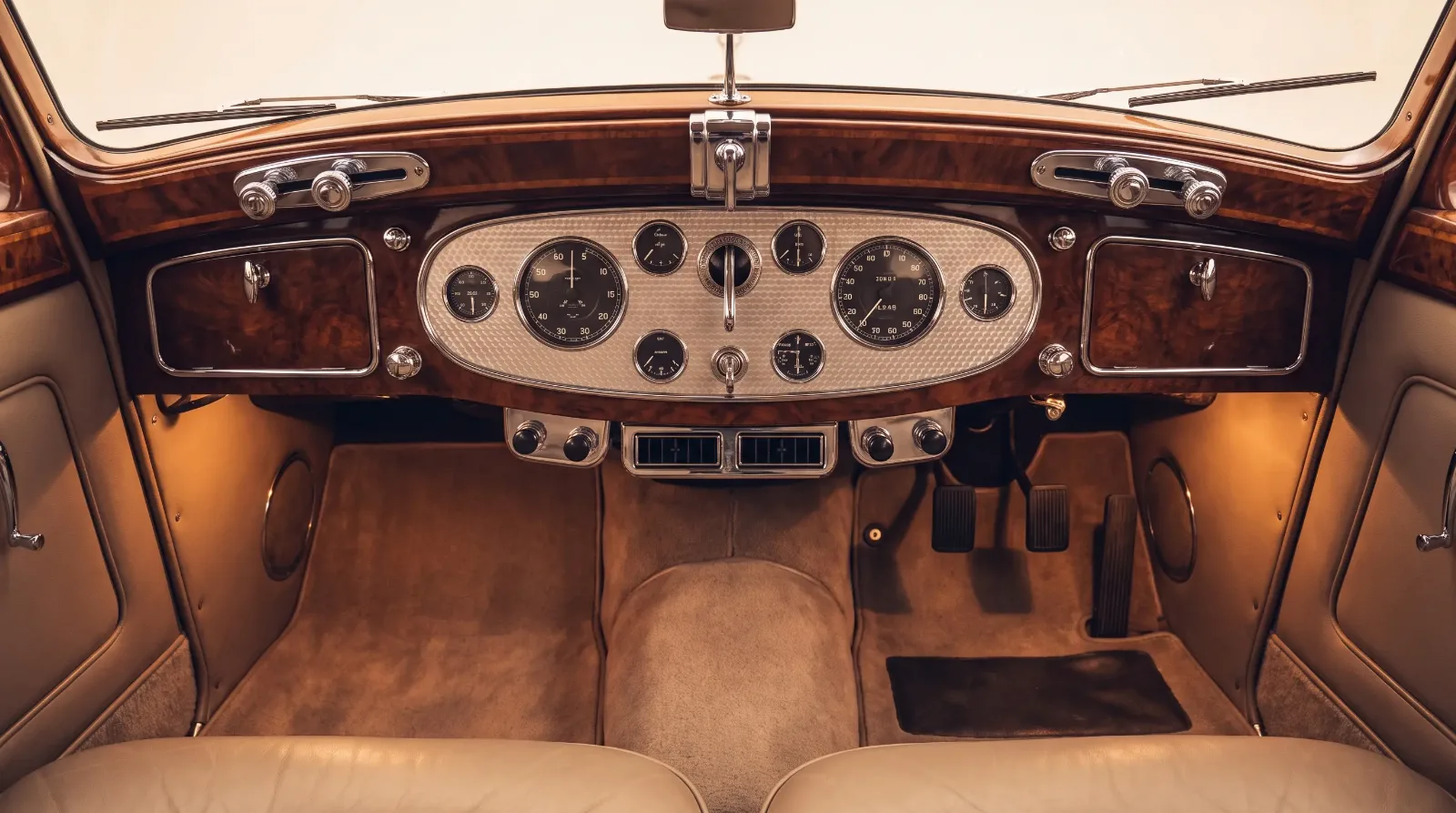
Step inside a well-preserved car from this era and the dashboard tells you almost as much about the design philosophy as the exterior does. Stepped panels, symmetrical gauge clusters, machined trim laid out with the same discipline a draftsman would apply to a building facade, the cabin became a place where the art deco vocabulary could be applied at close range, where an owner would actually sit and study it every day rather than glance at it from across a parking lot. For the wider design movement these interiors belong to, the art deco car dashboards story covers the fuller context.
The symmetry mattered as much as any individual gauge. Designers frequently mirrored elements across the dashboard's centerline, a pairing of decorative vents, matched trim strips, twin instrument pods, creating a formal balance that owed a clear debt to architectural facades of the same period. This was not incidental. Several manufacturers employed designers who moved between industrial design and interior architecture, and the crossover shows.
Instrument layout as a design statement
Gauge placement in this period was rarely just functional. Designers grouped instruments into a single unified panel, often circular or radiating from a central point, rather than scattering them wherever they fit mechanically. The effect, at its best, made checking your speed or oil pressure feel closer to reading a piece of jewelry than glancing at a control panel. Cheaper cars of the same period, by contrast, tended to keep gauges more functionally scattered, which is one of the clearer, if less discussed, markers of how much design investment went into a given model.
Material choice reinforced the hierarchy. Higher-end cars used genuine wood veneer, engine-turned metal, and higher-grade chrome plating on dashboard trim, while more modestly priced models substituted painted metal made to resemble those finishes. The imitation work was often skillfully done, but it wears differently over ninety years, and an original owner would have known immediately which car they were sitting in.
"A dashboard from this period was designed to be looked at, not just read. That distinction tells you almost everything about how seriously these interiors were treated."
— Sarah Whitfield
What originality looks like on a dashboard
Dashboards are among the more fragile parts of a car to keep original. Sun exposure cracks wood veneer and fades paint unevenly, gauges get swapped for later replacements when originals fail, and well-meaning restorers sometimes replace period-correct engine-turned trim with modern reproduction pieces that look similar but were never actually offered by the factory. None of this is disqualifying on its own, cars get used and repaired, but it changes what a buyer is actually looking at. A dashboard with its original finishes intact, even with honest wear, is a more complete historical document than one that has been quietly modernized under the guise of restoration.
Comparing a candidate car against factory photographs or surviving brochures is the most reliable way to confirm what the original layout, materials, and finishes were supposed to be. Discrepancies are common enough that they should be treated as a normal part of due diligence rather than an alarming discovery.
Where the interior style met the exterior
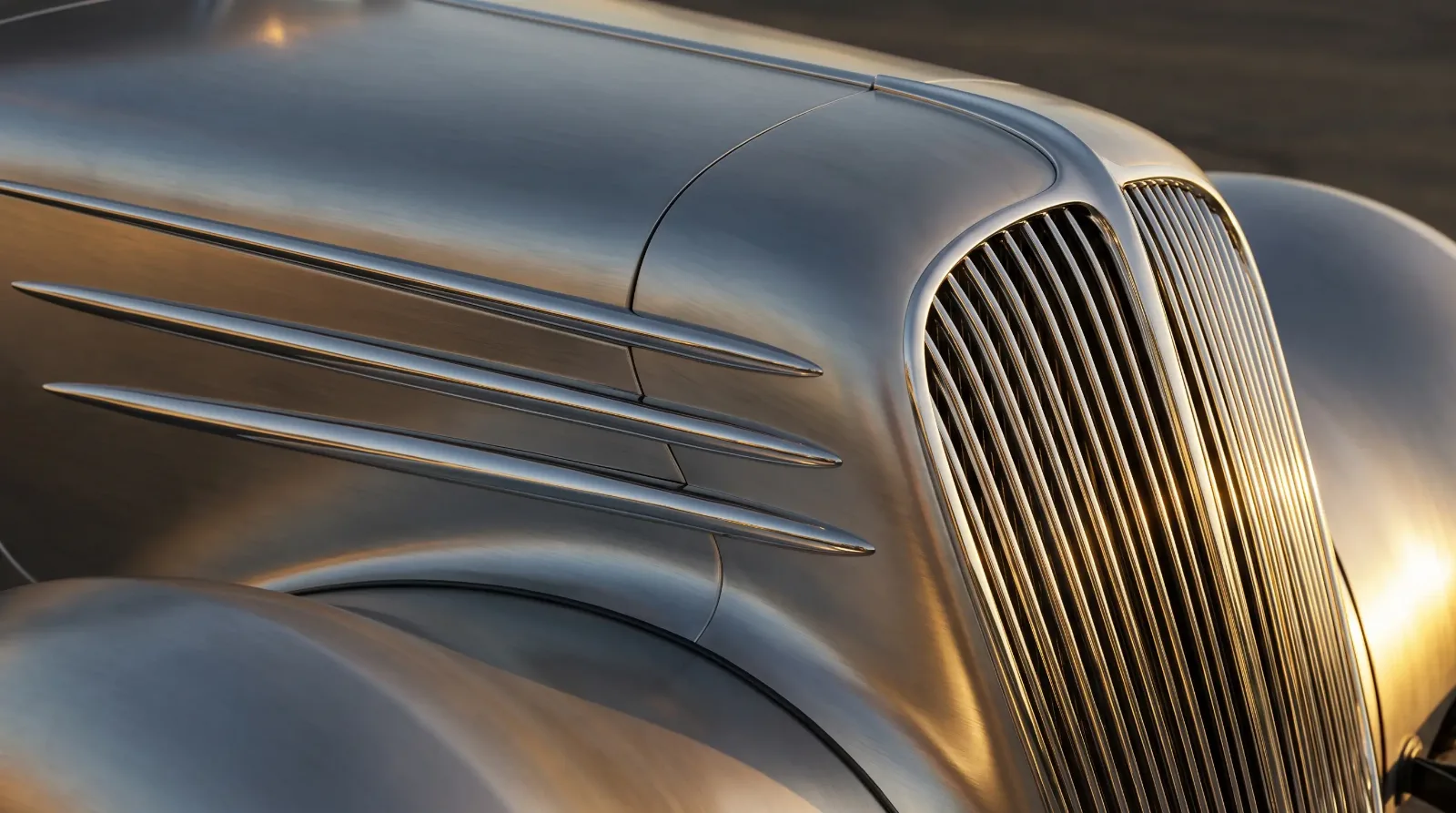
The dashboard's design language, symmetry, machined trim, deliberate use of chrome as accent rather than border, was not developed in isolation from the rest of the car. It echoed the same visual habits designers were applying to grilles, hood ornaments, and body trim, a consistency that separates the strongest designs of the period from cars that borrowed a few surface details without committing to the underlying discipline. The same logic that shaped a symmetrical dashboard also governed how chrome speedlines and grille work were handled on the exterior. A related read follows that thread outward, from the cabin back to the body.
Steering wheels and controls as part of the same discipline
The steering wheel itself often carried the design language further than most people notice on a quick walkthrough. Spokes were shaped to echo the same geometric or streamlined motifs used elsewhere in the cabin, and the horn button at the center frequently received its own small sculptural treatment, a scaled-down cousin of the hood ornament outside. Even the shift lever and window cranks, functional pieces with no real need for ornamentation, were often finished with the same attention to proportion and material quality as the more visible dashboard elements. Nothing in a well-designed cabin from this period was treated as purely utilitarian.
This consistency is one of the better tests for whether an interior has been left substantially original or quietly upgraded over the decades. A dashboard that looks period-correct but sits next to a generic aftermarket steering wheel, or window cranks that clearly don't match the rest of the trim's finish, tells you the interior has been assembled from parts rather than preserved as a unit. Buyers evaluating a car for its design integrity, not just its mechanical condition, should walk the whole cabin with this in mind rather than judging the dashboard in isolation.
Upholstery choices followed the same underlying logic as well, even though fabric survives far less reliably than metal or wood trim. Pattern and color on the seats and door panels were generally selected to complement, not compete with, the dashboard's material palette, so a car with mismatched or clearly later upholstery against an otherwise original dashboard is worth a closer look before assuming the whole interior tells a consistent story. Original upholstery this old is rare enough that most surviving cars have been reupholstered at least once, which is not itself a problem, but the quality and accuracy of that work varies enormously from one restoration to the next.
Documentation photographs, where an owner has kept them, are the fastest way to settle these questions without guesswork. A single clear interior photo from decades ago, showing the original upholstery pattern against the dashboard finish, can confirm or rule out an entire chain of assumptions in seconds. It is worth asking any seller directly whether such photographs exist before relying purely on the car in front of you to tell its own history.
Sources and notes
- Hagerty - How the Duesenberg brothers redefined the great American automobile
- Vanderbilt Cup Races - A close look at Duesenberg J instrumentation
- Gooding and Co - 1929 Duesenberg Model J instrument panel
- Curbside Classic - Dashboard evolution, pre-war symmetry
- Wikipedia: Dashboard
- Silodrome - 1930s-era dashboard instruments