
At almost every Camaro meet there is one plain RS coupe parked at the end of the row, and within ten minutes somebody asks the owner the question. Is it a real police car? The owner says yes, it is a B4C Camaro. A second person says prove it. Then the folder comes out of the trunk, and that folder decides how the rest of the afternoon goes. The B4C was Chevrolet's police pursuit coupe, a short run of cars from the end of the third-gen Camaro era, and it is one of the few factory Camaros where the paperwork matters more than the badges, because the badges were designed to say almost nothing.
Car Features
7 min read
The B4C Camaro: Chevrolet's Police Pursuit Coupe
The B4C Camaro was Chevrolet's 1991 to 1992 police pursuit coupe: Z28 and 1LE hardware under RS badges, about 1,180 built, and paperwork that decides value.
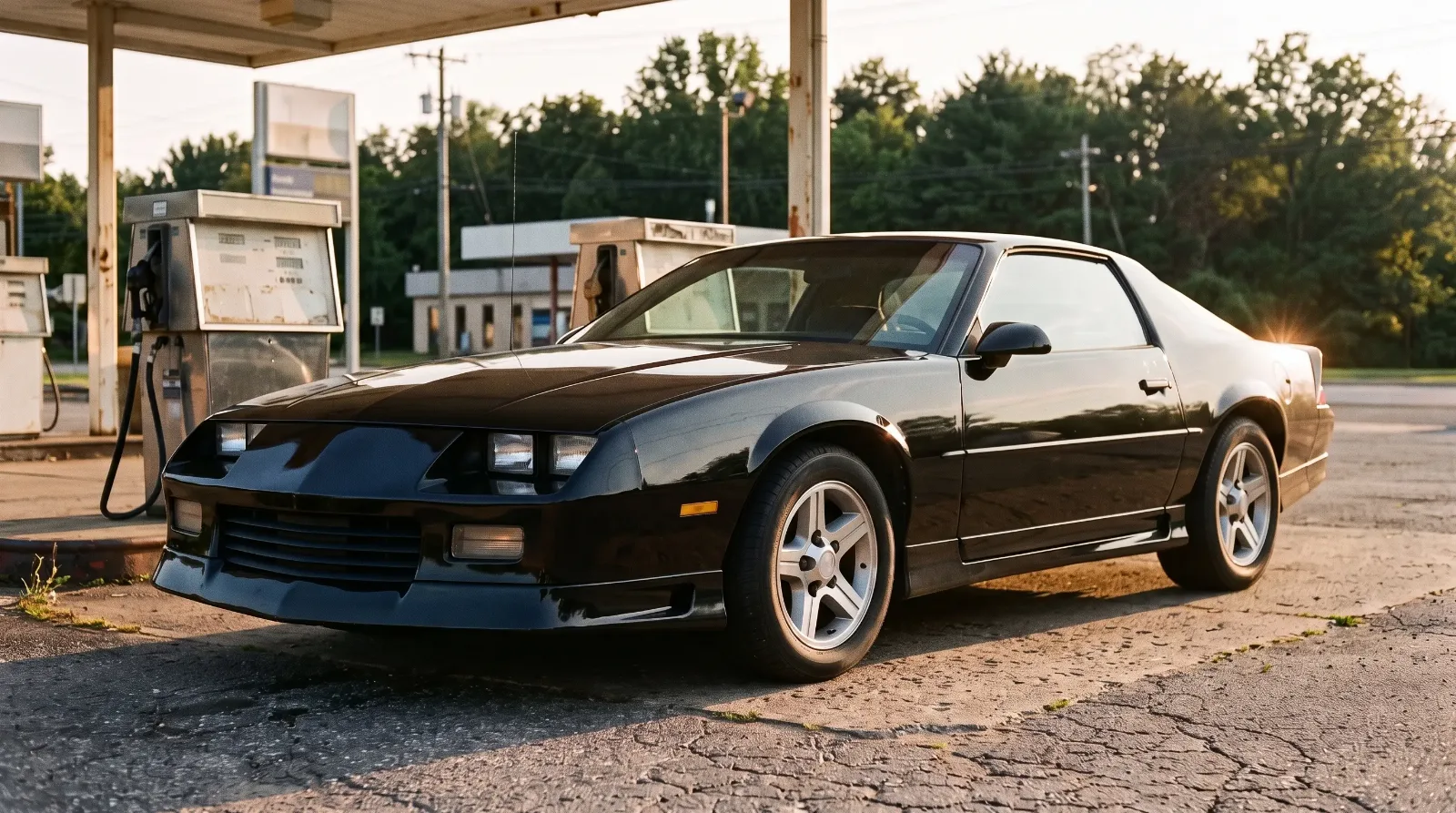
What the B4C Camaro package was
B4C is a regular production option code, and the name GM gave it was Special Service. It arrived for the 1991 model year, and it was offered to police departments, government agencies and the military. Private buyers walking into a showroom were not the audience. The package existed because Ford had been selling a Special Service Package Mustang to police fleets since 1982, and for most of a decade the Mustang had the pursuit coupe business to itself. The B4C was Chevrolet's answer, nine years late.
The car that came out of that decision was a sleeper by design. From the outside a B4C wore RS badges, the same badges found on the entry-level Camaro of the period. Underneath, it used the hardware Chevrolet had developed for the Z28 and for the 1LE race package. An officer got a car that looked like a commuter coupe and ran like the top of the range.
The price told the same story. In 1991 the B4C added $3,135 to the cost of an RS when it was ordered with the 5.0-liter V8, and $3,950 with the 5.7-liter. Both figures show that the package came with either V8, not just the big one.
The hardware under the RS badge
The equipment list reads like a list of things a patrol car breaks first. The B4C used 1LE components, a heavy-duty suspension and Corvette-style brakes. It had a baffled fuel tank, the same part the 1LE used to keep fuel at the pickup during hard cornering, and a bigger alternator to run radios, lights and the rest of the electrical load a patrol car carries. It also kept air conditioning.
That last item is the interesting one for anyone who knows the 1LE. On a civilian Camaro, the 1LE package was triggered by ordering the G92 performance axle and deleting air conditioning, so a buyer who wanted the race hardware had to give up the cold air. Police fleets did not have to make that trade. An officer spending a full shift in a patrol Camaro in a California summer got the brakes and the cooling both.
The top engine was the 5.7-liter L98 tuned port 350, rated at 245 hp in its 1990 to 1992 form. That rating put the B4C level with the strongest Camaro Chevrolet built in those years, the same engine fitted to the 1991 to 1992 Z28, without the Z28's spoilers and graphics. For a car meant to pull up behind somebody without being noticed first, that was the point.
1991 and 1992 production: small numbers, one argument
The B4C was never a volume car, and the totals stayed close to 600 in both of its third-generation years. The 1992 figure is settled at 589. The 1991 figure is where club members start leaning across the table. One count gives 591, two other references give 592, and one general reference says only just under 600. No primary GM document settles it, so the honest answer is about 590 for 1991.
| Item | 1991 | 1992 |
|---|---|---|
| B4C cars built | About 590 (591 or 592 by source) | 589 |
| All Camaros built | 100,838 | 70,007 |
| B4C share of production | About 0.6 percent | About 0.8 percent |
| Option price over an RS | $3,135 (5.0-liter), $3,950 (5.7-liter) | Not found in published sources |
| Brakes | Corvette-style brakes | 1LE brakes |
Put another way, fewer than one Camaro in a hundred built in those two years was a B4C. All of them came from Van Nuys, California, which had been building every Camaro since Norwood closed after 1987. If you want the background on why one plant carried the whole line by then, read more here. Van Nuys built the last third-generation car on August 27, 1992, and the B4C went out with it.
"Every B4C owner I have met has a story about the car's service life. The ones I trust are the owners who also have the order paperwork, because a story fits on a napkin and a build record does not."
Wayne Coburn
On patrol: the California Highway Patrol and the Copmaro
The best-known user of the B4C was the California Highway Patrol. The first 1992 B4C delivered to the CHP picked up a nickname that has followed the whole breed since: the Copmaro. That name now gets attached to any plain Camaro with a police story behind it, which is a problem for buyers, because the nickname is easier to copy than the car.
The published records do not show which other agencies bought B4C cars in 1991 and 1992, or how the orders split between engines and transmissions in each year. Those gaps are why the folder in the trunk matters. A former police Camaro that left service decades ago has usually been repainted, had its equipment removed and passed through several owners. The decals and light bars are long gone. What survives is the paper: the B4C code on the car's Service Parts Identification label, if it is still there, an agency's disposal or auction record, a title that shows a government owner in its chain.
After 1992, and how to prove one today
The B4C did not end with the third-generation car. Chevrolet kept the Special Service package in the catalog for the whole fourth generation Camaro run, 1993 to 2002, again putting Z28 mechanicals in a base body. Volumes stayed small and uneven: 135 cars in 1993, 668 in 1994, 310 in 1995, 228 in 1996, 253 in 1997 and 708 in 2002. Hagerty has called the later car "a bargain sleeper," which is about as fair a summary of the whole idea as anyone has written.
For the third-generation cars, the arithmetic is the selling point and the trap. With roughly 1,180 built across 1991 and 1992, a genuine B4C is far rarer than the RS it imitates, which sold in the tens of thousands. That rarity is exactly what makes a plain RS with a police story worth faking. The buyer's job is to make the seller do the proving.
So when the folder comes out at the end of the row, read it before you listen to the story. If the code is there, the police history is real and the hardware is worth checking. If the folder holds an old photo of a patrol car and a nickname, you are looking at a well-presented RS. That can still be a good car. It is not a B4C Camaro until the paper says so.
Sources and notes
Related Reading

Have a
Chevrolet Camaro
for Sale?
Reach thousands of serious classic car collectors across the US.
Sell It Here →
Selling a classic? Here's how: compare the places to sell classic cars
Are You a Classic Car Dealer?
List your full inventory and connect with targeted classic car buyers.
Join as a Dealer →

About the author
Wayne Coburn
Longtime Corvette owner, judge and club figure who knows the cars, the records and the people behind them.
Related Listings - Chevrolet Camaro



Comments
Be the first to comment on this article.