
A surprising number of people assume the Bel Air was Chevrolet's best-selling model from the moment it appeared. The production numbers say otherwise. Early bel air production tells a story of a niche premium offering that grew into a full lineup only gradually, and the surviving Fisher Body records make that progression easy to trace year by year if you know where to look.
Car Features
7 min read
1950-54 Bel Air Production
Early bel air production went from a single hardtop coupe in 1950 to a full three-body-style series by 1953, a structural shift many buyers misunderstand.
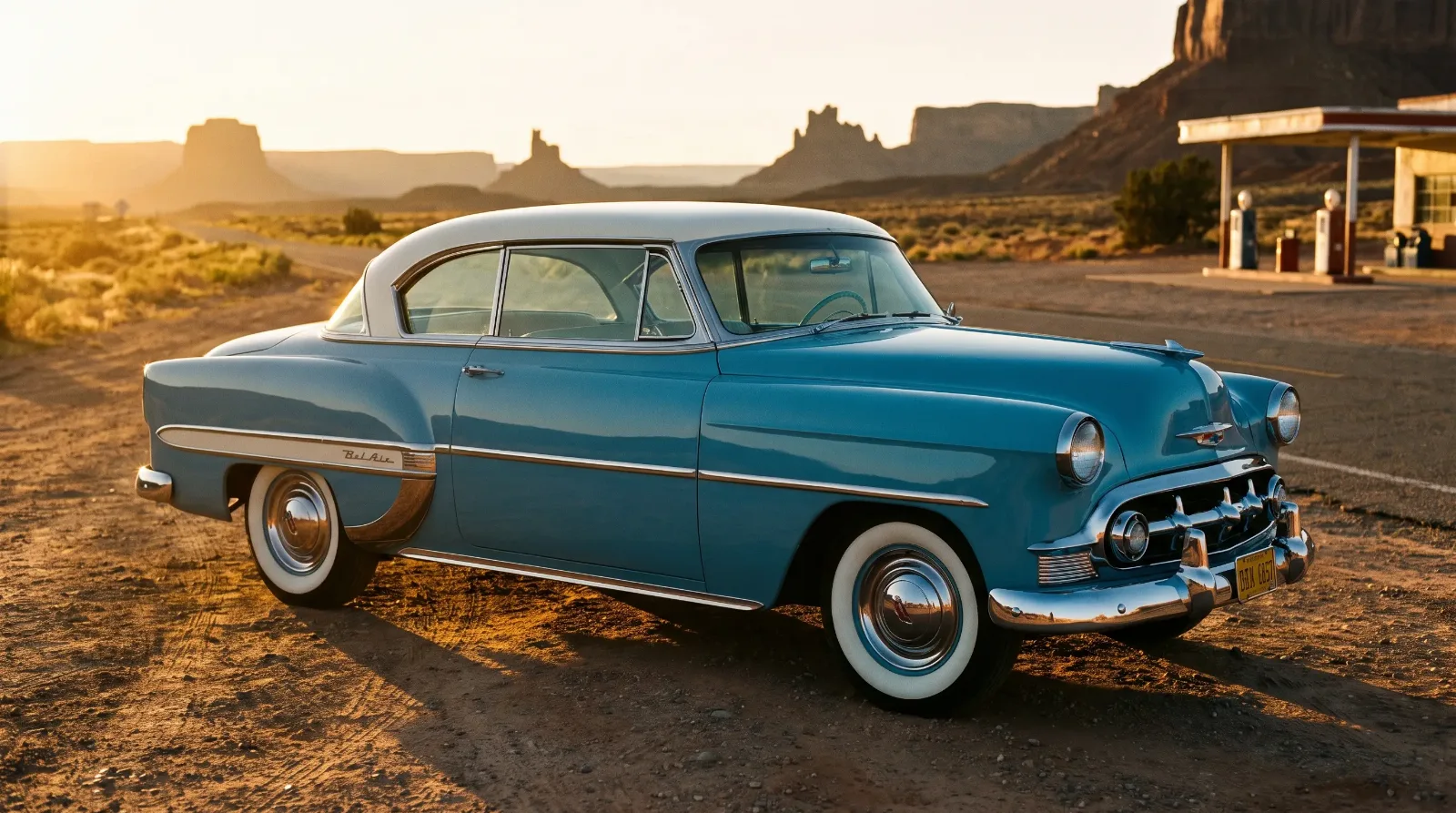
1950: a single body style, not a model line
When the Bel Air name first appeared for the 1950 model year, it applied to exactly one body style, the pillarless hardtop coupe, sitting at the top of the Styleline De Luxe series rather than existing as its own separate model line. Chevrolet built roughly 76,000 of these first-year Bel Airs, a healthy number for a brand-new body style but a fraction of total Chevrolet output that year, which topped 1.4 million units across all series. The Bel Air hardtop was a specialty item, priced above the convertible in some configurations, aimed at buyers who wanted the open-air look of a convertible without the top, wind noise, or complexity that came with one. The confirmed factory total for that first model year comes in at 76,662 units.
That first Bel Air used a steel roof panel engineered to keep the hardtop rigid without a B-pillar, borrowing structural lessons Fisher Body had worked out on GM's earlier hardtop experiments at Cadillac and Oldsmobile. Chevrolet was late to the hardtop format compared to those senior divisions, but the Bel Air's arrival still beat Ford and Plymouth to market with a low-priced hardtop by roughly a year.
1951 and 1952: steady growth, minimal change
Chevrolet made only modest styling revisions for 1951 and 1952, largely because the Korean War brought government restrictions on chrome and bright trim usage that limited how much manufacturers could change their cars cosmetically during those two years. Bel Air production held reasonably steady through this period rather than spiking, since the body style and market position had not shifted. The car remained a single hardtop offering within the top trim series, not yet its own standalone series with multiple body styles.
Records from these years are thinner than collectors would like, partly because wartime production restrictions meant fewer cars were built overall and partly because Chevrolet's own internal documentation from the early 1950s has not survived in complete form at every archive. Anyone researching a specific 1951 or 1952 Bel Air should expect gaps and treat unverified production claims with real skepticism.
"People want a clean number for every single year, and sometimes the honest answer is that the surviving records do not give you one. I would rather tell a customer I cannot confirm a figure than hand them a number I pulled from an unreliable source."
- Tom Ramirez
1953: the Bel Air becomes its own series
The real structural change came in 1953, when Chevrolet reorganized its full-size lineup into three distinct series: the 150, the 210, and the Bel Air, each now offered across multiple body styles rather than the Bel Air existing as a single hardtop grafted onto the De Luxe trim. This is the year early bel air production numbers jump meaningfully, because for the first time buyers could get a Bel Air sedan, convertible, wagon, and hardtop coupe, not just the coupe alone. Total 1953 Bel Air output reached roughly 513,779 units across those body styles, led by the four-door sedan at around 246,000 units, with the two-door sedan, sport coupe, and convertible filling out the rest, a dramatic increase from the single-body-style years that preceded it.
This reorganization is the detail that gets misunderstood most often by casual buyers, who sometimes assume the Bel Air name meant the same thing in 1950 as it did in 1953. It did not. A 1950 Bel Air is a specific hardtop coupe within a larger trim series. A 1953 Bel Air is a full series unto itself with real body style choice, which changes how you should think about rarity and originality when shopping either car.
1954: refinement before the big 1955 leap
1954 brought a facelift, a new grille treatment, and a switch to 12-volt electrics on some trims, but the fundamental three-series structure established in 1953 held steady. Bel Air production in 1954 continued the growth trend from the prior year, cementing the Bel Air as Chevrolet's genuine top-tier full-size offering heading into the 1955 redesign that would introduce the small-block V8 and permanently change the car's reputation. Read the full story for how these early production years connect to everything that came after, because the 1955 leap only makes sense once you understand the groundwork laid between 1950 and 1954.
Assembly plants and the geography of early production
Chevrolet built its full-size cars, Bel Air included, across a network of regional assembly plants rather than a single factory, which is a detail that surprises people used to thinking of car production as centralized in one Michigan location. Plants in cities including St. Louis, Kansas City, Baltimore, and Tarrytown assembled Bel Airs alongside the lower trims for their respective regions, using body shells shipped from Fisher Body plants and stampings supplied by Chevrolet's own network. The VIN and body tag on any given 1950 through 1954 Bel Air will identify which plant assembled that specific car, and that information matters more to serious collectors than most casual buyers realize.
Regional assembly meant minor variations could creep in between plants, from supplier substitutions to small trim differences, especially during the material restrictions of the Korean War years. A researcher trying to document a specific early Bel Air should always start with the body tag rather than relying on general production totals, because the tag ties a specific car to a specific plant, date, and configuration in a way that aggregate national figures never can. Exact plant-by-plant allocation numbers for this period are not consistently published, so treat any specific plant quota claim with caution unless it is backed by the body tag itself.
Why the production history matters when you are buying
Knowing which years represent genuine standalone Bel Air production versus the earlier single-body-style period changes how a buyer should evaluate rarity claims. A seller marketing a 1951 Bel Air sedan is describing something that did not exist as a factory offering, since the sedan body style was not part of the Bel Air line until the 1953 reorganization. Catching an error like that early saves a lot of wasted time chasing a car that cannot be what the listing claims.
If you want to see what is actually available across these early production years, there is classic Air for sale worth comparing against the documented history, and knowing the real production structure year by year will help you spot a listing that does not add up before you ever make a call.
Sources and notes
Related Reading
Have a
Chevrolet Bel Air
for Sale?
Reach thousands of serious classic car collectors across the US.
Sell It Here →
Are You a Classic Car Dealer?
List your full inventory and connect with targeted classic car buyers.
Join as a Dealer →
#Production History
#fisher body
#Chevrolet Bel Air
#1953 bel air
#Chevrolet assembly plants
#Bel Air history

About the author
Tom Ramirez
Corvette researcher and historian based in Bowling Green, Kentucky. Two decades documenting Corvette production history from original factory records.
Related Listings - Chevrolet Bel Air
Comments (1)
B
Bobby Szymanski
2 months ago
The insurance section is worth a separate article. A lot of people reach claim time before realizing agreed value coverage is completely different from what they bought.