
Before Bel Air was a series, before it was even a full trim level, it was a single body style tucked into the 1950 Chevrolet catalog under an existing model line. The 1950 chevy bel air arrived in March of that model year as a two-door hardtop, a style Chevrolet had not offered before and one the whole low-price field was watching closely. General Motors had already proven the idea worked at Cadillac and Oldsmobile and Buick. Chevrolet's version, priced for a much wider buyer, is where the Bel Air name starts.
Car Features
7 min read
The First Bel Air: The 1950 Hardtop Pioneer
Before Bel Air was a series, it was a single hardtop body style that talked buyers into paying extra for style alone. Here is how the pioneer year set the template for everything that followed.
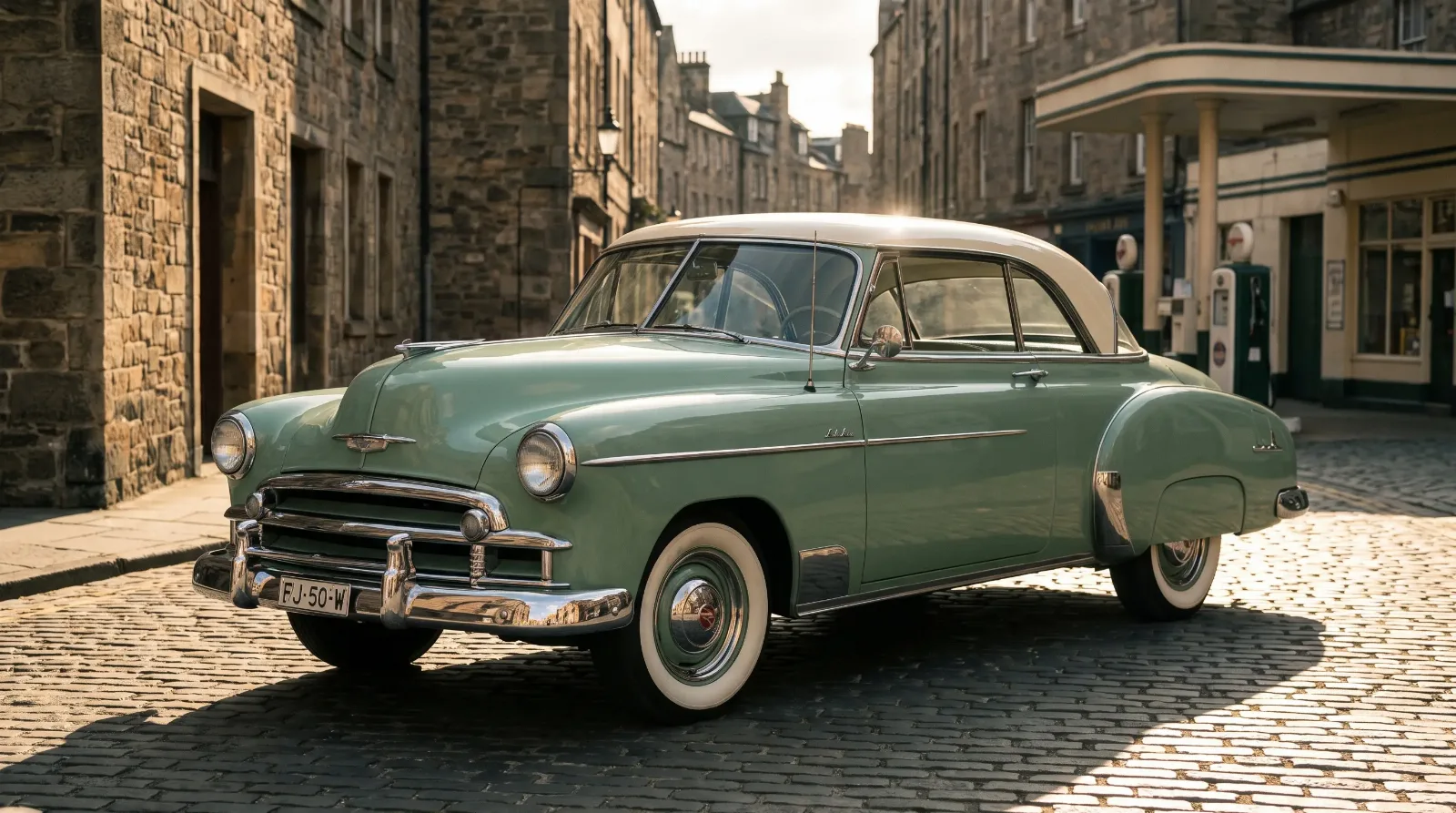
A hardtop grafted onto the Styleline DeLuxe
The 1950 Bel Air was not sold as its own series. It was a new body style added to the existing Styleline DeLuxe line, sitting alongside the sedans and the convertible. Structurally it borrowed its lower body and chassis from the Styleline DeLuxe sport coupe, but the roof was new: a slim-pillared, glass-heavy top with no B-pillar, styled to read as a convertible even with the top up. Chevrolet's engineers reinforced the floor and rocker panels to make up for the lost structural rigidity that a fixed B-pillar normally provides, a detail that mattered more than the styling did in the long run.
The idea was simple and it worked. Buyers wanted the open, airy look of a convertible without the price, the noise, or the leaking canvas top. Chevrolet's dealers had been asking for a hardtop since Cadillac's Coupe de Ville and Buick's Riviera landed for 1949, and by early 1950 Chevrolet finally had an answer of its own.
Building the case for a new nameplate
Chevrolet's stylists and product planners needed a name that suggested the same kind of upscale leisure that Cadillac and Buick were selling with their hardtops. They landed on Bel Air, borrowed from the wealthy Los Angeles neighborhood, a choice covered in more depth in a related story on how that name actually got attached to the car. For 1950 it was strictly a badge on one body style, not a statement about trim level or standard equipment beyond what any Styleline DeLuxe buyer already got.
What separated the Bel Air from its stablemates was mostly the roof, plus a bit of extra brightwork and upholstery that matched the car's aspirational pitch. Chevrolet was careful not to over-promise. This was still a full-size Chevrolet built on the same assembly lines as the sedans, with the same engine choices and the same chassis underneath. The Bel Air's job in 1950 was to look special while remaining, mechanically, an ordinary Chevrolet.
Sales numbers and what they proved
Production for the debut year landed at 76,662 units, a strong number for a body style that arrived roughly two-thirds of the way through the model year and carried a price premium over the standard coupe. That number told Chevrolet's management something important: buyers in the low-price field would pay extra for style alone, not just for room or power. The hardtop had no functional advantage over a sedan. It offered a look, and customers lined up for it anyway.
That lesson shaped Chevrolet's entire approach to the Bel Air line for the rest of the decade. Every expansion that followed, from the multi-body 1953 series covered in 1953 chevy bel air history, to the tri-five cars that eventually made Bel Air a household name, traced back to the confidence Chevrolet gained from that first hardtop's reception.
Powertrain and what buyers actually got
Under the hood, the 1950 Bel Air with the standard three-speed manual ran Chevrolet's familiar 216.5 cubic inch six, rated at about 92 horsepower. Buyers who ordered the new Powerglide automatic got a different, larger 235.5 cubic inch version of the same basic six, with hydraulic valve lifters and higher compression, rated at about 105 horsepower. That automatic option mattered more than most people realize; it was the first fully automatic transmission offered in the low-price field, and the Bel Air hardtop was one of the cars Chevrolet used to sell it.
| Spec | 1950 Bel Air Hardtop |
|---|---|
| Body style | Two-door hardtop, no B-pillar |
| Series | Styleline DeLuxe (Bel Air was a body style, not yet a series) |
| Engine | 216.5 cid inline six (manual) or 235.5 cid inline six (Powerglide) |
| Horsepower | About 92 hp manual, about 105 hp with Powerglide |
| Transmission | Three-speed manual standard, Powerglide automatic optional |
| Introduced | Spring 1950, mid model year |
Comparing the 1950 hardtop to its rivals
Chevrolet was not first to market with a pillarless hardtop. Cadillac and Oldsmobile beat every low-price competitor by roughly a year, and Buick's Riviera hardtop had already established the formula before Chevrolet's version arrived. What made the 1950 Bel Air significant was price. A buyer who could never afford a Coupe de Ville could now walk into a Chevrolet dealer and drive home something that captured the same visual idea, minus most of the cost. Ford and Plymouth had nothing comparable that model year, which gave Chevrolet a real window to establish the body style in the public's mind before competitors caught up.
That head start proved valuable. Ford did not answer with its own hardtop, the Victoria, until the 1951 model year, and Plymouth trailed even further behind. For a full year, Chevrolet had the low-price hardtop field essentially to itself, and the sales figures from that partial model year reflect a company that judged the timing correctly.
Why the pioneer year still matters
Collectors and Chevrolet historians sometimes skip past the 1950 car because it lacks the chrome, the fins, and the V8 that later Bel Airs are known for. That is a mistake. The 1950 hardtop is the reason the name exists at all, and it set the template that every later Bel Air followed: take a mainstream Chevrolet, dress it with a body style or trim package that borrows glamour from more expensive marques, and let buyers do the rest. Without that first hardtop selling as well as it did, there is no guarantee Chevrolet promotes Bel Air to a full series in 1953, and no guarantee the name survives to become attached to the 1955 through 1957 cars that made it famous.
Original, unrestored 1950 Bel Air hardtops are genuinely scarce today. Most that survive have been through at least one repaint and an interior redo, since the original woven fabrics and vinyl combinations were never built to last seven decades. Values trail the tri-five cars by a wide margin, which makes the 1950 an accessible entry point for anyone who wants a piece of Bel Air history without competing against 1957 fuel-injected convertible money.
"People assume Bel Air started as a top trim line. It didn't. It started as one roof stamping that Chevrolet was willing to bet on, and the records show they were right to take that bet."
- Tom Ramirez
If the pioneer year has you curious about what the badge became a few years later, the shift into a standalone series is worth reading on its own. And if you would rather stop reading history and start shopping, there are Airs for sale now spanning the entire run, from this first hardtop through the more familiar tri-five cars.
Sources and notes
Related Reading
Have a
Chevrolet Bel Air
for Sale?
Reach thousands of serious classic car collectors across the US.
Sell It Here →
Are You a Classic Car Dealer?
List your full inventory and connect with targeted classic car buyers.
Join as a Dealer →
#classic chevrolet
#Powerglide
#Chevrolet Bel Air
#1950 Chevrolet
#hardtop history
#Styleline DeLuxe

About the author
Tom Ramirez
Corvette researcher and historian based in Bowling Green, Kentucky. Two decades documenting Corvette production history from original factory records.
Related Listings - Chevrolet Bel Air
Comments
Be the first to comment on this article.