
There's a particular kind of quiet that settles over the Bonneville Salt Flats before a run, nothing like the noise and crowd energy of a drag strip on a Saturday night. Just white salt running flat to the horizon in every direction, a car staged at one end of a course marked out for miles, and a driver who's about to spend a couple of minutes completely alone with an engine and a steering wheel. It's a strange place to find a Chevelle, and also, if you know the car's history, not a strange place at all.
Car Features
7 min read
Bonneville and Land-Speed Chevelles
How Chevelles built for the Bonneville Salt Flats trade drag-strip launch power for sustained top-end speed over a measured mile.
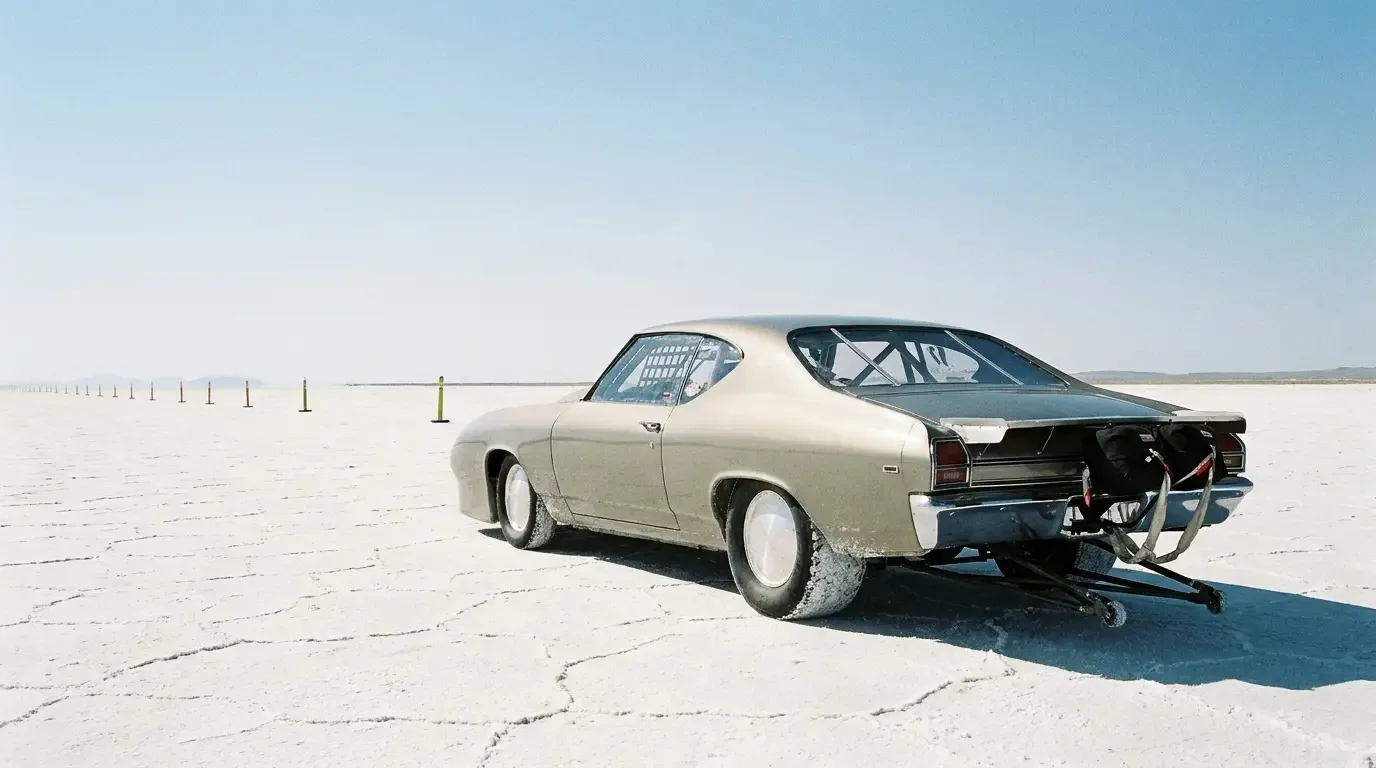
Land speed racing at Bonneville runs on a different clock than drag racing or NASCAR. The Southern California Timing Association has been running speed trials on the salt since the late 1940s, and Bonneville Speed Week has drawn everything from purpose-built streamliners to modified production cars for generations. Chevelles never dominated that world the way they dominated a quarter-mile strip, but they've had a real, sustained presence there, entered by privateers chasing class records rather than by factory teams chasing headlines.
Why a mid-size muscle car ends up on the salt at all
Bonneville racing is organized around classes defined by body style, engine configuration, and modifications, which means a Chevelle competes against other cars built to a similar formula rather than against streamliners or lakesters built from scratch. A gasser-class or production-class Chevelle running at Bonneville isn't trying to out-aerodynamic a purpose-built land speed car. It's competing within a class of similarly-bodied production cars, where the record that matters is the one set within that specific class, not an outright land speed number.
That class-based structure is part of why Chevelles show up on the entry lists at all. A car that's already built for straight-line performance, the same big-block-and-narrowed-rear combination that made it a strong platform for the Chevelle's competition history at the drag strip, translates reasonably well to a class built around production-bodied cars chasing a sustained top speed instead of a quarter-mile time.
What it actually takes to run a Chevelle on the salt

Building a Chevelle for Bonneville is a different exercise from building one for the strip, even with a similar big-block foundation. Salt racing demands a car that can hold a stable line at sustained high speed for a full measured mile, which means suspension and alignment work aimed at high-speed stability rather than launch traction, a roll cage and safety equipment built to SCTA technical requirements, and a rear gear ratio tall enough to keep the engine in its power band at speeds well above what most street Chevelles ever see. Aerodynamics matter more here than at a drag strip too, and it's common to see salt-run Chevelles with smoothed underbodies, taped panel gaps, and other detail work aimed purely at reducing drag over the course of a run rather than at looks.
Engine combinations vary by class, but a Bonneville-prepped big-block typically emphasizes reliability at sustained high RPM over the peak-power spikes a drag engine is built around. A motor that makes a strong number for a single quarter-mile pass isn't automatically ready to hold that kind of load for a full measured mile without something letting go, and salt racers who've learned that the hard way tend to build with a wider margin than a strip car needs.
| Discipline | Primary demand on the car | Typical build emphasis |
|---|---|---|
| Drag strip | Short, violent acceleration | Peak power, launch traction, low ET |
| Bonneville / land speed | Sustained top-end speed over a measured mile | High-speed stability, aerodynamics, sustained reliability |
The safety gear that makes the salt different
Nobody runs at Bonneville without going through SCTA technical inspection first, and the requirements are strict for good reason. A car crossing the measured mile at speeds that can push well past 150 mph in a strong-running Chevelle needs a certified roll cage, a parachute or equivalent braking system on faster entries, a fire suppression system, and a driver in a full firesuit with proper restraints, none of it optional and none of it something a builder can fudge and still pass inspection. The salt surface itself adds its own risk. A car that loses traction on wet or soft salt behaves very differently than one that loses grip on asphalt, and SCTA's tech inspectors have decades of experience spotting builds that look strong on paper but aren't actually ready for that specific surface.
That level of scrutiny is part of why a genuine Bonneville-run Chevelle carries real credibility. Passing SCTA tech inspection isn't a formality, it's a filter that keeps underprepared cars off the salt, and a car with a stack of old tech inspection sheets has cleared a bar that a garage-built claim of "land speed history" alone never will.
The class records and where Chevelles fit in
Chevelles have never been the headline cars at Bonneville the way purpose-built streamliners or the more common Studebaker and Ford coupes from the salt's early decades have been, and specific class records held by Chevelle entries change often enough between meets that any number quoted here should be checked against the current SCTA-BNI record book before repeating. What's consistent is that production-based intermediate classes have had Chevelle entries on and off for decades, campaigned by privateers who wanted to see what a proven street and strip platform could do stretched out over a mile instead of a quarter.
For a buyer or a builder looking at this corner of Chevelle history, the appeal isn't really about chasing headline numbers the way a drag racer chases a quarter-mile time. It's about a different kind of proof, showing what the same basic Chevelle recipe, big-block power and a chassis that can take it, does when the demand shifts from raw acceleration to sustained speed. That's a different flavor of the same story told across the full Chevelle story, one more example of a mid-size car that kept finding new forms of competition to show up in decades after it left the factory floor. It's a very different competitive world from the sanctioned bracket classes covered in NHRA Big-Block Chevelle Classes Explained, but both are built on the same underlying platform doing what it's always done best.
"A drag strip gives you thirteen seconds to get everything right. The salt gives you a mile, and the salt doesn't forgive a mistake any faster just because you're going slower to make it."
Patrick Walsh
Sources and notes
- SCTA-BNI current record book, Utah Salt Flats Racing Association
- Bonneville Speedway history and Speed Week format, Wikipedia
- SCTA Bonneville racing history overview, Whiteknuckler Brand
- Land speed records at the Bonneville Salt Flats, BonnevilleRacing.com
- SCTA Bonneville Speed Week overview, Fuel Curve
- Car class records and minimums, Bonneville 200 MPH Club
Related Reading

Have a
Chevrolet Chevelle
for Sale?
Reach thousands of serious classic car collectors across the US.
Sell It Here →
Are You a Classic Car Dealer?
List your full inventory and connect with targeted classic car buyers.
Join as a Dealer →

About the author
Patrick Walsh
Automotive journalist covering classic car shows, events, and the enthusiast community across North America.
Related Listings - Chevrolet Chevelle




Comments
Be the first to comment on this article.