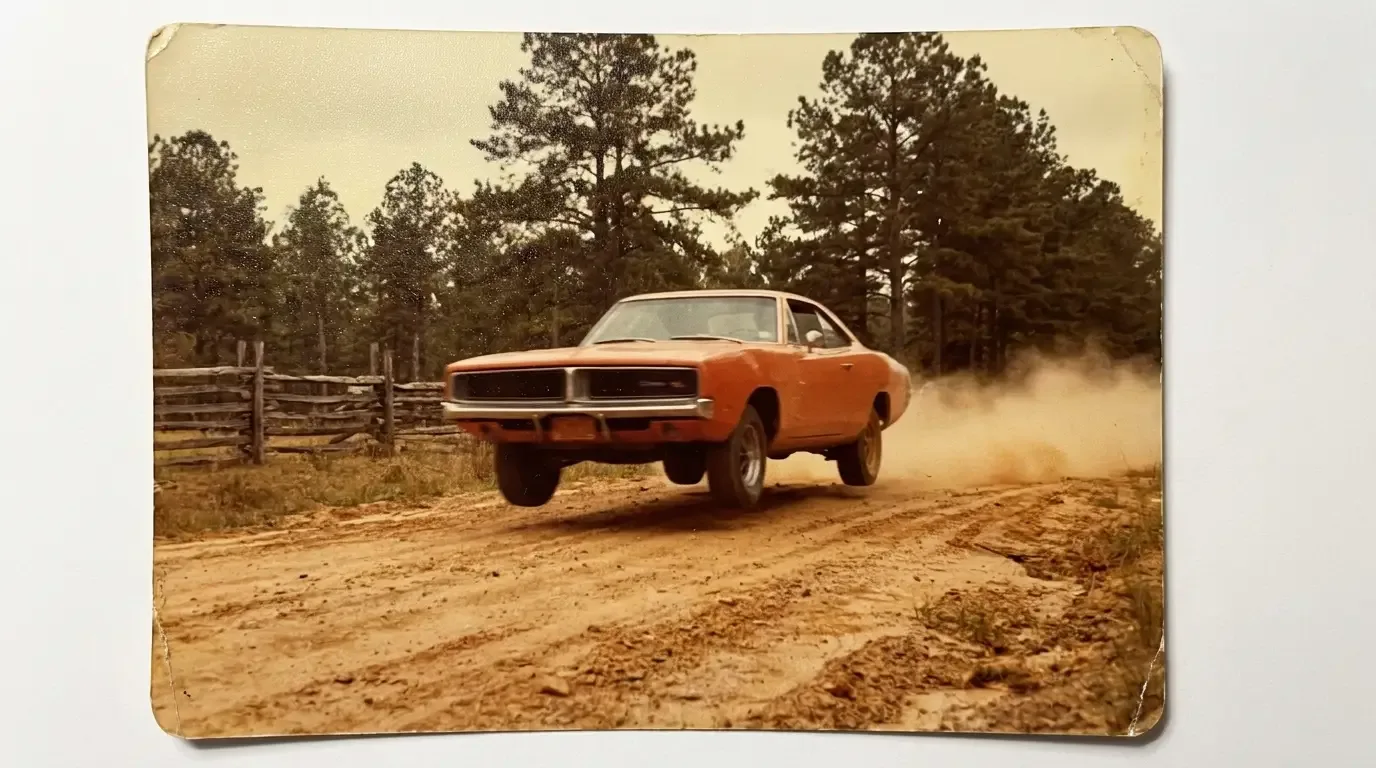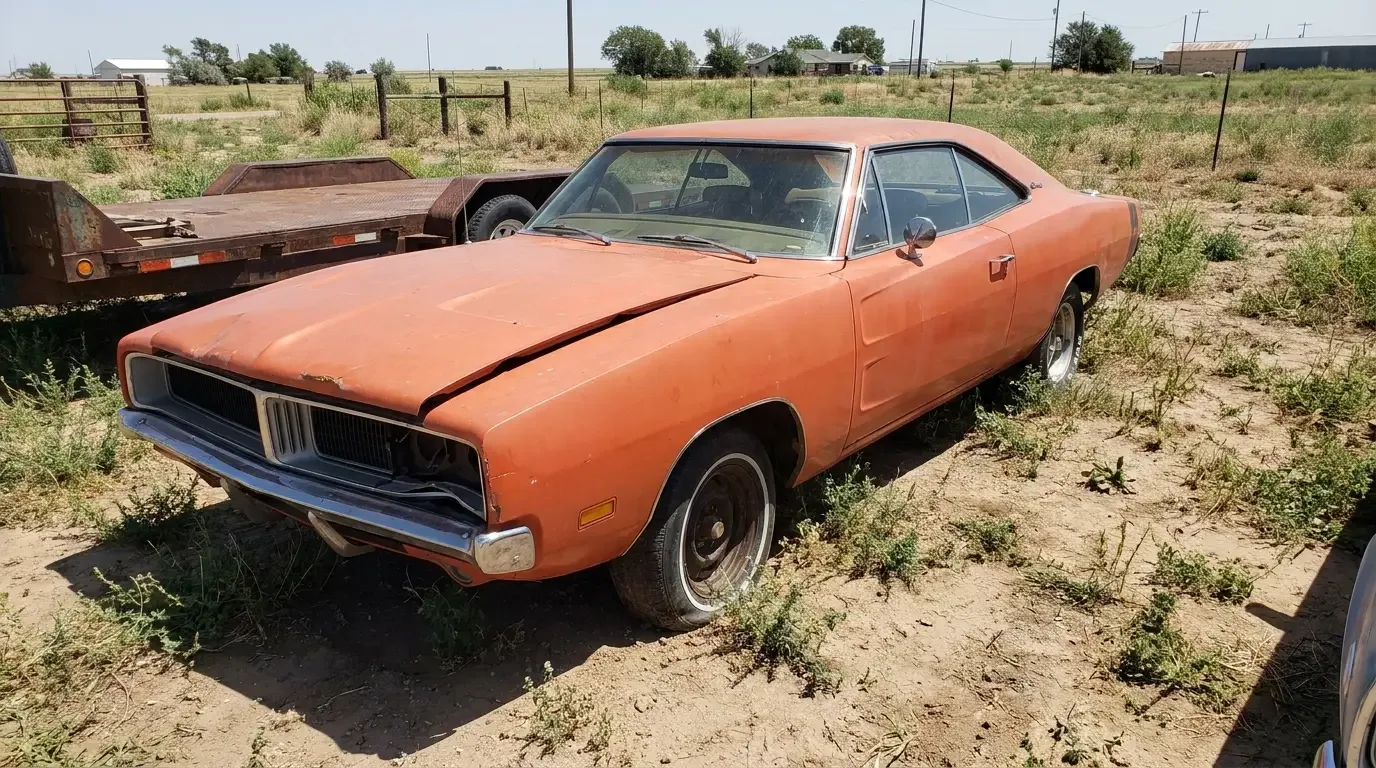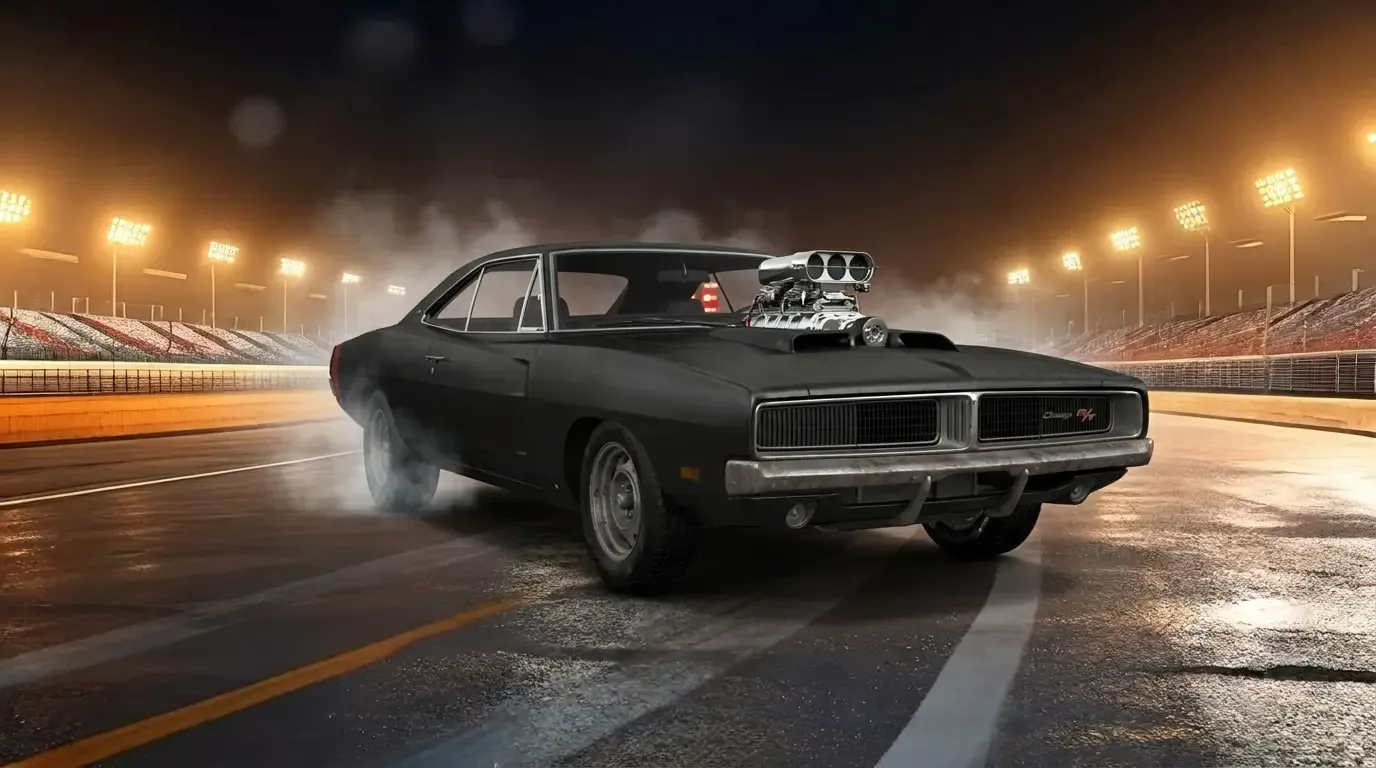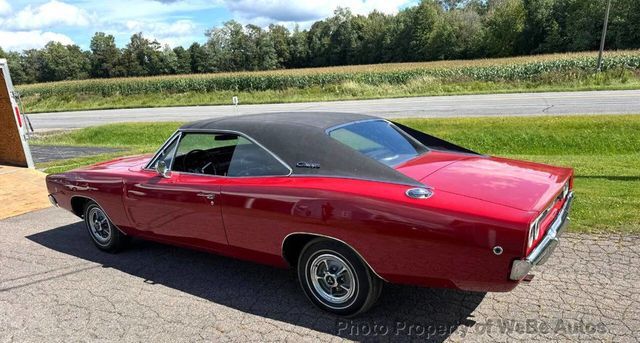
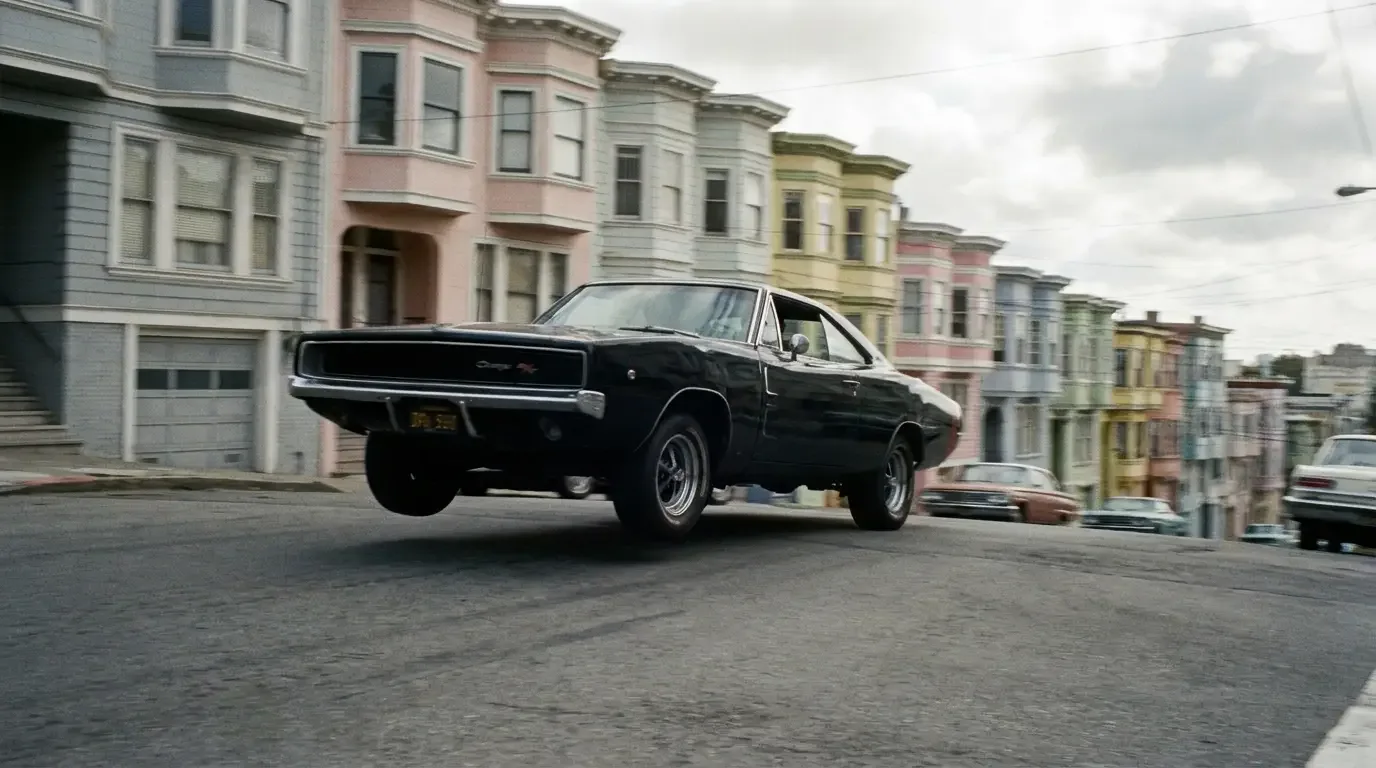
Before there was an orange Charger jumping over Georgia creek beds, there was a black one, low and menacing, weaving through San Francisco traffic with two hitmen inside it, trying to lose a green Mustang that would not let go. The 1968 film Bullitt gave the Dodge Charger its first great screen role, and it did something the Dukes of Hazzard never bothered with a decade later: it let the Charger be the bad guy.
Setting up the chase
Bullitt's ten-minute pursuit through San Francisco is built around a simple contrast. Steve McQueen's Highland Green Mustang GT fastback is the hero's car, agile and familiar. The Charger belongs to the men he's chasing, and everything about its screen presence is designed to make it feel like a predator instead of a getaway car. The long hood, the hidden headlights, the way the roofline drops toward the rear glass, all of it reads as aggressive rather than sporty, and the film's cinematographer leaned into that difference rather than fighting it.
The production used two 1968 Chargers for the chase, a common practice for stunt work of the era where a hero car, reserved for close-ups, and a stunt double car absorbed different levels of punishment. That two-car arrangement mirrored the two Highland Green Mustangs the production ran for McQueen's side of the sequence.
Why a 1968 Charger fit the villain role
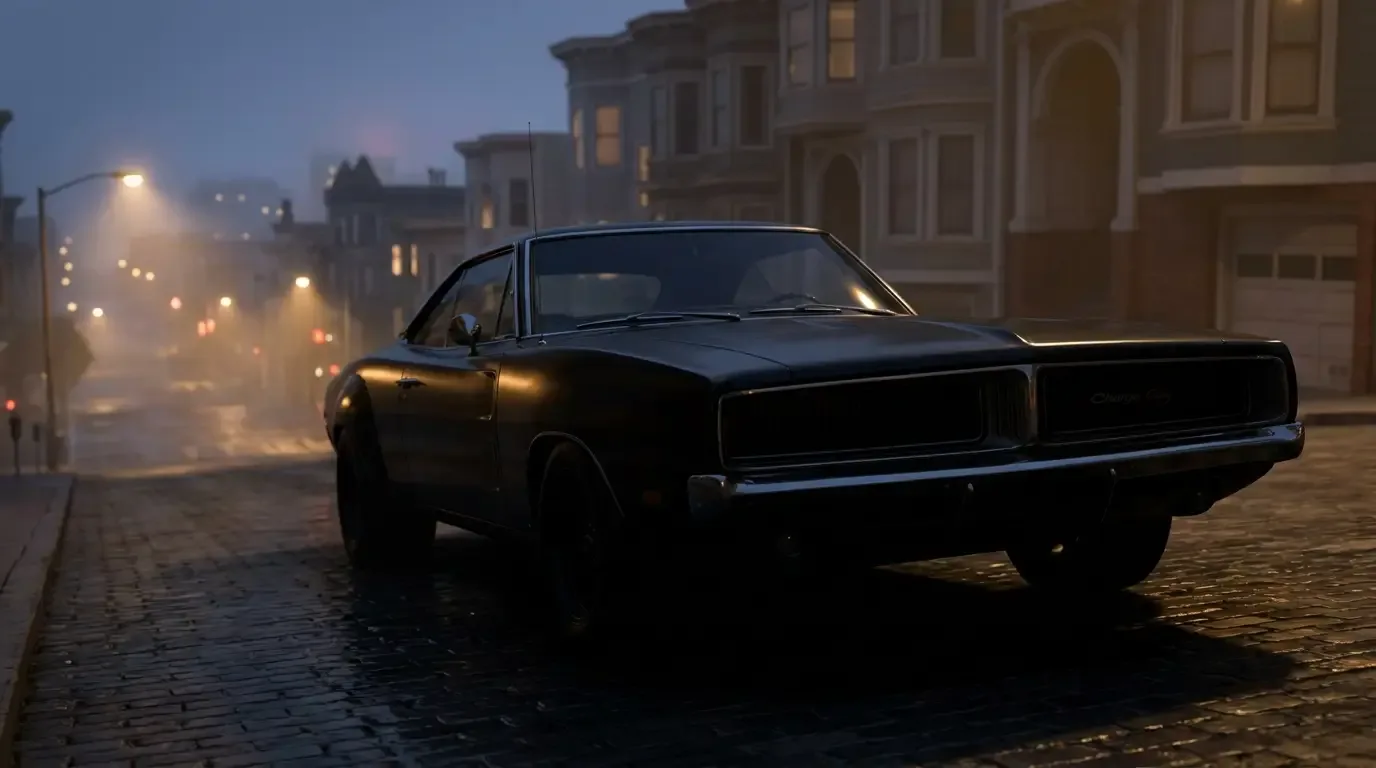
The second-generation Charger, produced from 1968 through 1970, had a silhouette unlike anything else on American roads at the time. Where the first-generation car from 1966 and 1967 wore a fastback profile that read almost like a personal luxury coupe, the redesigned 1968 body dropped the roofline, added a coke-bottle hip to the rear fenders, and gave the car a genuinely predatory stance from any angle. Filmmakers noticed. A car built to look fast standing still is exactly what a chase scene villain needs, since half the tension comes from how the car reads before it ever moves.
Under the hood, the film's Chargers ran 440 Magnum power, the big-block R/T option rated at 375 horsepower, giving the car real straight-line pull that comfortably out-muscled the Mustang GT's 390-cubic-inch V8 and its roughly 325 horsepower. Stunt driver Bill Hickman, at the Charger's wheel, reportedly had to ease off to let the pursuing Mustang keep up. The chase was shot with real speed on real San Francisco streets, not process-shot trickery, and the Charger's on-camera weight transfer through the hills is part of why the sequence still holds up.
| Detail | Bullitt Charger (1968) |
|---|---|
| Model year | 1968 |
| Engine | 440 Magnum V8, 375 hp |
| Screen role | Antagonist's pursuit car |
| Chase location | San Francisco, California |
| Number of production cars used | Two 1968 Chargers (hero + stunt) |
| Known surviving example | One car presented as the surviving camera car; documentation debated |
How the chase was actually filmed
Part of what makes the sequence hold up is that very little of it was faked. The production shot on real San Francisco hills, at real speed, with stunt drivers who understood exactly how much a heavy American V8 would unload its weight over a crest before landing hard on the far side. Several of the jumps that read as dramatic on screen were simply the natural consequence of driving a full-size sedan at speed over the city's steep grades, not a rigged gag built for the camera.
The Charger's role in that realism is easy to undersell. A lighter, twitchier car would have looked wrong chasing anything through those streets. The Charger's mass and long wheelbase gave the chase a sense of weight and consequence that a smaller car simply could not have sold to an audience, and that physical presence is a big part of why the sequence is still taught in film schools as a benchmark for practical stunt driving.
What happened to the actual cars
The fate of the Bullitt Charger stunt cars is one of the murkier corners of movie car history. Unlike McQueen's Mustang, whose two cars are now both accounted for after a decades-long search, the Charger's cars largely disappeared from the record after filming wrapped. One of the two was intentionally destroyed on screen in the gas-station crash that ends the chase. Decades later, a Mopar enthusiast bought and restored a car he identified, through film analysis and matching camera-mount evidence, as the surviving close-up "camera car"; it has since been shown at SEMA and Goodwood and offered for sale by a German dealer. That identification rests largely on the owner's own detective work rather than an unbroken studio paper trail, so it remains debated among film-car historians.
That gap matters for collectors. A period-correct 1968 Charger R/T, restored to the same color and equipped similarly to the film cars, makes a legitimate tribute build, but it is not the same claim as owning an actual screen-used unit, and the absence of surviving records means nobody should be selling one as such without extraordinary documentation behind it.
The Charger's villain legacy on screen
Bullitt set a template that Hollywood kept returning to. A Charger reading as the antagonist's car, low, dark, and mechanically serious, became a recurring casting choice long after 1968, something explored more fully in the Charger feature on Classic Cars Arena. The role would eventually flip entirely once a different Charger, in a different decade, became the hero's own car rather than the villain's, a shift covered in the Dom's 1970 Charger in Fast & Furious story.
"What makes the Bullitt Charger work isn't the horsepower figure anybody argues about online. It's that the car looks like it belongs to somebody dangerous before it ever turns a wheel, and that's a much harder thing to fake than a fast lap time."
— Nora Beckett
For anyone tracing the model's full arc, from its 1966 debut through the redesign that made Bullitt possible, dodge charger history lays out the whole timeline, and the Charger's own great rivalry with a different screen car built the same decade is worth reading in a related classic-muscle rivalry.
Sources and notes
- SlashGear - What Happened to the Bullitt Charger - confirmed two 1968 Chargers (one hero, one stunt), the 440 R/T engine, and the claimed surviving camera car later shown by Chrome Cars.
- Street Muscle - The Baddies' 1968 Charger R/T - verified the 440 Magnum rated at 375 hp, the A-833 four-speed and Dana 60 rear, and Bill Hickman's driving.
- Motor Sport Magazine - Bullitt's forgotten hero - corroborated the Charger out-muscling the Mustang GT 390 and having to slow for the chase.
- autoevolution - The original Bullitt movie car - confirmed the Mustang GT 390's ~325 hp and the two-car-per-model production practice.
- Star Cars Wiki - Bullitt Charger - cross-checked the on-screen gas-station destruction of one car and the murky post-production record.