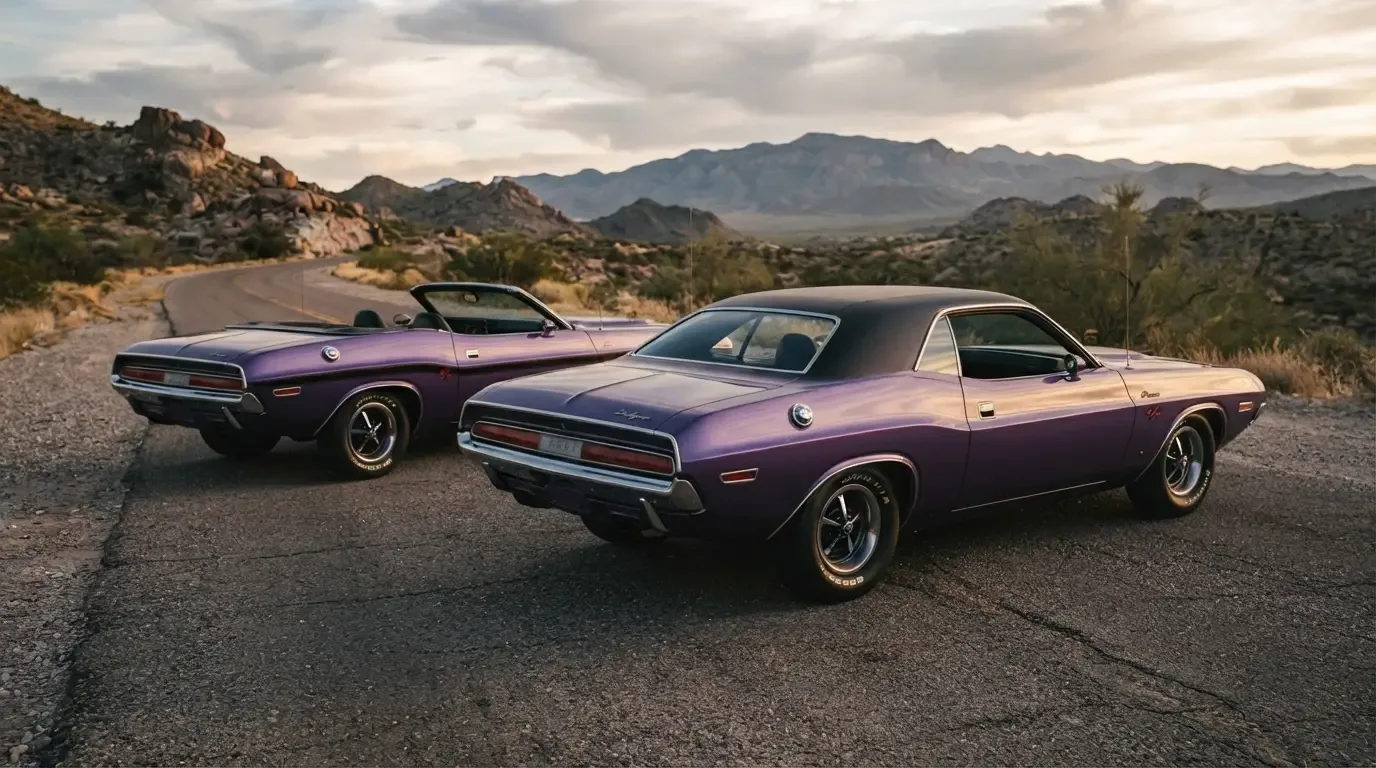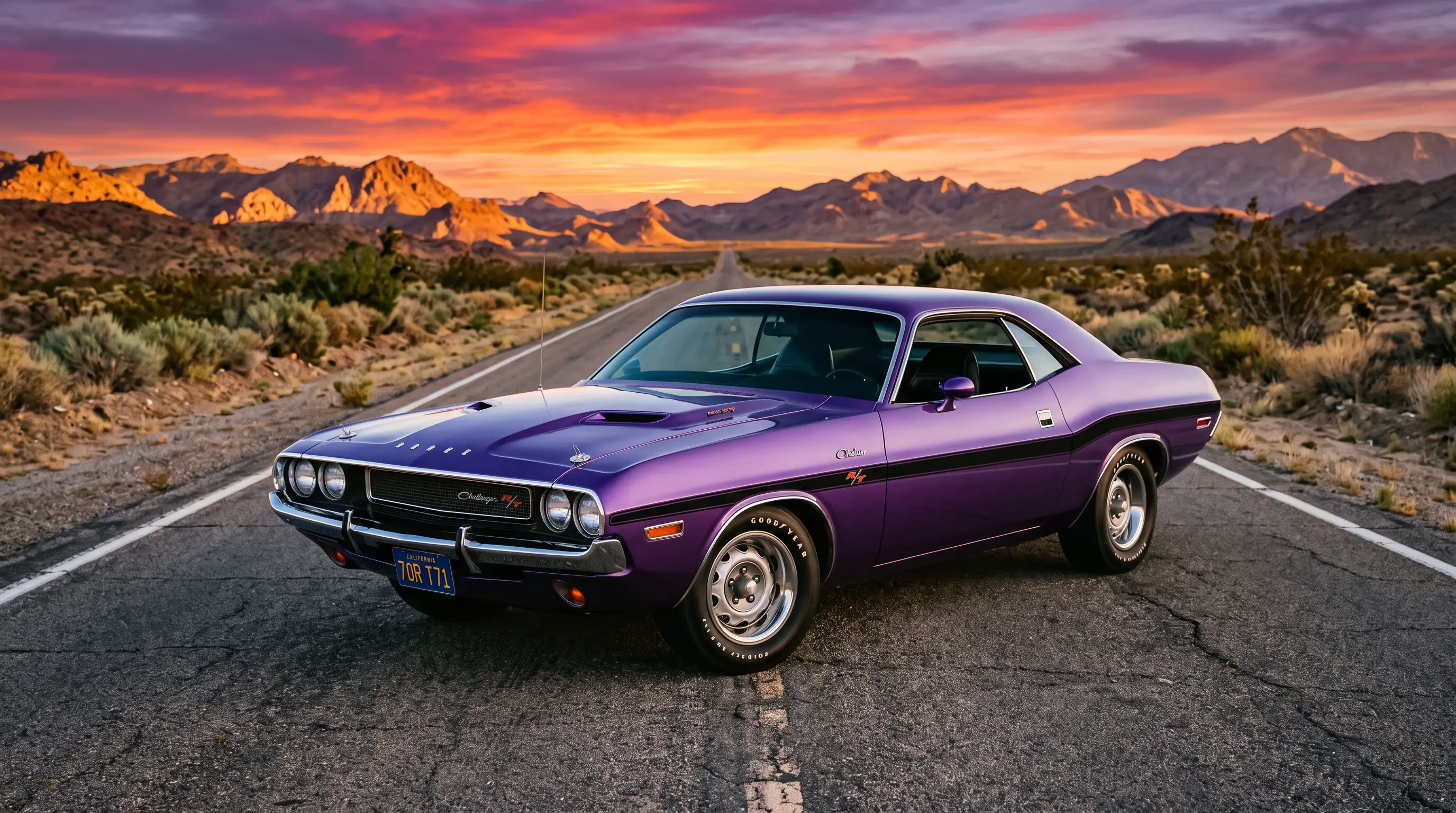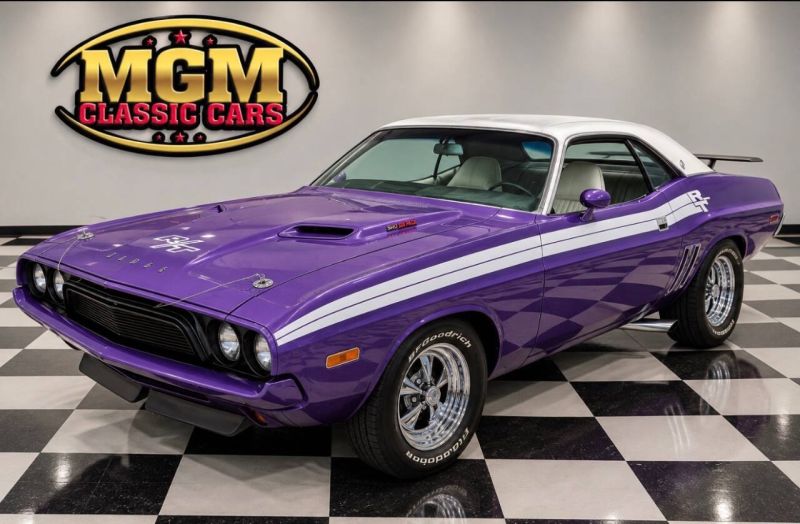
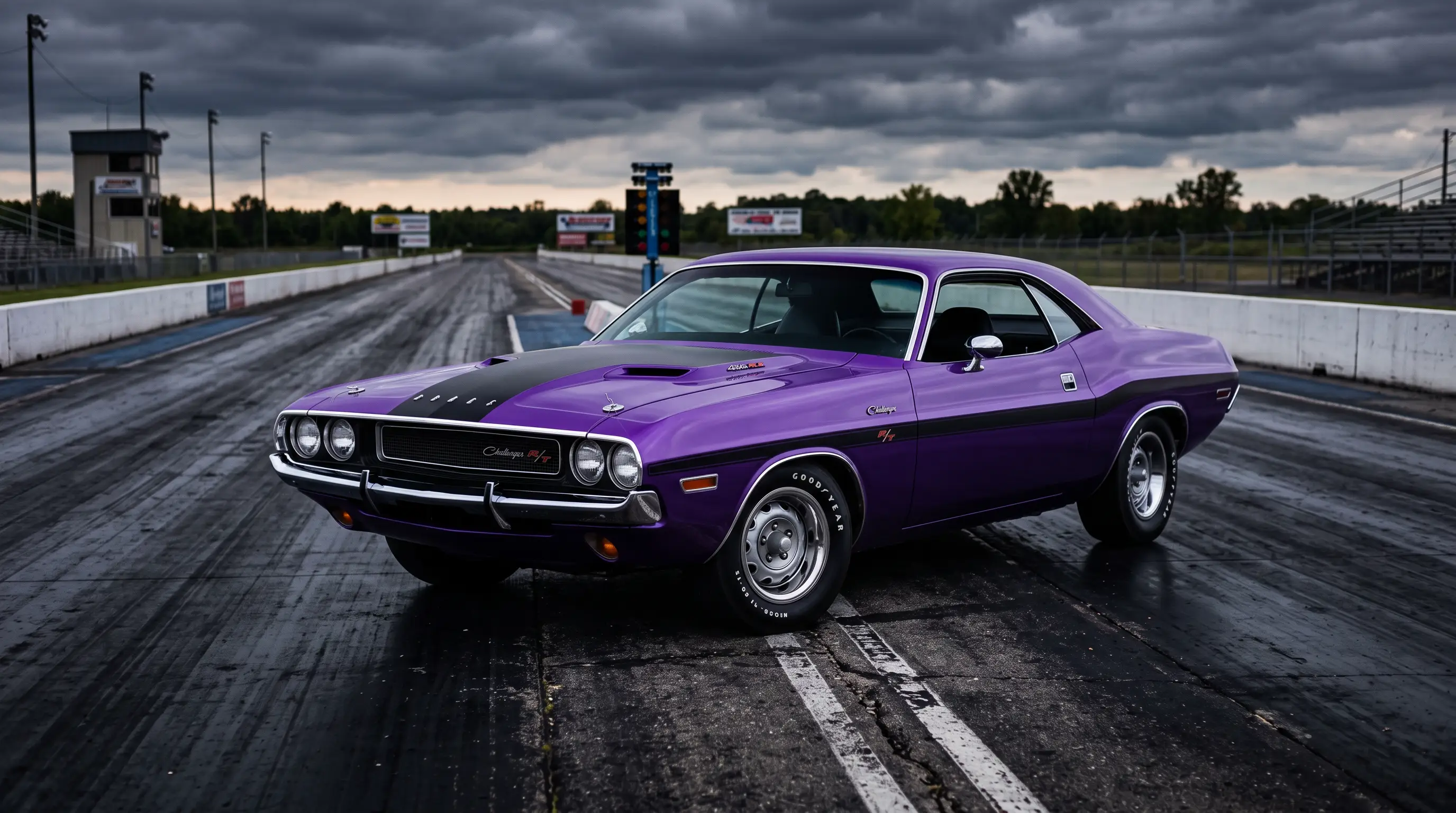
A man at a car show in Ohio once told me he bought his Plum Crazy Challenger the week his daughter was born, because he wanted a color loud enough to match how he felt that day. He still owns the car. She is grown now. The purple has faded a shade or two under forty summers of sun, and he says he will never have it touched up to match the original chip, because the fade is part of the story too. That is the plum crazy challenger phenomenon in one small conversation. This is not a color people buy quietly.
A color built to be an argument
Plum Crazy landed on Dodge order sheets in 1970, one entry in Chrysler's High Impact palette designed to grab a customer's eye the second they walked onto the lot. It is a bright, almost electric purple, closer to violet under direct sun and deeper toward magenta in shade. Plymouth sold the identical formula under the name In-Violet, which tells you the corporation itself cared more about brand identity than a shared name, only that it needed to be seen from across the showroom floor.
Buyers in 1970 either loved it immediately or refused to consider it at all. There was very little middle ground, and dealers reportedly struggled to move Plum Crazy cars in some markets where the customer base skewed more conservative. That resistance in period is exactly why the color feels so special now. Cars that seemed too loud for some buyers in 1970 are the same cars collectors chase hardest fifty years later.
The short window that made it rare
Chrysler offered Plum Crazy on the Challenger for essentially two model years before the High Impact program got trimmed back as the muscle car era cooled through 1972 and beyond. Two years is not a long production run for any single color, and within those two years only a fraction of total Challenger buyers actually checked that box on the order form. Most people, even people who wanted a Challenger badly, played it safer with a more traditional color like Rallye Red or a simple white.
That restraint from 1970s buyers is the reason a genuine Plum Crazy Challenger, verified against its fender tag, draws real attention and real money at auction today. Scarcity created by customer hesitation fifty years ago becomes a premium paid by an entirely different generation of buyers who grew up seeing the color in movies and magazines rather than on their own street.
What the color means to the people who own it
I have talked to more than one Plum Crazy owner who describes the car in almost the same language, something about the color making the car feel less like transportation and more like a small, rolling declaration. Nobody buys this color to blend into traffic. Every owner I have spoken with knew exactly what they were signing up for, the stares, the questions at gas stations, the strangers who walk over at a stoplight just to ask what year it is.
That emotional weight is part of why these cars get passed down inside families rather than flipped for profit. A car this visually loud tends to attach itself to a specific memory, a specific year, a specific person who chose it on purpose knowing it would never be subtle. The man from Ohio is not unusual. He is fairly typical of the people who end up keeping these cars for decades rather than a few years.
"Nobody buys a Plum Crazy Challenger by accident. Every single owner made that choice on purpose, knowing exactly how much attention it would bring, and most of them tell you they would choose it again."
- Nora Beckett
Living with a color this loud
There is a quieter side to owning one of these cars too, away from the car shows and the stoplight conversations. Early mornings, empty roads, the purple looking almost black before the sun fully clears the horizon. Owners talk about that version of the car too, the version nobody else sees, when the color settles into something closer to a personal secret than a public statement. It is a strange thing for a paint job to hold both of those moods at once, loud in daylight and almost private before dawn, but that is what people describe when they talk about actually living with the car rather than just showing it.
If you want our complete history of how this color fits into the wider High Impact story, including how it compares to the other loud shades Dodge offered the same year, that piece lays out the fuller picture beyond just this one color's story. And if a conversation like the one I had in Ohio has you thinking about your own version of this, you can find a classic Challenger and start looking at what is actually available today, purple or otherwise.
Fifty some years on, Plum Crazy has not mellowed into a tasteful classic the way some once-loud colors eventually do. It is still an argument, still a declaration, still the color a man in Ohio chose on purpose the week his daughter was born. Some choices just stay loud. This one clearly has.
How the color shows up across generations of one family
I have started noticing a pattern talking to Plum Crazy owners over the years. It is rarely a single owner who loves the car in isolation. It is usually a whole family orbiting around it, one generation passing the story to the next even when the car itself briefly leaves the family and gets bought back later. A woman in Michigan told me her grandfather sold his Plum Crazy Challenger in the late seventies to help pay for a wedding, then spent the next thirty years quietly looking for it or something close enough to it, before his grandson finally tracked down a matching year and color as a gift he never got to see finished.
That kind of multigenerational pull is unusual for a car, let alone for a single paint color within one model line. Most colors do not generate their own family folklore. Plum Crazy seems to attract exactly that, story after story of people connecting a specific shade of purple to a specific relative, a specific year, a specific version of themselves they were trying to hold onto or recreate. The car becomes almost secondary to what the color represents once a family has attached enough meaning to it.
None of that sentiment shows up on a spec sheet, and none of it moves an auction estimate on its own. But it explains something about why these cars so rarely get flipped quickly for profit compared to some other collector vehicles. People do not just buy a Plum Crazy Challenger. They inherit an idea of one first, long before they ever find the actual car, and that idea tends to keep the car in the family a lot longer than a simple purchase decision ever would.