
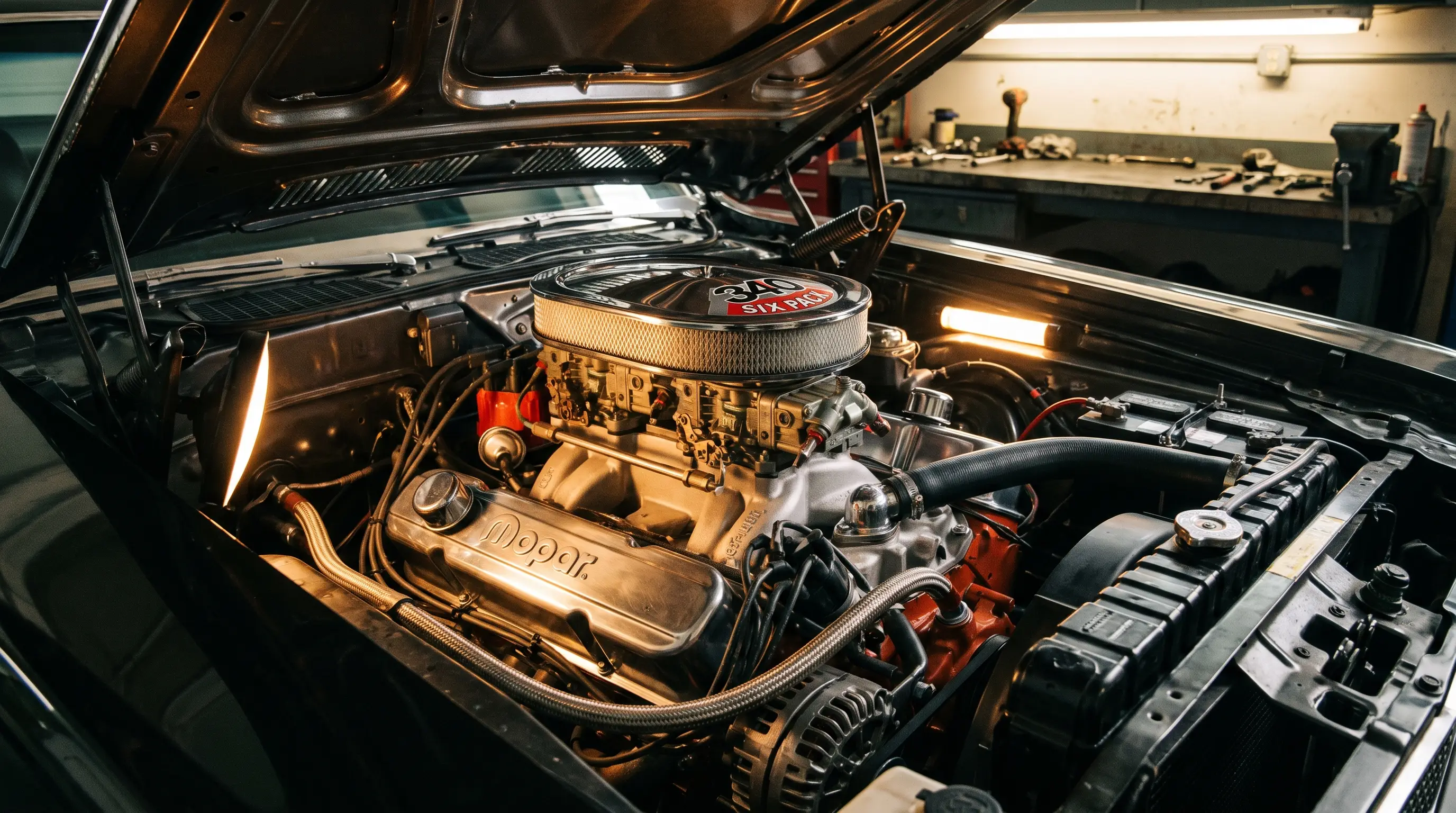
The challenger ta engine is one of the more misunderstood powerplants in the Mopar catalog, mostly because people assume "race special" means "biggest number available." It does not. The 340 cubic inch small block under the T/A's hood was smaller than the 383 and 440 options sitting one line up on the order form, and that was the entire point. Dodge was not building a straight line drag car. It was building a road racer, and the engineering choices reflect that from the first spec sheet.
Car Features
7 min read
The T/A Engine and the Race Version It Homologated
The challenger ta engine was built to satisfy a racing rulebook, not a horsepower war, and the Six Pack 340's design choices still tell that story today.
Why a 340, not a 440
SCCA Trans Am rules capped engine displacement at 305 cubic inches for the racing class the Challenger was entering. No production Chrysler small block matched that number exactly, so engineers took the 340 and set it up to be sleeved down to 303.8 cubic inches for the actual race cars, which slipped under the limit. The street T/A kept the full 340 displacement, since homologation rules required the road car to share the block and architecture, not the exact bore of the track version. That distinction trips people up constantly. The street engine and the race engine are related, not identical, and understanding that gap explains most of what is unusual about this car.
Readers who want the full context around why this car exists at all should check our complete history of the model, since the engineering only makes sense once you understand the racing mandate behind it.
Three carburetors, one intake, real complexity
The signature feature of the street 340 in T/A trim was the Six Pack induction system, three two barrel Holley carburetors mounted on an Edelbrock aluminum intake manifold. This was not a bolt on accessory. It was a specific tune calibrated for the combination, with the center carburetor handling normal driving duty and the outer two opening under heavier throttle. Factory rated output was 290 horsepower, a figure that period road tests and later retrospectives generally treated as conservative, with real world output likely closer to the 330 to 350 range once the underrating conventions of the era are accounted for.
| Spec | Detail |
|---|---|
| Displacement | 340 cubic inches (5.6 liters) |
| Induction | Six Pack, three two barrel Holley carburetors |
| Intake manifold | Edelbrock aluminum |
| Factory rated output | 290 horsepower |
| Transmission options | Four speed manual or TorqueFlite automatic |
| Exhaust | Side exit, ahead of the rear wheels |
The aluminum intake was a meaningful weight saving choice on a car built around a racing mission, and it is one of the details that gets lost when people describe the T/A purely by its horsepower figure. Chrysler engineers were solving a weight distribution and cornering problem, not just a straight line power problem, and the intake choice shows that priority clearly.
Where the design fails, honestly
I like to be direct about failure modes, because glossing over them does a disservice to anyone actually researching this car. The Six Pack system has a well documented reputation for finicky tuning. Three carburetors staying in synchronization over years of ownership, climate changes, and inevitable amateur adjustment is a harder engineering problem than a single four barrel setup, and many surviving T/A engines have been detuned, modified, or swapped to simpler induction at some point in their history by owners who wanted reliability over authenticity. That is a rational owner decision and a real headache for anyone trying to verify originality decades later.
The side exit exhaust routing, while visually distinctive and functionally tied to the racing image, also created real world drawbacks. Exhaust note and heat routed near the rear wheel wells was a known complaint among period owners, and several dealers reportedly rerouted the system to conventional rear exit exhaust under warranty requests. This is the kind of detail that separates an engineering history from a marketing brochure. The T/A's powertrain choices were purposeful and occasionally uncomfortable to live with, which is true of most homologation specials built to satisfy a rulebook rather than a customer clinic.
"The 340 Six Pack was never meant to be the easiest engine to own. It was meant to be legal on a race track. Those are different design briefs, and the T/A shows both of them at once."
- Emily Chen
The transmission and drivetrain reality
Buyers today gravitate toward the four speed manual T/A, and the data on surviving cars supports that preference as the more track focused configuration, matching a close ratio gearbox to the Six Pack's power delivery. The TorqueFlite automatic was available and, mechanically, is arguably the more durable transmission of the two over a long ownership period, since it tolerates abuse and inconsistent maintenance better than a manual clutch and linkage setup. Anyone assembling a challenger ta engine today for a restoration project needs to decide early whether the goal is period correct racing specification or long term daily reliability, because those two goals pull in slightly different directions on parts sourcing and tuning philosophy.
For readers evaluating an actual car rather than just the history, it helps to browse classic Challenger listings with these mechanical details in hand, since the engine bay tells a more reliable story than a seller's description often does.
Parts sourcing today, the practical side
Anyone rebuilding a challenger ta engine today faces a parts market that has genuinely improved over the past two decades, but improvement is not the same as ease. Correct casting number blocks are increasingly scarce and increasingly expensive, which pushes many restorers toward period correct reproduction pieces for anything beyond the core numbers matching components. The Six Pack carburetor setup specifically has a healthy reproduction market now, largely because the demand from restorers finally justified the tooling investment, but sourcing an original, unmolested set of three factory Holleys with correct casting dates is still a hunt that can take years.
Machine shops that specialize in this era of small block Mopar work are not evenly distributed geographically either, and I have advised more than one owner to ship a block across several states rather than trust a local generalist shop with a build this specific. The tolerances and tuning knowledge required to get a Six Pack setup running the way it was designed to run are not common skills anymore, and a poorly executed rebuild will leave an owner with a car that looks period correct and drives nothing like the original specification intended.
What the engineering says about the car overall
Every choice under the hood of the T/A traces back to a single rule on an SCCA rulebook page, and that is unusual in the muscle car world, where most engine decisions were driven by marketing and dealer floor competition. The 340 Six Pack exists because Chrysler needed to build a specific number of road cars to legally race a specific class, and the engineering team solved that problem with real ingenuity rather than simply dropping in the biggest available block. It is a smaller, more technically interesting engine than its reputation sometimes suggests, and understanding why it was built the way it was tells you more about the car than the horsepower number ever will.
Sources and notes
Related Reading
Have a
Dodge Challenger
for Sale?
Reach thousands of serious classic car collectors across the US.
Sell It Here →
Are You a Classic Car Dealer?
List your full inventory and connect with targeted classic car buyers.
Join as a Dealer →

About the author
Emily Chen
Bay Area engineer with a deep focus on vintage Japanese and European performance cars. Approaches classic car research and restoration with an analytical eye.
Related Listings - Dodge Challenger




Comments
Be the first to comment on this article.