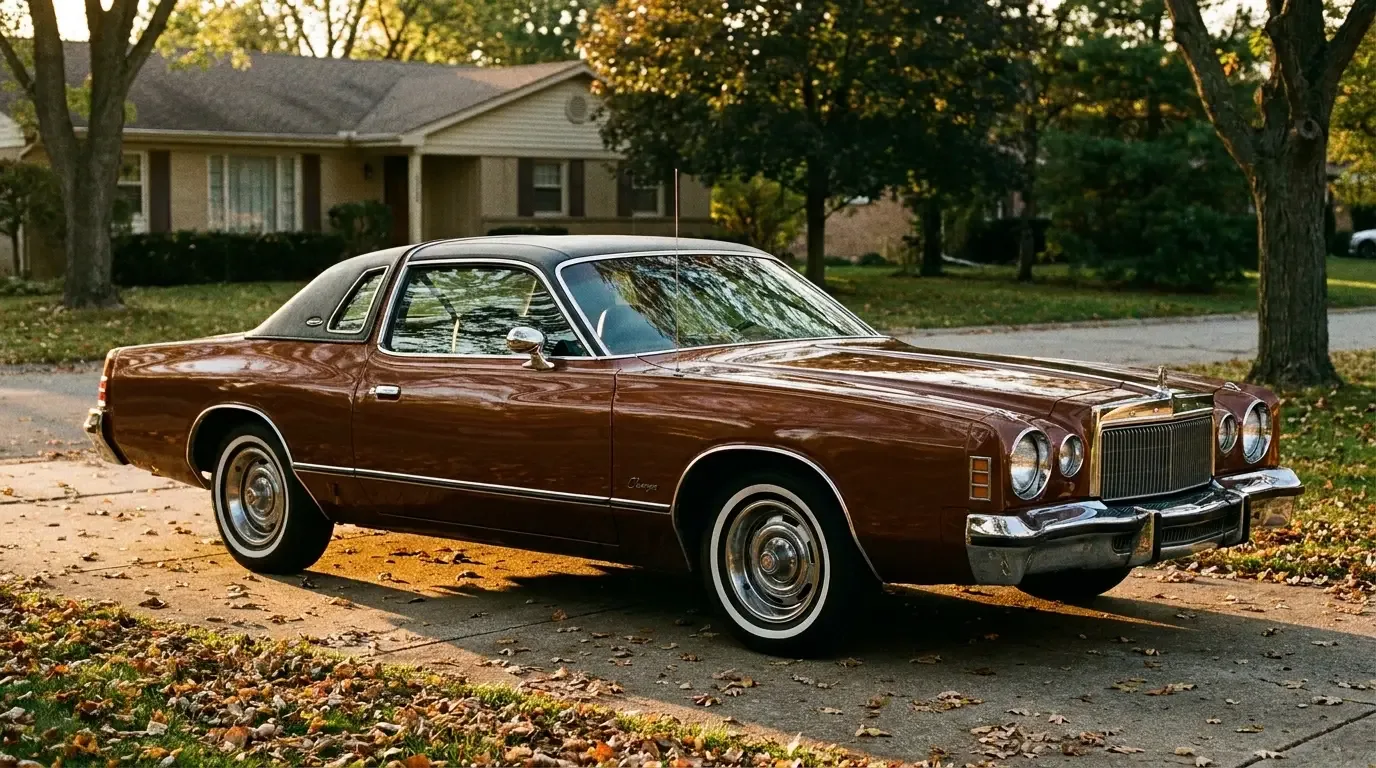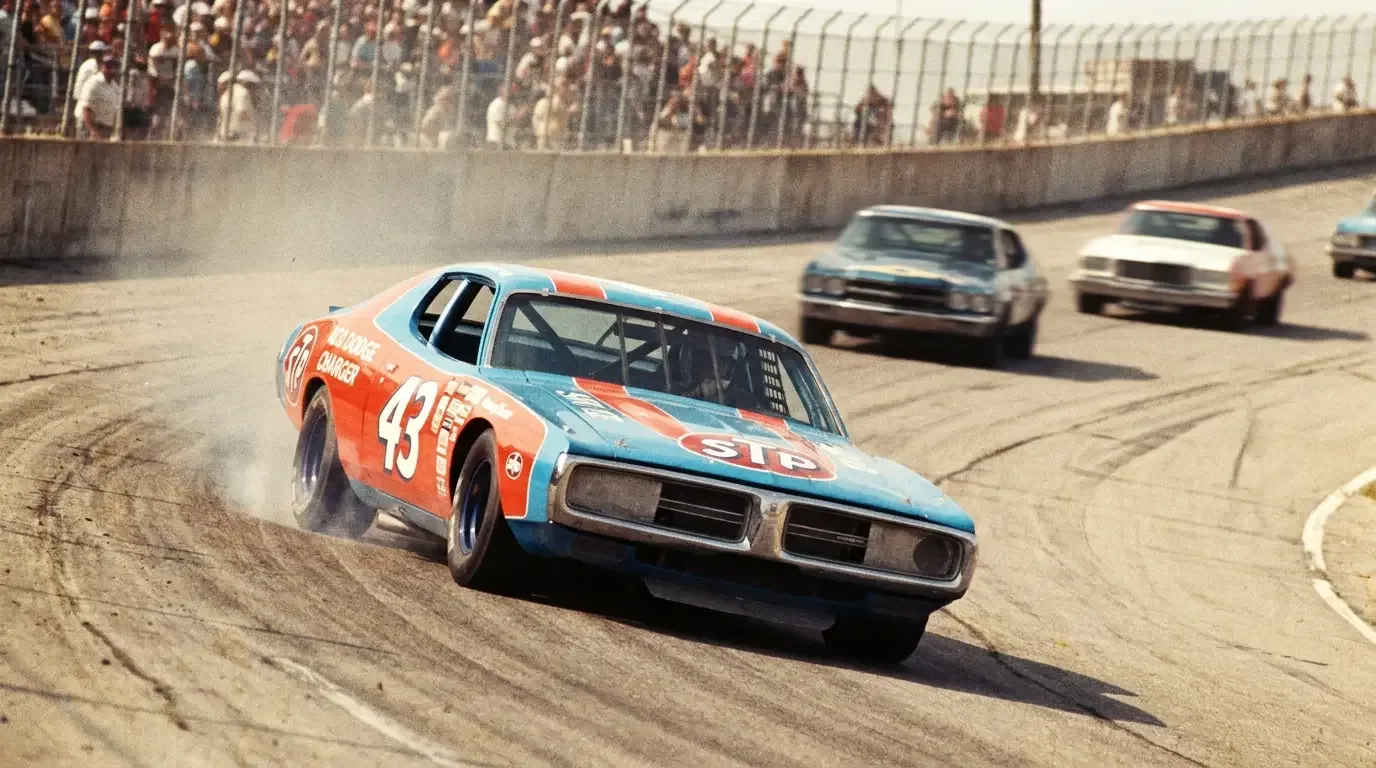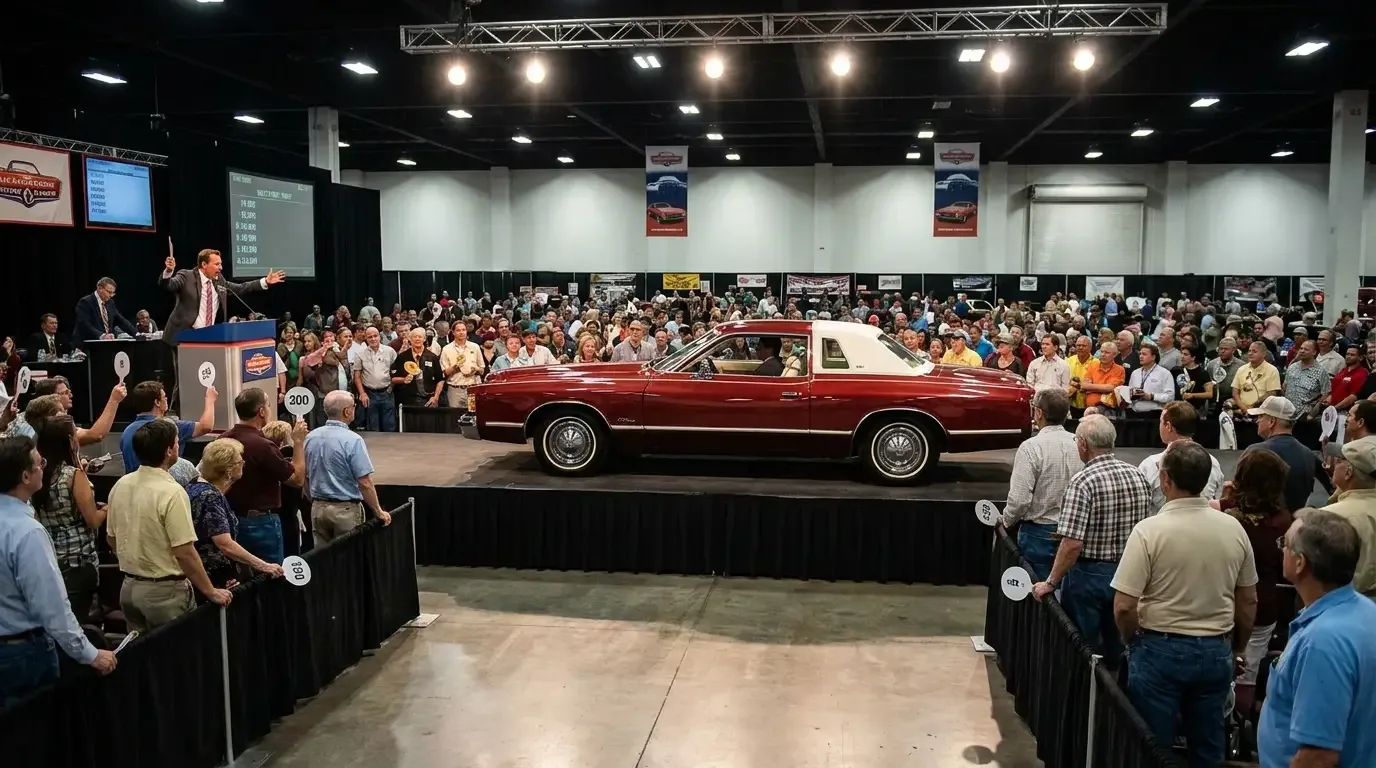
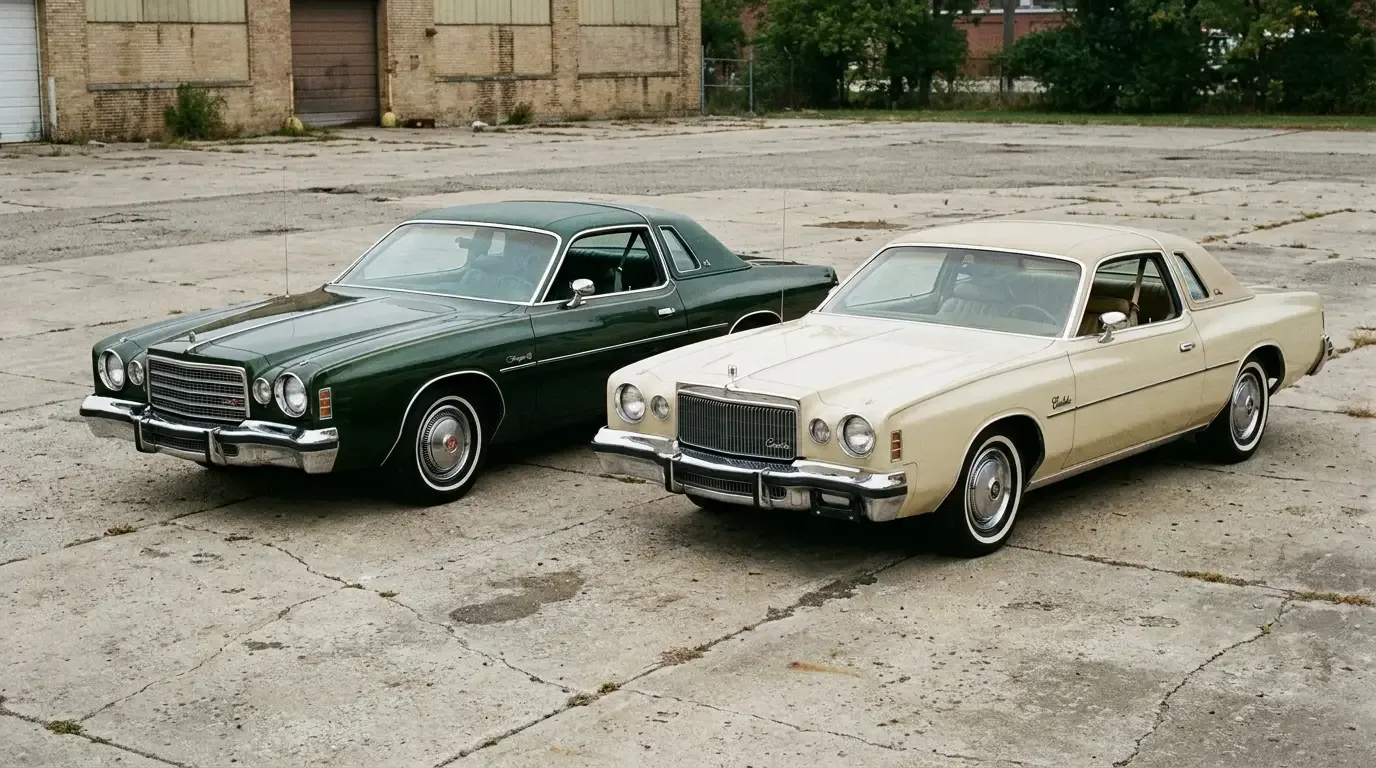
Ask a casual observer to tell the 1975 Dodge Charger SE and the Chrysler Cordoba apart at a car show, and a fair number will hesitate. That's not an insult to either car. It's a fact of corporate history. Chrysler built both cars on the same fundamental B-body architecture during the same stretch of years, aimed them at overlapping buyers, and marketed them through sister divisions competing for the same dollar. Understanding why they ended up so close requires looking at the build sheets and the sales data, not just the sheet metal.
Two divisions, one platform
The fourth-generation Charger and the Cordoba both rode on Chrysler's B-body platform, sharing the same new-for-1975 coupe shell on a 115-inch wheelbase, right down to a great deal of the structure and glass. This wasn't unusual for Chrysler in the mid seventies. The corporation was stretching platform investment across as many badges as it could justify, and the personal-luxury segment was exactly the kind of high-margin category worth doubling up on. Dodge got the Charger. Chrysler division got the Cordoba. Both launched into a market that Ford and General Motors were also crowding with their own personal-luxury coupes.
The build records I've worked through show the platform sharing went deeper than most casual buyers realize, down to suspension components and some drivetrain parts. That's useful information for anyone doing a restoration today, since a Cordoba parts source can sometimes fill a gap a Charger-specific vendor can't, and vice versa. I wouldn't call this common knowledge even inside the hobby. It's the kind of detail you only find by pulling actual factory documentation rather than relying on what enthusiasts repeat at shows.
Where the two cars actually differed
The most consistent difference between the two, model year to model year, was positioning rather than hardware. The Cordoba leaned further into imported-luxury cues, with Chrysler's marketing built around Ricardo Montalban's television campaign and a heavier emphasis on the car as a genuine luxury purchase rather than a sporty coupe with comfort features bolted on. The Charger SE kept a slightly younger, sportier identity even after the personal-luxury pivot, a distinction that shows up in the option lists and the interior trim choices more than in anything mechanical.
Engine offerings tracked closely between the two cars, both drawing from the same Chrysler pool, the 318 and 360 small-blocks and the 400 and 440 big-blocks, with exact availability shifting year to year as emissions rules tightened. Neither car offered anything close to muscle-era output; the hottest 400 four-barrel was rated around 225 horsepower in 1975 and fell from there. What I can say without hedging is that neither car was marketed on outright performance by this point. Both were selling ride quality, interior appointments, and styling presence.
"The build record matters here more than most people assume, because two cars that look nearly identical to a casual eye can carry genuinely different option codes underneath, and the only way to know for certain is to go find the paperwork rather than guess from the outside."
— Tom Ramirez
Sales numbers and how buyers chose between them
Sales figures for both nameplates show the Cordoba didn't just outsell the Charger, it buried it. In their shared debut year of 1975, Chrysler moved 150,105 Cordobas against roughly 30,800 Chargers, a gap of nearly five to one, and the Cordoba alone accounted for about 60 percent of Chrysler division's sales that year. That reflects both Chrysler's heavier marketing push, anchored by Ricardo Montalbán's famous "rich Corinthian leather" television campaign, and the Cordoba's positioning as the more overtly upscale car. That sales gap has shaped how each car is remembered today. The Cordoba became the more visible face of Chrysler's personal-luxury era, while the Charger's version of the same story gets treated as a footnote, something enthusiasts discover almost by accident rather than something they set out looking for.
| Feature | Dodge Charger SE | Chrysler Cordoba |
|---|---|---|
| Platform | Chrysler B-body, 115-in wheelbase | Chrysler B-body, 115-in wheelbase (shared shell) |
| Positioning | Sportier personal-luxury coupe | Full luxury personal coupe |
| Marketing face | Dodge division campaigns | Ricardo Montalbán "rich Corinthian leather" campaign |
| 1975 sales volume | About 30,800 | About 150,100 (roughly 5x the Charger) |
The badge-engineering question, answered honestly
People sometimes ask me flatly whether the Charger SE was "just a Cordoba with different sheet metal," and the honest answer is that it's more complicated than that framing allows. Shared platform architecture doesn't mean identical cars, the same way two houses built from the same foundation plan can end up feeling nothing alike once the finish work is done. The Charger and Cordoba shared structural bones and some driveline hardware, but Dodge and Chrysler division each specified their own interior trim, exterior styling details, and option packages independently. I've cross-referenced enough build sheets from both cars to say the divergence in factory-installed trim was real and consistent, not a marketing illusion layered over identical hardware.
What I won't do is pretend I've resolved every question about parts commonality down to the last bracket and fastener. Chrysler's documentation from this era, particularly for lower-volume trim-specific hardware, isn't always complete or easy to source, and I've hit dead ends chasing a specific interior panel's cross-reference more than once. When a source tells you with total confidence that two parts are identical across both cars without citing where that claim comes from, I'd treat it the same way I'd treat an unverified engine output number. Interesting, possibly true, not yet proven.
What this means for collectors today
For a buyer deciding between the two nameplates today, the choice usually comes down to which badge and which design language appeals more, since the underlying mechanical case for one over the other isn't strong enough to matter much in daily ownership. The Charger name carries more performance heritage baggage, for better or worse, which is part of why the Malaise Charger Value story has become relevant to collectors reassessing this era. The Cordoba, without that earlier muscle car history attached to its name, gets judged purely on its own terms, which has its own advantages for buyers who don't want their personal-luxury coupe compared unfavorably to a 1969 R/T.
I don't have a strong verdict on which car is the better buy, and I'd be suspicious of anyone who claims they do without qualifying it. Both cars represent the same corporate moment, executed through two different brand identities, and the right choice depends entirely on which identity a given buyer wants their garage to say something about. For the fuller history of how the Charger got to this point in its own right, this story lays out the full transition from muscle car to personal-luxury coupe.
Sources and notes
- Chrysler Cordoba, Wikipedia - confirmed the 115-inch B-body platform, the 1975 debut, and Ricardo Montalbán's "rich Corinthian leather" campaign.
- Mac's Motor City Garage on the 1975 Cordoba - confirmed 150,105 Cordobas sold in 1975, roughly 60 percent of Chrysler division volume.
- Dodge Charger (B-body), Wikipedia - confirmed the ~30,800 Charger figure for 1975 and the shared 318/360/400/440 engine pool.
- Old Cars Weekly on the 1975 Cordoba - period detail on the Cordoba's luxury positioning and interior trim.
- Classic.com Cordoba market - corroborated the two cars' shared-platform lineage and current collector standing.