
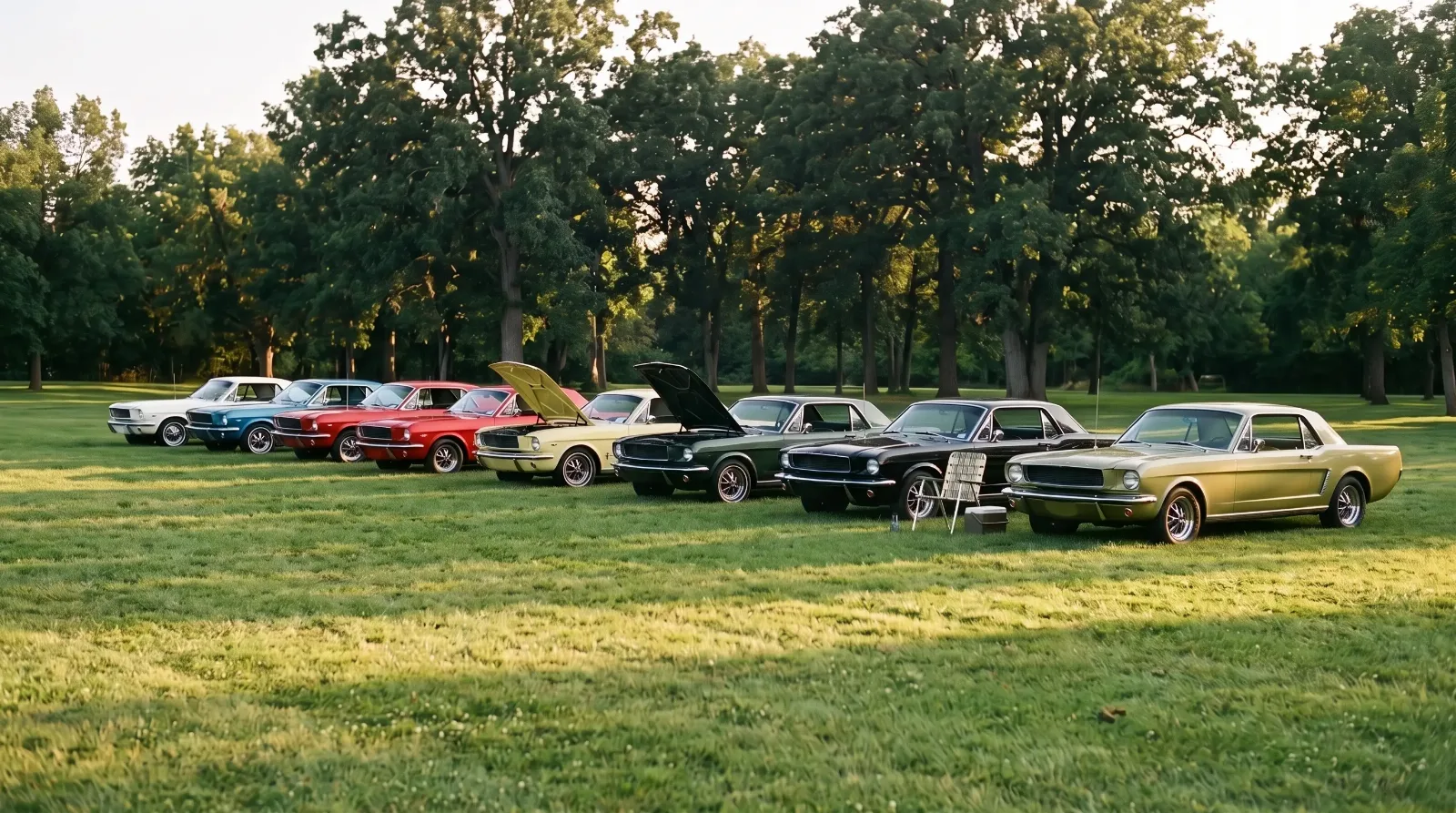
Stand next to any Mustang at a cars-and-coffee and listen. Within ten minutes somebody will call a 1969 fastback a SportsRoof, someone else will ask whether the 289 is a Hi-Po, and a third person will want to know if the car has a Marti Report. Mustang terminology is a dialect, built up over sixty years by factory paperwork, sales brochures, racers and owners who argued in parking lots. Learn it and the conversations open up. Get it wrong and people notice.
Car Features
7 min read
A Classic Mustang Glossary: Fastback, SportsRoof, Hi-Po and 60 More Terms
Mustang terminology from 1964½ to 2000 in one place: body styles, model names, engine codes, trim slang and the paperwork words buyers hear.
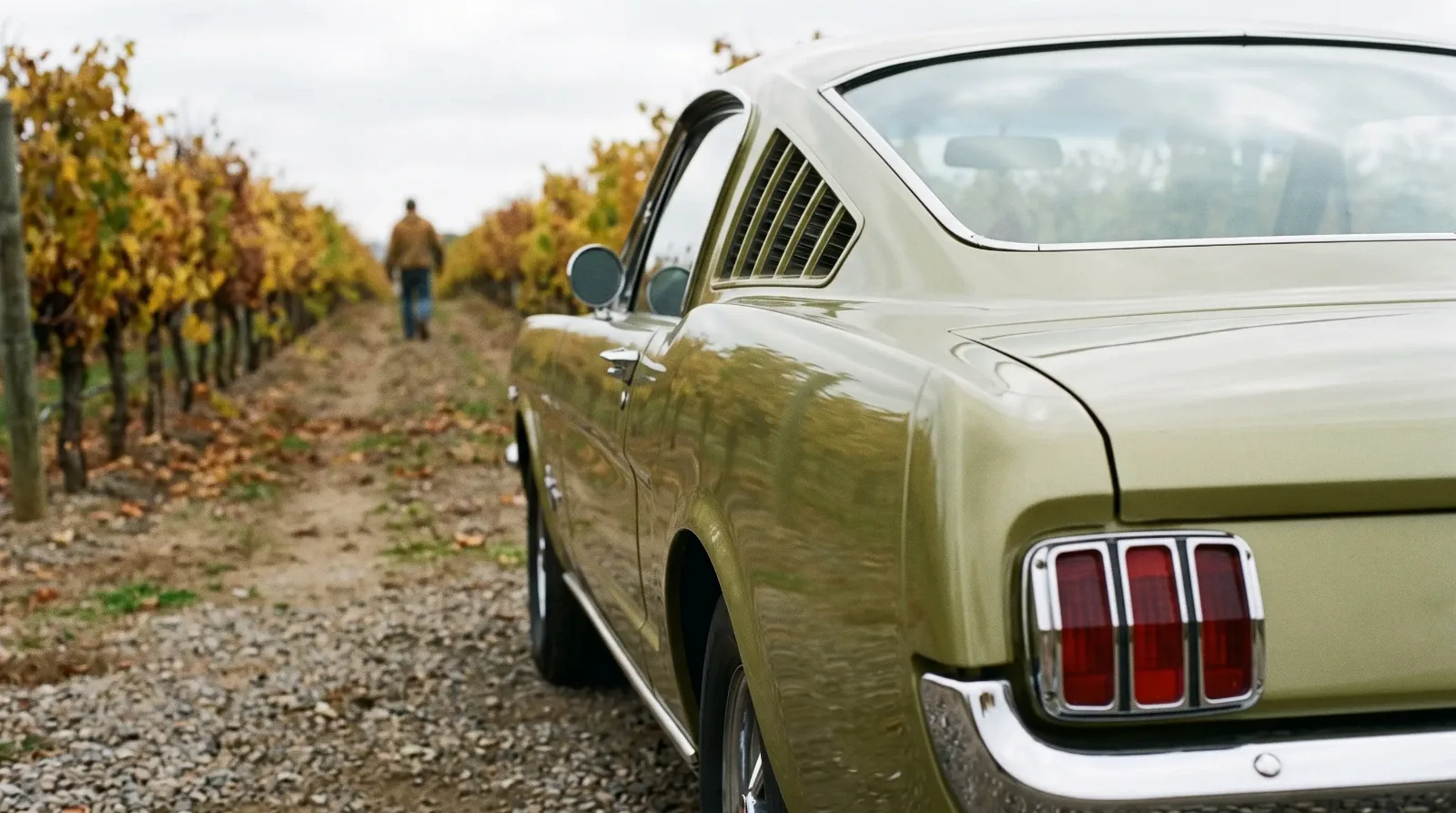
This glossary collects 73 terms you will hear around classic Mustangs from 1964½ to 2000, grouped by where they show up. The paperwork side of identification is covered here in depth; this page is the quick reference you keep open in another tab.
Body styles: hardtop, fastback, SportsRoof and the rest
Hardtop. Ford's name for the notched-roof coupe. On 1964½ to 1966 cars it carries data plate body codes 65A, 65B or 65C and VIN body code 07.
Convertible. Data plate codes 76A to 76C and VIN body code 08 on the early cars. The Mustang dropped it after 1973 and brought it back for 1983.
Fastback (2+2). The sloping-roof body, added in August 1964. VIN body code 09 in 1965 and 1966, 02 in 1967 and 1968.
SportsRoof. Ford's brochure name for the fastback from 1969. Same idea, new word.
Notchback. Fox-era shorthand for the coupe with a separate trunk lid, as opposed to the hatchback.
Hatchback. The lift-up rear door arrived on a production Mustang with the 1974 Mustang II.
T-top. Twin removable tinted glass roof panels, introduced on the Mustang II hatchback in mid-1977 and offered again on the Fox car from 1981.
Pony car. The class of compact, sporty, long-hood cars the Mustang started.
Model names and packages
GT. The GT Equipment Group, a performance and appearance package offered from April 17, 1965 through 1969. On 1965 and 1966 cars it required a four-barrel 289 (A or K code).
GTA. A GT with an automatic transmission. The "GTA" fender badge was used in 1967 only.
Grande. The luxury model, offered from 1969 as a hardtop only.
Mach 1. The SportsRoof performance model from 1969. The name carried over to the Mustang II and ran through 1978.
Boss. From designer Larry Shinoda's "the boss's car," the boss being Ford president Bunkie Knudsen. The Boss 302 was built so Ford could race in SCCA Trans-Am.
Boss 429. The big-block Boss built to meet NASCAR's 500-engine homologation rule: 859 in 1969 and 499 in 1970.
Boss 351. The 1971-only Boss, powered by an R-code 351 Cleveland HO; 1,806 were built.
Sprint 200. A 1966 six-cylinder package sold during the mid-year "Million Mustang Sale," with a chrome air cleaner, console and wire wheel covers.
High Country Special. A regional special for Ford's Denver sales district, sold from 1966 to 1968.
GT/CS. The 1968 California Special, a regional model for California dealers.
GT350H. The 1966 Shelby GT350 built for the Hertz rental fleet; about 1,000 went into service.
KR. "King of the Road," the 428 Cobra Jet Shelby GT500KR, built from April 1968.
Ghia. The Mustang II luxury model, named for the Italian design house Ford bought in 1970.
Cobra II. A 1976 to 1978 appearance package for the Mustang II hatchback, with stripes, spoilers and a simulated hood scoop.
King Cobra. The 1978 V8-only limited edition; 4,313 were built.
Stallion. A 1976-only appearance group with blacked-out trim and decals, shared with the Pinto and Maverick.
Cobra R. The stripped, race-oriented SVT Cobra, built in small runs for 1993, 1995 and 2000.
Mustang terminology under the hood
Engine talk is where the dialect gets dense, because Ford identified engines by a single VIN letter and owners turned those letters into nouns.
| Term | What it means |
|---|---|
| Thriftpower Six | Ford's official name for its 1960s inline six, built in Lima, Ohio |
| Code letter | The engine character in the VIN (fifth on 1960s cars): T, C, A, K and so on |
| Hi-Po (K-code) | The 289 High Performance V8: 271 hp, Autolite 4100 four-barrel, solid lifters |
| FE | Ford's big-block family, introduced 1958, home of the 390 and 428 |
| S-code | The 390 four-barrel, first big-block Mustang engine, 320 hp in 1967 |
| Windsor | The 351W: H-code two-barrel (250 hp) or M-code four-barrel (290 hp) in 1969 |
| Cleveland | The 351C, which replaced the 351W for 1970 |
| Cobra Jet | The 428 FE rated at 335 hp, on the regular line from April 1968 |
| Super Cobra Jet | A Cobra Jet with a stronger crank and 427 "LeMans" rods, tied to the Drag Pack |
| Drag Pack | The 3.91 or 4.30 axle option that brought the SCJ parts; no factory A/C |
| Ram Air | Functional hood-scoop induction |
| Shaker | A scoop bolted to the air cleaner, poking through the hood and moving with the engine |
| Toploader | Ford's four-speed, named for its top-mounted inspection plate |
| 9-inch | Ford's drop-out rear axle with a 9.00 in ring gear, replaced by the 8.8 in 1986 |
| Traction-Lok | Ford's limited-slip differential, offered with every engine from 1981 |
| 5.0 HO | The High Output 302; 225 hp in fuel-injected Fox form, 1987 to 1992 |
| Modular | The overhead-cam 4.6 V8 family, in the GT from 1996 |
| DOHC | The four-valve 4.6 used in the SVT Cobra from 1996 |
Trim, gauges and the parts you can see
Pony interior. The nickname for the 1965 and 1966 Interior Decor Group, from the running horses embossed on the seatbacks.
Rally-Pac. A column-mounted tachometer and clock, named for Ford's 1963 Monte Carlo Rally success and offered through 1966.
Five-dial cluster. The round five-gauge instrument panel, standard from 1966.
Corral. The chrome surround framing the running horse in the grille.
Tri-bar taillights. The three-segment lamps, already on the 1963 Mustang II concept and a styling signature ever since.
Magnum 500. A Motor Wheel Corp. wheel that debuted on the 1969 Boss 302 and Mach 1.
Torq Thrust. An American Racing aftermarket wheel, never a factory option, made famous by the Bullitt car.
C-stripe. The side stripe that curves along the body side, new for 1968 on the GT, Sprint and GT/CS, and reshaped for the 1969 Boss 302.
Hockey stick. The 1970 Boss 302 stripe shape, later a 1973 Exterior Decor Group option.
Hood pins. Twist-type pins on the 1969 and 1970 Mach 1 hood.
Cheese grater. Owner slang for the louvered taillights on the 1987 to 1993 GT.
Pony wheels. The 16-inch five-spoke "star" alloys on 1991 to 1993 V8 cars.
"Half of these words were written by Ford's marketing people and the other half by owners in parking lots. The owners usually win."
Patrick Walsh
Paperwork, eras and nicknames
VIN. The serial number. Pre-1981 cars use Ford's short format; 17 characters became mandatory from 1981. For the early format, start with decoding the VIN.
Data plate. The door-mounted warranty plate. On a 1965 car it lists body, color, trim, date, DSO, axle and transmission, and nothing that says "GT."
DSO. District Sales Office, the code for the sales district that ordered the car. Denver was 51; Los Angeles was 71.
Buck tag. A tag named for the assembly jig ("buck"), fitted before paint.
Marti Report. A build report drawn from Ford's production database; Marti Auto Works is the only licensee, and coverage starts with 1967.
Kar Kraft. The Brighton, Michigan, contractor that installed Boss 429 engines and assigned each car a KK number.
Numbers-matching. A car whose major components carry the numbers and codes they left the factory with.
Clone. A car dressed up as a rarer model it never was.
Survivor. In the Bloomington Gold program, a car over 20 years old that passes a road test and keeps its original engine.
Mustang II. The smaller 1974 to 1978 generation.
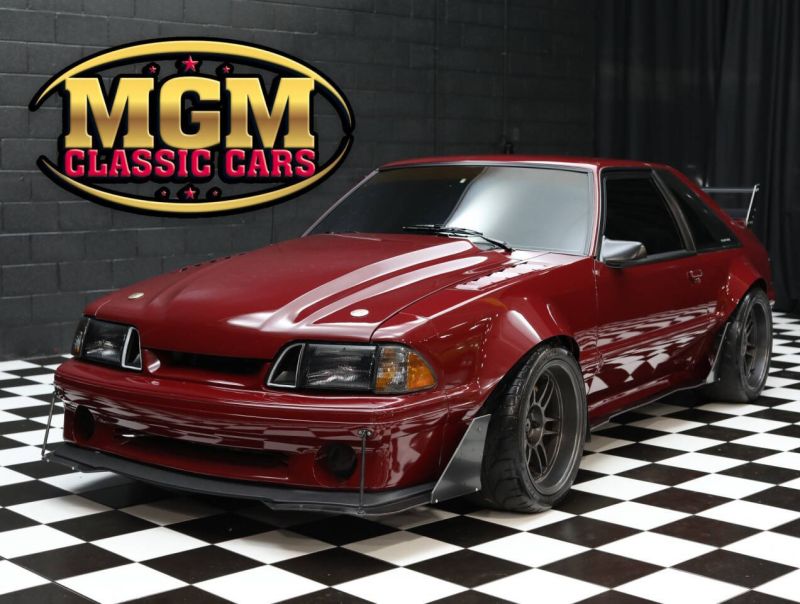
Fox body. The 1979 to 1993 Mustang, built on Ford's rear-drive Fox platform.
Four-eye. A 1979 to 1986 Fox with four rectangular sealed-beam headlamps.
Aero. The 1987 nose with flush aerodynamic headlamps, first seen on the 1985½ SVO.
LX. The plainer Fox trim; with the V8 it became the "LX 5.0."
SVO. Special Vehicle Operations, formed in 1980, and the turbocharged 1984 to 1986 Mustang it built.
SVT. Special Vehicle Team, which took over production-car tuning from SVO and launched the 1993 Cobra.
SN95. Ford's code name for the 1994 Mustang on the updated Fox-4 platform.
New Edge. The 1999 restyle in Ford's New Edge design language. Fourth-generation VINs and tags have their own logic, and the background is worth reading before you buy one.
Words follow the cars, and the cars follow history. If you want to see how each of these terms fits into the bigger arc, read a short history of the Ford Mustang with this page beside it.
Sources and notes
Related Reading
Have a
Ford Mustang
for Sale?
Reach thousands of serious classic car collectors across the US.
Sell It Here →
Selling a classic? Here's how: the best sites to sell a classic car
Are You a Classic Car Dealer?
List your full inventory and connect with targeted classic car buyers.
Join as a Dealer →
#mustang identification
#Ford Mustang
#classic Mustang
#SportsRoof
#Fox-body
#Mustang engine codes
#Mustang terminology
#Mustang glossary

About the author
Patrick Walsh
Automotive journalist covering classic car shows, events, and the enthusiast community across North America.
Related Listings - Ford Mustang

More in Car Features
Comments
Be the first to comment on this article.