
On a 1981 to 2000 Mustang, three characters of the VIN settle most arguments: the 8th, the 10th and the 11th. Engine, model year and plant. Read those right and you know whether the "GT" in front of you left Dearborn with a V8, and whether the year on the title is honest. That is the core of any fox body mustang vin decoder, and it carries over to the SN95 with one new letter for each new engine. The Mustang II, built before the 17-character standard, needs a different method, so we start there.
Car Features
7 min read
Decoding a Mustang II, Fox Body or SN95 VIN, 1974 to 2000
How to read a 1974 to 2000 Mustang VIN: Mustang II codes, the 17-character Fox and SN95 layout, and the engine letters that matter.
If your car is a 1964½ to 1973, the older 11-character system is covered in the classic Mustang VIN decoder. This guide picks up in 1974.
Mustang II, 1974 to 1978: the old 11-character format
The Mustang II kept the same 11-character layout as the first-generation car: one digit for the year, one letter for the plant, two digits for the body, one letter for the engine, then a six-digit serial. A VIN of 4F02Y229405 reads as 1974, Dearborn, hardtop, 2.3 four, serial 229405.
The plant letter on a US car is F for Dearborn or R for San Jose. The body codes are short and worth memorizing:
| VIN body code | Mustang II body | Ford body style code |
|---|---|---|
| 02 | Hardtop | 60F |
| 03 | Three-door hatchback | 69F |
| 04 | Ghia hardtop | 60H |
| 05 | Mach 1 hatchback | 69R |
Engine letters are just as simple: Y for the 2.3 four, Z for the 2.8 V6, F for the 302 V8. A Mach 1 with a Z in the engine slot is correct, because the V6 was standard on the Mach 1. A Mach 1 with a Y is not.
How the fox body mustang vin decoder works, 1981 to 1993
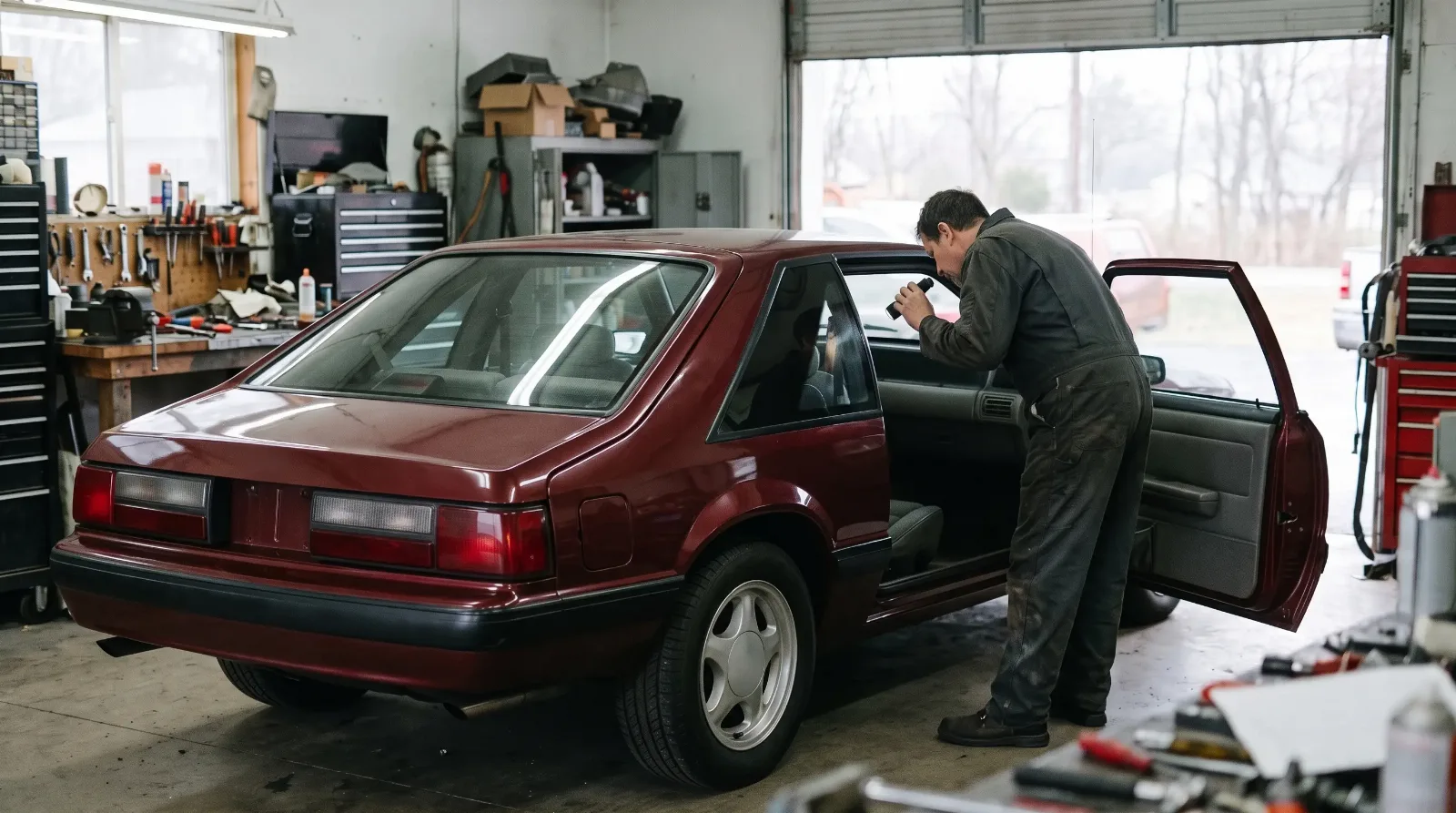
NHTSA standardized the 17-character VIN from the 1981 model year. The 1979 and 1980 Fox cars came before that and still carry the 11-character Ford layout described above, so a decoder built for 17 characters will not read them. The body codes carried over too: 02 is the coupe, 03 the hatchback, 04 the Ghia coupe and 05 the Ghia hatchback. A 1979 Indy Pace Car replica such as 9F03F486029 reads as 1979, Dearborn, hatchback, F for the 302. From 1981 on, every position has a fixed job. The ones that matter most for a Mustang:
Positions 1 to 3 identify the maker, and on the cars in this guide they read 1FA. Positions 5 to 7 are the body and series: P40 is an LX notchback, P41 an LX hatchback, P42 a GT. Position 8 is the engine. Position 9 is a check digit, calculated from the rest of the VIN, so a typo or a stamped-over character often makes it fail. Position 10 is the model year, from B for 1981 through Y for 2000, skipping I, O, Q, U, Z and 0. Position 11 is the plant: F for Dearborn, R for San Jose. San Jose built Fox Mustangs only through 1983; from about 1984 every US car is an F.
Take a real example: 1FABP41E4KF152360. P41 is an LX hatchback. E is the 5.0 HO. K is 1989. F is Dearborn. That is an LX 5.0 hatchback, and the VIN proves it without anyone's word. The broader story of those cars is in our Fox history, and you can read more here.
Engine codes by year: the 8th character
This is the character that separates catalog claims from real hardware. Ford reused and changed letters as the engines changed, so always read the engine letter together with the year letter.
| 8th character | Engine | Year seen |
|---|---|---|
| A | 2.3 four | 1982 |
| F | 5.0 V8 | 1985 |
| M | 5.0 HO, sequential injection | 1986 |
| E | 5.0 HO, EFI | 1987 to 1993 |
| T | 5.0 HO | 1994 GT |
| D | 5.0, SVT Cobra | 1994 to 1995 |
| X | 4.6 SOHC GT (Windsor-built engine) | 1996 to 1998 |
| W | 4.6 (Romeo-built) | 1996 to 1998 |
| V | 4.6 DOHC, SVT Cobra | 1998 |
| 4 | 3.8 V6 | 1998, 2000 |
The practical use is simple. A 1987 to 1993 "LX 5.0" with anything other than E in position 8 started life as a four-cylinder or V6 car. A 1996 to 1998 GT should show X or W. A 1998 Cobra shows V, and its body code also changes: 1FALP47V2WF100001 decodes as a 1998 Cobra with P47 in the body slot. The 1994 and 1995 Cobra does not match the GT either. It carries D in position 8 for its 240 hp 5.0, while the body slot still reads P42, the same as a GT coupe. NHTSA decodes 1FALP42DXRF226479 as a 1994 Cobra coupe built in Dearborn, so on these two years the engine letter is what separates a real Cobra from a GT wearing Cobra parts.
"A window sticker can be faked and a badge costs twenty dollars. The 8th character was stamped before anyone had a reason to lie about it. Start there."
Dan Reeves
SN95, 1994 to 2000: same system, new letters
The SN95 used the same 17-character system, and every SN95 came from Dearborn, so position 11 should always read F. The body codes simplified because the notchback and hatchback were gone: P40 is the V6 coupe, P42 the GT coupe, P44 the V6 convertible. A 1994 GT reads like 1FALP42T2RF100001, with T for the 5.0 and R for 1994. A 1998 GT reads 1FAFP42X2WF100001, with X for the 4.6 and W for 1998. A 1998 V6 coupe is 1FAFP4042WF100001, with 4 for the 3.8.
Watch the year letters around the change. R is 1994, S is 1995, T is 1996, V is 1997, W is 1998, X is 1999, Y is 2000. Note that T and X appear as both engine codes and year codes in this period. Position matters: in the 8th slot T is the 5.0, in the 10th slot it means 1996.
What the VIN cannot tell you
The VIN is a summary, not a build record. It does not carry paint, trim, axle ratio or most options. For those you need the door label and, for anything from 1967 through 2020, a Marti Report, which comes from Ford's production database and lists the options the car left the factory with. It does not list dealer add-ons and does not judge condition. Tag layouts were not identical across these years, so decode any tag with a chart for that exact model year and compare it against a known-good car of the same year.
Tuner cars add one more layer. Saleens, for example, carry a Saleen registry number alongside the Ford VIN, and both are worth checking. A Ford VIN on its own only proves the donor car. The same discipline applies when you look at survivor cars, where an original VIN is the minimum, not the proof.
If you want the bigger picture of where these three generations sit, our overview of the Mustang from 1964 to 2000 lays out the timeline. And when you are ready to put the decoder to work on real cars, browse the Fox Body Mustangs for sale and read the 8th character first.
Sources and notes
- Vehicle identification number, Wikipedia: the 17-character standard, check digit, model-year and plant positions
- NHTSA vPIC decode of 1FABP41E4KF152360, a 1989 LX 5.0 hatchback
- NHTSA vPIC decode of 1FALP42DXRF226479, a 1994 SVT Cobra
- MustangSpecs: 1974 Mustang II production by body code and VIN code
- MustangSpecs: 1979 Ford Mustang production by body and VIN code
- Marti Auto Works: Marti Report coverage and contents
Related Reading



Have a
Ford Mustang
for Sale?
Reach thousands of serious classic car collectors across the US.
Sell It Here →
Selling a classic? Here's how: sell my classic car
Are You a Classic Car Dealer?
List your full inventory and connect with targeted classic car buyers.
Join as a Dealer →

About the author
Dan Reeves
Performance engine builder from North Carolina's motorsports corridor, focused on swaps, forced induction and making real, repeatable power.
Related Listings - Ford Mustang




Comments
Be the first to comment on this article.