The last Oldsmobile Cutlass rolled off a line that had built more of them than any other Oldsmobile in history, and almost nobody outside Lansing noticed the day it happened. There was no parade for the final Cutlass the way there would be, five years later, for the final Oldsmobile of any kind. That is the strange shape of this story. The nameplate that carried Oldsmobile through its best decades did not go out with a bang. It just stopped, quietly, in 1999, while the brand itself staggered on for a few more years before General Motors closed the book entirely.
To understand how a car this popular could disappear this quietly, you have to look at what Oldsmobile had become by the time the last Cutlass was built, and why the corporation above it had already decided the brand's fate.
A nameplate stretched past recognition
By the late 1990s, the Cutlass name had been asked to do almost too much work for almost forty years. It had covered a mid-size coupe, a personal luxury car, a muscle machine, a diesel sedan, a station wagon, and finally a front-wheel-drive sedan built on the same architecture as the Chevrolet Malibu. Each version made sense in its moment. Stacked together, they told a story of a badge stretched thinner every decade, applied to whatever body GM needed a trim level attached to.
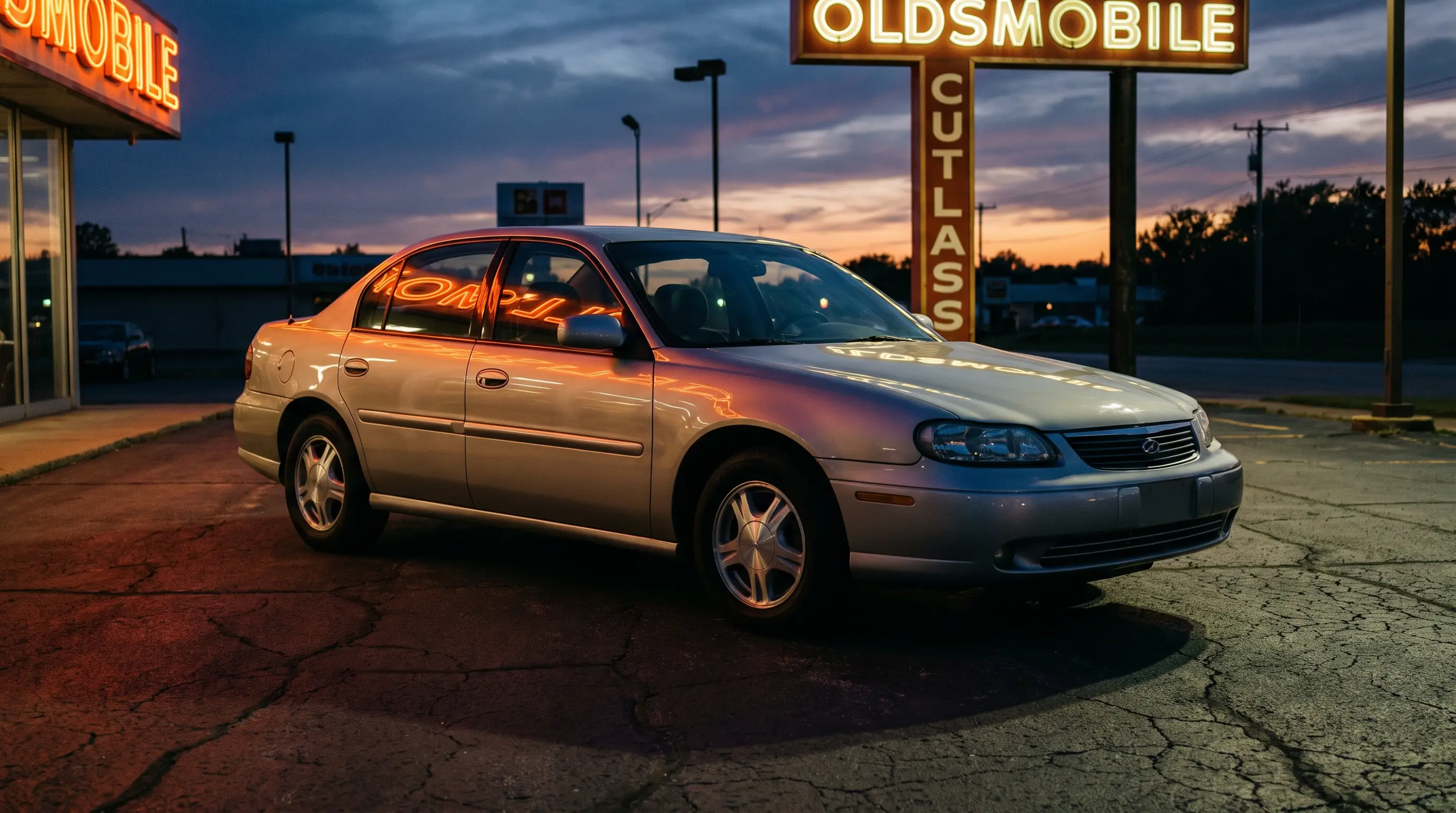
The final Cutlass, sold from 1997 through 1999, was a competent front-drive sedan with a V6 and a reasonably comfortable interior, built alongside the Chevrolet Malibu on GM's N-body platform. Its first year was short, since Malibu and Cutlass production was just ramping up, but 1998, its first full model year, brought roughly 53,000 Cutlass sedans built, a respectable number for a car wearing a badge that was already fading. It was not a bad car. It was simply no longer a distinct one. Buyers cross-shopping it against the Malibu it was built alongside had little reason to pay extra for the Oldsmobile badge, and that erosion of identity had been building for years across the whole lineup.
The corporate decision that ended the brand
The Cutlass name quietly retired after the 1999 model year, but the bigger news came the following December, when General Motors announced it would wind down the entire Oldsmobile division. The reasoning was blunt. Oldsmobile's sales had fallen for years, its buyers were aging out faster than new ones arrived, and GM's dealer network had more brands than the market could support. Oldsmobile, America's oldest surviving automobile marque, tracing back to Ransom E. Olds in 1897, was the one GM chose to close.
That decision landed hard in Lansing, Michigan, where Oldsmobile had built cars for generations and where whole families worked the same assembly lines their parents had. The wind-down took years rather than months. GM kept the brand limping through a run of final-edition trucks and sedans, honoring warranties and easing dealers out of their franchise agreements, but everyone involved understood the outcome from the day of the announcement. The question of why the Cutlass endures as a name people still recognize, decades after it stopped appearing on a showroom floor, has everything to do with what came before this ending and little to do with how the ending itself was handled.
The final car and the final five hundred
On April 29, 2004, the last Oldsmobile ever built came off the Lansing line, an Alero GLS sedan finished in Dark Cherry Metallic, numbered 500 of 500 in a commemorative run GM called the Final 500. Workers signed the inside of the fender before it went down the line, and Oldsmobile flew banners outside the plant that read, simply, that the final chapter had closed. It was a dignified send-off for a brand that had spent its last years fading rather than failing outright, and it stood in sharp contrast to how quietly the Cutlass name itself had disappeared five years earlier.
The gap between those two moments matters. The Cutlass did not die alongside Oldsmobile. It died first, on its own, without ceremony, while the brand around it kept building cars under other names for a few more years. Only in hindsight does the retirement of the Cutlass read as the opening act of the Oldsmobile's closing chapter.
What the ending meant for owners and collectors
For people who already owned a Cutlass when the news broke, the brand's closure changed very little day to day. Parts supply held up reasonably well for years afterward, since GM had built millions of these cars across four decades and the used market was flooded with donor vehicles. What changed was psychological. A car that had once belonged to an active, ongoing brand now belonged to history, full stop, and that shift is part of why interest in preserving good examples has only grown since.
| Milestone | Date |
|---|---|
| Final Cutlass model year | 1999 |
| GM announces Oldsmobile closure | December 2000 |
| Final Oldsmobile built (Alero GLS, Final 500) | April 29, 2004 |
| Oldsmobile founded | 1897, by Ransom E. Olds |
"There is something almost merciful about a car company that closes slowly instead of collapsing overnight. Oldsmobile got to say goodbye properly, even if the Cutlass, the car that made the brand's name for two generations, slipped out the back door a few years earlier without anyone throwing it a party."
— Patrick Walsh
Younger buyers coming into the hobby now often discover the Cutlass with no memory of the brand it came from ever existing, which changes how they relate to the car. There is a companion piece that looks at exactly that shift, and how a generation with no Oldsmobile dealership memories has still found its own reasons to love this nameplate.
Looking back at what was lost
What Oldsmobile's closure really cost the industry was a brand willing to experiment. Oldsmobile had built America's first mass-produced automobile, pioneered the automatic transmission, and later gambled on turbocharging and front-wheel drive years before rivals caught up. The Cutlass carried a share of that experimental spirit through its muscle years and its personal luxury years alike, even as the badge diluted around it in its final decade.
None of that history disappeared when the plant went quiet in 2004. It moved into garages and driveways, into the hands of people who kept the good examples running long after the parent company stopped existing. That is where the story lives now, and it is a better ending than the sales charts from the late 1990s ever suggested the nameplate deserved. Anyone drawn into this history by the ending should know the beginning is just as easy to find: a classic Oldsmobile Cutlass for sale is still out there, waiting for someone willing to carry the story forward.