
The production records from this period are clear on a point most people never learn in school: for a decade or more, electric cars were not a fringe experiment. They were a legitimate, well-selling category, built by dozens of manufacturers, and by some counts they briefly outsold their gasoline competitors in the American market. The electric car is not new. It is a technology that lost a first race a hundred years before it won a second one.
Car Features
7 min read
Electric Cars of the 1900s-1910s: Forgotten EVs
Electric cars were a legitimate, well-selling category in the 1900s and 1910s, not a novelty. Here is what killed their first run at the market.
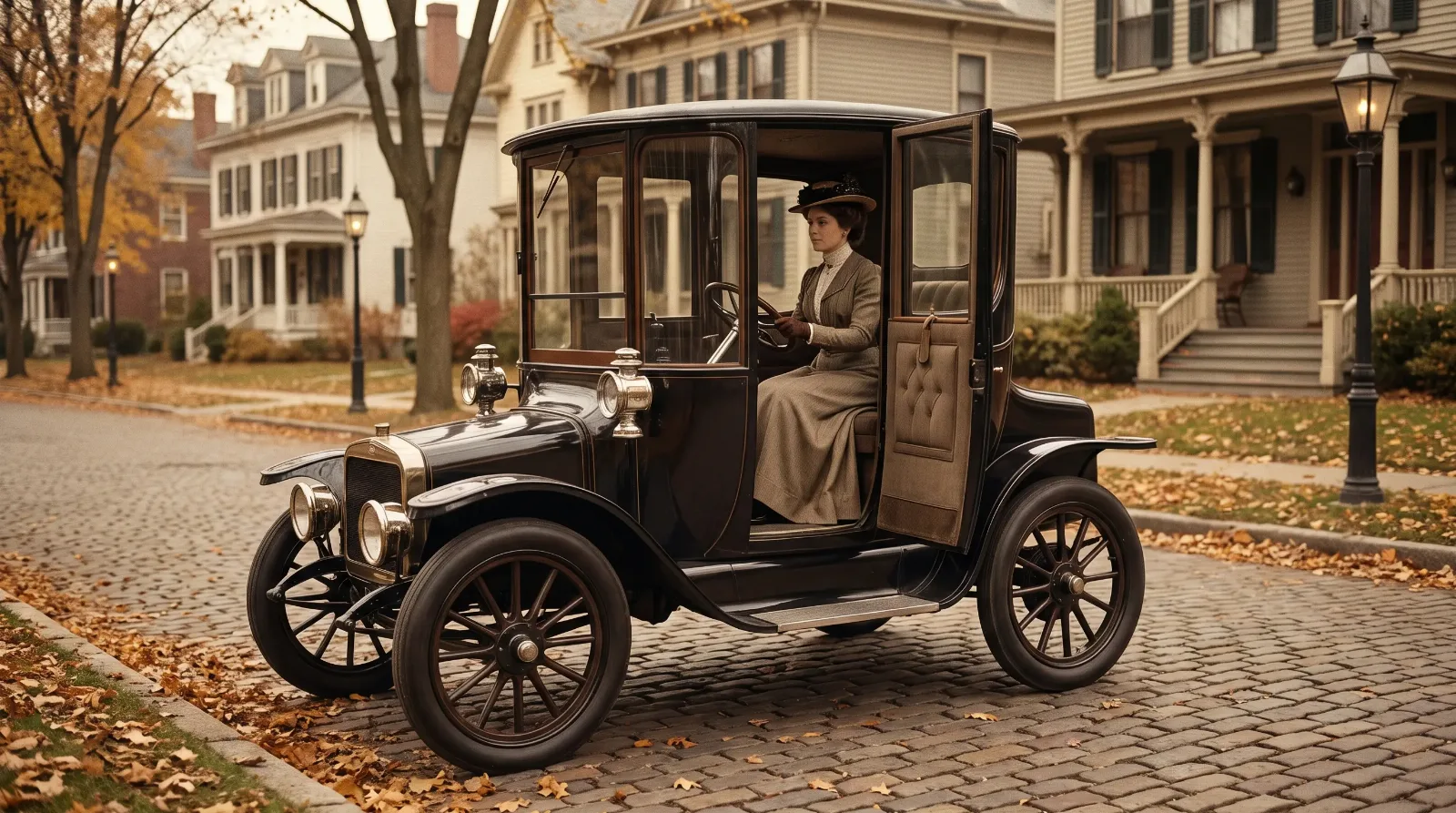
What the electric car actually was in 1905
Companies like Detroit Electric, Baker, Columbia, and Woods built electric vehicles through the first two decades of the twentieth century, and the cars were genuinely good at what they were designed to do. No hand crank, no gear shifting, no exhaust smell, and a smooth, quiet ride that a gasoline car of the same period could not match. You pressed a control and it went. Compared to a gasoline car that needed skill, strength, and a bit of luck to start, the electric was simple enough that it did not intimidate a new driver.
Detroit Electric in particular built cars all the way into 1939, far longer than most people assume, and Thomas Edison himself worked on improved battery chemistry hoping to extend range, a project he pursued for years with mixed commercial results.
The range problem that never got solved
A typical electric car of this era was advertised at 80 miles or more on a charge, with Detroit Electric and Baker both claiming figures in that range, though real-world driving with hills, cold weather, and stop-and-start city traffic often cut that number down. Recharging took hours, not minutes. That was workable for city errands and short trips between fixed points, which is exactly how these cars were marketed and exactly how they were used. It was not workable once American road trips started stretching further, and it was never going to compete with a gasoline car that could refuel at a general store in five minutes and keep going another hundred miles.
The battery technology of the day, mostly lead-acid, was heavy, slow to charge, and lost capacity over its life in ways that owners felt directly. Nobody figured out how to fix that with the materials science available at the time. It took closer to a century of battery development before that particular problem had a real answer.
Weight compounded the problem in a way that is easy to overlook. A lead-acid battery pack heavy enough to move a car any real distance also made the car itself heavy, which in turn drained the battery faster, a loop that engineers of the day understood but could not break with the chemistry available to them. Add cold weather, which sapped lead-acid capacity even further, and an owner in a northern winter might see their already modest range shrink by a third or more, right when short daylight hours made reliable range matter most.
Read the early electric cars history story for how electric power stacked up against its steam and gasoline rivals in the same years, because all three were genuinely competing for the same buyers.
The self-starter changes everything
The electric car's entire pitch rested on one advantage: gasoline cars were hard and occasionally dangerous to start. Once Charles Kettering's electric self-starter appeared on the 1912 Cadillac and spread across the gasoline industry within a few years, that advantage disappeared almost overnight. A gasoline car became just as easy to start as an electric one, while still offering better range, faster refueling, and a lower price once mass production brought costs down.
From there the electric car's market share fell fast. By the early 1920s it had become a niche product, and by the 1930s most of the manufacturers that had built electrics in the boom years were gone or had switched entirely to gasoline. The technology did not fail because it was bad. It failed because the one problem it solved, hard starting, stopped being a problem for its competitor.
"I look at the production ledgers from this period and the story is not that the electric car was a novelty act. Real companies built real numbers of these cars and sold them at a profit for years. What changed was not the electric car getting worse. It was gasoline getting easier to live with, and once that happened the electric's one clear advantage was gone."
Tom Ramirez
What survives and what it is worth
Original brass era and early 1910s electric cars are genuinely rare today, more so than comparable gasoline cars from the same window, partly because fewer were built and partly because batteries and drivetrain components have not survived a century of storage the way a cast iron gasoline engine block generally does. A running, correctly restored Detroit Electric or Baker Electric draws real interest at shows, both for the novelty and for the direct line it draws to the electric vehicles being sold again today.
If you come across one, expect the interior details to be a strong selling point. These were often built with a level of coachwork attention closer to a formal carriage than a utilitarian gasoline runabout, since they were marketed toward a wealthier, often urban buyer who wanted comfort as much as motion.
Mechanically, an electric car from this period is a different kind of restoration project than a gasoline one. There is no engine to rebuild in the traditional sense, but the motor controller, the battery tray, and the original charging equipment are specialized pieces that few shops today have direct experience with. Finding a restorer who has actually worked on one of these drivetrains before, rather than one who is learning on your car, is worth the extra search time.
The bigger picture
The early electric car is a useful reminder that technological progress does not move in a straight line. An idea can be genuinely good, sell well, and still lose to a competitor that simply solves its own weaknesses faster. That is exactly what happened here, and it is worth keeping in mind anytime somebody tells you a new technology's early struggles prove it will never work. The electric car proved the opposite, eventually, just a century later than anyone at Detroit Electric expected.
For more on the era that shaped these competing technologies, the next story looks at what the brass era actually was and why the name has nothing to do with any single power source. And for the full arc of what came after, from the Model T's black paint to the classics that followed, our pre-war era guide picks up the thread.
Sources and notes
Related Reading
Have a
Classic Car
for Sale?
Reach thousands of serious classic car collectors across the US.
Sell It Here →
Are You a Classic Car Dealer?
List your full inventory and connect with targeted classic car buyers.
Join as a Dealer →

About the author
Tom Ramirez
Corvette researcher and historian based in Bowling Green, Kentucky. Two decades documenting Corvette production history from original factory records.




Comments
Be the first to comment on this article.