
The Model A is usually filed under Henry Ford's name, and the engineering record supports that up to a point. The shape of the car is another matter. Ask who decided how the 1928 Ford would look, how its colors would be chosen and what its radiator and body lines would borrow, and the documents point to his son. The Edsel Ford Model A connection is the reason the car read as a modern automobile in December 1927 rather than as a Model T with a new engine.
Car Features
7 min read
Edsel Ford and the Styling of the Model A
How Edsel Ford shaped the look of the 1928 Model A: the baby Lincoln styling, the colors, safety glass and the first Ford blue oval.

This article looks at that contribution as a design historian would: what Edsel controlled, where his ideas came from, what evidence survives on the cars themselves, and where the sources stop. For the mechanical side of the changeover, see our Model T to Model A guide.
A president with limited authority
Edsel Ford was born on November 6, 1893, and became president of the Ford Motor Company in 1919. The exact day is disputed between Ford's heritage pages and other references, so the year is the safe statement. The title was real; the power was not complete. Henry Ford kept final authority, and Edsel was repeatedly overruled in his efforts to replace the Model T.
His design instincts show up well before the Model A. He urged styling changes to the Model T in 1923 and again in 1925, and his father eventually allowed color back onto the car. The 1926 to 1927 Improved Model T could be had in Fawn Gray, Royal Maroon or Highland Green, with a nickel radiator shell standard on the Coupe, Tudor and Fordor. These were modest changes on an old chassis, but they read now as rehearsals. Edsel was testing whether Ford buyers would respond to color and brightwork, and they did.
The pressure that finally moved Henry came from outside. Chevrolet passed Ford in 1927, and General Motors had bet on owners trading up for comfort and style. In late 1926 Henry directed his engineers to begin work on a new car. The arguments that preceded that decision are covered in the father and son fight; what matters here is that once the work began, the body was Edsel's.
Why the Edsel Ford Model A looked like a small Lincoln
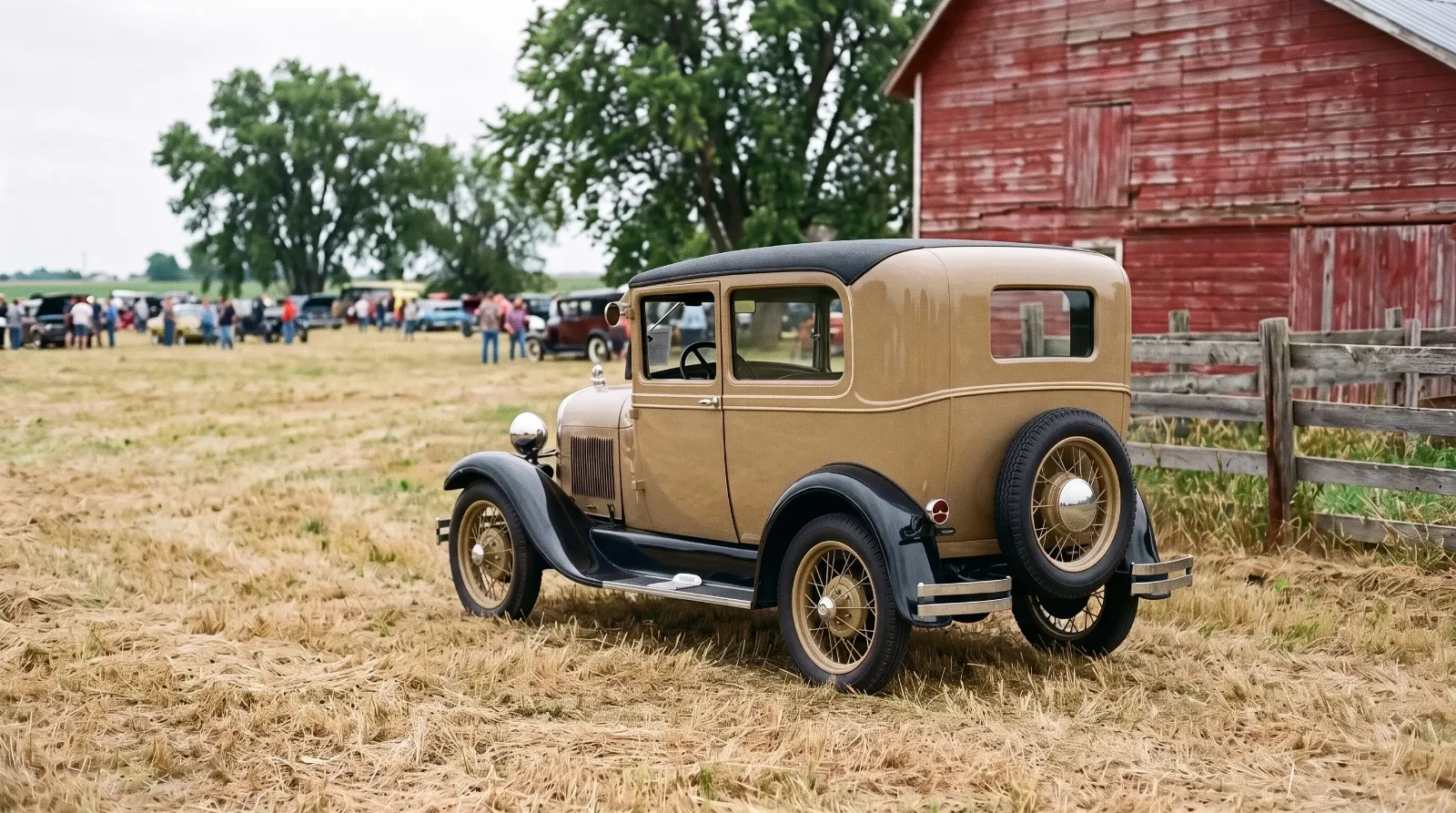
Ford had bought Lincoln in 1922, which gave Edsel a luxury division and a body of coachwork practice that the Model T world had never needed. The Model A's styling was directed by Edsel and was described as a "baby Lincoln." The phrase is worth taking at face value. The new Ford took the vocabulary of a costly car, a tall, crisply edged radiator shell, a hood line that ran cleanly back to the cowl and well-proportioned fenders, and reduced it to a price that started at $385 for the 1928 Roadster.
The people around him matter to the attribution. Edsel developed the body with József (Joe) Galamb, the Hungarian-born engineer who had been central to the Model T. Sources differ on Galamb's exact Model A role: some credit him with the body alongside Edsel, another with the chassis and suspension. The careful statement is that he worked with Edsel on the new car. One enthusiast-press source also names Lincoln chief engineer Frank Johnson on the wider project team under Eugene Farkas, with Lawrence Sheldrick. That is a single source, but it fits the Lincoln influence that everyone agrees on.
"The surviving cars are the best witness. Stand a 1928 Tudor beside a 1927 Tudor and the bodies share a name and almost nothing else. Proportion, color and the treatment of the radiator were decided by someone who had studied expensive cars closely."
Sarah Whitfield
Edsel's reach did not end at the sheet metal. Charles Sorensen later recalled that Edsel spotted an intake manifold deficiency during engine development, and fixing it gave a significant gain in power. Wikipedia's biography also credits him with persuading Henry to accept the sliding-gear transmission and four-wheel brakes. Neither point makes him an engineer. Both show a president who looked at the whole car.
Color, glass and the blue oval
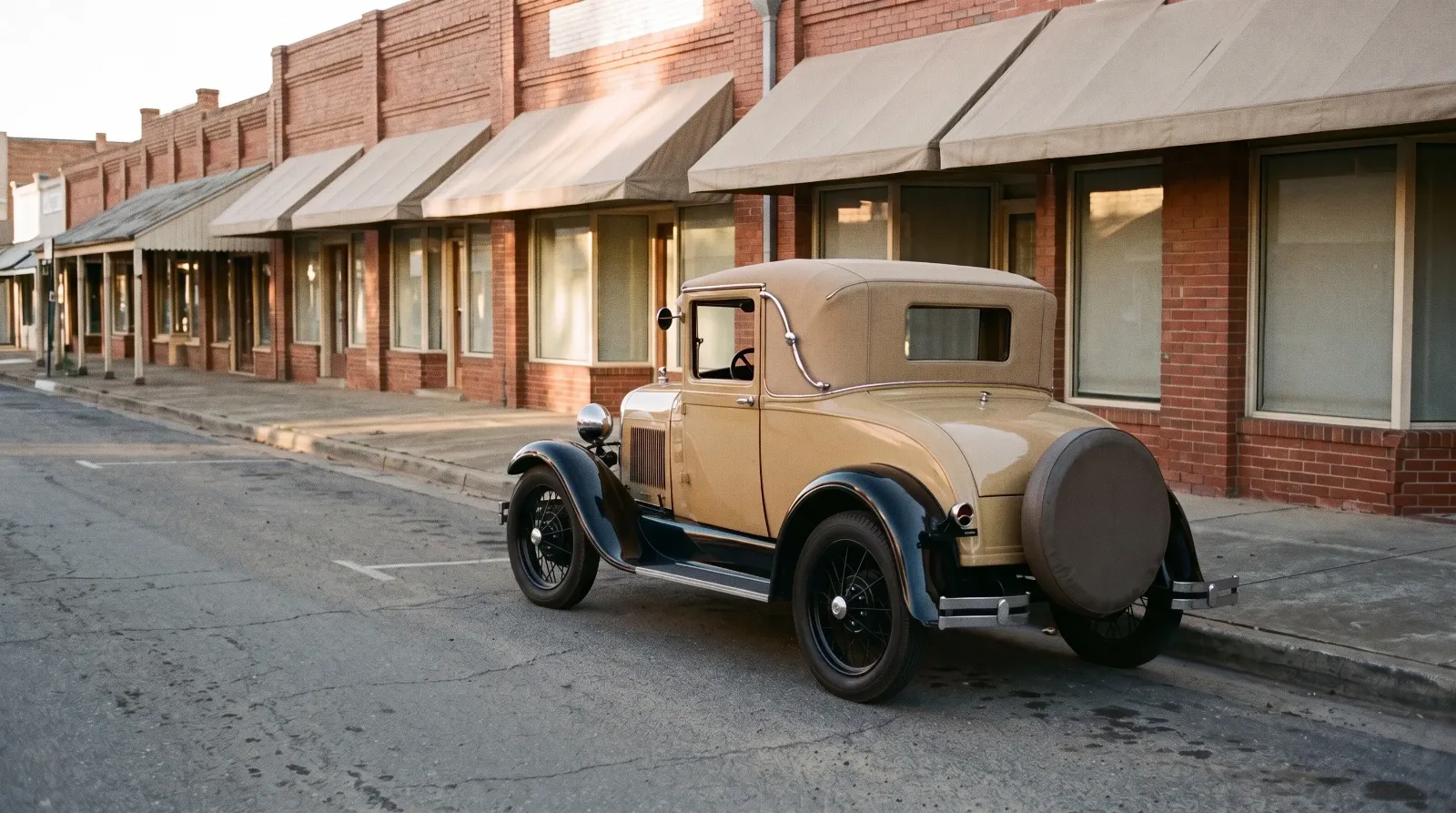
Color was the clearest break with the Model T. The Model A Ford Club of America's paint chart lists dozens of body colors across the run. Among the 1928 shades are Arabian Sand, Niagara Blue in light and dark tones, Dawn Gray, Gunmetal Blue, Rose Beige and Copra Drab. These are subdued, period-correct earth and sky tones, and their survival as documented codes is what lets a restorer today paint a car the way it left the Rouge.
| Color | Years | Code (DuPont / PPG) |
|---|---|---|
| Gunmetal Blue | 1928 | DS151 / 436 |
| Arabian Sand Light | 1928 | G8883 / 432 |
| Andalusite Blue | 1928 to 1930 | G8592 / 121 |
| Rose Beige | 1928 to 1929 | DS086 / 119 |
| Copra Drab | 1928 | DS094 / 440 |
The glass has a personal story behind it. According to Ford's own heritage page, Edsel pushed for safety glass after a friend was badly cut in a 1926 accident. The Model A brought laminated safety glass to the low-price market as standard in the windshield: two layers of glass around a plastic interlayer. The claim is about the windshield in the low-price field, not every window and not the first car anywhere.
The badge is the smallest detail and perhaps the longest lasting. Ford's own account lists the 1928 Model A as the first Ford to carry the blue oval. Owners who wanted a finishing touch could add the official radiator-cap accessory, the Quail mascot, made by Stant in 1928 to 1929 and 1930 to 1931 versions.
Body styles as a design program
A styling program shows its quality in how it scales. The Model A ran from roadsters and phaetons through coupes, Tudor and Fordor sedans, cabriolets and a Town Car that listed at $1,200 in 1929 and 1930. Each was a variation on one front end and one set of proportions, which is why the line holds together visually. For the individual bodies and their style numbers, see the Model A bodies explained.
Two later additions deserve mention because they extend the Lincoln idea downward. For the 1929 model year Ford became the first of the Big Three to offer a factory-built station wagon, and RM Sotheby's states that Edsel commissioned it. In November 1930 came the Victoria, with a slanted visorless windshield and a bustle back. Edsel had followed the Victoria style among Lincoln's coachbuilt bodies, and he is credited with championing it at Ford. The 1930 restyle itself raised the hood and radiator, switched the shell to stainless steel and cut the wheels from 21 inches to 19, which made the whole car sit lower. No source we found documents his personal hand in the details of that restyle, so the safe statement is that it continued the direction he set in 1927.
Edsel Ford died on May 26, 1943, at 49. The Model A is where his eye first reached millions of ordinary buyers, and the cars that survive still carry it.
Sources and notes
- Wikipedia: Edsel Ford
- Ford Motor Company heritage page: Edsel Ford (archived copy)
- The Henry Ford: 1930 Ford advertising proof, "An Admired Grace of Line and Contour"
- Model A Ford Club of America: Model A paint codes
- Mac's Motor City Garage: Edsel's favorites, the Ford Victorias
- The Henry Ford: Ford Model A station wagon
Related Reading



Have a
Ford Model A
for Sale?
Reach thousands of serious classic car collectors across the US.
Sell It Here →
Selling a classic? Here's how: sell my classic car
Are You a Classic Car Dealer?
List your full inventory and connect with targeted classic car buyers.
Join as a Dealer →

About the author
Sarah Whitfield
Third-generation classic car collector specializing in pre-war American and European coachbuilt automobiles. Researcher and concours enthusiast.
Related Listings - Ford Model A

Comments
Be the first to comment on this article.