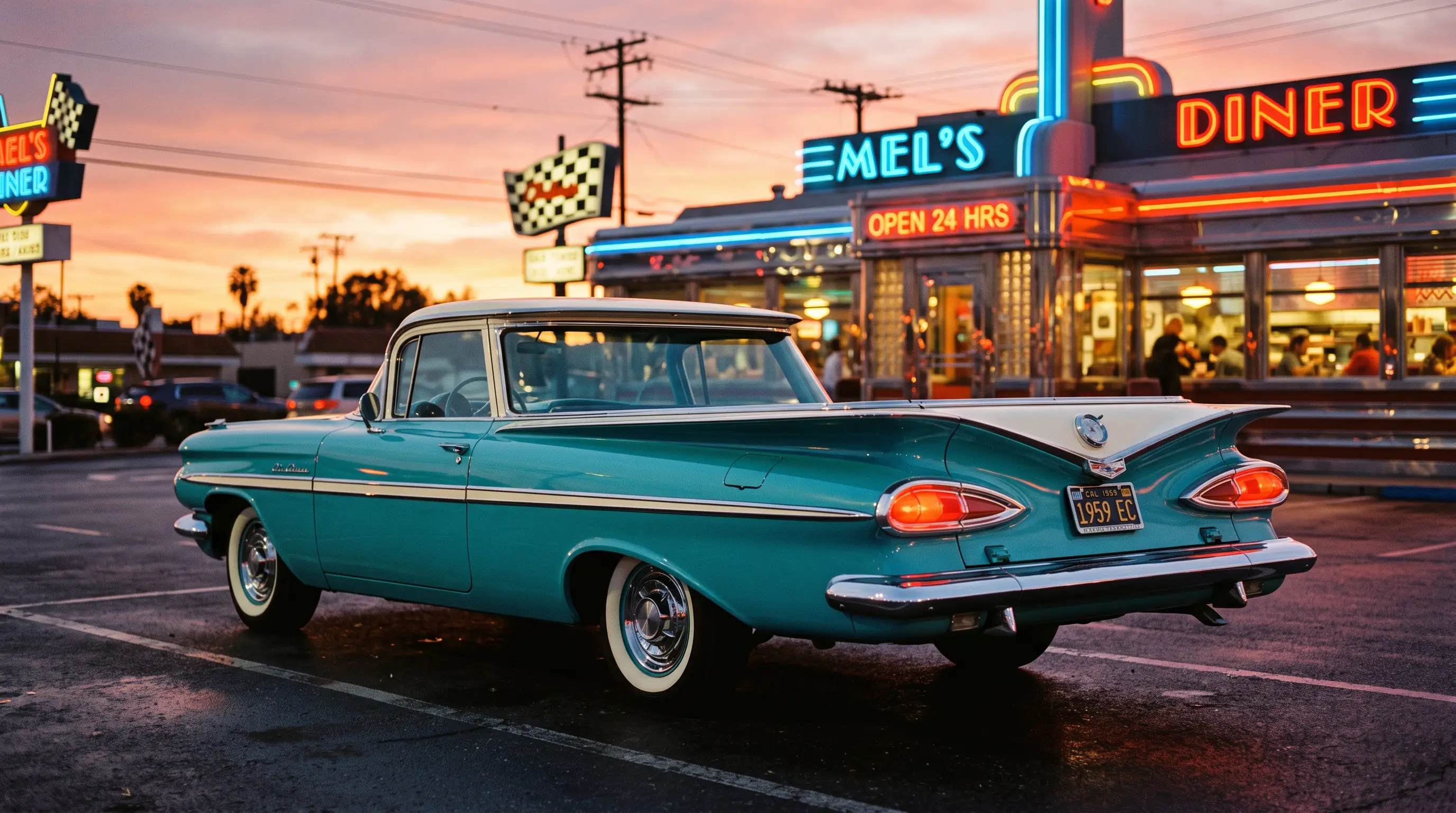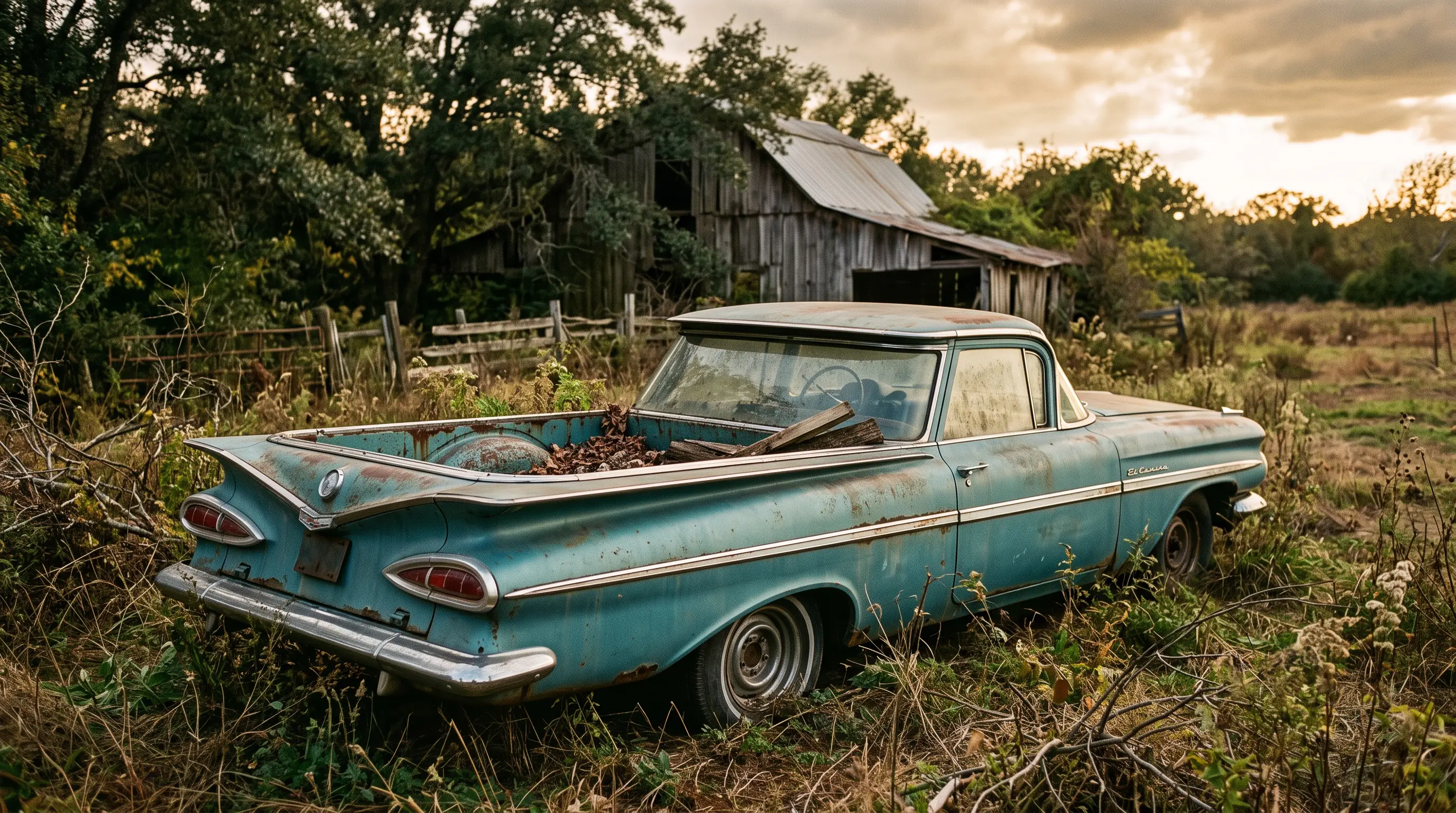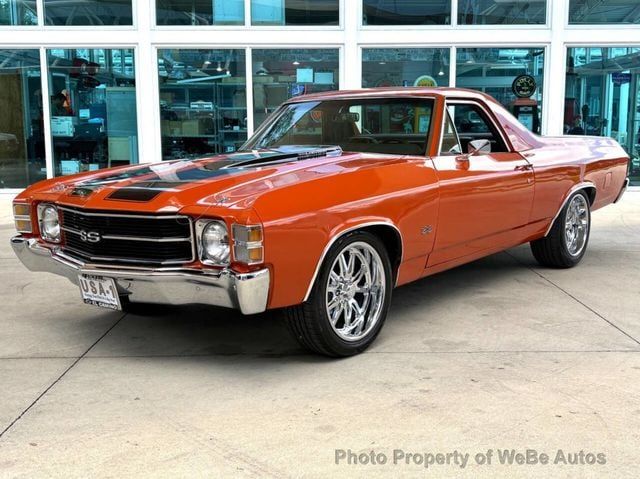
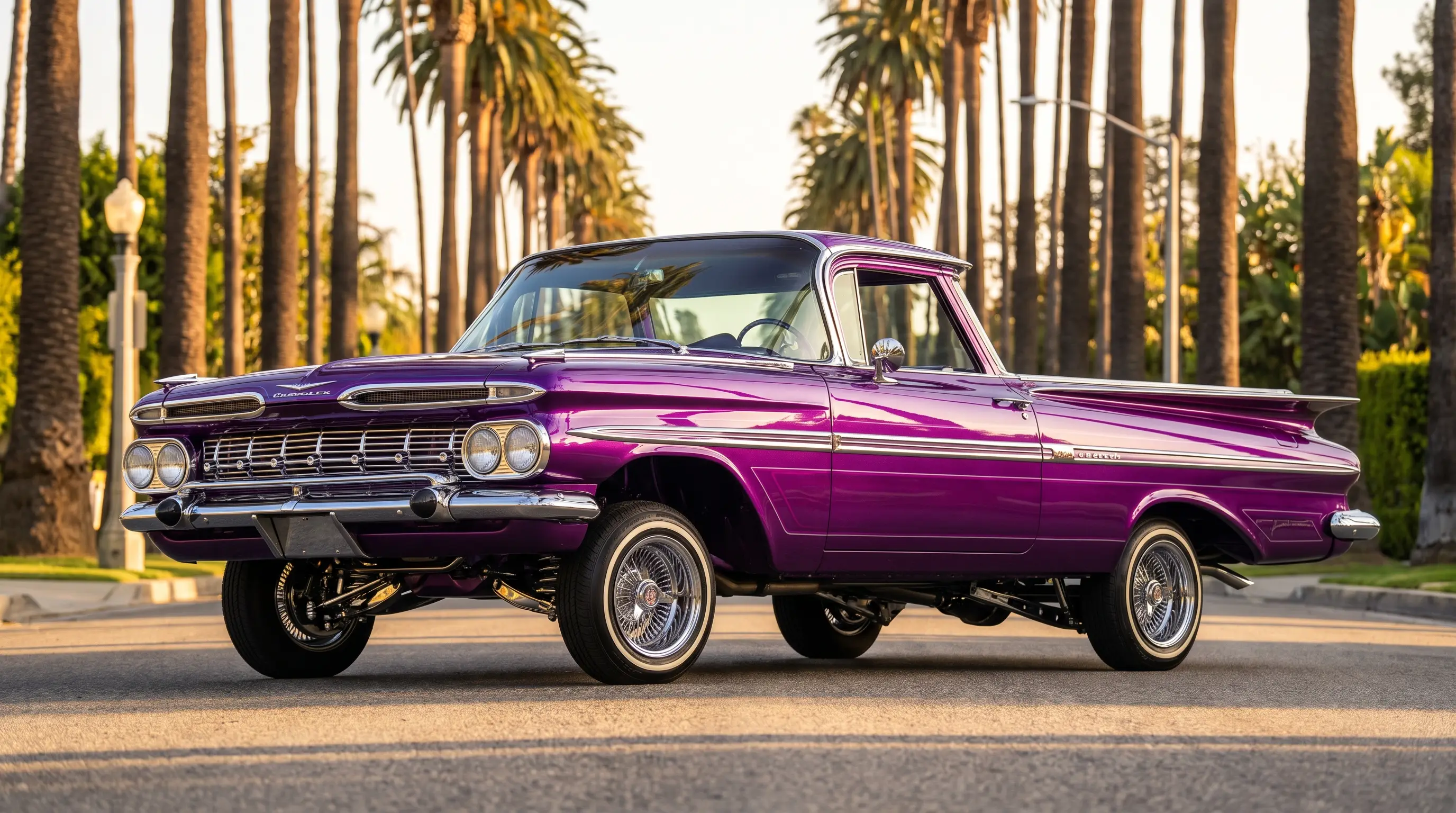
The 1959 Chevrolet El Camino was already the wildest shape the company ever put on a factory hauler before a single owner ever touched it with a paint gun. It is no real surprise, then, that this specific model year became a favorite canvas in kustom and lowrider circles once these cars started aging out of daily use and into the hobbyist market. A body already built around drama gives builders something to work with rather than against, and that relationship between factory styling and later customization is a real thread running through how this car is remembered today.
A shape that customizers did not have to fight
Kustom culture, rooted deeply in the postwar Southern California hot rod scene, has always favored cars with strong, sweeping lines that a builder can chop, channel, or lower without fighting the factory proportions. The 1959 El Camino's horizontal batwing fins, its low beltline, and its wraparound windshield gave builders a body that already read as low and wide before any modification began. Dropping the stance or reworking the trim on a car like this tends to amplify what Chevrolet's stylists were already doing rather than fight against a more upright or conservative factory shape.
That same quality made the 1959 body attractive to lowrider builders working in a different but related tradition, one that emphasizes hydraulics, deep paint, and detailed pinstriping over the aggressive chopped rooflines more associated with kustom builds. A car with dramatic factory fins gives a painter more surface and more visual incident to work with when laying out a mural or a graphic pattern, and the El Camino's fin shape in particular has shown up as a design element inside custom paint jobs, not just underneath them.
The cargo bed itself opens up possibilities neither a sedan nor a wagon offers a builder. That flat steel floor behind the cab has served as a display surface at shows, sometimes carrying a second, smaller custom presentation inside the bed itself, trophies, club banners, or a themed diorama tied to the paint scheme up front. Few other body styles from this era hand a builder that kind of extra canvas, and creative use of the bed has become its own small tradition within the wider culture surrounding these cars.
Community, not just craftsmanship
What keeps a car like the 1959 El Camino relevant in these scenes is not only what a shop does to one, but who shows up when it rolls into a parking lot. Car clubs built around lowrider and kustom traditions have long treated events as gathering places as much as competitions, spaces where builders trade knowledge, families bring folding chairs, and a well-known local car becomes a fixture people recognize by sight before they recognize the owner's name. A distinctive body like the batwing El Camino tends to become exactly that kind of fixture, since its shape is memorable even to people who do not follow the hobby closely.
That community dimension matters as much as any individual build. A car passed through a family or a club over decades accumulates a reputation that outlasts any single paint job or set of wheels, and long-time members of these scenes often talk about specific El Caminos the way other communities talk about people, by history and relationships rather than only by specifications.
Multi-generation ownership shows up often in these circles too. A grandfather buys a running 1959 El Camino cheap in the 1970s or 1980s, a son or daughter inherits it and starts the first real custom build, and a grandchild eventually takes over maintenance and keeps showing the car at the same regional events the family has attended for decades. That kind of ownership arc is common enough in kustom and lowrider communities that it has become its own recognized storyline, distinct from the collector-market path where a car changes hands between strangers and its history is reconstructed mostly from paperwork rather than lived memory.
Respecting the factory shape while making it personal
Builders working on a 1959 El Camino inside these traditions generally understand they are starting from an already extreme factory design, and the more thoughtful builds in this space tend to work with that shape rather than erase it. Custom paint that follows and extends the fin's horizontal line, rather than ignoring it, tends to read as more considered than a build that treats the body as a blank canvas unrelated to what Chevrolet's designers originally drew. That respect for the original lines is part of why some of the more celebrated custom builds on this specific model year are remembered as much for what they preserved as for what they changed.
None of this is a restoration conversation, and it should not be confused with one. Custom and lowrider culture treats these cars as a living, evolving tradition rather than a fixed historical artifact, and a heavily customized 1959 El Camino sits in a completely different category from a numbers-matching, factory-original example. Both traditions have their own communities, their own standards, and their own reasons for valuing a car, and the batwing El Camino has managed to earn genuine respect in both worlds at once.
That dual respect is not always easy to hold at the same time. A concours judge scoring factory originality and a lowrider show judge scoring paint depth and stance are evaluating almost opposite qualities, and a car built to win one kind of trophy will rarely place at the other kind of event. What both traditions share, though, is a genuine seriousness about craft and standards, and that shared seriousness is part of why owners moving between the two worlds tend to earn respect from both sides rather than being dismissed by either one.
"We do not build these cars to erase what Chevrolet did in 1959. We build them because the shape already gave us so much to work with. A fin that dramatic deserves paint that dramatic, and the community around these cars understands that better than anyone."
- Nora Beckett
Where this fits in the broader El Camino story
The custom and lowrider chapter of the 1959 El Camino's story sits alongside, not against, the car's factory history, and understanding one deepens appreciation for the other. Getting the whole picture of this model year, from its Impala-based trim through its brief two-year production run, gives useful context for why this particular body became such a favorite subject for builders decades later. Anyone drawn to the shape, whether for a future custom project or a factory-correct restoration, can shop classic El Camino listings to see what is currently available on the market today.