
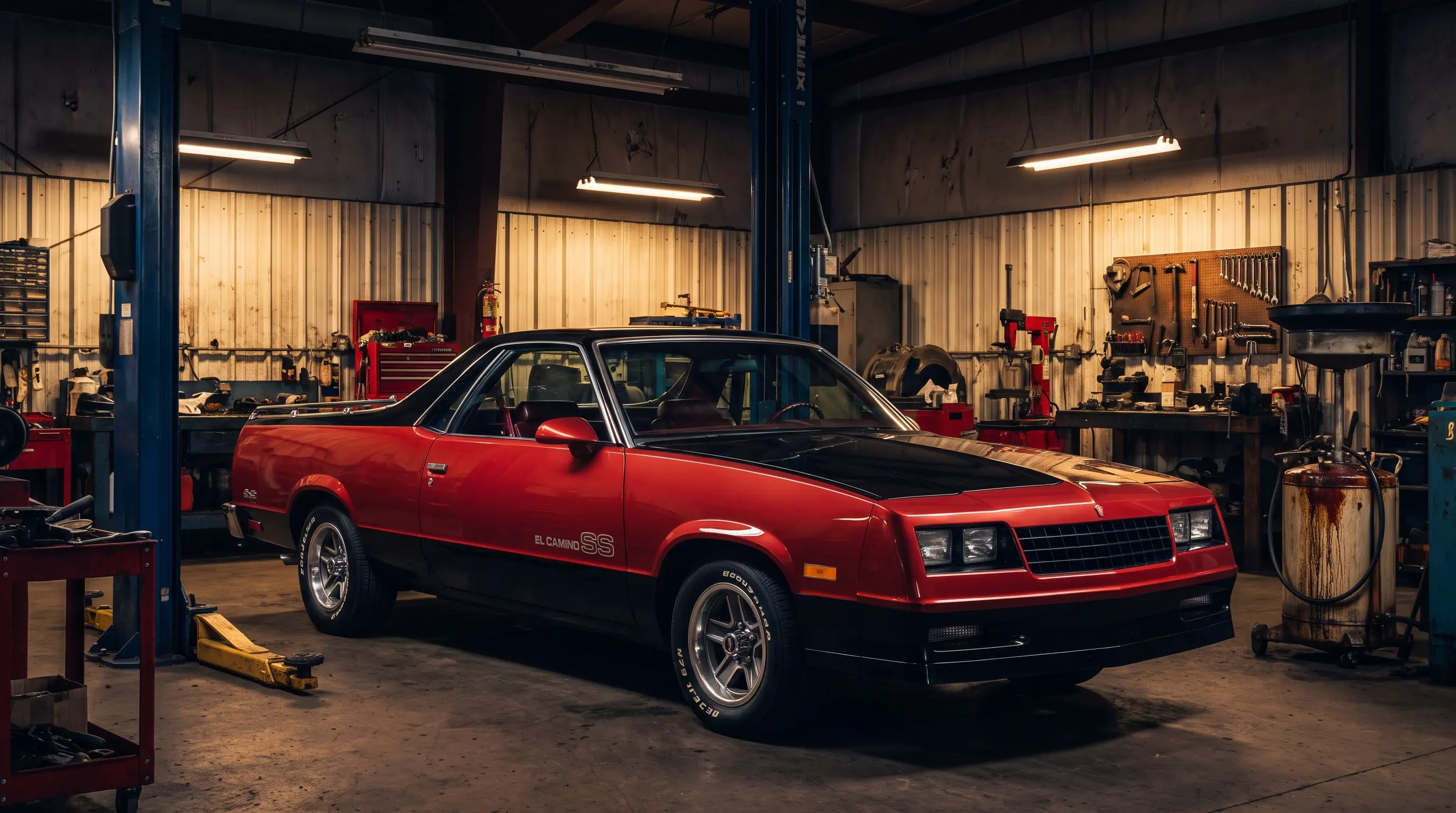
By the mid-1980s, a factory El Camino SS carried a badge that promised more attitude than its 305 cubic inch V8 could really deliver, and a Chattanooga, Tennessee shop called Choo Choo Customs built a business around dressing up that gap. Working through Chevrolet dealerships as a documented conversion partner, the company took new El Caminos and gave them a bolder, more aggressive look, a rare instance of a factory-authorized aftermarket appearance program during an otherwise power-starved decade for the nameplate.
Car Features
7 min read
Choo Choo Customs and the SS Conversion Story
Choo Choo Customs partnered with Chevrolet dealers to convert G-body El Camino SS models into genuine performance cars, a rare dealer-authorized program worth documenting.
Who Choo Choo Customs actually was
Choo Choo Customs was founded in 1975 by John Rogers and Terry Rutherford out of a small Chattanooga garage, originally making its name converting stock Chevrolet vans into plush custom cruisers with captain's chairs, high-top roofs, and premium interiors. The Choo Choo name came from Chattanooga's own CB radio nickname. The company's El Camino SS partnership began in 1983 and ran through the nameplate's final 1987 model year, giving the G-body SS a Monte Carlo SS-style aerodynamic front fascia with unique parking light lenses, body-side SS graphics, and a small chrome "train" badge above the glovebox, a cosmetic package rather than a mechanical one.
These were not backyard modifications performed after the sale. Choo Choo Customs worked through the dealer network, and roughly 4,950 Choo Choo El Caminos were built between 1983 and 1987, all sold through Chevrolet dealerships with factory-backed warranties, meaning documented conversions came with paperwork tying the modification to the original sale, a detail that matters enormously to collectors and historians trying to verify authenticity on surviving examples decades later. Cars that went through this program left the assembly line as standard G-body SS models and were then given the appearance conversion before reaching the end customer. The package changed the look of the El Camino but not its factory performance; the drivetrain underneath remained whatever engine the buyer had ordered.
Why a dealer would authorize outside modification
Dealer-sanctioned conversion programs served a real purpose for Chevrolet during this period. The factory SS package, built around emissions-compliant small block power, satisfied buyers who wanted the badge and the appearance package but left style-focused customers wanting something bolder than the standard factory look could provide given the regulatory environment of the mid-1980s. Rather than developing an in-house special-edition variant, which would have required its own certification and engineering investment for what was likely a limited market, Chevrolet allowed a specialty shop like Choo Choo Customs to fill that gap through the dealer network instead.
This arrangement mirrors similar programs across the industry during the same period, where automakers partnered with outside shops to offer appearance or specialty variants without bearing the full engineering and certification cost of an in-house special edition. read the background on the broader 1985 El Camino lineup to understand exactly what limitations these conversion programs were working around.
Finding and verifying a real conversion today
Authenticating a genuine Choo Choo Customs conversion decades after the fact requires documentation, ideally original paperwork tying the specific vehicle identification number to the conversion program, since the physical modifications themselves may have been altered, removed, or replicated by later owners chasing the same look without the underlying provenance. Buyers should treat any claim of a documented conversion with appropriate skepticism absent supporting paperwork, given how easily the visual elements of these conversions can be recreated on an ordinary G-body SS.
Collectors who specialize in this specific niche of the El Camino's history tend to value documentation above all else, more so than with mainstream factory SS models where production records and VIN decoding provide a more standardized verification path.
Why this chapter matters to the nameplate's story
The Choo Choo Customs program represents a small but genuine attempt to keep the SS badge visually exciting within the El Camino lineup during a decade when the factory car could not legally back it up with big-inch power. It is a reminder that the story of the SS badge did not end when big block engines disappeared from the options list, it simply moved outside the factory gates for a portion of the buying public willing to seek it out through a dealer network partnership most casual fans never knew existed.
"Provenance is everything with a car like this. Anyone can bolt on the look. Very few cars can actually prove the dealer paperwork behind a real conversion, and that paper is worth more than the parts themselves."
- Sarah Whitfield
What a typical conversion involved
The Choo Choo package was built around styling rather than mechanicals. The centerpiece was the aerodynamic front fascia borrowed in spirit from the Monte Carlo SS, paired with unique parking light lenses not available on a standard factory El Camino, along with SS-specific body-side graphics and the small chrome train logo mounted above the glovebox. Chevrolet and Choo Choo Customs never marketed the conversion as adding horsepower or handling capability beyond what the ordinary G-body SS already offered; the appeal was entirely about giving the car a sharper, more purposeful look to match the badge on its fender.
That cosmetic focus is itself one of the clues collectors use to authenticate a genuine example today, since the front fascia, lenses, graphics, and train badge are all distinctive enough that a real Choo Choo conversion is straightforward to identify once someone knows what to look for, even without paperwork in hand.
Why regional conversion shops mattered beyond one company
Choo Choo Customs was not unique in concept, even if its specific relationship with Chevrolet dealers in the Chattanooga area gave it a distinct regional identity. Similar shops operated in other parts of the country during the same general period, each filling a comparable gap between what factory cars could legally offer visually and what a segment of buyers still wanted to purchase. Studying these regional programs collectively gives a fuller picture of how the American performance car market adapted to emissions regulation, sometimes through styling rather than genuine speed.
The market position of a converted example today
A properly documented Choo Choo Customs conversion occupies unusual territory in the collector market, sitting somewhere between a standard factory SS and a full custom build with no factory connection at all. It carries genuine dealer-sanctioned provenance, which appeals to buyers who want authenticity, while also offering a distinctly bolder look than an unmodified SS, which appeals to buyers who want their El Camino to look like it means business even though the drivetrain underneath is unchanged. That dual appeal has kept interest in these specific conversions alive among a small but dedicated segment of El Camino collectors who specialize in the nameplate's more obscure corners.
Prices for confirmed examples still trail well behind genuine factory big block cars from the 1970 era, which keeps this corner of the market accessible to collectors who want something distinct without competing for the same limited pool of numbers-matching muscle car icons that dominate the top end of El Camino values.
If a documented conversion vehicle from this era interests you, budget real time for research before you buy. In the meantime, find a classic El Camino and compare standard G-body SS examples as a baseline before pursuing a rarer converted car.
Sources and notes
- Choo Choo Customs helped Chevy deliver a proper-looking El Camino SS - Hagerty Media
- 430 BHP LS3-Swapped: A 1987 Chevrolet El Camino "Choo Choo" SS - Silodrome
- For Sale: A Rare Original "Choo Choo" Chevrolet El Camino From 1987 - Silodrome
- Choo Choo Customs El Camino SS: Remembering America's Last Sporty Ute - autoevolution
- Choo Choo Custom: 1986 Chevy El Camino SS - Barn Finds
Related Reading
Have a
Chevrolet El Camino
for Sale?
Reach thousands of serious classic car collectors across the US.
Sell It Here →
Selling a classic? Here's how: sell my classic car
Are You a Classic Car Dealer?
List your full inventory and connect with targeted classic car buyers.
Join as a Dealer →

About the author
Sarah Whitfield
Third-generation classic car collector specializing in pre-war American and European coachbuilt automobiles. Researcher and concours enthusiast.
Related Listings - Chevrolet El Camino




Comments (1)
R
Rosa Villarreal
4 weeks ago
Last spring a seller near Houston showed me an El Camino he called a documented Choo Choo conversion. The front fascia and the train badge were there, but the only paper he had was a bill of sale from 1994. Would the original dealer invoice normally name the conversion? And where would the VIN tie-in actually appear?