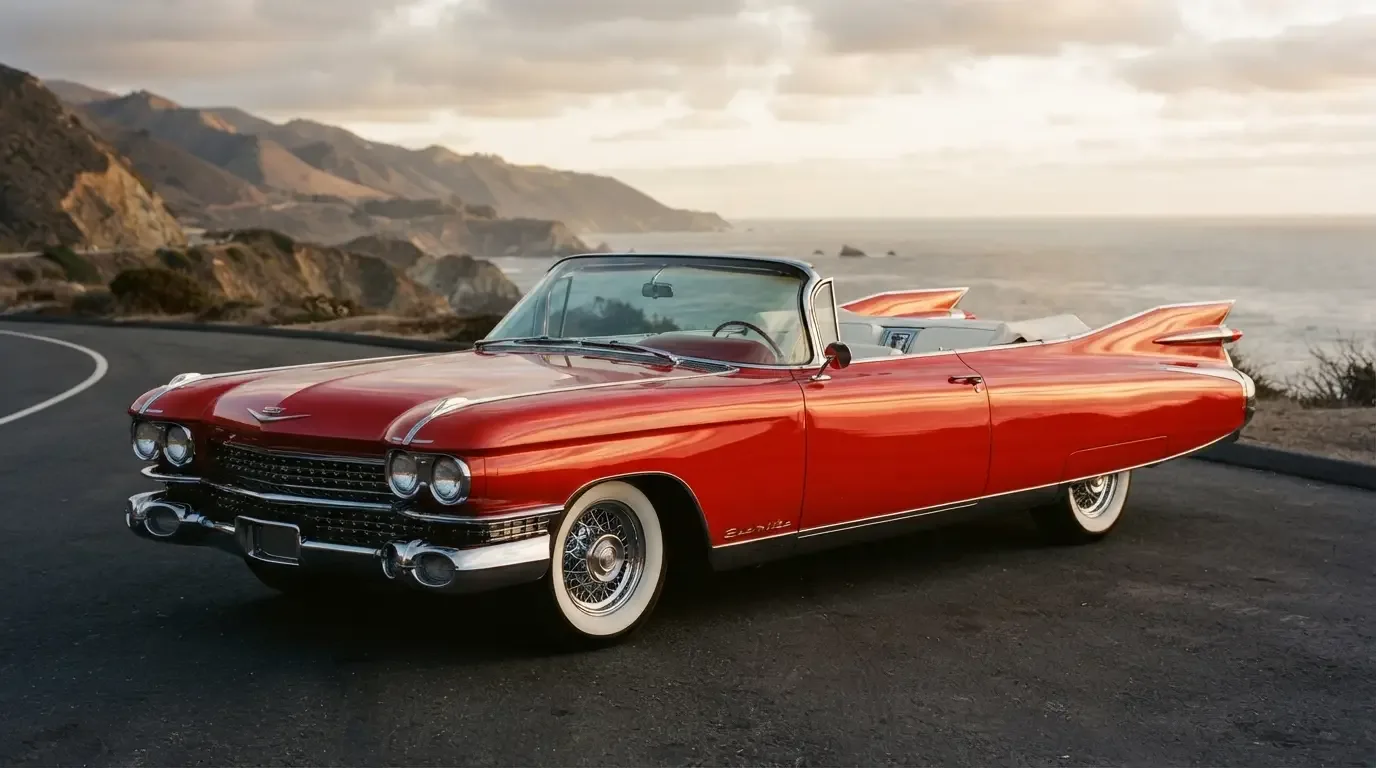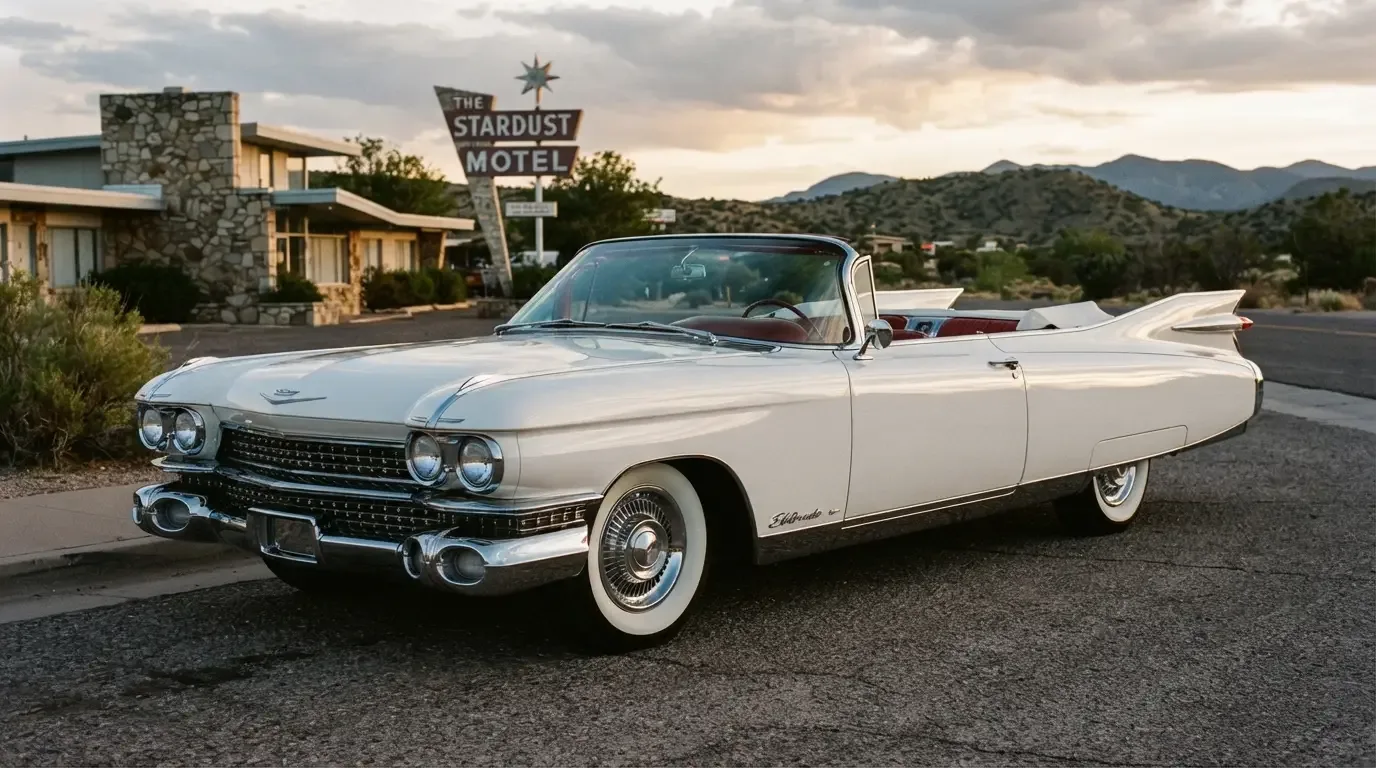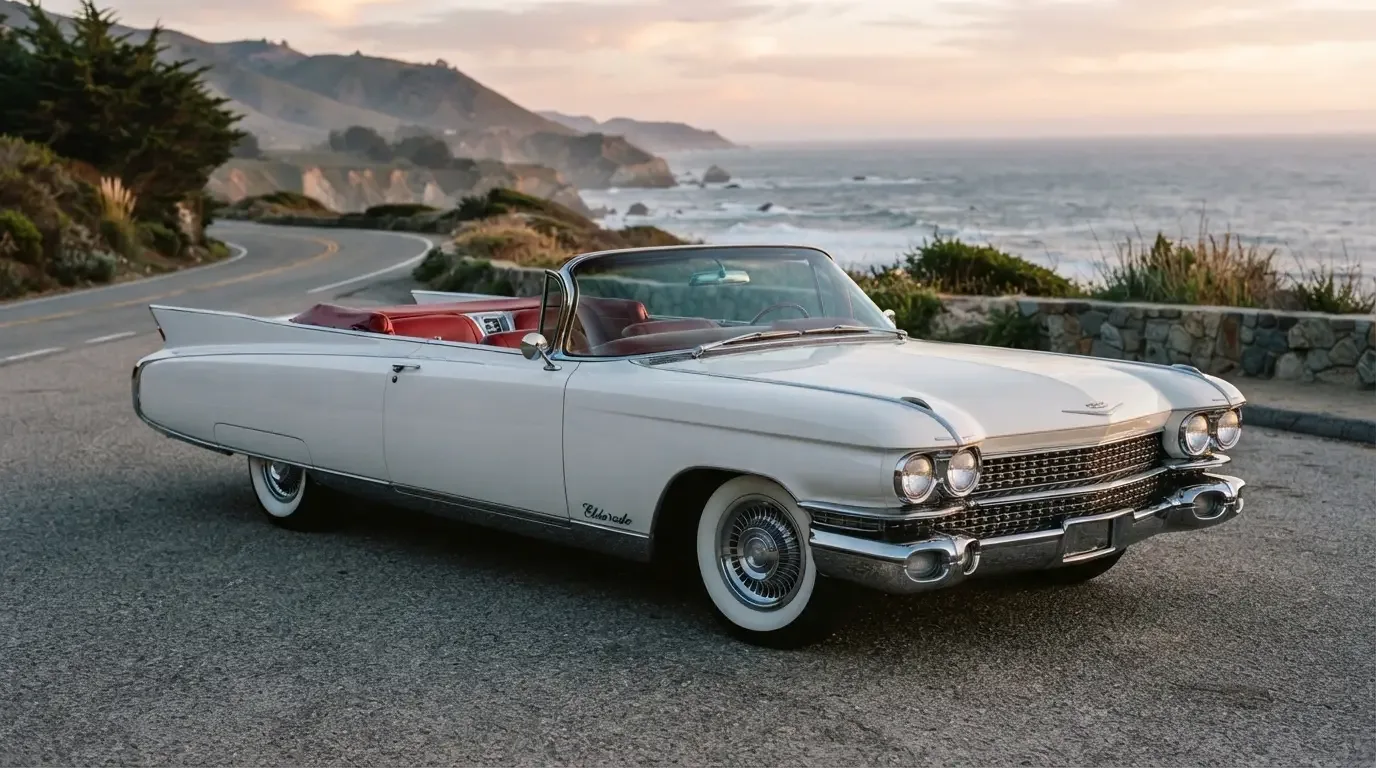
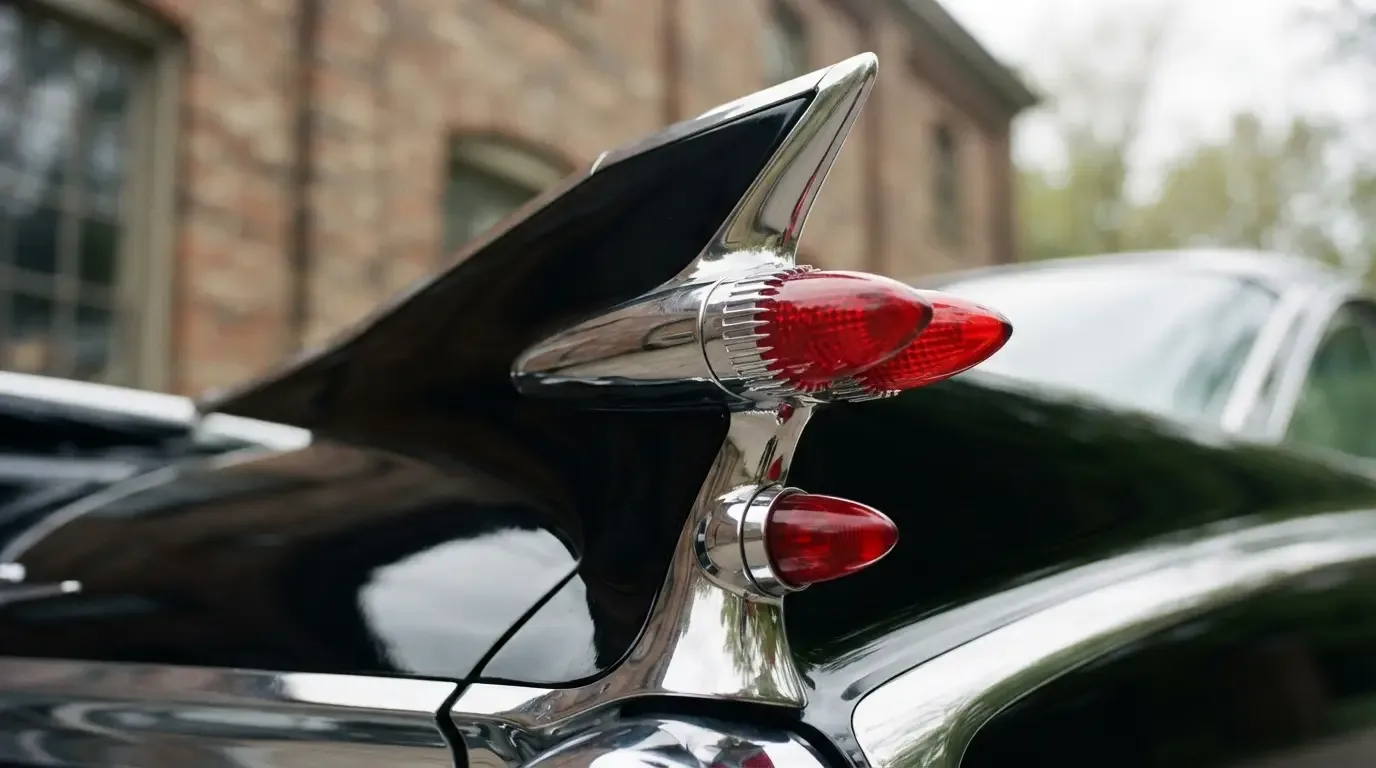
Of every detail on the 1959 Cadillac Eldorado, the dual bullet taillights are the one that shows up most often as a standalone image, printed on posters, tattooed on forearms, and referenced by designers decades after the car itself went out of production. As a piece of automotive design history, the bullet taillight deserves to be studied on its own terms rather than treated as a footnote to the fin it sits on top of. For the broader context of the model year that produced it, the full story covers the rest of the car.
How the bullet shape came to be
Cadillac's taillights had been growing more prominent through the 1950s as the fin itself grew taller, but 1959 marked the year the taillight stopped being an accent and became the visual terminus of the entire rear design. The dual bullet lenses sat mounted at the tip of each fin, chromed and conical, catching light in a way that flat lenses from earlier model years simply could not. The shape drew directly on the same aviation and rocket imagery that inspired the fin itself, continuing a visual language Cadillac had been developing since Franklin Hershey's original fin design in 1948.
What made the 1959 execution distinct from Cadillac's own earlier taillight designs, and from what Chrysler and Lincoln were doing the same year, was the sheer conviction of the shape. Earlier Cadillac taillights integrated into the fender contour. The 1959 bullet asserted itself as a separate, sculptural object sitting atop the fin, almost like a mounted ornament rather than a functional lighting component that happened to be styled.
Two bullets, and why that mattered
The dual arrangement, one bullet stacked or paired with a companion element depending on the exact model and trim, gave the rear of the car a symmetry that read clearly even at highway distance and at night. Period road testers commented specifically on how visible and distinctive the 1959 Eldorado was from behind in traffic, a detail that mattered more in an era before standardized rear lighting regulations made taillight design somewhat more uniform across the industry in later decades.
From a documentation standpoint, the bullet taillight is also one of the most useful details for dating and authenticating a 1959 Cadillac at a glance, since the design was unique to that model year before Cadillac revised the rear treatment substantially for 1960. A car wearing the correct 1959 bullet lenses, correctly seated in the fin tip with matching chrome bezels, is an immediate visual confirmation that you are looking at the right year, which is not something every design detail on a car can offer so cleanly.
| Detail | 1959 Eldorado taillight |
|---|---|
| Shape | Conical "bullet" lens |
| Mounting location | Fin tip, each side |
| Design lineage | Rocket and aviation-influenced |
| Model-year uniqueness | Distinct to 1959, revised for 1960 |
| Cultural status | Most reproduced Cadillac design detail |
A detail that outlived the car
Design historians point to the 1959 Cadillac taillight as one of the most referenced automotive details of the entire postwar era, showing up in retrospective advertising, museum exhibitions, and even unrelated product design that borrows the conical shape as visual shorthand for mid-century American optimism. Few individual components from any single model year of any car achieve that kind of independent cultural life, recognized even by people who could not otherwise identify the car it came from.
That staying power says something about how completely Cadillac's design team committed to the idea in period. The bullet taillight was not hedged or softened for mainstream taste the way many bold styling ideas get watered down before reaching production. It went into showrooms exactly as dramatic as the design studio conceived it, and that commitment is a large part of why it still reads as bold rather than dated more than sixty years later.
"When you catalogue a 1959 Eldorado for a concours field, the taillights get inspected as carefully as the paint. Lens clarity, chrome bezel condition, seating in the fin tip, all of it matters, because this is the detail judges and photographers gravitate toward first."
- Sarah Whitfield
How the design was received in period
Contemporary reviews of the 1959 Cadillac lineup did not treat the taillight as a minor styling flourish. Automotive press coverage from the year singled out the rear treatment specifically, often alongside commentary on the fin height overall, and the language used at the time skews toward the same words that get used today: dramatic, assertive, unmistakable. That consistency between period and modern reaction is worth noting, since plenty of 1950s design elements read very differently now than they did to buyers walking a showroom floor in 1959. The bullet taillight has not needed that kind of reassessment. It made an impression immediately and has kept making one ever since.
Competing manufacturers noticed too. Within a few years, taillight designs across the American industry began experimenting more freely with sculptural, non-flush treatments, though few committed to the idea as fully or as briefly as Cadillac did with the 1959 Eldorado. That willingness to go further than the rest of the industry, for exactly one model year before pulling the design back for 1960, is part of what gives the detail its specific, dated appeal. It belongs entirely to 1959, and nothing else.
Condition and authenticity considerations
Because the bullet taillight is such a recognizable, photographed detail, it is also one of the components most likely to have been replaced with reproduction parts over a car's life. Original lenses can develop clouding or minor cracking with age, and reproduction lenses of varying quality have been available for decades to address that, a normal part of any car this old that has spent real years on the road rather than sitting under a cover. The better reproductions match the original conical geometry closely, while lower quality parts sometimes show a slightly different taper or a less precise chrome bezel fit, details a trained eye catches without much difficulty.
For a buyer evaluating a car specifically for its design and documentation value, confirming taillight authenticity, or at minimum confirming correct-style reproduction parts with proper fitment, is a worthwhile line item alongside paint and mechanical condition. It is also one of the more visually satisfying things to check, since the payoff, a correctly presented 1959 Eldorado from directly behind, remains one of the most striking sights in the entire history of American car design.
Few individual components on any classic car reward that kind of close attention as consistently as this one does. Those exploring the market firsthand can browse classic Eldorado listings to see how much variation exists across surviving examples, and how much the taillight detail alone can shift a car's presentation.