
Sit in a stock 1957 Ford F100 interior today and the first thing you notice is how much room there is between the seat and the doghouse. Ford leaned hard into modern, car-like styling for this redesigned cab when it launched, and the cab itself backed up the pitch. It was roughly three inches wider than the cab it replaced, and this was the first Ford truck cab that gave a driver's elbow real room instead of leaving it against the door panel for eight hours a day.
Car Features
7 min read
Inside the 1957-60 F-100
The 1957 Ford F100 interior brought car-like comfort to a work truck cab for the first time, and it still holds lessons for anyone restoring one today.
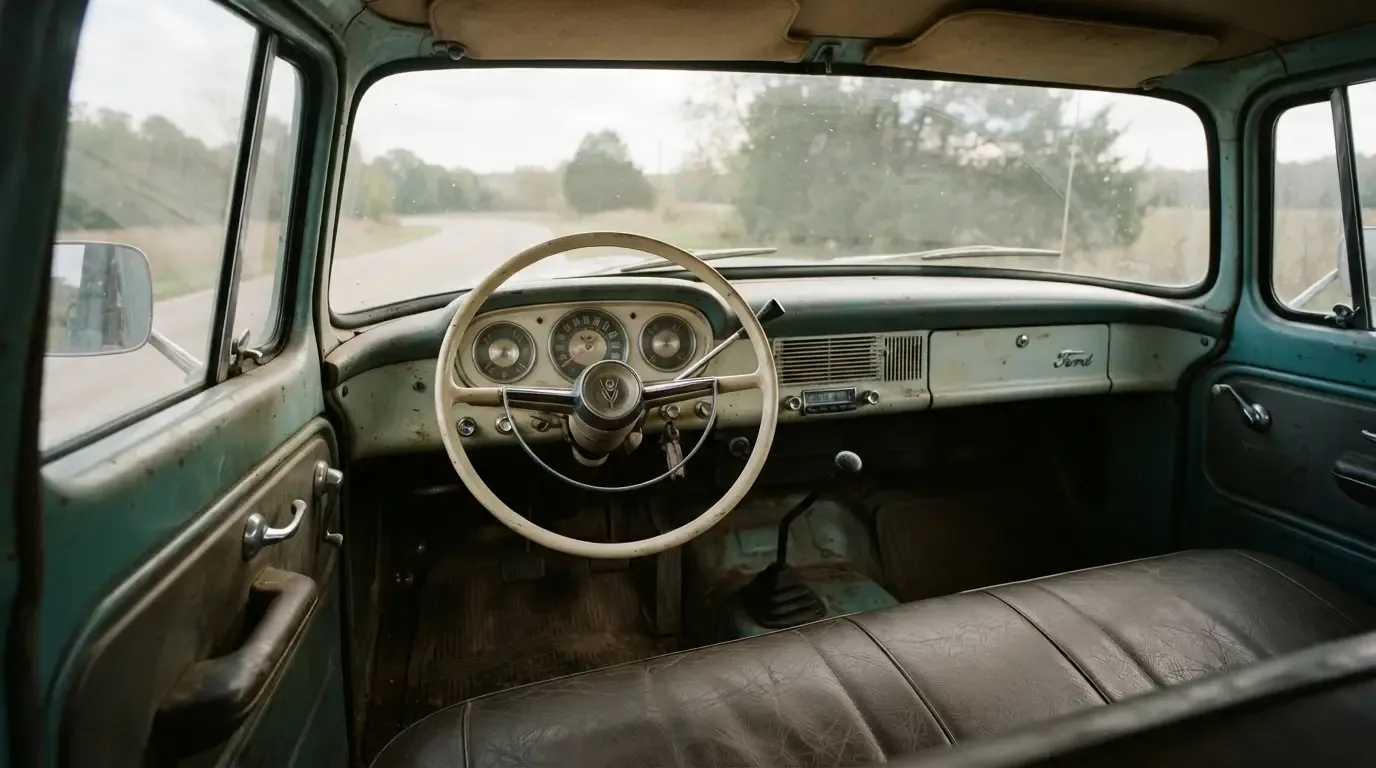
A cab built for the driver, not just the job
Before 1957, Ford truck cabs were narrow and upright, built around the idea that a driver would tolerate discomfort because the truck's job was to work, not to coddle. The redesigned 1957 cab flipped that assumption. It was wider by several inches, the seat was set further back from the wheel, and the dash was laid out with actual thought given to where a driver's eyes and hands naturally fell. Gauges sat in a simple cluster ahead of the wheel instead of scattered across the dash, and the wraparound windshield opened up the view in a way that made the whole cab feel less like a box.
Headroom improved too, which mattered more than it sounds. A tall driver in an older Ford truck cab had to duck slightly getting in. In the new cab, that problem mostly went away, and Ford advertised it accordingly, showing men in hats climbing in and out without so much as tilting their brim.
Custom Cab versus base trim
The base interior was rubber floor mats, a bench seat trimmed in tough vinyl, and painted metal wherever chrome or brightwork was not strictly necessary. It held up to a work life of dropped tools and muddy boots, and that was the point. The Custom Cab option, by contrast, brought better upholstery patterns, more chrome trim around the gauges and door panels, a dome light, and in later years of the run, options like a passenger-side sun visor and armrests that the base trucks skipped entirely.
A lot of the trucks that survive today wear the base interior worn thin by decades of actual use, which is honestly part of the appeal. A Custom Cab truck with its trim intact is a different animal, closer to what a proud owner drove to town on a Saturday than what a farmhand drove through a muddy field on a Tuesday.
What actually wears out, and what to check
Vinyl seat covers crack and split along the seams first, usually where the driver's hip contacts the bolster thousands of times over a working life. Headliners sag or stain from decades of sun and cigarette smoke. Rubber floor mats dry out and crumble, and the metal underneath them is worth a careful look for rust that mat moisture trapped over the years rather than kept out.
Door panels are another tell. Original cardboard-backed panels rarely survive intact this long without at least one repair or replacement, so a set that looks factory-fresh is either a very lucky survivor or a well-done reproduction. Neither is a dealbreaker, but knowing which one you are looking at changes how you should think about the truck's overall originality, and by extension its value against similar trucks in the same market.
"I've stripped a dozen of these cabs down to bare metal, and the thing that gets me every time is how much thought went into a truck nobody expected to still be running sixty years later. That wide bench and that clean dash weren't accidents. Somebody fought for that in a design meeting."
- Jim Vasquez
Restoring it right versus restoring it fast
The temptation with any tired interior is to gut it and drop in whatever reproduction kit ships fastest. That works fine for a driver-quality truck built to be used, but it flattens a lot of the small details that separate a correct restoration from a generic one, things like the exact stitch pattern on the seat, the correct color of the steering wheel, or the placement of trim pieces that varied slightly between model years within the run.
Original parts, even rough ones, are worth saving as reference before they get tossed. A worn factory door panel tells a reproduction shop exactly what pattern and color to match. Once it is gone, that information usually goes with it, and the next owner is stuck guessing from old catalog photos instead of the real thing.
Steering wheels and small details
The steering wheel is one of the easiest tells for spotting an incorrect restoration. Factory wheels from this run came in colors that matched the interior scheme, and a lot of trucks on the road today wear a generic black aftermarket wheel because it was cheaper and easier to source than a correctly colored reproduction. It is a small detail, but judges at truck shows notice it immediately, and so do buyers who have done their homework before shopping.
Knobs, switches, and the horn ring tell a similar story. These small parts were often the first things to go missing over decades of ownership, either broken off, swapped for a universal replacement, or simply lost during an engine swap or dash repair. A complete set of correct, period switchgear is a genuinely underrated indicator of how carefully a truck has been kept, often more telling than the condition of the paint itself.
Gauges and what they reveal
The simple gauge cluster ahead of the driver was a real departure from older Ford truck dashboards, and it holds up well today because it prioritized legibility over decoration. A speedometer, fuel gauge, and a small cluster of warning lights or secondary gauges sat directly in the driver's line of sight, a layout borrowed more from passenger car thinking than from the utilitarian dashboards trucks had used before. Original gauge faces yellow and crack with age, and a lot of owners replace the whole cluster rather than restoring the individual faces, which is a shame given how much character the original ivory-toned lettering carries once cleaned up properly.
A functioning original gauge cluster, needles included, is worth more to a serious buyer than a modern replacement that merely looks the part. It is one more small piece of evidence that separates a truck restored with real care from one restored for a quick resale.
Seeing it in person
Photos flatten interiors in a way that makes it hard to judge condition honestly. If you are shopping seriously, spend time browsing a classic F-100 for sale in person rather than trusting listing photos alone, and bring a flashlight for under the seat and behind the kick panels. That is where moisture damage and old repairs hide, and it is where an honest seller's description and an actual truck sometimes part ways.
The full context for this cab, from its design brief through the changes Ford made across the run, lives in the full story, and it is worth reading before you commit to a purchase. An interior this well thought out deserves an owner who understands why Ford built it the way they did.
Sources and notes
Related Reading
#truck restoration
#ford f-100
#Custom Cab
#1957 Ford F100
#classic truck interior
#Task Force trucks

About the author
Jim Vasquez
Southern California hot rod and custom car builder with roots in the traditional kustom kulture scene.
Related Listings - Ford F-100
Comments
Be the first to comment on this article.