
The Firebird Formula spent about three decades as the car nobody at auction bothered chasing. Bidders wanted Trans Ams, they wanted the shaker hood and the graphics, and the Formula sat in the background as the sensible alternative nobody paid a premium for. That started changing over the past several years, and the shift shows up clearly once you look at consignment results rather than asking price listings. Formula collectible status is no longer a fringe argument. It's a trend line, and it's worth understanding why it's happening now rather than a decade ago.
Car Features
6 min read
Why Collectors Rediscovered the Formula
Auction data shows the Firebird Formula's collectible status has shifted from afterthought to real bidding activity, but only for documented, numbers matching cars.
What the auction data actually shows
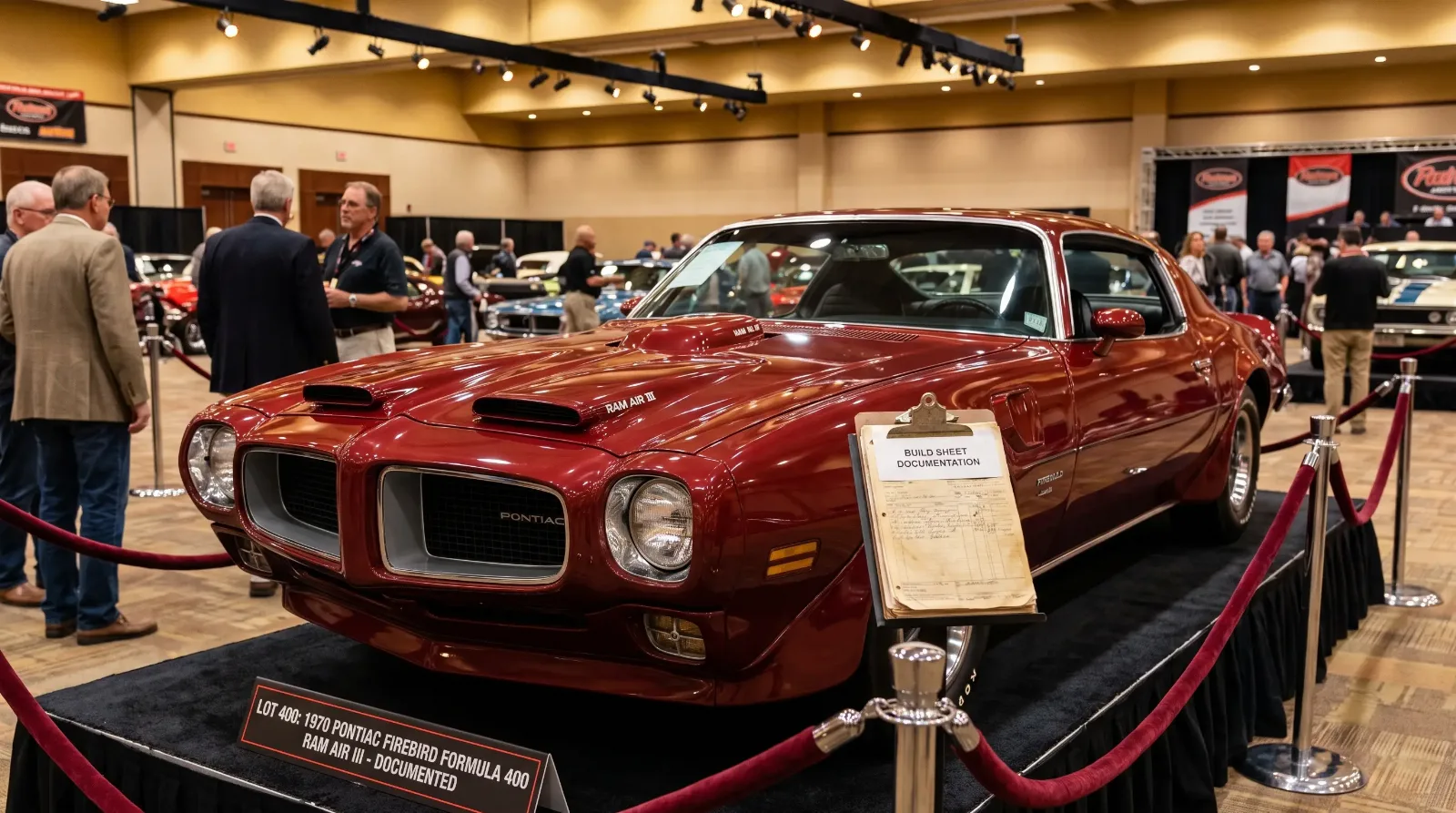
Documented, numbers matching Formulas with 455 HO or Ram Air III drivetrains have moved from afterthought lots to cars that draw real bidding activity at the major houses. A rough or undocumented driver quality Formula still lags well behind a properly documented example, and the better documented cars are pulling bids that would have been unthinkable for this trim a decade ago. That's not a single outlier sale skewing the picture. It's a pattern across multiple auction cycles and multiple houses, which is the kind of evidence that tells me this is a real market shift rather than noise.
I look for confirmation across at least two full auction seasons before I call anything a trend rather than a fluke, and the Formula has now cleared that bar. Consignors who once had to be talked into offering a Formula at all are now requesting it be scheduled in a prime lot slot, which is itself a signal that the houses expect real bidding rather than a quiet no-sale.
| Configuration (1970 Formula 400) | Fair | Good | Concours |
|---|---|---|---|
| Standard 330 hp 400 | around $13,600-$26,600 | around $26,300-$44,500 | around $69,200-$90,300 |
| Ram Air III 400 (documented) | roughly 20 percent above the standard 400 at every tier | roughly $44,500 | roughly $90,000 |
For comparison, a good condition standard Trans Am of the same era trades for roughly $6,000 more than an equivalent Ram Air III Formula, and the rarest 1970 Trans Am, the Ram Air IV of which only 88 were built, brings roughly $96,000 in good condition and over $160,000 in showroom condition. The Formula still trails its more famous sibling at every tier, but the gap has narrowed enough that documented Formulas are no longer an afterthought at these auctions.
Why this is happening now
Part of it is simple supply. The Trans Am market has been picked over long enough that documented, unmolested examples in the top condition tiers are getting harder to find at any price, and buyers who missed that window are looking one trim level down at cars with the same drivetrain and a fraction of the competition for good examples. Part of it is generational. The buyers entering this market now grew up admiring the muscle car era broadly, not specifically chasing the one badge that dominated the poster market in the late 1970s. They're more willing to buy the mechanically identical car without the graphics premium attached.
I'd also point to a broader trend across the collector car market generally, one that isn't unique to Pontiac. As top tier examples of the marquee trims in any given segment climb out of reach for a wider swath of buyers, money migrates down to the next tier that offers comparable substance. We've seen versions of this pattern play out in other muscle car segments over the past several cycles, and the Formula's rise fits that broader pattern rather than standing apart from it.
There's also a documentation story here that shouldn't be overlooked. As the muscle car market matured, buyers got more sophisticated about verifying build sheets, cowl tags, and factory paperwork. A well documented Formula now competes on the strength of its paper trail rather than losing automatically to a Trans Am on badge alone. That shift toward valuing documentation over decoration has helped every underdog trim in this era, and the Formula has benefited more than most because the underlying cars were always mechanically comparable to their more famous siblings.
"When a market matures, buyers stop paying for the poster and start paying for the paperwork. That's exactly what's happened to the Formula over the last several auction cycles."
David Mercer
What didn't sell tells you as much as what did
I pay close attention to no-sale results, and the pattern here is instructive. Formulas without documentation, with replacement engines of unknown provenance, or with cosmetic restorations covering unaddressed rust are still struggling to clear reserves even in this stronger market. The rising tide has lifted documented cars significantly. It has lifted undocumented, rough, or questionable cars much less. That gap is worth remembering if you're a seller assuming the whole trim has appreciated uniformly. It hasn't. The appreciation is concentrated in cars that can prove what they claim to be.
Is now the right time to buy a Formula
For a buyer looking at documented examples, yes, with a caveat. You're no longer buying at the bottom of this market, that window closed a few cycles ago, but you're still buying at a meaningful discount to the Trans Am for a mechanically comparable car, and the trend line still points upward rather than plateauing. For a buyer looking at an undocumented project car hoping the market rescues a bad purchase, the data says no. That car isn't appreciating the way the headlines about this trend might suggest. Buy the paperwork, not just the badge, and the Formula collectible story still has room to run.
I'd frame the opportunity this way for anyone weighing it right now. The cars still carrying the most upside are the ones sitting in the middle tier, solid drivers with real documentation but not yet fully restored to show condition. Those are the examples that benefit most as buyers keep discovering this trend, because there's still room between where they sit today and where a documented top tier example is already trading. The fully restored, concours level Formulas have already captured most of their recent appreciation. The mid tier cars are where I'd be looking if I were buying into this trend rather than just watching it from the sidelines. For the full history behind why this car ended up in this position, the Formula story covers the background, and the next story in this set goes deeper into the specific drivetrain that's driving most of this appreciation.
Sources and notes
- CarBuzz: The Firebird Formula 400 valuation and history
- Hagerty Insider: The 8 Priciest Firebirds Ever Sold at Auction
- Hagerty Valuation Tools: Pontiac Firebird
- Barrett-Jackson: 1971 Pontiac Firebird Trans Am 455-HO docket
- ClassicCars.com Journal: Pick of the Day, 1973 Pontiac Formula 455
- Wikipedia: Pontiac Firebird
Related Reading
Have a
Pontiac Firebird
for Sale?
Reach thousands of serious classic car collectors across the US.
Sell It Here →
Are You a Classic Car Dealer?
List your full inventory and connect with targeted classic car buyers.
Join as a Dealer →

About the author
David Mercer
Classic car market analyst with two decades of experience tracking collector car valuations, auction results, and investment trends.
Related Listings - Pontiac Firebird




Comments (1)
D
dodgepowerwagon
6 days ago
About the Did You Know note on badge and documentation demand between the Formula and the Trans Am: engine options overlapped in most years, yes. It is worth adding that a drivetrain is more than an engine, and as I understand the 1970 specification the two cars were not built to the same chassis standard. The Trans Am came with the Ram Air III as its standard engine, a heavier handling package, larger sway bars and a quicker steering ratio, while a Formula buyer started at the 330 horsepower 400 and could end up with a considerably softer car underneath. Two cars sharing an engine code can still behave very differently on a mountain grade. Some of that price gap is hardware, not decals.
L
LS_everything
6 days ago
Badge snobbery aside, he's right. Bolt Trans Am bars onto a Formula and it's a different car in the canyons.
D
dodgepowerwagon
6 days ago
That is my point exactly, and the parts do bolt over, which is the trouble for a buyer. A Formula wearing Trans Am bars and a quick steering box drives like a Trans Am and still documents as a Formula. Fine for an owner who wants to use it. For anyone paying for originality, the bars and the steering box need checking against the build sheet the same as the engine does.