
Pull the bound volumes of Car and Driver, Motor Trend, and Hot Rod from 1970 through 1978 and you'll find the same pattern every time. The magazines lined up for the Trans Am. They photographed the Trans Am. And then, almost as an afterthought, they'd mention that the Formula sitting one row over at the press preview was actually the quicker car, or the better handling car, or both. Formula road tests are a strange little archive. They're not hard to find once you know what to look for, but nobody was building a magazine cover around them, and that tells you something about how the car was positioned versus how it actually drove.
Car Features
6 min read
The Formula in Period Road Tests
Old magazine road tests kept finding the same thing: the plainer Firebird Formula was often quicker and better balanced than the Trans Am parked next to it.
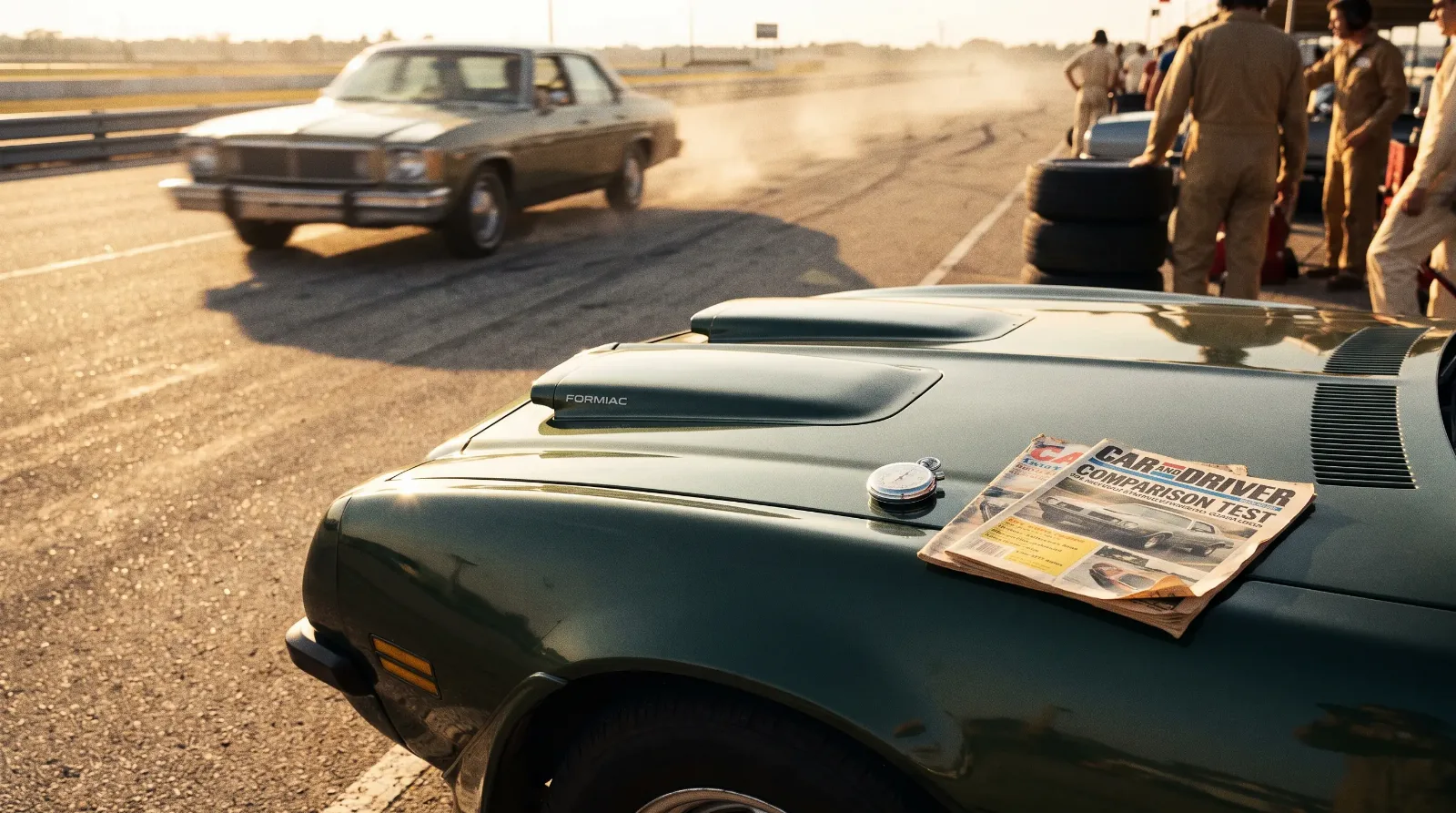
What the magazines were actually driving
Most of the period tests I've dug up were built around the 400 cubic inch engine, which was the volume seller in the Formula lineup through the mid 1970s, with the 455 four barrel and later the 455 HO showing up in the higher output tests. A tester in 1971 or 1972 was almost never getting the base two barrel car. Magazines requested the healthiest engine combination Pontiac would hand them, which means the numbers you read in an old road test are closer to a best case scenario than an average customer's driveway experience. That matters if you're using an old magazine test to set expectations for a car you're about to buy, because the seller quoting you a 1972 road test figure may be quoting a car built nothing like theirs.
The dual snorkel hood on the Formula, functional on the right engines, drew comment in nearly every test I've read. Testers liked that it fed cold air without the visual theater of the Trans Am's shaker scoop. It's a small detail, but it shows up again and again as the kind of thing a working journalist notices when he's trying to explain why a car that looks plainer than its sibling is keeping pace with it.
The numbers on paper versus the numbers on the road
Factory rated output for the standard 455 in the mid 1970s ran around 250 hp net in 1974, dropping to roughly 200 hp net by 1975 as emissions rules tightened further, and period quarter mile figures for a well sorted Formula 400 or 455 clustered in the 15.0-to-16-second range depending on gearing, transmission, and altitude. Those are the kind of numbers that read modestly today and read even more modestly against the gross horsepower ratings from a few years earlier, before the industry switched measurement standards. I've had guys show up with a dyno sheet from their own 400 arguing the factory numbers undersold the car, and depending on the specific engine build and the state of tune, they might be right. Factory ratings from this era were never a precise science, and Pontiac was not alone in that.
| Model year | Formula engine tested | Approx. factory output |
|---|---|---|
| 1970-1971 | 400 (Ram Air III available) | Around 335-345 hp gross |
| 1973-1974 | 400 four barrel | Around 225-230 hp net |
| 1974-1976 | 455 (SD-455 and standard 455) | 250 hp net standard 455 in 1974, 290 hp net on the SD-455, dropping toward 200 hp net by 1975-76 |
| 1977-1978 | Pontiac 400 / Olds 403 | 180-220 hp net depending on state and emissions calibration |
What the road tests got right
The consistent theme across a decade of coverage is weight distribution. The Formula carried less front end mass than a fully optioned Trans Am, no front air dam hanging off the nose, no functional shaker assembly bolted through the hood, and testers who bothered to drive both back to back on the same day at the same track kept landing on the same conclusion: the plainer car turned in a little quicker and complained a little less on a bumpy back road. That's not opinion dressed up as fact. It's the kind of result you get when you strip weight off the nose of a car built on a chassis that was never overly forgiving of understeer to begin with.
I've pulled apart enough of these cars to know the suspension tuning between Formula and Trans Am wasn't identical either. Spring rates and sway bar diameters moved around from year to year, and a Formula ordered with the WS6 handling package, once it became available, closed whatever gap remained. A tester driving a well equipped Formula in the mid to late 1970s was not driving a watered down Trans Am. He was driving a car that, in some configurations, handled better.
"Read enough of these old road tests back to back and you start noticing what the writers were too polite to say outright, that the car they were supposed to be excited about wasn't always the car that actually got around the track quicker."
Mike Sullivan
What the tests missed, and why it still matters
Magazine road tests are snapshots of a brand new car, professionally maintained, driven by somebody who knew exactly how to launch it. They don't tell you how a Formula ages, what the exhaust manifolds look like after forty years of Midwest winters, or whether the specific engine in front of you still has its original internals. That's a gap I see buyers fall into constantly. Somebody finds a 1974 road test quoting a strong quarter mile number, and they assume the survivor car they're looking at, with an unknown rebuild history and a carburetor that's been rebuilt twice, will perform the same. It won't, not until somebody puts real time and real parts into it.
If you want the sleeper Firebird story in full, that's where the buying and ownership side of this gets covered in depth. And if you want to see why the plainer trim built a following of its own instead of just riding the Trans Am's coattails, another angle on that argument is worth your time too.
Reading old road tests the right way today
Use these tests for what they're good for: relative comparisons, contemporary opinion, and a sense of what the factory considered a strong running example. Don't use them as a guarantee of what a specific used car will do forty or fifty years later. Every Formula on the market now has its own history, its own miles, its own rebuild or lack of one. The magazines tell you what the car could do in 1974. Your mechanic, or somebody like me standing next to it with a compression tester, will tell you what it can do now. For the broader arc of how this model line developed across two generations, Pontiac's Firebird history lays out the full timeline.
Sources and notes
- Wikipedia - Pontiac Firebird (second generation)
- Automobile Catalog - 1973 Pontiac Firebird Formula 400 4-speed specs
- Automobile Catalog - 1974 Pontiac Firebird Formula 400-4 specs
- Automobile Catalog - 1974 Pontiac Firebird Formula SD-455 4-speed specs
- Hagerty Media - Sorting through Pontiac's Ram Air engine production
- Muscle Car Facts - 1975 Pontiac Firebird
Related Reading
Have a
Pontiac Firebird
for Sale?
Reach thousands of serious classic car collectors across the US.
Sell It Here →
Are You a Classic Car Dealer?
List your full inventory and connect with targeted classic car buyers.
Join as a Dealer →

About the author
Mike Sullivan
Detroit-area muscle car enthusiast and restoration specialist with three decades of hands-on experience working on American iron.
Related Listings - Pontiac Firebird

Comments
Be the first to comment on this article.