
Understanding the ford bronco 1969 driving character requires separating nostalgia from engineering fact, and the factory record actually helps with that more than most people expect. Ford's own development notes and period road tests from 1969 describe a truck that felt distinctly different from its off-road rivals, and the reasons behind that difference were deliberate engineering choices, not accidents of packaging.
Car Features
6 min read
What Driving a 1969 Bronco Feels Like
Ford's own engineering notes explain why the 1969 Bronco rides softer than its rivals, and what the coil-spring front end and 302 V8 actually changed behind the wheel.
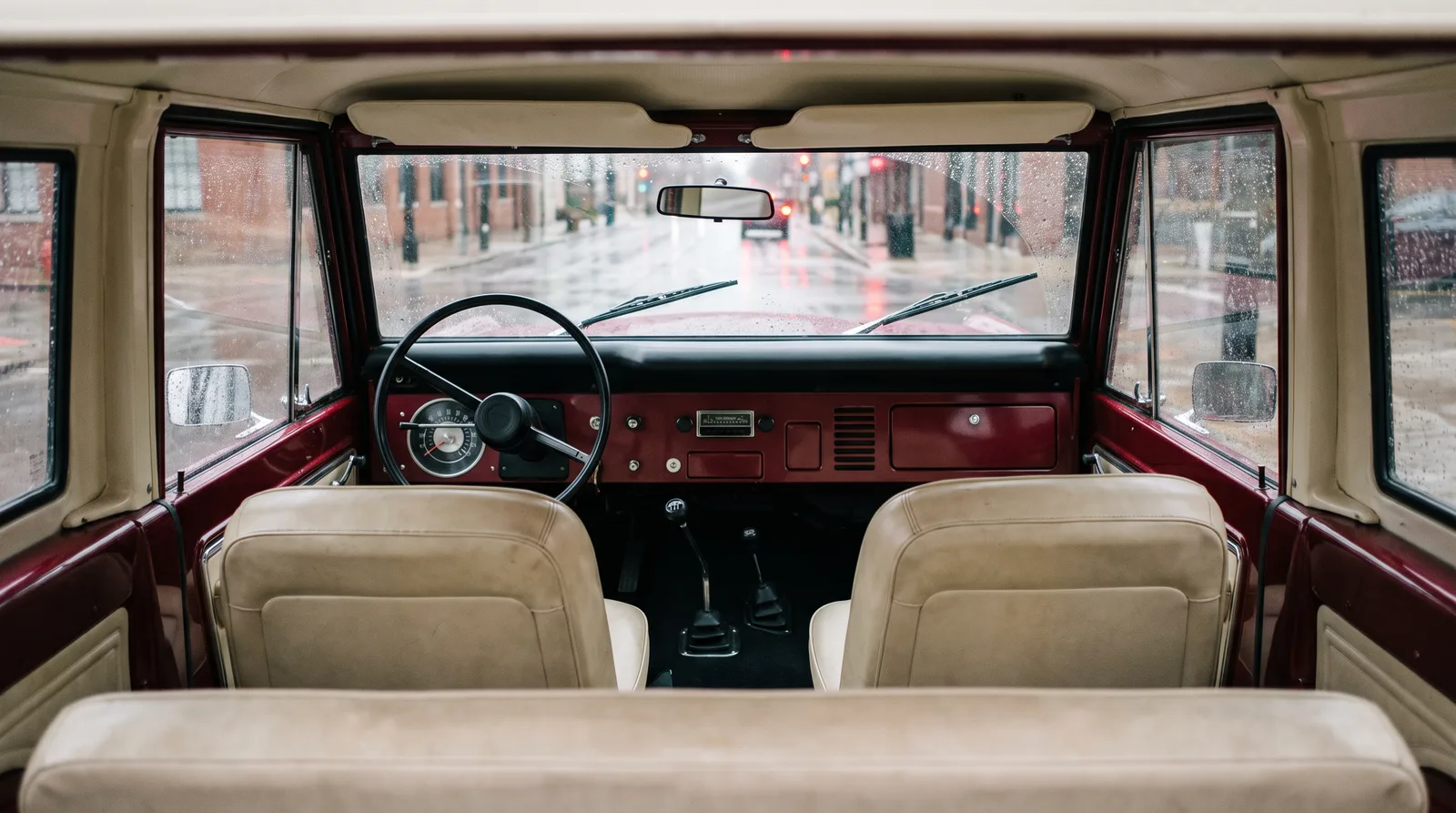
The coil-spring front end that changed everything
The single biggest factor in how a 1969 Bronco drives, compared to something like a contemporary Jeep CJ-5 or International Scout, is the Mono-Beam front suspension Ford engineered specifically for this truck. Where its rivals used leaf springs on a solid front axle, a setup that transmits every road imperfection directly into the cabin, the Bronco used coil springs with radius arms locating the axle. Ford's engineering documentation from the period frames this choice explicitly around ride comfort, a deliberate departure from the harsher character of competing off-roaders.
That difference is immediately noticeable behind the wheel. A 1969 Bronco rides with a softness that surprises people expecting a stiff, utilitarian truck. It still has the vertical motion and body roll you would expect from a short-wheelbase, high-center-of-gravity vehicle riding on period tires, but the harshness that defined so many of its rivals is largely absent. Ford was not just building a capable off-roader. Company records make clear they were trying to build one that a driver could tolerate on pavement for an extended commute, not just a weekend trail run.
What the 302 V8 changed at highway speed
1969 marked the year the 302 cubic inch V8 replaced the 289 as the top engine option, and that swap is felt most clearly at highway speed rather than off-road. The 302 offered a broader torque curve, which meant less downshifting and less strain merging onto faster roads, a meaningful improvement over the six-cylinder Bronco's more labored highway manners. Buyers who selected the six-cylinder engine, still common given its lower cost, describe a noticeably different driving character, adequate around town but working noticeably harder to maintain speed on a grade or against a headwind.
A common misconception about the steering feel
Modern drivers who get behind the wheel of a 1969 Bronco for the first time often assume the vague, slow steering they feel is a sign of wear or a tired steering box. Sometimes that is true. But factory specifications confirm the steering ratio itself was simply slower and less direct than what a modern driver is used to, a deliberate choice suited to low-speed trail maneuvering rather than precise highway response. A well-maintained example still feels notably relaxed at the wheel compared to anything built even a decade later, and that character is original, not a symptom of neglect.
Low range and the moment the truck changes personality
On pavement, a 1969 Bronco drives like a soft-riding, upright compact truck. Engage the transfer case and drop into low range, and the entire character shifts. Factory gearing gave the truck genuinely useful crawling ability, low enough to walk down a steep grade under engine braking alone in many conditions, a trait period road testers noted approvingly even when comparing the Bronco against dedicated off-road specialists. That dual personality, docile commuter one moment, capable crawler the next, is central to why period reviewers and buyers alike described the truck as unusually versatile for its size and price.
"Ford's own engineers were explicit that they wanted a truck that did not force a buyer to choose between comfort and capability. The 1969 model, with the coil-spring front end fully sorted by that point, is arguably where that goal was most fully realized in the first-generation Bronco."
- Tom Ramirez
Braking and how period technology shaped the feel
Stopping power on a 1969 Bronco reflects the technology of its time rather than anything close to a modern reference point. Drum brakes at all four corners were standard, and while adequate for the truck's weight and typical use, they demanded a different driving rhythm than what most drivers are used to today. Factory service documentation notes the importance of proper adjustment and even braking balance front to rear, details that mattered more on a drum system than they do on later disc-equipped trucks. A driver accustomed to modern braking response needs a moment to recalibrate, planning stops earlier and pressing with a firmer, more deliberate pedal input than instinct suggests.
This is not a flaw so much as a period characteristic, consistent with nearly every other compact truck and off-roader on the market in 1969. Ford's engineering choices here were conventional for the era rather than a compromise specific to the Bronco, and drivers who understand that context tend to adapt to the truck's braking manners quickly rather than judging them against a modern standard the truck was never engineered to meet.
How this compares to driving one today
A well-sorted 1969 Bronco today still delivers roughly the driving character Ford's engineers intended, provided the suspension and steering components have been properly maintained rather than simply patched over decades of ownership. Worn bushings and tired shocks can exaggerate the body roll that was already part of the original character, leading some drivers to assume the truck is simply sloppier than it was designed to be. A truck in genuinely good mechanical order tells a different story, one much closer to what period road testers actually described in 1969, soft over rough pavement, planted enough at moderate speed, and composed in a way that surprised reviewers who expected a harsher, more agricultural experience.
To understand where this started, the fuller history of the 1969 model year covers the design and production decisions that shaped this driving character in the first place. And for anyone who wants to experience it firsthand, it is worth taking the time to shop classic Bronco listings and look specifically for trucks with documented suspension and steering condition, since that is where the real difference between a great driving experience and a disappointing one usually lives.
The 1969 Bronco was never trying to out-drive a sports car, and it was never trying to out-crawl a purpose-built rock buggy either. It was trying to do both reasonably well in the same vehicle, and by most honest measures, including the factory's own, it succeeded. That balance, documented in period engineering notes rather than invented by later nostalgia, is the real story behind why this particular driving character still earns respect from people who have driven far newer trucks since.
Sources and notes
Related Reading
Have a
Ford Bronco
for Sale?
Reach thousands of serious classic car collectors across the US.
Sell It Here →
Selling a classic? Here's how: sell my classic car
Are You a Classic Car Dealer?
List your full inventory and connect with targeted classic car buyers.
Join as a Dealer →
#Ford Bronco
#classic 4x4
#Mono Beam suspension
#1969 Bronco
#Bronco driving impressions
#Bronco engineering

About the author
Tom Ramirez
Corvette researcher and historian based in Bowling Green, Kentucky. Two decades documenting Corvette production history from original factory records.
Related Listings - Ford Bronco


Comments
Be the first to comment on this article.