
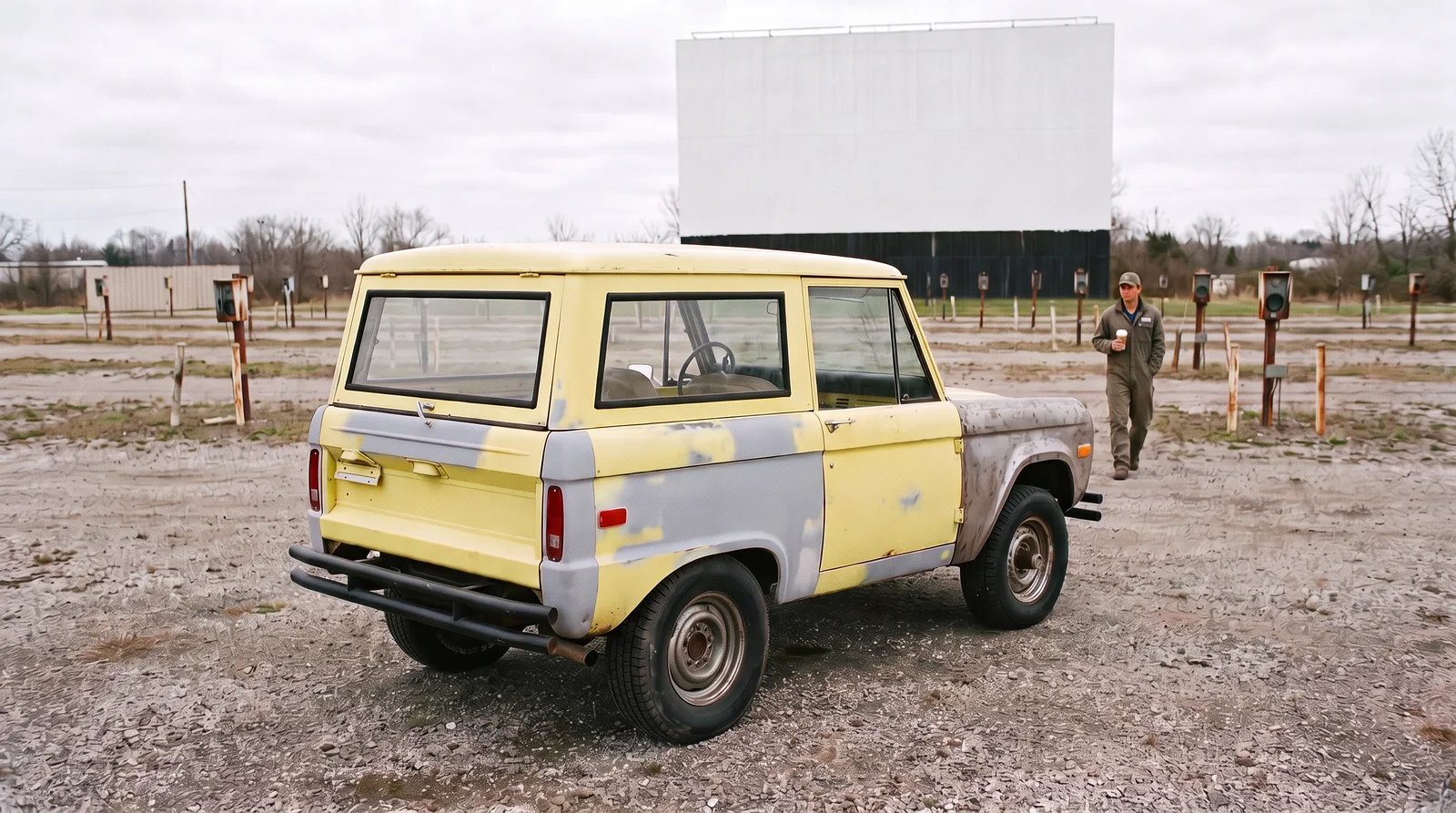
On a Saturday morning in almost any part of the country, there is a good chance someone is standing in a driveway or a small garage with a cup of coffee going cold, staring at a 1969 Bronco in some state of undress. That scene, repeated across thousands of driveways for decades, is really the ford bronco 1969 restoration culture story. It is less about parts and paint than it is about the particular kind of patience these trucks seem to ask of the people who take them on.
Car Features
6 min read
Restoring a 1969 Bronco, the Enthusiast Scene
Inside the tightly knit community of clubs, swap meets, and multigenerational owners who have kept 1969 Bronco knowledge alive for more than fifty years.
A community that grew up around a shared truck
What sets Bronco restoration culture apart from a lot of other classic vehicle communities is how tightly it has stayed knit together over the years. Regional clubs formed early, in some cases within a decade of the truck's introduction, and many of those same clubs are still holding meets and swap days now. There is a continuity here that is rare. A person who bought a Bronco new in 1969 might have a grandchild attending the same club gathering their grandparent once did, looking at a truck from the exact same model year.
That continuity matters because it has kept knowledge alive in a way that written manuals alone never could. Longtime club members have watched three or four generations of owners work through the same questions, the same stubborn problems, the same debates about what counts as correct for a given trim level. When a newcomer shows up with a rusted, incomplete 1969 Bronco and no idea where to start, there is usually someone at the next meet who has been exactly there before and is happy to talk through it over a folding table full of parts.
Why this particular model year draws its own following
The 1969 Bronco sits at an interesting point for restoration-minded owners. It carries the 302 V8, which gives a builder more support and more period-correct parts availability than the earlier 289-equipped trucks, while still wearing the compact, early-generation body style that purists favor over the larger trucks that came later. That combination has made it a popular starting point for people entering Bronco ownership for the first time, and clubs have noticed the pattern. Several regional groups now maintain informal records tracking which model years their newer members tend to gravitate toward, and 1969 shows up consistently near the top.
The emotional weight of taking one on
People rarely talk about how personal this process becomes. A truck bought at auction with no history attached still somehow ends up feeling like family property by the time the work is finished. Owners name them. They keep notebooks of every part sourced and every small decision made along the way. I have sat with more than one owner who could tell me exactly where a particular bolt came from, a swap meet in another state, a fellow club member's garage, a box of parts inherited from someone who had passed the truck along rather than sold it outright.
"People think they are restoring a truck. What they are actually doing, most of the time, is building a relationship with a piece of machinery that outlived the people who first owned it, and figuring out how to carry that forward honestly."
- Nora Beckett
Documentation as an act of care
The culture around these trucks has developed a real respect for documentation, not as a dry paperwork exercise but as a way of honoring a truck's actual history. Owners photograph everything before disassembly. They keep receipts, correspond with previous owners when they can be found, and treat old registration papers or dealer invoices as something closer to family records than mere proof of ownership. That instinct has quietly done more to preserve accurate knowledge about the 1969 Bronco than any single reference book could, and it means a truck sold today often comes with a paper trail thicker than the vehicle's own factory file, assembled entirely by people who cared enough to keep it.
Swap meets as a social calendar
For a lot of Bronco owners, the annual calendar is built around a handful of regional swap meets and club shows rather than around the truck sitting quietly in the garage the rest of the year. These events function as something closer to a reunion than a market. Yes, parts change hands, and yes, a rare original piece can spark genuine competition between buyers who both need the same thing. But most of the value people describe from attending is the conversation itself, catching up with people they only see once or twice a year, comparing notes on a project that has been going for a decade, trading stories about a particular truck that everyone in the group has watched evolve over multiple shows.
Younger owners entering the hobby often say the social side surprised them more than the mechanical side. They expected to learn about trucks. They did not necessarily expect to end up with a network of people across several states who would answer a phone call about a stuck bolt or a missing trim piece at almost any hour, or who would drive three hours with a spare part just because someone they met once at a swap meet needed it before a show.
Where new owners find their footing
Anyone starting down this road tends to discover the same thing fairly quickly. It is a slower process than expected, both in time and in the patience it demands, but the community around it makes the slowness bearable. Questions get answered. Rare pieces surface in unexpected places because someone at a meet remembered a truck they saw years ago. For deeper background on the truck itself, 1969 ford bronco history lays out the production and design context that helps a new owner understand what they are actually working with, and pairing that with a related story on specific surviving trucks can offer a useful sense of what a finished, well-documented example can look like.
For those still searching for their own starting point, it is worth taking a look at Broncos for sale now to see what is currently available, since the right project truck often has more to do with honest condition and a clear history than with finding something already finished. The culture around this truck has never really been about arriving at a perfect result. It is about the people who show up, year after year, willing to help a stranger get one running again, and about a truck built simple enough in 1969 that it can still be understood, cared for, and passed along by hand more than half a century later.
Sources and notes
Related Reading
Have a
Ford Bronco
for Sale?
Reach thousands of serious classic car collectors across the US.
Sell It Here →
Selling a classic? Here's how: sell my classic car
Are You a Classic Car Dealer?
List your full inventory and connect with targeted classic car buyers.
Join as a Dealer →
#Ford Bronco
#classic truck culture
#restoration community
#Bronco history
#1969 Bronco
#Bronco clubs

About the author
Nora Beckett
Automotive features writer and photographer who tells the human stories behind the cars, from show fields to cross-country road trips.
Related Listings - Ford Bronco
Comments (1)
J
Jerome
1 week ago
A man from my old garage bought a '69 Bronco at auction last spring with nothing in the glovebox. No receipts, not even an old registration. From the sound of it, the clubs care about paper as much as the truck. Will they still take him in with a no-history rig, or does he start at the back of the line?
They will take him in, Jerome, and sooner than he expects. Most of the people behind those folding tables started with a truck that had no story at all. The history he is missing is the history he gets to write: photographs before the first bolt comes out, a notebook, the name of whoever sells him a part. Someday somebody will buy that truck with a thick folder, and it will be his handwriting inside.
D
Dwight W.
1 week ago
Had something similar with my Corvair. Bought it with zero paperwork, and a club member two counties over drove a fan belt to my house before a show because the parts counter quoted three weeks. Never asked for gas money. That's how you get adopted. Bottom line: the paper builds itself once you show up.