
A 1973 Ford Bronco is one of the few classics that still earns its keep on a Tuesday commute. The ford bronco 1973 daily classic question comes up constantly in Bronco circles, because the 1973 model sits at a sweet spot in Dearborn's early production run: it carries the coil-sprung Dana 30 front axle Ford used on the Bronco from its August 1965 launch, a larger fuel tank added in the early 1970s, and enough factory parts commonality with later trucks that keeping one running is far less punishing than owning a rarer 1966 or 1967 example. This is not a restoration guide. It is a look at what actually happens when an owner decides to use a fifty-plus-year-old truck as a regular vehicle rather than a trailer queen.
Car Features
7 min read
Living With a 1973 Bronco as a Modern Classic
What it actually takes to drive a 1973 Ford Bronco as a regular vehicle, from parts availability to the honest limits of a fifty-year-old truck.
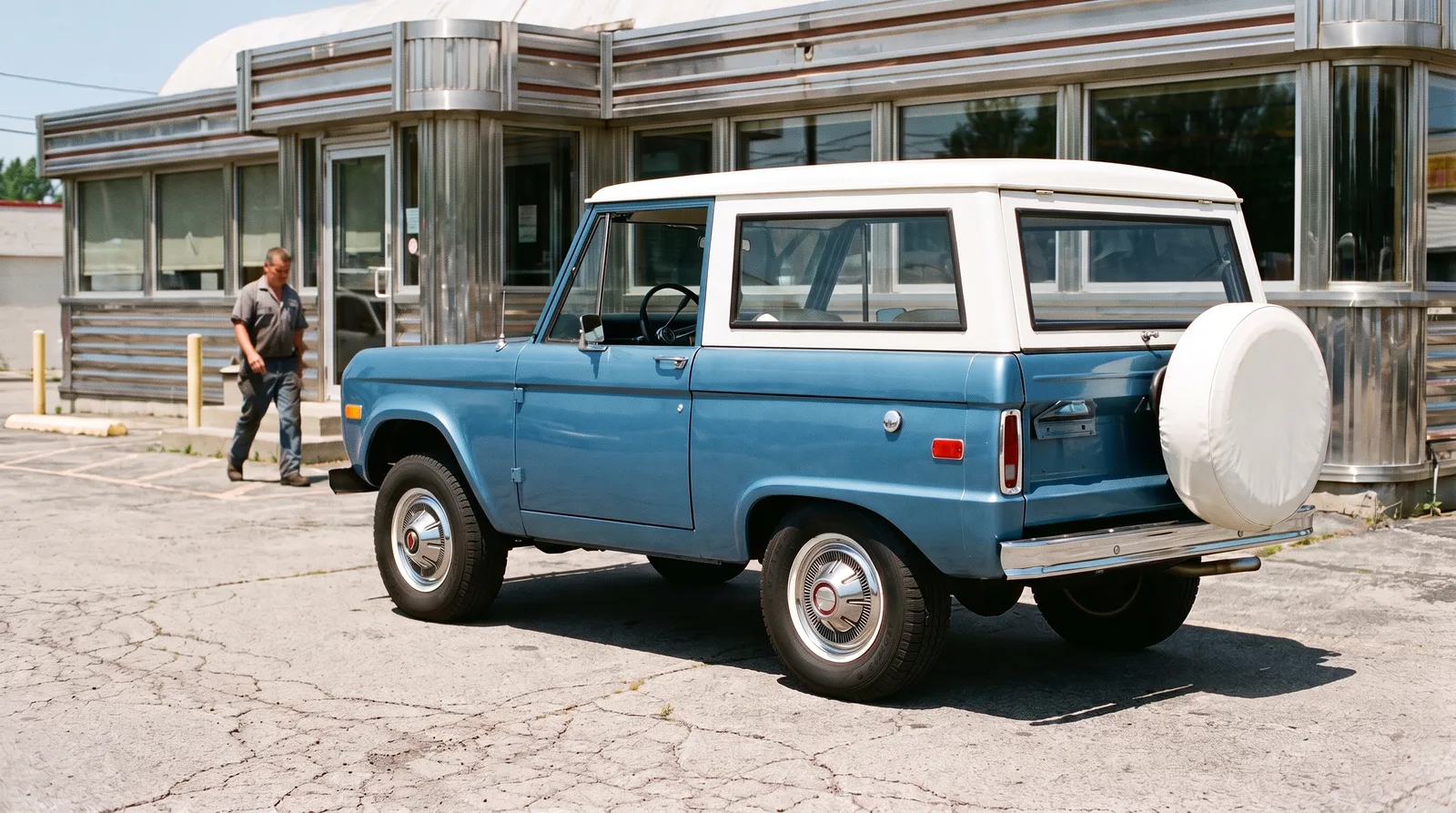
Why the 1973 year sits in a usable window
Ford built the Bronco with remarkably few structural changes between 1966 and 1977, which is exactly why a 1973 truck can function daily without feeling like an archaeological project. The uni-body frame and body remained the same basic architecture for the entire first generation, and the running gear had been refined by the early 1970s. A 1973 Bronco already has the coil-sprung front suspension Ford used on the Bronco from day one (a feature that set it apart from the leaf-sprung Jeep CJ and International Scout), plus the larger fuel tank and a dashboard layout that had matured past the plainer early trucks. None of this makes the truck modern. It makes it the most sorted version of an old design, which is a different thing.
For readers who want the full lineage of how the truck got to this point, our complete history traces the changes year by year from the 1966 launch through the 1973 refinements.
What daily use actually exposes
Owners who put real miles on a 1973 Bronco report the same handful of truths. The 302 cubic inch V8, when it is present and healthy, is a forgiving engine that tolerates modern gasoline and modest neglect better than the inline sixes some early trucks carry. Drum brakes on all four corners, standard on the 1973 truck, require more pedal effort and more attention than anything built after the mid 1970s, and that is simply the reality of the year, not a defect to be corrected here. Cabin noise is considerable at highway speed. Heat in summer and cold in winter both come through the thin sheet metal and simple insulation in ways a modern SUV owner would find startling. None of that is a flaw in the truck. It is the honest experience of driving a vehicle engineered before insulation, sound deadening, and cabin comfort were treated as competitive features.
The parts reality behind the romance
A 1973 Bronco benefits from something the 1966 trucks do not: a production run large enough that reproduction and salvage parts exist in real supply. Ford built early Broncos in meaningful numbers through the early 1970s, and the aftermarket eventually caught up to that demand with reproduction sheet metal, brightwork, and mechanical wear items. That does not mean every part is easy or cheap. Trim pieces specific to the 1973 model year, certain interior panels, and correct glass can still take patience to source. But compared to the scarcity that plagues the earliest first-year trucks, a 1973 owner is working with a far friendlier parts landscape.
"The 1973 truck gets treated like a compromise year by people who have never owned one. It is not a compromise. It is Ford having finally worked the bugs out of a design they introduced in 1966, and the production records back that up."
- Tom Ramirez
Where the truck struggles as a daily driver
Honesty matters here. A 1973 Bronco was never going to match a contemporary vehicle on any measure of comfort, safety, or efficiency, and it does not close that gap simply because it has aged into collector status. There is no power steering unless the previous owner added it, no factory air conditioning in most examples, and no crash structure that would satisfy a modern regulator. Fuel economy sits in the low double digits on a good day. Highway merging with the stock engine and gearing takes planning rather than confidence. None of this should discourage a buyer who understands what they are signing up for. It should discourage anyone expecting an old truck to behave like a new one.
What the ownership experience actually rewards
What a 1973 Bronco offers instead is a driving position, a mechanical simplicity, and a visibility out of the glass that no modern truck replicates. Owners describe the appeal less in terms of speed or comfort and more in terms of feel: a direct connection to the road, a cabin small enough that every control is within reach, and a shape that draws attention at every gas stop without the owner having done anything to invite it. That trade, slower and simpler for more engaged and more visible, is the actual case for daily use, not a nostalgia argument dressed up as practicality.
Readers weighing whether a 1973 example is the right entry point compared to other early years should keep exploring what these trucks are commanding in the current market before committing to a purchase.
Weather, storage, and the year-round question
Anyone considering a 1973 Bronco for genuine daily duty has to think honestly about climate before anything else. A truck this old has no rust-proofing by modern standards, and road salt in a northern winter will do more damage in a single season than a decade of dry-climate storage. Owners in salt-belt states who do use these trucks daily tend to garage them from late fall through early spring and drive something else for that stretch, treating the Bronco as a three-season vehicle rather than a true year-round commuter. That is not a failure of the truck. It is simply a recognition of what unprotected 1970s sheet metal and an open-body uni-body structure can and cannot tolerate over time. Owners in drier climates, by contrast, report far less anxiety about daily use, since the biggest threat to an old truck's structure barely exists in their environment.
Storage habits matter just as much as climate. A 1973 Bronco that sits outside uncovered accumulates UV damage to paint and rubber seals far faster than one kept under any kind of roof, and gaskets original to the era were never engineered for fifty years of service regardless of use pattern. Daily drivers among this crowd tend to be the trucks with the most attentive owners, not necessarily the ones with the deepest restoration budgets, because consistent use combined with consistent care keeps small problems from becoming structural ones.
The verdict on daily use
A 1973 Bronco rewards an owner who wants an old truck to feel like an old truck, not a modern one wearing a costume. Anyone shopping the market for a truck this specific year should look at a genuine classic Bronco for sale and inspect it in person rather than trusting photographs, because the condition variance across surviving examples is wide enough to make or break the daily-use case entirely.
Sources and notes
Related Reading
Have a
Ford Bronco
for Sale?
Reach thousands of serious classic car collectors across the US.
Sell It Here →
Selling a classic? Here's how: the best sites to sell a classic car
Are You a Classic Car Dealer?
List your full inventory and connect with targeted classic car buyers.
Join as a Dealer →
#Ford Bronco
#classic truck ownership
#daily driver classic
#early bronco
#Bronco history
#1973 Bronco

About the author
Tom Ramirez
Corvette researcher and historian based in Bowling Green, Kentucky. Two decades documenting Corvette production history from original factory records.
Related Listings - Ford Bronco
Comments
Be the first to comment on this article.