
The 1973 Ford Bronco sits at an odd point in the model's timeline. It is not the truck that started the story in 1966, and it is not the truck that closed out the original small Bronco in 1977. It is the year in between, when Ford had already begun planning the truck's replacement while dealers kept selling the compact rig largely unchanged. Understanding the 1973 Bronco means understanding what Ford was quietly building toward, and why the small Bronco's days were already numbered even as it sold well on showroom floors.
Car Features
7 min read
The 1973 Bronco and the Countdown to a New Era
The 1973 Bronco sold as a known quantity while Ford quietly developed its larger F-100 based replacement, making this transitional year the last full expression of the original compact concept.
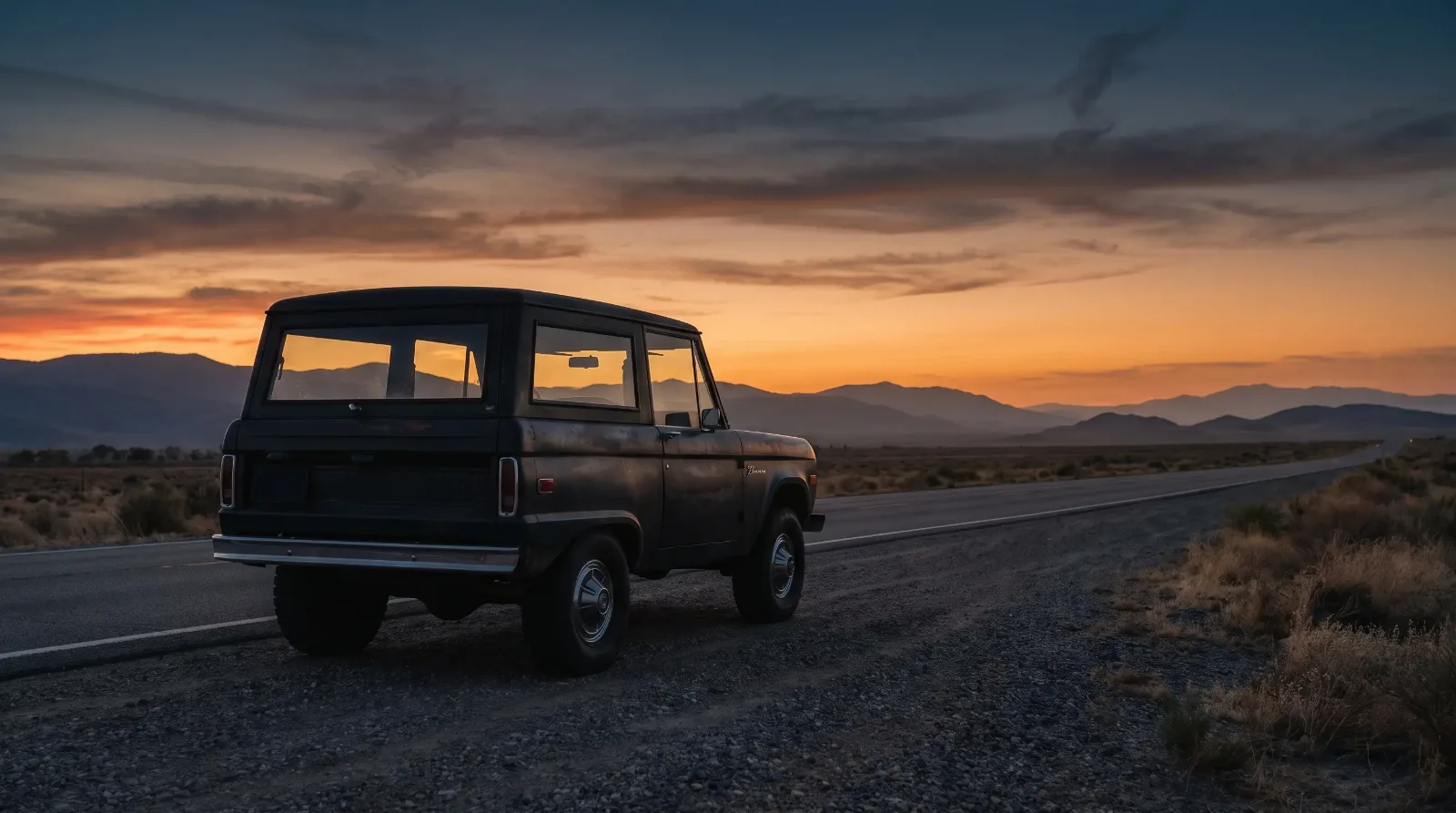
A truck built on a five-year-old idea
By 1973 the Bronco platform was already seven model years old, dating to its 1966 introduction as a purpose-built off-road vehicle rather than a repurposed car chassis. Ford engineers had given the truck a boxed ladder frame, coil-spring front suspension with the Dana 30 axle, and a wheelbase of 92 inches that made it nimble on trails but tight for passengers. Those numbers had not changed since the beginning, and by the early 1970s the competition had moved on. The Chevrolet Blazer, introduced in 1969, and the GMC Jimmy, which followed a year later, offered full-size cab comfort with removable tops. The Bronco, by comparison, still felt like a jeep with a Ford badge.
Ford's product planners knew this. Internal development on a larger Bronco, one built on the F-100 pickup platform, had been underway since the early 1970s. The 1973 model year, then, was less a fresh chapter than a holding pattern, a truck sold largely as-is while the next generation took shape in engineering studios in Dearborn.
What actually changed for 1973
Ford did not leave the 1973 Bronco completely untouched. Federal safety mandates pushed the company to add shoulder belts as standard equipment, and the parking brake handle moved to a more accessible position under the dash. Emissions regulations continued to tighten, and the 302 and 200-cubic-inch inline six both saw modest recalibration to meet the standards, with the 302 V8 rated at roughly 141 horsepower under the SAE net measurement Ford had adopted. Buyers could still choose between the six-cylinder base engine and the 302 V8, with a three-speed manual as standard and Ford's C4 automatic, offered on the Bronco for the first time in 1973, as the popular option.
Trim offerings carried over largely unchanged from 1972, with the Sport package remaining the dress-up choice for buyers who wanted brightwork and two-tone paint without stepping up to a full custom build. For the full accounting of specs, trim levels, and production details across the model year, our team has put together the whole picture on the 1973 truck.
Dealers still moved the small Bronco
None of the coming change slowed sales. The compact Bronco had built a loyal following through the late 1960s and into the 1970s, particularly among buyers who wanted something smaller and more maneuverable than a full-size pickup but still capable off pavement. Ford's dealer network treated the 1973 model as a known quantity, easy to sell to repeat customers who already understood what the truck could and could not do. That familiarity mattered more than novelty at a moment when the industry was absorbing fuel price shocks and buyers were growing more cautious about vehicle choice.
Production numbers for the era show the small Bronco holding a consistent, if modest, share of Ford's light truck lineup, well behind the F-Series pickups but steady enough that Ford saw no urgent need to rush a replacement. The truck's simplicity, a body-on-frame design with few complicated systems to service, also kept warranty costs low and dealer technicians comfortable.
The last of a distinct breed
Looking back, the 1973 Bronco reads as one of the final full expressions of the original concept: compact, mechanically simple, and unapologetically utilitarian. When the 1978 Bronco arrived on the larger F-100 platform, it solved the space and comfort complaints but also abandoned the tight, purpose-built proportions that had defined the truck since 1966. For collectors and historians today, that makes the early-to-mid 1970s trucks, 1973 among them, a distinct chapter that closed for good once the redesign landed.
Production and archival documentation from Ford's Dearborn engineering records make clear that the compact Bronco was never intended to run forever unchanged. What is sometimes lost in casual retellings is how gradual the transition was. Ford did not abruptly kill the small Bronco to make room for something new. It let the old truck finish its run while a new one was built in parallel, a pattern common across Ford's product planning in this period and one that rewards a careful read of factory paperwork over assumption.
"People assume Ford just woke up one day in 1978 and reinvented the Bronco. The paper trail says otherwise. They were sketching the bigger truck while the small one was still on the line, and that overlap tells you everything about how deliberate Ford's product planning really was."
- Tom Ramirez
Reading the transition through Ford's own paperwork
Factory service bulletins from this period offer a useful window into how Ford treated the small Bronco during its final years. Rather than issuing sweeping technical updates, the bulletins focus on small corrective fixes, adjustments to carburetor calibration, revised torque specifications, minor trim supplier changes, the kind of routine maintenance guidance a manufacturer issues for a mature product it intends to keep building with minimal disruption. There is nothing in that paperwork suggesting engineers expected a major overhaul before the platform's eventual replacement. It reads instead like documentation for a truck Ford considered essentially finished, in the sense that its fundamental character had been settled years earlier.
That stability is part of what makes trucks from this window appealing to collectors who value consistency. A 1973 Bronco built to the same fundamental specification as one from a year or two earlier or later gives buyers a wider pool of comparable trucks to draw from when sourcing parts, verifying originality, or simply understanding what a stock example should look like mechanically. Dealers of the period rarely needed to explain significant year-over-year changes to returning customers, because there usually were not many to explain.
Why 1973 still matters to buyers today
For anyone researching a ford bronco 1973 last of line preview, the value of understanding this transitional year is practical as well as historical. Trucks from this window carry the compact dimensions, coil-spring front end, and mechanical simplicity that define the original Bronco concept, without the added years of wear that earlier examples from 1966 through 1969 often carry. They represent a truck built on a mature, well-sorted platform, right before Ford moved on to something entirely different.
That combination, maturity without the redesign, is part of why these years continue to draw steady interest from buyers who want the classic Bronco silhouette in a truck that benefited from a few extra years of refinement. Anyone shopping this window of production should shop classic Bronco listings with that context in mind, comparing trim level, drivetrain, and documented history rather than treating every 1973 example as identical.
The 1973 Bronco was never meant to be remembered as a landmark year on its own. Its significance comes from what it represents: the last stretch of road before Ford changed direction entirely, and a snapshot of a truck built with a formula the company had already decided to retire.
Sources and notes
Related Reading
Have a
Ford Bronco
for Sale?
Reach thousands of serious classic car collectors across the US.
Sell It Here →
Selling a classic? Here's how: where to sell your classic car online
Are You a Classic Car Dealer?
List your full inventory and connect with targeted classic car buyers.
Join as a Dealer →

About the author
Tom Ramirez
Corvette researcher and historian based in Bowling Green, Kentucky. Two decades documenting Corvette production history from original factory records.
Related Listings - Ford Bronco
Comments
Be the first to comment on this article.