
A ford bronco 1973 vs ramcharger comparison requires a bit of careful framing, because Dodge's Ramcharger did not actually reach dealer lots until the 1974 model year. Still, the two trucks belong in the same conversation. The Ramcharger was designed and announced while the refined 1973 Bronco was already on sale, and its arrival the following year changed the competitive field the Bronco had to operate in for the rest of the decade. Understanding the 1973 Bronco means understanding what was coming right behind it.
Car Features
6 min read
1973 Bronco vs Dodge Ramcharger, the New Challenger
The ford bronco 1973 vs ramcharger question is really about timing: Dodge's Ramcharger arrived for 1974, built as a direct response to the segment the Bronco had already proven out.
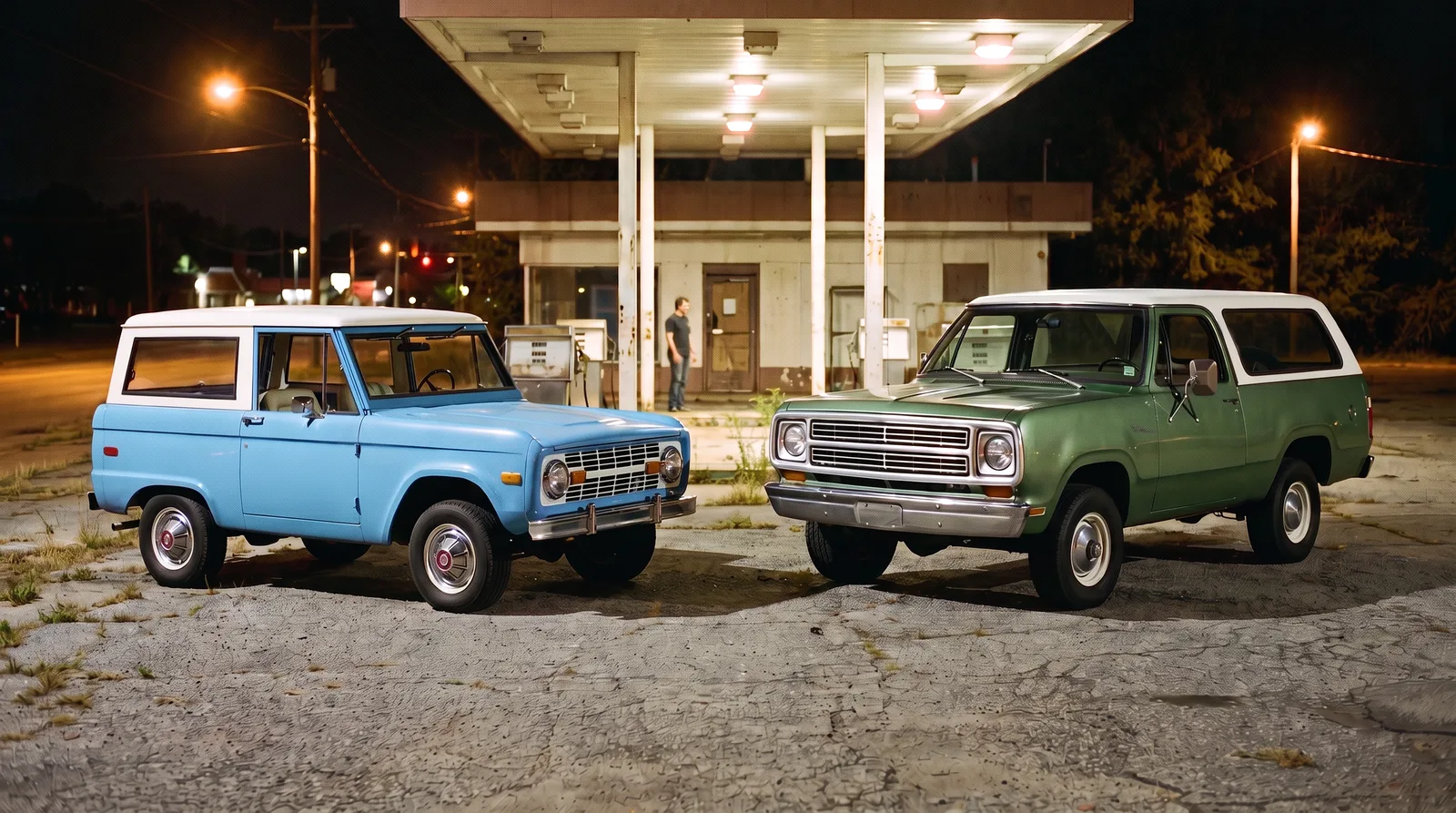
The Bronco Dodge was aiming at
By 1973, the Bronco had built a solid reputation as a compact, capable 4x4 with a loyal following among buyers who valued its tight dimensions and off-road manners. Ford had spent that model year adding power steering and refining trim options, moves aimed squarely at keeping the truck competitive as buyer expectations shifted toward more comfort. Dodge, watching both the Bronco and the Chevrolet K5 Blazer perform well in this growing segment, decided the compact and mid-size utility truck market was worth entering directly rather than ceding to Ford and Chevrolet.
The Ramcharger, when it arrived for 1974, took a different approach than the Bronco's tight, purpose-built platform. Dodge built it on a shortened version of its full-size truck chassis, closer in spirit to Chevrolet's Blazer strategy than to Ford's compact Bronco philosophy. That decision meant the Ramcharger entered the market as a bigger, roomier alternative rather than a direct dimensional match for the Bronco.
What the timing tells us about the segment in 1973
The fact that Dodge felt compelled to develop the Ramcharger while the 1973 Bronco was still a relatively fresh, well-received truck says something important about how quickly the compact and mid-size 4x4 segment was growing in the early 1970s. This was not a stagnant niche. It was an expanding category that three major domestic manufacturers all wanted a share of, and each one arrived with a distinct interpretation of what the ideal utility truck should be.
Ford's answer, refined through the 1973 model year, stayed compact and nimble. Chevrolet's answer, established a few years earlier, prioritized size and comfort on a pickup-derived platform. Dodge's eventual answer, the Ramcharger, would follow closer to Chevrolet's philosophy than Ford's, leaving the compact-and-agile lane largely to the Bronco through most of the 1970s.
How this shapes the way we read the 1973 Bronco today
Looking back with the full decade in view, the 1973 Bronco represents the high point of Ford's original compact philosophy before market pressure eventually pushed the company to redesign the truck onto the larger F-Series-based platform for 1978. That later, bigger Bronco would compete far more directly against the Ramcharger and the Blazer on their own terms. The 1973 truck, by contrast, is a snapshot of the last era when the Bronco stood genuinely apart from its domestic rivals in size and character.
Readers interested in the fuller context of what changed for the 1973 model year, including the power steering option and updated trim choices covered elsewhere, can read the background on the complete model year story.
"Dating the Ramcharger correctly matters here. It was not a 1973 rival to the Bronco, it was the truck Dodge started developing because the Bronco and the Blazer had already proven the segment was real. That sequence tells you the Bronco was ahead of the curve, not chasing it."
- Sarah Whitfield
What the Ramcharger's design choices reveal about the segment's future
Dodge's decision to build the Ramcharger on a shortened full-size platform, rather than developing something closer to the Bronco's dedicated compact architecture, turned out to be a preview of where the whole segment was headed. Within a few years, Ford itself would abandon the compact Bronco formula for the larger, F-150-based truck introduced in 1978, following the same basic logic Chevrolet had pioneered with the Blazer and Dodge would confirm with the Ramcharger. Bigger platforms were cheaper to engineer, shared more components with existing pickup lines, and gave manufacturers more interior room to sell against a market that increasingly wanted both capability and comfort in one vehicle.
Seen from that angle, the 1973 Bronco stands as one of the final examples of a genuinely different engineering philosophy, a purpose-built compact 4x4 rather than a shrunk-down pickup. That distinction is a meaningful part of why the truck draws such dedicated interest from collectors who specifically want the smaller, dedicated platform rather than any of the larger, pickup-based utility trucks that followed it through the rest of the 1970s.
What buyers should take from this comparison
For a modern collector weighing a 1973 Bronco purchase, the Ramcharger comparison mostly reinforces why the compact Bronco holds a distinct place in truck history. It was not competing against a like-for-like rival in its own model year. It was setting the standard that Dodge, arriving a year later with a bigger, pickup-based alternative, had to respond to. Anyone shopping today can find a classic Bronco and see firsthand how that compact, purpose-built character still sets these trucks apart from the larger utility vehicles that followed.
Why this comparison still gets debated among enthusiasts
Online forums and club discussions regularly revisit the Bronco versus Ramcharger question, often without acknowledging the year gap between the two trucks' introductions. That confusion is understandable given how closely the two names get associated with the same general era of American 4x4 history, but it also flattens a more interesting story about how quickly the segment matured between 1973 and 1974. A buyer researching either truck benefits from understanding the actual sequence of events rather than treating both as simultaneous, equally positioned rivals from the same model year.
Getting the timeline right also matters for anyone trying to accurately value or describe a truck for sale. Advertising a 1973 Bronco as having outsold or outperformed the Ramcharger in its own model year is simply inaccurate, since the Ramcharger did not exist yet to compare against. The more honest and more interesting framing, that the Bronco helped prove out a market Dodge later entered, gives collectors a clearer and more defensible picture of where the 1973 truck actually sits in the broader history of the segment. Get the sequence right, and the Bronco's role looks even more significant than the flattened, same-year version of the story usually gives it credit for.
For a truck often remembered mainly for its compact size and off-road manners, that role as an unwitting trendsetter is a genuinely underappreciated part of its legacy, and it is worth mentioning any time the Bronco and Ramcharger come up in the same conversation. It is a small correction, but it changes how the whole comparison should be read.
Sources and notes
Related Reading

Have a
Ford Bronco
for Sale?
Reach thousands of serious classic car collectors across the US.
Sell It Here →
Selling a classic? Here's how: compare the places to sell classic cars
Are You a Classic Car Dealer?
List your full inventory and connect with targeted classic car buyers.
Join as a Dealer →

About the author
Sarah Whitfield
Third-generation classic car collector specializing in pre-war American and European coachbuilt automobiles. Researcher and concours enthusiast.
Related Listings - Ford Bronco

Comments
Be the first to comment on this article.