
Walk any classic truck show and count the Broncos. A disproportionate number will carry 1973 build tags. That is not an accident of memory or a trick of survivorship bias alone. The 1973 Ford Bronco exists in genuinely larger surviving numbers than many of its immediate predecessors, and the reasons trace back to production volume, regional distribution, and the specific mechanical traits that let these trucks outlast their peers.
Car Features
6 min read
Why So Many 1973 Broncos Survive Today
Strong production volume, dry-climate regional distribution, and mechanical simplicity explain why 1973 Ford Broncos survive in unusually deep numbers today.
A production run near its peak
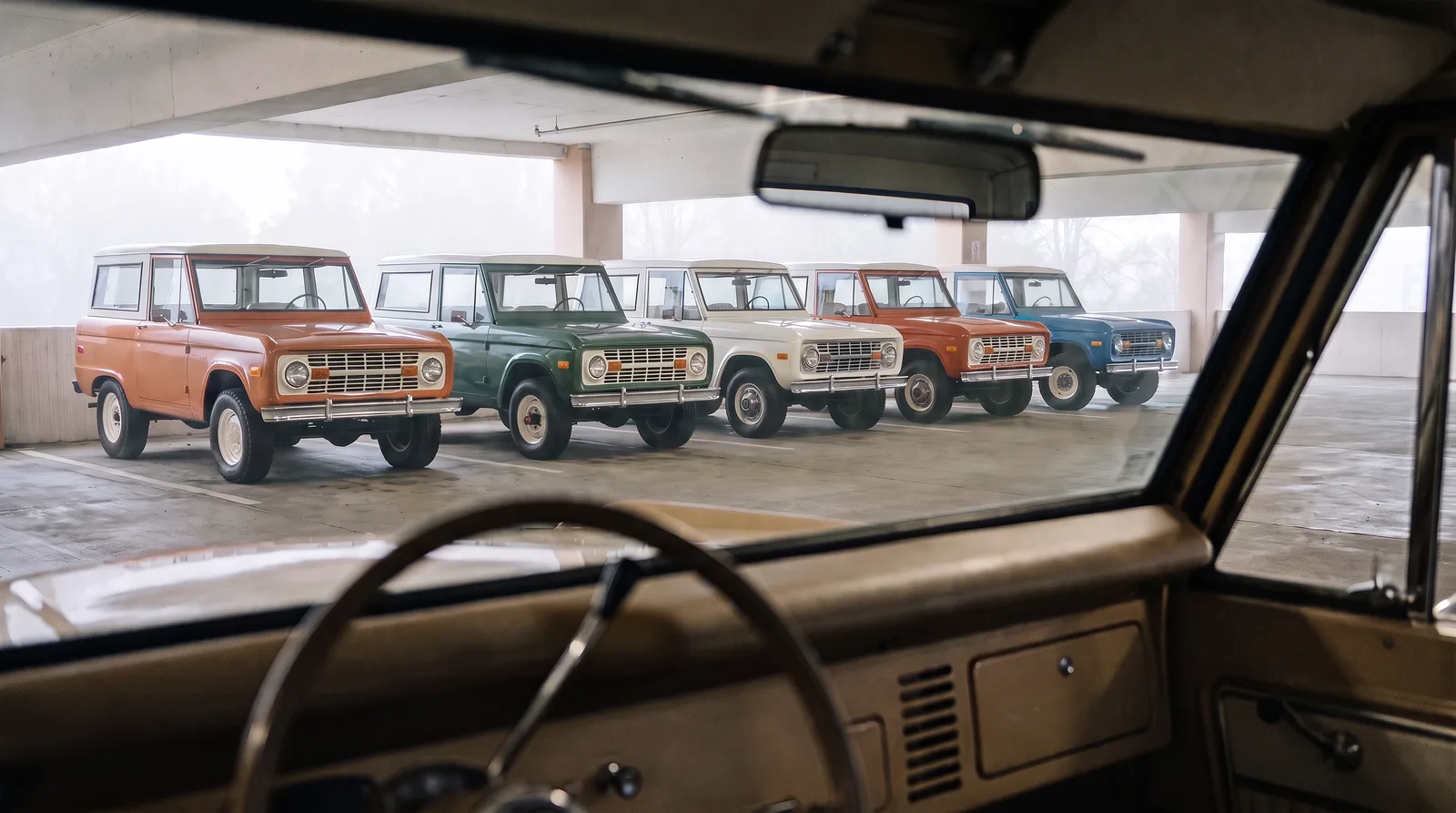
The compact Bronco's sales climbed steadily through the early 1970s as four-wheel-drive recreational vehicles gained broader appeal beyond farm and ranch buyers. Ford built roughly 21,894 Broncos for the 1973 model year, a total that ran well ahead of the lean 1967 and 1968 seasons, when volumes dipped to around 14,000 to 17,000 units, even though it did not quite match the truck's strong 1966 launch year. Dealer demand through the early 1970s stayed healthy enough that 1973 still ranks among the more productive years of the first-generation Bronco's run.
More trucks built simply means more trucks available to survive into the collector era, a straightforward numbers argument that accounts for a meaningful share of why 1973 examples turn up so often at auctions and swap meets today.
Geography did the rest
Production volume alone does not explain the disproportionate survival rate. Distribution mattered just as much. Ford's dealer network sent a substantial share of these trucks to the dry, low-corrosion regions of the American Southwest and interior West, precisely the terrain where four-wheel-drive utility vehicles found their most natural customer base. Trucks that spent their working lives in Arizona, New Mexico, and similar climates avoided the road salt and moisture that dissolved the frames and rocker panels of Broncos sold in the Rust Belt and Northeast.
Archival dealer allocation records from this period show a clear regional skew toward these arid markets, and that skew is visible today in the geographic origin of well-preserved survivors. A collector researching provenance on a specific truck will often find that the strongest, straightest examples trace back to a handful of Southwestern states rather than a random national spread.
Mechanical simplicity as a preservation advantage
The Bronco's design itself deserves credit too. The 1973 truck used a straightforward boxed frame, solid axles front and rear, and a drivetrain that a competent home mechanic could service with basic tools. Unlike more electronically dependent vehicles from later decades, these trucks did not become unrepairable simply because a specific module or sensor stopped being manufactured. Parts interchange broadly across the first-generation Bronco's production run from 1966 through 1977, which means a 1973 truck missing an original component can often be restored using period-correct parts sourced from a donor of a slightly different model year.
That interchangeability has kept a meaningful population of 1973 Broncos on the road rather than in scrapyards, because owners facing a mechanical failure have rarely needed to abandon a truck for lack of available parts. For the full mechanical and specification history behind this durability, our coverage of the 1973 ford bronco story lays out the platform in detail.
The restoration and collector market effect
A second wave of preservation arrived decades later, once the classic truck market began treating these Broncos as legitimate collector vehicles rather than used farm equipment. As values climbed through the 1990s and 2000s, owners who might once have let a tired truck sit and decay instead found it financially sensible to restore. That shift pulled a number of 1973 Broncos back from the edge of being parted out, adding to the surviving population years after their original service life would have suggested.
This second-life preservation effect is not unique to the 1973 model year, but it compounds with the truck's larger original production run and favorable regional distribution to produce the abundance seen today. Readers who want the broader arc of the Bronco nameplate, from its 1966 debut through the end of the classic era, can find the full story in our complete history coverage.
"When I trace title histories on these trucks, the pattern is consistent. A dry-climate 1973 Bronco with clean documentation almost always beats a rust-belt truck of the same year on structural integrity alone, regardless of how much cosmetic work has been done."
- Sarah Whitfield
Comparing survival against other early Broncos
Set a 1973 Bronco's survival rate against the trucks built in the platform's opening years and the contrast sharpens further. The earliest 1966 and 1967 model year Broncos exist today in comparatively small numbers, partly because fewer were built as Ford introduced the nameplate cautiously, and partly because five additional years of exposure to weather, salt, and neglect took a heavier toll before the collector market began actively protecting these trucks. A 1973 example, by comparison, benefited from both a larger initial production run and a shorter window of vulnerable, undocumented ownership before enthusiasts began treating the model as worth preserving.
That timing advantage should not be overstated. A poorly stored 1973 truck can be in worse structural condition than a well-kept 1967, and buyers should never assume model year alone predicts condition. What the comparison does establish is a baseline expectation: all else being equal, a shopper is statistically more likely to find a sound, honest 1973 example than an equally sound truck from several years earlier, simply because more of them exist to choose from and a larger share came from favorable climates.
What abundance means for today's buyer
For a buyer approaching the ford bronco 1973 inventory abundance question from a practical angle, the takeaway is straightforward. There are simply more 1973 Broncos on the market than there are examples from several surrounding model years, which gives buyers real leverage to be selective. Rather than settling for the first available truck, shoppers can afford to prioritize documented provenance, dry-climate history, and matching-numbers drivetrains, because the supply exists to support that patience.
That said, abundance in absolute numbers does not mean abundance in quality. Many surviving 1973 Broncos have been modified, poorly repaired, or subjected to inconsistent restoration work over five decades of ownership. The larger population simply means a more careful buyer has more genuine options to choose from. Anyone shopping this segment should take the time to compare several classic Broncos on the market before committing, using the documented history and regional origin discussed here as a starting filter rather than relying on appearance alone.
The story of why so many 1973 Broncos survive is ultimately a story about production timing, climate, and mechanical design working together. None of those factors alone would explain today's relatively deep inventory, but combined, they account for why this specific model year remains one of the most attainable entry points into first-generation Bronco ownership.
Sources and notes
- Wikipedia: Ford Bronco (first generation)
- Conceptcarz: 1973 Ford Bronco Specifications
- Hagerty: Vintage Ford Bronco values, a breakdown by generation
- Metro Moulded Parts: 1973 Ford Bronco Catalog and Classic Car Guide
- Autoevolution: 1973 Ford Bronco Fully Restored Barn Find
- Ford Truck Enthusiasts Forums: Bronco Production Numbers
Related Reading
Have a
Ford Bronco
for Sale?
Reach thousands of serious classic car collectors across the US.
Sell It Here →
Selling a classic? Here's how: sell my classic car
Are You a Classic Car Dealer?
List your full inventory and connect with targeted classic car buyers.
Join as a Dealer →

About the author
Sarah Whitfield
Third-generation classic car collector specializing in pre-war American and European coachbuilt automobiles. Researcher and concours enthusiast.
Related Listings - Ford Bronco
Comments
Be the first to comment on this article.