
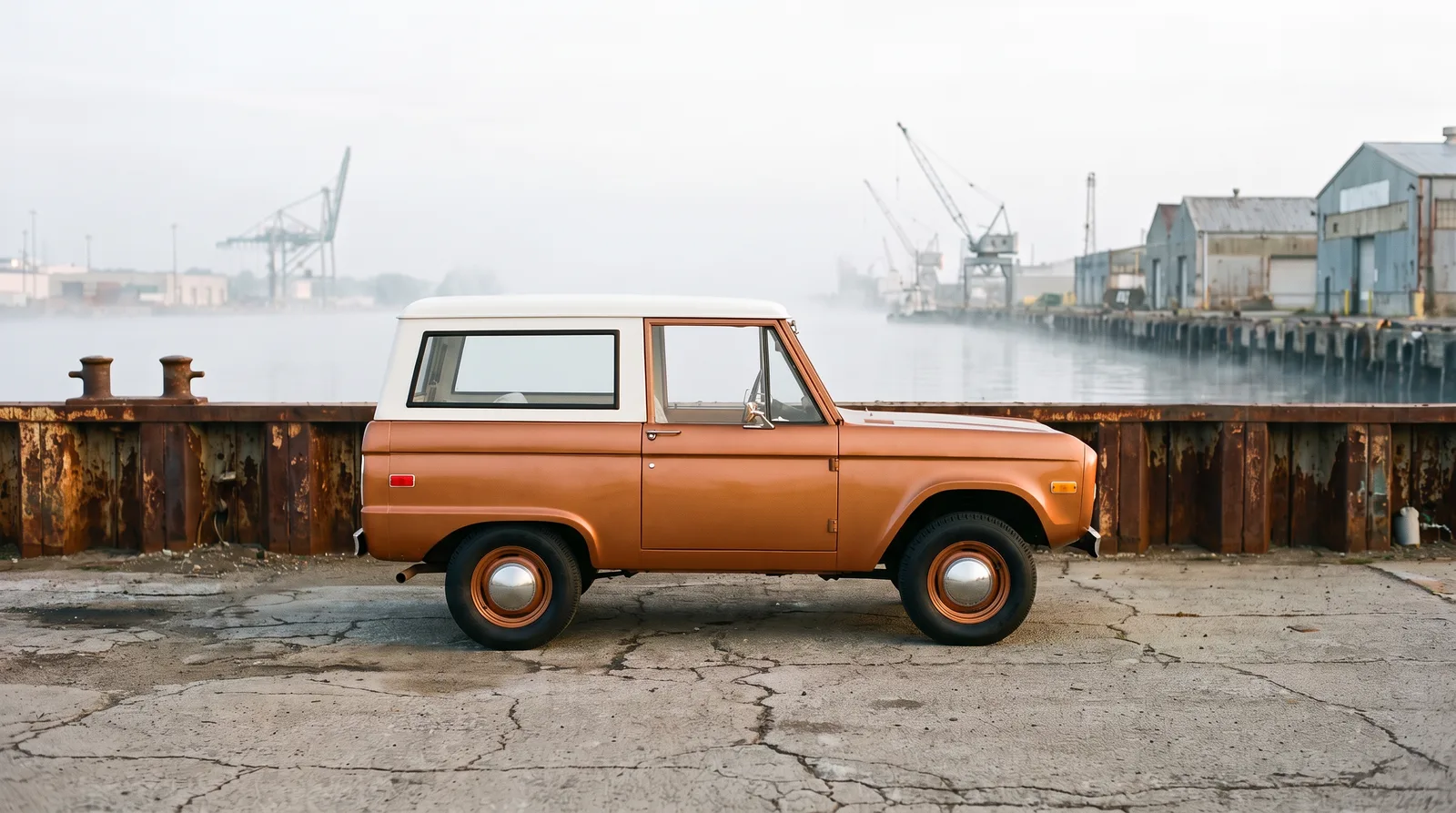
The ford bronco 1977 final first gen story is really the story of an ending that nobody at Ford treated as an ending while it was happening. The 1977 model year closed out eleven years of the uni-body Bronco, the design that had launched in 1966 and carried through with steady refinement rather than a single dramatic redesign. Production records show no fanfare, no special final-year package, and no factory acknowledgment that this was the last truck of its kind. Ford was already deep into engineering the larger, F-150-based second generation that would replace it for 1978. The 1977 truck simply kept building to the established formula until the line quietly stopped.
Car Features
7 min read
The 1977 Bronco, the Last of the Early Broncos
Why the 1977 Bronco closed out the uni-body first generation quietly, and what that final year means for collectors today.

What the 1977 truck actually was
By 1977, the Bronco had absorbed a decade of running changes onto its original 1966 architecture. The coil-spring front suspension carried over from the 1966 original, the enlarged 20-gallon fuel tank added in 1971, and a cabin refined by successive years of federally mandated safety updates all carried into this final year. Engine offerings by 1977, the 200 cubic inch inline six and the 302 cubic inch V8, reflected the emissions-driven power reductions that had affected the entire American auto industry through the mid 1970s, meaning a 1977 Bronco's factory output figures generally sit below what the same engine families had produced in the mid 1960s before emissions controls tightened. This was not a Bronco in decline. It was a Bronco built at the very end of a design's natural life, carrying every improvement Ford had made to it along the way.
The full account of how the design reached this point is covered in read the background, which traces the changes across all eleven years of the uni-body run.
Why Ford ended the design when it did
The decision to replace the uni-body Bronco was not primarily about the 1966 architecture failing to sell. It was about market direction. Ford's F-150 platform had grown into a larger, more capable full-size truck, and Ford's own product planning increasingly saw the future of the Bronco tied to that platform's capability and interior room rather than the compact, uni-body format that had defined the truck since its introduction. The result was the 1978 and 1979 big Bronco, built on a shortened F-150 frame, followed shortly by the full-size third generation Bronco that ran from 1980 to 1996. None of those later trucks shared the uni-body construction that made the original design distinct, which is exactly why 1977 marks such a hard structural line rather than a soft transition.
Why the final year carries specific collector weight
Any last model year of a discontinued design tends to attract a particular kind of collector attention, and the 1977 Bronco is no exception. It represents the design at its most complete, carrying every incremental improvement Ford made across eleven years without yet losing any of the compact proportions and uni-body character that define the early Bronco. Buyers specifically seeking the most refined version of the original truck, rather than the earliest or rarest, often gravitate toward 1976 and 1977 examples for exactly this reason. That is a different collecting instinct than chasing the 1966 first-year truck, and it is just as legitimate.
"The production records don't show a company winding down a design. They show a company still refining it right up until the last unit came off the line. That tells you the 1978 change was a market decision, not an admission that the original truck had run its course."
- Tom Ramirez
How the 1977 truck compares to its neighbors
Set against a 1976 example, the 1977 Bronco offers few if any unique mechanical distinctions, since Ford was not treating the year as special at the time. Set against the 1978 that followed it, the difference is total: a different frame, a different body, and a significantly larger footprint. This makes the 1977 truck less a standalone milestone and more a marker, the final data point in a continuous line of development that stretched back to a very different America in 1966. Enthusiasts curious about the parallel cultural life these trucks lived, particularly the uncut and unmodified examples still surviving from this era, may find worth a look too a useful companion piece on that specific collecting niche.
The people who built the last ones
Production line workers assembling Broncos through 1977 had no way of knowing they were building the final examples of a design that had run, largely unchanged in its fundamental architecture, since before many of them had started at the plant. Factory records from the period document a truck built to the same processes and the same quality standards as any other year in the run, with no indication that anyone treated the line as winding down. This matters for how collectors think about 1977 trucks today. There was no rushed, corner-cutting final push and no deliberate effort to make the last units special. They were simply built the way every Bronco before them had been built, which is itself part of why the year holds up so well against scrutiny decades later.
Dealer inventory records from late 1977 and early 1978 show 1977 Broncos and the newly arriving 1978 big Broncos briefly sharing showroom floors in some markets, a transitional period that must have been genuinely strange for salespeople trying to explain to customers why two trucks wearing the same nameplate looked and drove so differently from each other. That overlap window, brief as it was, is part of the historical texture around the changeover that rarely makes it into simplified summaries of the model's history.
Surviving correspondence and dealer bulletins from the period give no indication that Ford marketed the 1977 model with any acknowledgment of its status as the final uni-body year. Advertising continued to sell the truck on its established strengths, compact size, off-road capability, and everyday practicality, the same pitch Ford had used with only minor variation for most of the previous decade. Whatever significance the year now carries was assigned entirely in hindsight, by a collector community that only recognized the ending's importance once the 1978 redesign made clear just how completely the truck had changed.
That retrospective significance is worth sitting with for a moment, because it says something honest about how automotive history actually gets written. Few endings look like endings while they are happening. The workers on the line, the dealers selling the trucks, and the buyers driving them off the lot in 1977 were simply going about an ordinary model year. It took the sharp contrast of the 1978 redesign to reveal, after the fact, exactly what had quietly concluded.
What it means for today's buyer
A genuine 1977 Bronco offers a buyer the most developed version of the original uni-body design without the scarcity premium attached to the earliest first-year trucks. It is not automatically rarer or more valuable than other years in the run, but it does carry a specific historical distinction as the closing chapter of an eleven-year story that never got a proper send-off at the time. Shoppers interested in this exact year, or in comparing it against neighboring model years, can shop classic Bronco listings and evaluate the differences firsthand.
Sources and notes
Related Reading


Have a
Ford Bronco
for Sale?
Reach thousands of serious classic car collectors across the US.
Sell It Here →
Selling a classic? Here's how: compare the places to sell classic cars
Are You a Classic Car Dealer?
List your full inventory and connect with targeted classic car buyers.
Join as a Dealer →

About the author
Tom Ramirez
Corvette researcher and historian based in Bowling Green, Kentucky. Two decades documenting Corvette production history from original factory records.
Related Listings - Ford Bronco
Comments
Be the first to comment on this article.