
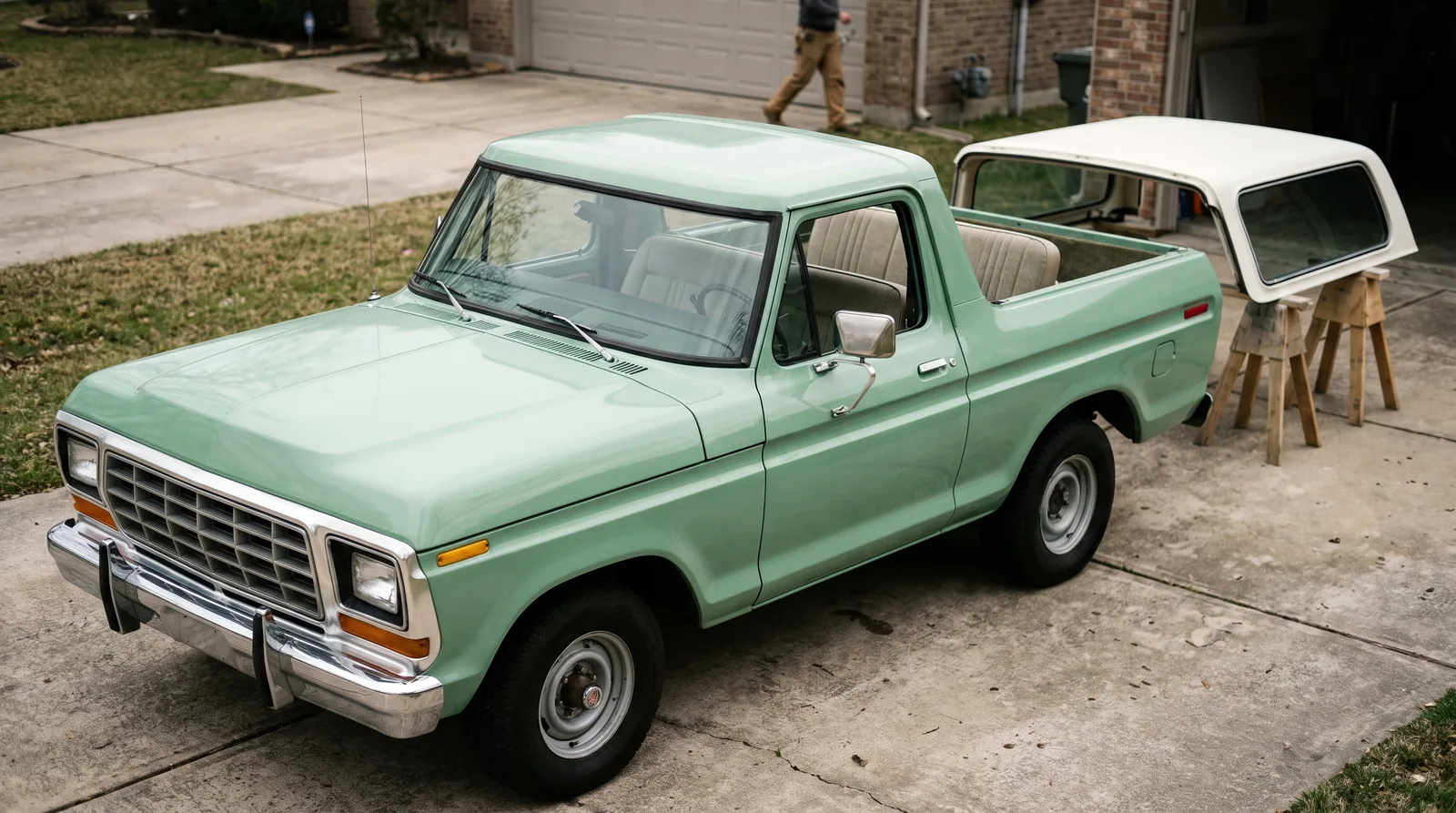
There is a particular sound a Bronco owner remembers before any other detail: the scrape and thunk of a fiberglass roof panel coming free in a driveway, two or three friends steadying it between them, the sky opening up over a truck that a minute earlier had looked like any other closed cab. The ford bronco 1978 removable top carried that same small ritual forward from the original compact Bronco into the bigger, F-Series-based truck that replaced it, and for a lot of owners that single detail mattered more than the horsepower rating under the hood.
Car Features
7 min read
The Removable Hardtop of the Second-Gen Bronco
The fiberglass removable top carried forward into the full-size 1978 Bronco, and for many owners it mattered more than anything under the hood.
A feature that survived the redesign
When Ford rebuilt the Bronco on F-Series bones for 1978, plenty changed. The wheelbase grew, the dashboard came from the pickup line, the whole truck put on weight and size. But the removable fiberglass hardtop stayed, carried over in spirit from the original 1966 design even as almost everything underneath it was new. That continuity was not an accident. Ford understood the top was part of what made a Bronco feel like a Bronco, distinct from a Blazer or a Scout, and cutting it would have severed a connection to the nameplate's identity that no amount of new sheet metal could replace.
The 1978-79 top was larger and heavier than the piece it replaced, sized to match the bigger cab it sat on. Removing it was a two-person job in most driveways, sometimes three depending on how careful the owner wanted to be with the gel coat. It was not a quick operation like folding back a convertible roof. It was a small project, planned for a weekend morning, done with friends who understood exactly why you were doing it.
What the top actually meant to owners
Ask someone who owned one of these trucks in the late 1970s or early 1980s what they remember, and the top comes up before the engine, before the towing capacity, before almost anything else Ford put on the spec sheet. A family heading to a lake for the weekend could pull the top and drive the last stretch of gravel road with the wind coming straight down over the windshield. A hunter could load gear in the back with the whole rear opened to the sky rather than fighting a tailgate and a low roofline. The top turned a truck built mostly for hauling and towing into something closer to an open-air experience, on demand, whenever the owner wanted it.
That flexibility set the Bronco apart from most of its competition. A Blazer's removable top existed too, but the Bronco's version, inherited from a decade of Bronco owners who had already made pulling the top part of the truck's culture, carried more weight as tradition. the full story covers how that tradition fit into the broader redesign that reshaped nearly everything else about the truck for 1978.
Living with fiberglass and gel coat
The top was not without its quiet costs. Fiberglass panels this size are heavy and awkward, and storing one safely between removals required space most owners had to plan for, usually a garage rafter sling or a dedicated stand. Gel coat cracked with age and sun exposure, especially on trucks that spent summers in the Southwest, and the weatherstripping around the top's edges wore out in ways that let water find its way in if an owner was not careful reinstalling it. None of that stopped people from doing it, season after season, but it meant the top demanded a kind of patience that a simple soft-top Jeep never asked for.
There is something quietly honest about a feature that requires effort to enjoy. Nobody removed a Bronco top by accident. Every open-air drive in one of these trucks was a decision, made deliberately, usually the night before, when someone checked the weather and decided the morning was worth the work.
| Detail | 1978-79 Bronco top |
|---|---|
| Material | Molded fiberglass |
| Removal | Two to three people, bolted attachment points |
| Common wear point | Gel coat cracking, weatherstrip fatigue |
| Storage need | Overhead sling or dedicated stand |
The community that grew around a shared inconvenience
Because removing the top genuinely required help, it turned into a small social ritual for a lot of owners rather than something done alone in a driveway on a whim. Neighbors and friends who owned Broncos of their own knew the drill and often showed up unasked once word got around that someone was pulling the top for the season. That kind of casual cooperation built quiet friendships among owners in a lot of towns, the kind that started with a shared truck and grew into something closer to community.
Some owners kept a rotation going through the warmer months, top off for weekend trips and back on for the work week, while others treated the top as a seasonal fixture, removed once in late spring and reinstalled only when the weather turned in the fall. Either approach required planning and a place to store the panel safely, and both approaches produced the same result: a truck that felt different depending on the choice its owner made, open one week and closed the next, all without changing a single mechanical thing about how it drove.
That flexibility is part of what makes the top such an enduring detail in Bronco stories told decades later. It was not a passive feature. It asked something of the owner, effort and planning, and in exchange it gave back an experience that a fixed roof never could.
A detail that still sells the truck
Decades later, the removable top remains one of the details buyers ask about first when they walk up to a surviving 1978-79 Bronco. Not the engine. Not the towing figures. The top, and whether it comes with the truck, and whether the gel coat has held up. It is a small thing to build an entire buying decision around, but it makes sense once you understand what the top represented to the people who owned these trucks originally. It was the moment the truck stopped being just transportation and became something closer to a mood.
"I have talked to a lot of owners about their Broncos, and almost every one of them tells me about a specific morning, a specific lake or trailhead, when they pulled that top for the first time. The engine never comes up first. The sky does."
- Nora Beckett
Original tops that survive today in good condition carry a certain weight among restorers and buyers, since sourcing a replacement panel decades later is neither cheap nor simple. Reproduction tops exist, but matching the exact contour and mounting geometry of an original 1978-79 piece takes real care, and a well-preserved factory top is often treated as a genuine asset when a truck goes up for sale. That scarcity has only reinforced how much the top matters to the truck's identity, turning what began as a practical, everyday feature into something closer to a defining trait of the whole generation.
If a truck with that same open-air history is what you are after, you can browse classic Bronco listings and see which surviving examples still carry their original removable top.
Sources and notes
Related Reading
Have a
Ford Bronco
for Sale?
Reach thousands of serious classic car collectors across the US.
Sell It Here →
Selling a classic? Here's how: where to sell your classic car online
Are You a Classic Car Dealer?
List your full inventory and connect with targeted classic car buyers.
Join as a Dealer →

About the author
Nora Beckett
Automotive features writer and photographer who tells the human stories behind the cars, from show fields to cross-country road trips.
Related Listings - Ford Bronco

Comments
Be the first to comment on this article.