
Museum catalogers learn quickly that the interesting years in any production run are rarely the ones with the biggest headline. The Ford Bronco 1982 changes fall into exactly that category, a set of quiet mid cycle revisions to the bullnose generation that get skipped over in most retrospectives in favor of the flashier 1980 debut or the 1987 restyle. Treated as an artifact rather than a footnote, the 1982 model year tells a precise story about how Ford was adjusting the full-size Bronco in real time, engine by engine and option by option, as it learned what buyers actually wanted from the redesigned truck.
Car Features
7 min read
The Mid Bullnose Bronco Updates of the Early Eighties
The 1982 Bronco settled the bullnose generation's engine lineup and quietly upgraded its cabin, a mid cycle refinement that documentation-minded collectors should not overlook.
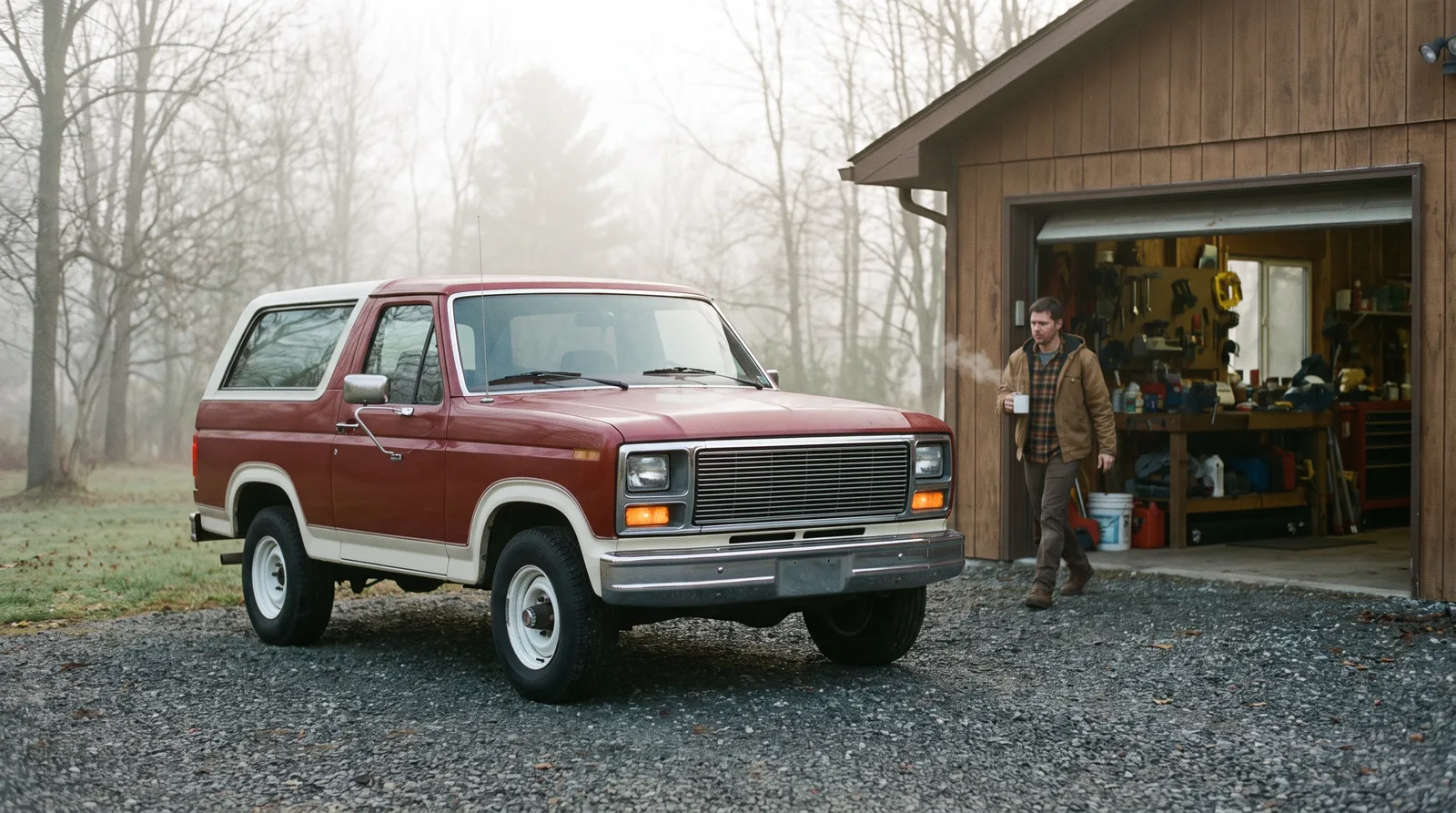
The engine lineup settles
By 1982, Ford had finished trimming the engine choices that had opened the decade in flux. The 351 cubic inch modified V8 that had briefly carried over into the early bullnose years was fading from the Bronco order sheet, and the lineup had largely consolidated around the 300 cubic inch inline six as the standard offering with the 302 cubic inch V8 as the step up option. This was not an accident of parts bin housekeeping. Ford's engineers were responding directly to emissions certification costs and CAFE pressure, and running fewer engine variants through certification each year was cheaper than chasing every configuration a regional sales office wanted to offer.
The six cylinder engine picked up incremental carburetor and ignition refinements during these years as well, part of a broader effort across Ford's truck line to close the driveability gap that early emissions controls had opened in the late 1970s. None of it was dramatic on a spec sheet, but period road tests noted that the truck idled and pulled away from a stop more smoothly than its immediate predecessor, a small but real improvement that mattered to a daily driver.
Inside the cab, a truck growing up
The interior of the 1982 Bronco reflects a manufacturer starting to take truck buyers seriously as customers who wanted comfort, not just utility. Ford expanded the availability of higher trim packages, improved seat design and upholstery choices, and added sound insulation that made the cabin noticeably quieter at highway speed than the trucks of just a few years before. Gauges were redesigned for legibility, and options that had once been reserved for cars, like tilt steering and better climate control, became easier to order on a Bronco without forcing a buyer into the most expensive trim level.
Documenting the details that get overlooked
This is the part of the story that a researcher spends the most time on, because it is also the part that gets lost first. Trim tags, build sheets, and dealer invoices from 1982 show a truck that was being fine tuned rather than reinvented, with running changes made mid year that never made it into brochures. A collector chasing an accurate restoration needs to know that not every 1982 Bronco left the factory configured the way the catalog implies, since running production changes were common practice at Ford's truck plants during this period and were rarely documented for public consumption.
Reading the paperwork like an artifact
Anyone who has spent time in an archive knows that a vehicle's original documentation is worth more than its shine. For a 1982 Bronco, that means locating the original window sticker or dealer order form whenever possible, since these documents record option codes that a casual restoration otherwise guesses at. Ford's option codes from this era specified everything from axle ratio to interior color in a shorthand that only makes sense with a period parts catalog in hand, and a surprising number of surviving trucks carry replacement parts installed decades ago that no longer match what the truck left the factory wearing.
Provenance research on a truck like this also means paying attention to regional variation. Broncos built for northern states often left the factory with different rust protection packages and heavier duty cooling than trucks destined for the Sun Belt, differences that rarely show up in a general production summary but matter enormously to someone trying to verify a specific vehicle's history. A patient buyer who cross references chassis numbers against known build sequences can usually place a truck within a narrow production window, which in turn helps confirm whether its equipment list is plausible or has been altered somewhere along the way.
Why the mid bullnose years matter to collectors
Trucks from this window occupy an odd position in the market. They are too recent to carry the cachet of the original 1966 Bronco and too early to have the aerodynamic styling that collectors associate with the later 1980s trucks, so they tend to be undervalued relative to how well built and how usable they actually are. That undervaluation is an opportunity for a buyer who wants an accurate, drivable example of the bullnose generation without paying a premium for a nameplate moment. If you want more on the bullnose ford bronco, the broader run from 1980 through the mid 1980s is documented in detail, and the earlier truck that started the whole Bronco story is worth understanding too, since it explains where this started before Ford ever considered a full-size platform.
"The trucks nobody photographed for the brochure are usually the ones that tell you the most about how the factory actually worked that year."
- Sarah Whitfield
What to check on a 1982 example
| Detail | What to verify |
|---|---|
| Engine | Confirm original block matches trim tag, since 300 six to 302 V8 swaps are common over four decades |
| Interior trim level | Compare seat and dash hardware against known documentation for the build month, not just the model year |
| Transmission | Note whether automatic or manual, since availability generally shifted by engine choice during this window |
| Options | Check for tilt steering, upgraded gauges, and sound insulation upgrades as originality markers |
A well documented 1982 Bronco, mid bullnose in every sense, rewards a buyer who cares about accuracy over flash. If you are shopping for one, there are usually a handful of classic Broncos on the market from this generation at any given time, and comparing several against known build records is the surest way to find a truck that matches its own paperwork rather than a generic catalog description.
A generation worth cataloging properly
Every collector vehicle deserves the same rigor a museum piece would get, and the mid bullnose Bronco is overdue for that treatment. These trucks were built during a period when Ford was actively experimenting with how to balance cost, comfort, and emissions compliance, which means no two years look quite identical under close inspection even though the overall silhouette barely changed. That makes 1982 specifically a useful reference point for dating other bullnose trucks whose records have been lost, since its documented changes give researchers a fixed marker to compare against. A truck this well understood should not be treated as an interchangeable stand in for the whole bullnose run. It is a specific, dateable object with its own story, and it deserves to be described that way rather than folded anonymously into a decade long generalization about early 1980s trucks.
Sources and notes
Related Reading
Have a
Ford Bronco
for Sale?
Reach thousands of serious classic car collectors across the US.
Sell It Here →
Selling a classic? Here's how: where to sell your classic car online
Are You a Classic Car Dealer?
List your full inventory and connect with targeted classic car buyers.
Join as a Dealer →

About the author
Sarah Whitfield
Third-generation classic car collector specializing in pre-war American and European coachbuilt automobiles. Researcher and concours enthusiast.
Related Listings - Ford Bronco
Comments (1)
K
Kenny
13 hours ago
Undervalued? Shoot, folks at auction want first-gen money for rusty '82s now. Ain't no bargains left out there.