
Every enthusiast community keeps at least one story about the car that almost was, and among early Ford Bronco owners that story is the boss 302 ford bronco prototype. It surfaces at swap meets and in club newsletters every few years: somewhere inside Dearborn engineering, in the years when the Boss 302 was rewriting what a small Ford V8 could do on a road course, someone supposedly dropped that same high-winding 302 into a Bronco test mule. No production run followed. No brochure ever mentioned it. What survives is a scattering of photographs, a handful of secondhand accounts from retired engineers, and a lot of speculation.
Car Features
7 min read
The Boss 302 Bronco Prototype That Never Was
Club lore says Ford dropped a Trans-Am spec Boss 302 into an early Bronco test mule. The photos and secondhand accounts do not quite add up to proof.
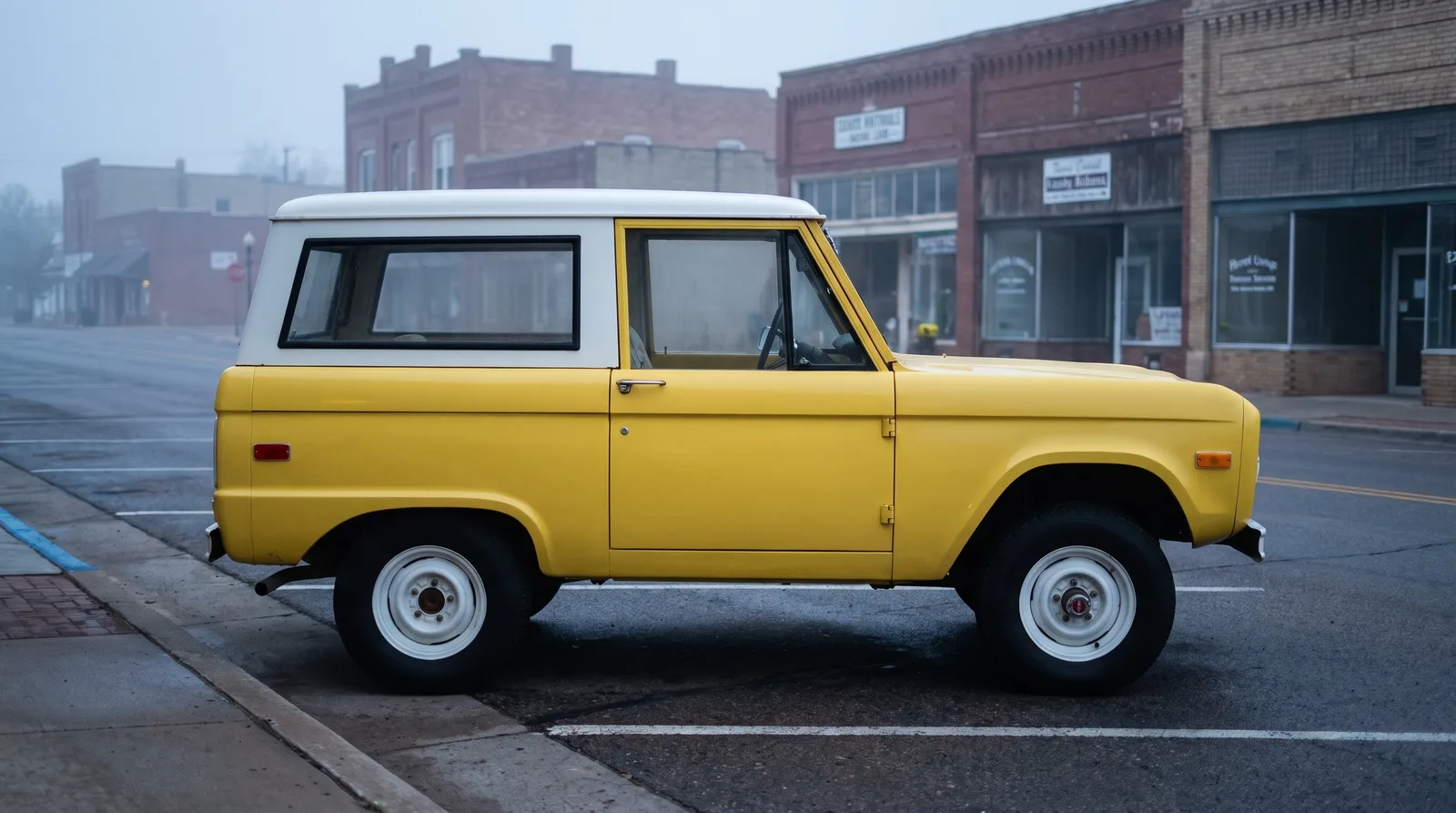
I want to treat this carefully, because the difference between a documented prototype and a garage legend matters. The early Bronco (1966 to 1977) was built as a light utility rig, not a performance vehicle, and its production drivetrains never included a Boss-spec engine. So the prototype claim, if true, describes a one-off engineering exercise that never got anywhere near a sales floor. That is a different category of car than, say, a factory special edition, and it deserves to be discussed with that distinction intact.
What the Boss 302 actually was
Ford built the Boss 302 engine for one reason: to win the SCCA Trans-Am series against the Chevrolet Camaro Z/28. It used a high-revving small block with big-port heads borrowed from the 351 Cleveland program, solid lifters, and a compression ratio that demanded premium fuel and a driver who kept the tachometer near the top of the dial. Rated at 290 horsepower on paper, the real output was widely understood inside Ford to run higher, and independent dyno pulls from the era back that up. It was, by design, a track engine wearing a street-legal disguise, offered in the 1969 and 1970 Mustang.
None of that engineering intent lines up with what a Bronco needed. The early Bronco ran a 170 cubic inch inline six as its base engine and later offered Ford's small block 289 and 302 V8s in mild, torque-friendly tune, suited to low-range crawling and towing rather than 6,000 rpm blasts down a straight. A Boss 302 dropped into that chassis would have been an odd match: all top-end power, none of the low-speed grunt that made the Bronco useful off pavement. That mismatch is actually one of the better arguments for why the prototype, if it existed, never went beyond a test mule.
Where the story comes from
The prototype account traces back mostly to oral history rather than a paper trail. A few retired Ford engineers, interviewed decades later at Bronco club events, have described a small-block swap program that used surplus Boss 302 hardware for a handful of test vehicles during the early 1970s. The claimed purpose was less about building a performance Bronco for sale and more about stress-testing chassis components against a stronger, higher-revving engine than anything in the regular lineup, essentially using the Boss block as a torture-test tool rather than a product plan. If that account is accurate, the horsepower figure most often repeated for the test mule is the Boss 302's own factory rating of 290 gross horsepower, the same number Ford quoted for the engine in the 1969 and 1970 Boss 302 Mustang. Nobody I have found has produced a build sheet or dyno chart tying that figure to an actual Bronco test mule rather than simply repeating the stock engine's rating. Ford's engineering archives from that period are incomplete, and a huge share of what circulates about specialty programs like this one rests on memory rather than documentation. I treat the number as plausible, not proven.
Why no photo tells the whole story
A handful of grainy photographs, some reproduced so many times in club forums and newsletters that their provenance is nearly impossible to verify, get cited as evidence for the prototype's existence. A Bronco body, a set of period-correct Boss 302 valve covers, and an engine bay that looks tighter than a stock inline six installation are not, by themselves, proof of a coordinated engineering program. They could just as easily show an owner's later swap, done for fun decades after the Bronco left the factory, and then misattributed to the factory era once the photo started circulating without context.
This is the trap with any unofficial prototype story: the physical evidence and the swap-culture evidence look almost identical. Both involve a Boss 302 in a Bronco engine bay. Only one of them happened inside Ford during development. Without a chassis number tied to an engineering build record, I cannot separate the two with confidence, and neither can anyone else currently making the claim publicly.
"I have looked at three of the supposed prototype photos side by side, and the mounting brackets do not match between any of them. If this was one coordinated engineering program, the fabrication should be consistent. It is not, and that tells me at least two different builders were involved, possibly decades apart."
- Emily Chen
The bigger context, where this started
To understand why this rumor keeps circulating, it helps to go back to where this started, the Bronco's original body and engine lineup. Ford built the early Bronco as a purpose-built off-road utility, competing against the Jeep CJ-5 and International Scout rather than any performance coupe. Its engines were chosen for durability and low-speed torque, and the factory never offered anything close to a Trans-Am spec V8 through a dealer. That gap between what the Bronco was engineered to do and what a Boss 302 was engineered to do is exactly why a prototype pairing the two would have been unusual enough to become a legend in the first place. Stories like this tend to persist precisely because they describe something the factory catalog never actually offered.
What this means for collectors today
For collectors, the practical takeaway is simple: no verified factory Boss 302 Bronco exists in any recognized registry, and claiming one without a documented chassis history invites skepticism from serious buyers. If someone offers a Bronco described as the prototype or a survivor from that program, the burden of proof sits entirely with the seller. Engine casting numbers, a documented chain of ownership back to Ford engineering, and corroborating paperwork would be the minimum bar, and even then I would want a second opinion from someone who has handled genuine Boss 302 blocks.
What is not in dispute is the appeal of the idea. A Bronco with a genuine Trans-Am engine under the hood combines two of Ford's most storied names from the same era, and that combination is compelling enough on its own to keep the story alive even without hard proof. If you are chasing an early Bronco for your own collection, provenance conversations like this one are worth having before you buy, not after. Plenty of honest, well-documented Broncos are out there if you want to find a classic Bronco without wading into unverifiable prototype claims.
The honest verdict
I do not think the boss 302 ford bronco prototype story is a fabrication out of nothing. Too many independent, unconnected sources describe some version of a Boss-powered test mule for it to be pure invention. But I also do not think the evidence currently available supports treating it as settled fact. It sits in the space between documented history and persistent legend, and until someone produces a build record or a verifiable chassis, that is exactly where it should stay.
Sources and notes
Related Reading
Have a
Ford Bronco
for Sale?
Reach thousands of serious classic car collectors across the US.
Sell It Here →
Selling a classic? Here's how: compare the places to sell classic cars
Are You a Classic Car Dealer?
List your full inventory and connect with targeted classic car buyers.
Join as a Dealer →

About the author
Emily Chen
Bay Area engineer with a deep focus on vintage Japanese and European performance cars. Approaches classic car research and restoration with an analytical eye.
Related Listings - Ford Bronco
More in Car Features
Comments
Be the first to comment on this article.