
Most people who love the Ford Bronco have never actually seen a U13 Roadster in person, and that is not an exaggeration. This was the stripped-down, no-doors, barely-there version of the original Bronco, and Ford built it for such a short window that finding one today means either deep pockets or a lot of luck. I have worked on exactly two of them in my shop over the years, and both times the owner treated the truck less like a vehicle and more like an artifact.
Car Features
6 min read
The U13 Roadster, the Bronco Stripped to Essentials
The doorless, topless U13 Roadster was the leanest version of the original Bronco lineup, and its short production window makes it one of the hardest early configurations to buy honestly.
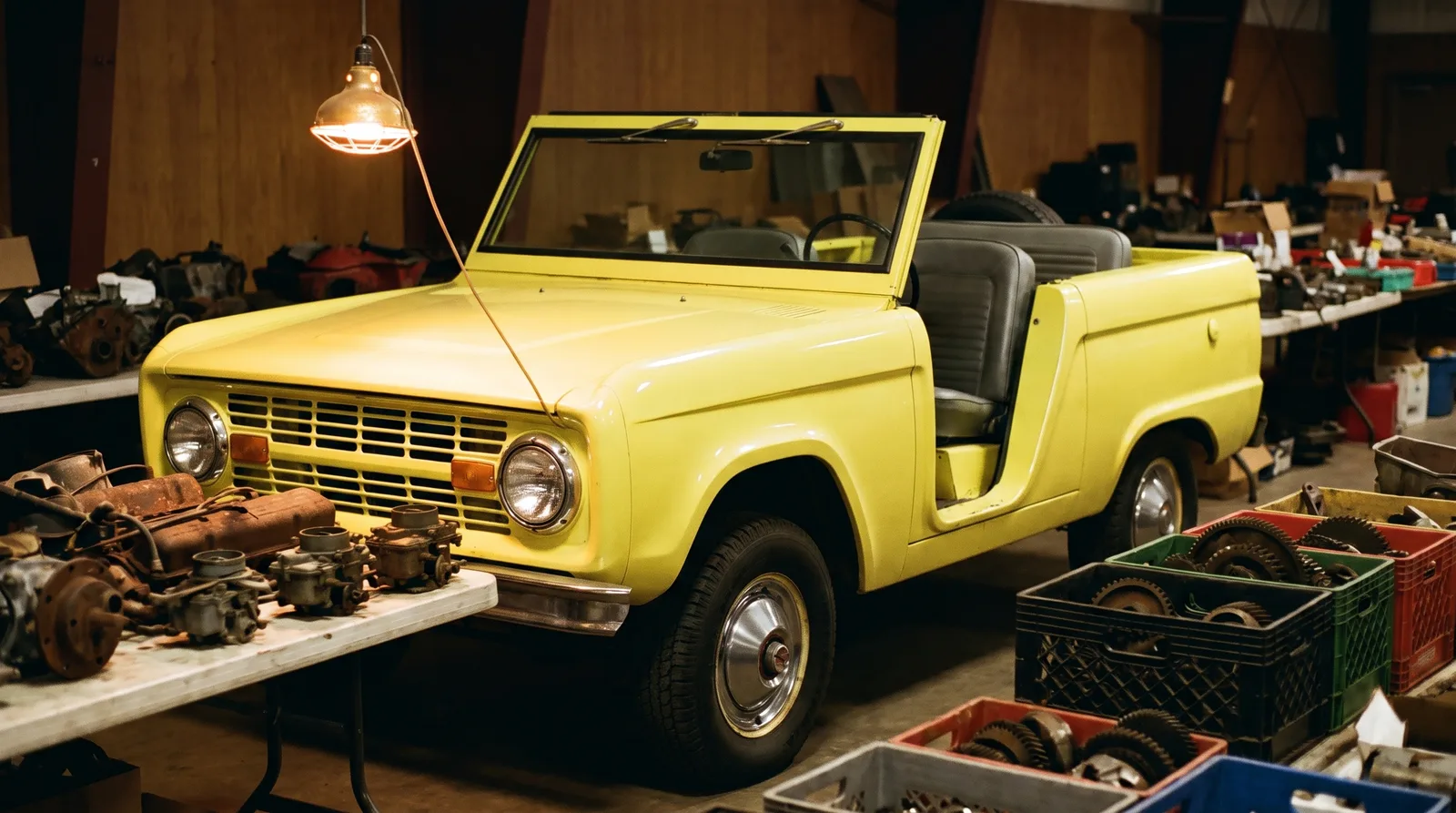
What the U13 actually was
Ford's internal body style codes for the first-generation Bronco split the lineup into three configurations. The U13 was the Roadster, a no-frills version with no doors, no top in its most basic form, and a minimal windshield setup. It sat below the U14 half-cab pickup and the U15 wagon in the lineup, and it was aimed at buyers who wanted the Bronco at its most stripped, closest to a dune buggy in spirit even though it shared its chassis and drivetrain with the other body styles.
That simplicity is exactly why the U13 sold in such small numbers relative to the wagon. Most buyers in 1966 wanted at least some weather protection and cargo capacity, which the Roadster did not really offer. Ford discontinued the U13 configuration early in the Bronco's production run, and that short window is the entire reason it is scarce today. A truck does not need to be objectively better to become rare, it just needs to stop being made while demand for something more practical takes over.
Why builders respect this body style so much
From a fabrication standpoint, the U13 is the purest expression of what the early Bronco's platform could do without any of the comfort compromises Ford built into the other configurations. No doors means no door seals, no window regulators, no weight from glass and hardware most owners never think about until they are removing it. A stripped Roadster sits lighter and simpler than its siblings, and anyone who has actually torn one down to bare metal comes away with real respect for how clean the original engineering was underneath all the later trim Ford added to other body styles.
That simplicity also makes the U13 brutally honest about condition. There is nowhere for rust or bad bodywork to hide on a truck with this little sheet metal to begin with. A rough U13 looks rough immediately, and a well-preserved one is obvious at a glance too. I tell people shopping for one of these that the inspection process is faster than on a wagon precisely because there is less truck to hide problems.
The poseur problem in the U13 market
Here is where I get opinionated, because the U13's rarity has created a real problem in the market. Because doors and tops on early Broncos were somewhat interchangeable across body styles, some sellers have taken a U14 or U15 that lost its doors or top over the decades and started representing it as an original U13. That is not a harmless shortcut. The frame, the floor pan reinforcement, and certain mounting points differ enough between configurations that a knowledgeable buyer can usually tell the difference with a careful inspection, but plenty of buyers do not know what to look for and end up paying Roadster money for a modified wagon or half-cab.
Anyone shopping this specific body style needs to check the VIN plate coding and, ideally, get someone who has actually handled a documented U13 to look the truck over before money changes hands. I would rather see someone walk away from a deal that felt slightly too easy than get stuck owning a truck they paid a premium for that was never actually what it claimed to be. Genuine U13s exist and they are worth the effort to find honestly.
"A real U13 does not need a story from the seller to explain why it looks the way it does. The truck tells you what it is if you know where to look."
- Jim Vasquez
Where the U13 fits in the bigger picture
Understanding the U13 makes more sense once you see it against the rest of the early Bronco lineup, because Ford built these three body styles to serve genuinely different buyers rather than just offering trim variations on one truck. For a full breakdown of how the Roadster, half-cab, and wagon compared and how each one found its market, ford bronco half cab history covers the full lineup in detail.
If the half-cab version interests you as much as the Roadster does, there is a dedicated look at that configuration too, and a related story goes deep on what made the U14 its own distinct piece of the Bronco story rather than just a wagon with a shorter bed.
For buyers serious about finding a genuine early Bronco in any configuration, patience and documentation matter more than speed. The market moves slowly enough that a good truck rarely disappears overnight, and there is no shortage of trucks currently listed if you know where to look. Browsing what is out there right now through Broncos for sale now is a reasonable place to start, but treat any U13 specifically with extra scrutiny before you commit. The truck's rarity is exactly what makes it worth the extra homework.
What restoring one actually involves
People assume a stripped-down truck with no doors and minimal trim means an easier restoration, and in some ways that is true. There are fewer body panels to source, fewer weatherstrip parts to hunt down, and no window mechanisms to rebuild. But the parts you do need get harder to find precisely because so few U13s were built to begin with. Windshield frame hardware, the specific mounting brackets for the minimal top, and certain trim pieces unique to the Roadster configuration are not interchangeable with U14 or U15 parts, and reproduction suppliers have less incentive to tool up for a part that only fits a small fraction of surviving trucks.
That reality shapes how I approach any U13 project that comes through the shop. I tell owners upfront to expect long lead times on certain parts and to budget for having some pieces fabricated from scratch rather than sourced off a shelf. It is not a restoration for someone in a hurry, and it is not one where you can lean on a parts catalog the way you can with a wagon. What you get in exchange is a truck that very few other owners can claim, built in a configuration that represents the early Bronco at its most honest and unadorned. For the right owner, that trade is worth every extra month the parts search takes.
Sources and notes
Related Reading
Have a
Ford Bronco
for Sale?
Reach thousands of serious classic car collectors across the US.
Sell It Here →
Selling a classic? Here's how: sell my classic car
Are You a Classic Car Dealer?
List your full inventory and connect with targeted classic car buyers.
Join as a Dealer →

About the author
Jim Vasquez
Southern California hot rod and custom car builder with roots in the traditional kustom kulture scene.
Related Listings - Ford Bronco
Comments
Be the first to comment on this article.