
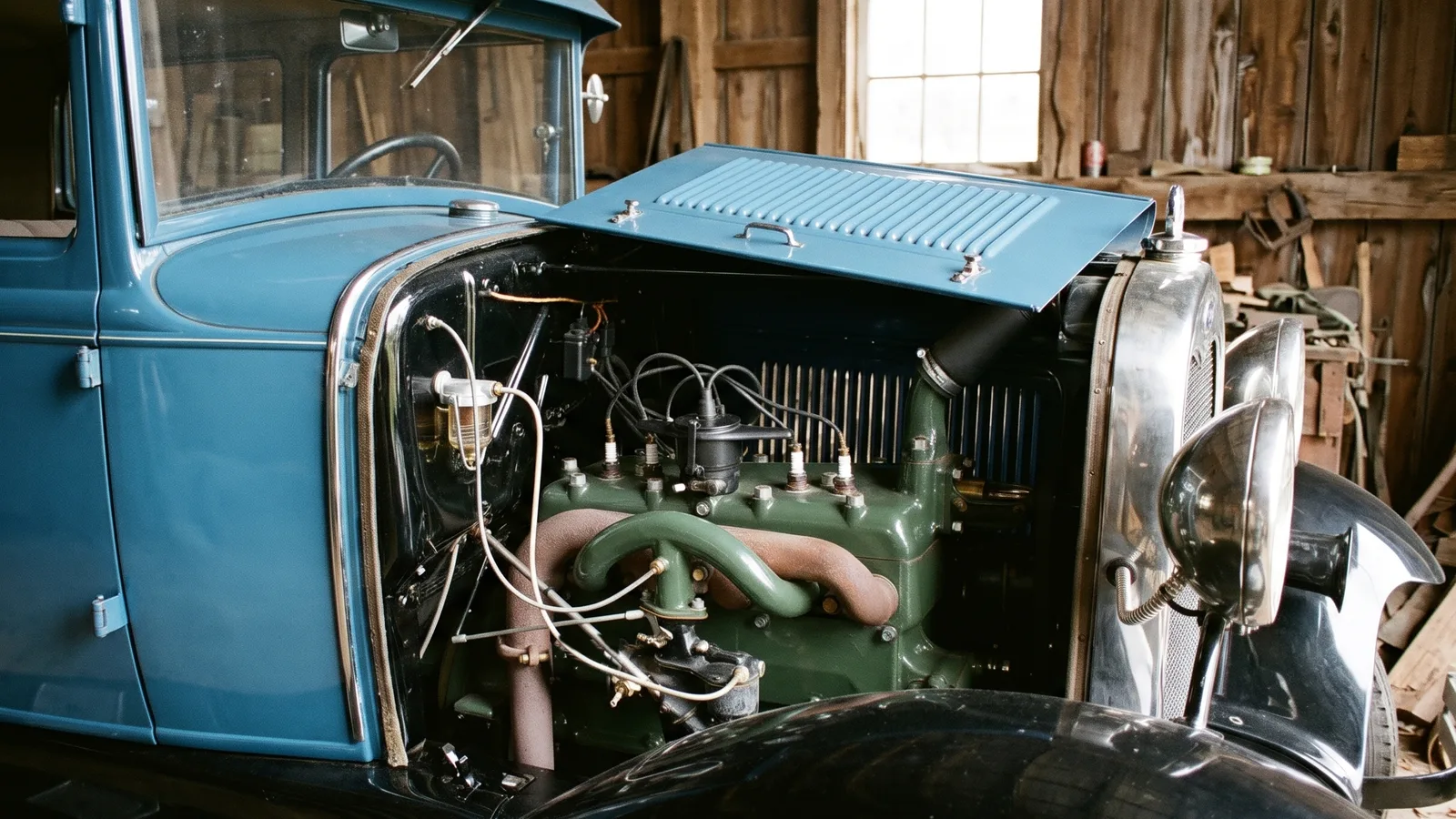
Ford built the Model A engine to run all day, not to win anything. It was a 200.5 cubic inch L-head four with a 4.22 to 1 compression ratio (4.3 on the earliest 1928 heads), rated at 40 horsepower at 2,200 rpm. That is a fine number for a family car in 1928. To a certain kind of young man with a garage and no money, it was an opening bid. Within a couple of years of the car's launch, a small group of builders was selling Model A speed parts that promised far more than Dearborn ever put under the hood.
Car Features
7 min read
Model A Speed Equipment of the 1930s: Riley, Winfield and Cragar
Riley heads, Winfield carburetors and cams, and the Miller-based Cragar head: the Model A speed parts that turned a 40 hp four into a racer.
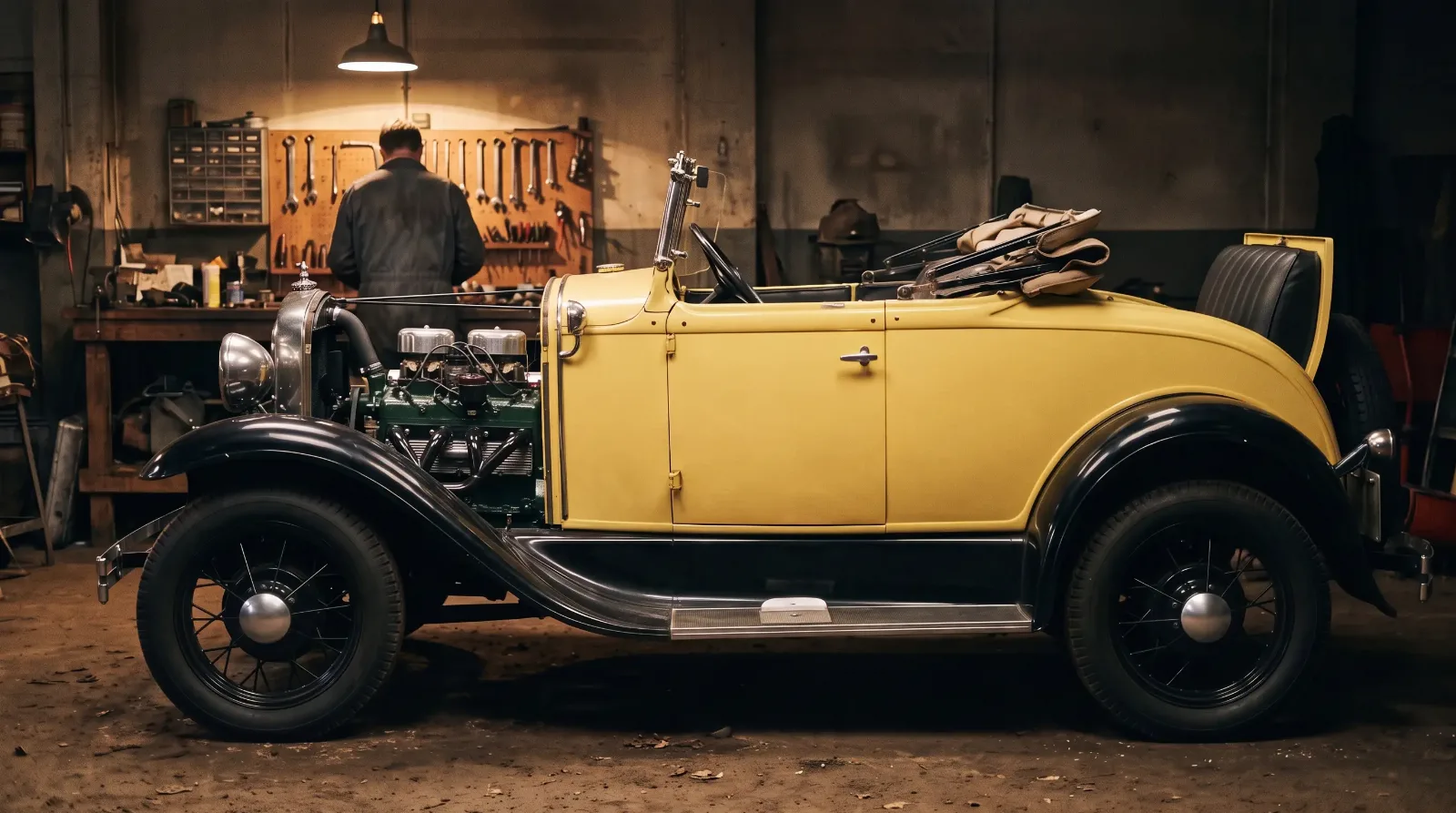
Three of those names matter most: George Riley, Ed Winfield and the outfit that became Cragar. None of them worked for Ford. All of them understood the Ford four better than most of the people selling the car.
Where Model A speed parts came from
The idea was not new. Model T owners had been bolting on overhead valve heads since the early 1920s. The best known was the Frontenac, or "Fronty," head that Louis and Arthur Chevrolet developed in early 1921. It sold for $100 and took a stock T from about 17 horsepower to over 30. RAJO and Laurel heads were popular too, and Fronty-Fords were a fixture on small dirt tracks. In 1923 Indianapolis Ford dealer Barber-Warnock entered a single Fronty-Ford in the Indianapolis 500, and L. L. Corum drove it to fifth place. If you want the stock side of that story, the Model T engine history covers it.
Not every accessory was about speed. Glover Ruckstell had built a business on the Model T with the Ruckstell axle, a two-speed rear axle that gave the T an underdrive. For the Model A, Ruckstell sold a "Dual High" three-speed overdrive transmission, shown in June 1931 literature, which cut engine speed by 25 percent. At least 3,100 were built. That was the gentleman's speed part: same engine, lower revs, longer life on the highway.
The Model A gave the speed builders a better starting point than the T ever had. A real three-speed gearbox and 40 horsepower instead of 20 meant every gain at the top went further.
George Riley and the valve-in-head conversions
George Riley was selling valve-in-head conversions for the Model A by 1930. His brochure from that year lists heads called Models "B," "C" and "D," along with a two-port design that put the intake valves overhead while leaving the exhaust in the block, the layout the trade calls an F-head. It was a sensible compromise: better breathing on the intake side without throwing away Ford's block.
Riley also wrote about it. In September 1931 the trade paper Ford Dealer & Service Field ran his article "Secrets of Speed," which walked readers through building a 100 mph Model A speedster. Think about where that ran. Not a racing paper. A magazine for Ford dealers and their service departments, telling them how to make the car go faster than Ford intended.
His later four-port head went further: two overhead intake valves per cylinder, with the single exhaust valve still in the block, on the Model A or Model B block. Riley claimed "as much as 160HP at 4500rpm" with a Winfield cam. Treat that as what it was, a maker's claim from a man selling heads, and remember that the stock engine made 40 at 2,200. The four-port was sold and raced all over the country in the 1930s. Its exact debut date is not settled in the sources I could check; an early Riley racing four-port head on one surviving Model A is dated to 1932 or 1933, which puts it around the end of Model A production and the start of the Model B years.
Ed Winfield: carburetors, cams and one cylinder head
Ed Winfield was born on October 4, 1901, built his first carburetor in 1919, and by the early 1920s had a thriving Winfield Carburetor Company. He was a carburetor man first and a camshaft grinder close behind, and the cams are why his name turns up next to Riley's 160 horsepower claim.
During the Depression he developed the S and SR carburetors, which found their way onto hopped-up Fords. There was also a period "Super Winfield" cylinder head, and at least one 1930 Model A that crossed an auction block carried one. Winfield designed only one overhead valve head of his own, and it was for the 1932 Model B four, in 1934. So for Model A people, Winfield means fuel and cams more than heads, and that is no small thing. An engine that cannot breathe or meter its fuel does not care how many valves you give it.
"Everybody wants to talk about the overhead heads because they look good with the hood off. Talk to the guys who actually ran these engines and they will tell you about the carburetor and the cam first. Riley built the doors. Winfield decided how much went through them."
Gary Nowak
Cragar and the Miller connection
The Cragar story starts with Harry Miller, the racing engine builder. In 1929 Miller's business passed to the Schofield group, and the operation known as Miller-Schofield built an overhead valve head for the Model A designed by Leo Goossen, Miller's draftsman. Miller-Schofield went bankrupt at the end of 1930, and Cragar took over the head. Cragar's own history dates the company to 1930 and credits Crane Gartz as founder, the name built from the first letters of his first and last names; other accounts name Harlan Fengler as his partner and president. Cragar heads were on sale from 1931.
Gartz did not keep it long. According to Cragar's own timeline, George Wight, the founder of Bell Auto Parts, bought the company in 1933, and Roy Richter bought it in 1955, when it became Cragar Equipment Company. The name outlived the original heads by decades. The early Miller-Schofield details come mostly from secondary accounts, so treat the fine print with care. The part that is not in doubt: Miller's design work ended up on Model A blocks through Cragar conversions, and that is a long way from a farm road in 1928.
| Name | What it sold for the Model A | When | Notes |
|---|---|---|---|
| Riley | Valve-in-head heads (Models B, C, D) and a two-port F-head; later a four-port head | 1930 brochure; four-port in the 1930s | Four-port: two overhead intake valves per cylinder, exhaust in the block; maker claimed up to 160 hp with a Winfield cam |
| Winfield | S and SR carburetors, camshafts, "Super Winfield" head | Depression years | Only Winfield OHV head was for the Model B (1934) |
| Cragar | OHV head based on the Miller-Schofield design by Leo Goossen | From 1931 | Took over Miller-Schofield tooling; details from secondary sources |
| Ruckstell | "Dual High" three-speed overdrive transmission | June 1931 literature | 25 percent engine-speed reduction; at least 3,100 built |
Put the four together and you have the kit that turned a forty horsepower family car into something that could run on a dry lake or a dirt oval. The speed parts did not change what the Model A was in the showroom. They changed what it could become afterward, and that is the root of the Model A as a hot rod platform. Ford's own answer came in 1932 with the Model B four at 50 horsepower and the V8 beside it. By then the old guys in their garages had been showing Dearborn the way for a couple of years, and they never got a thank-you note for it.
Sources and notes
Related Reading
Have a
Ford Model A
for Sale?
Reach thousands of serious classic car collectors across the US.
Sell It Here →
Selling a classic? Here's how: the best sites to sell a classic car
Are You a Classic Car Dealer?
List your full inventory and connect with targeted classic car buyers.
Join as a Dealer →

About the author
Gary Nowak
Lifelong Midwest rodder who has been building and driving traditional pre-war hot rods since the 1970s.
Related Listings - Ford Model A


More in Car Features
Comments
Be the first to comment on this article.