
Start with the result: 385 horsepower and 385 lb-ft of torque from a 5.4-liter, four-valve V8, in a Mustang that weighed 3,590 pounds and was rated at 177 mph. That is the 2000 Cobra R. Ford's Special Vehicle Team built 300 of them, painted every one Performance Red, and priced the car at $54,995. No factory Mustang from 1964½ to 2000 carried a higher rating, and unlike some of its siblings, the paper on this one mostly holds up.
Car Features
6 min read
The 2000 Cobra R: 385 hp and a 5.4
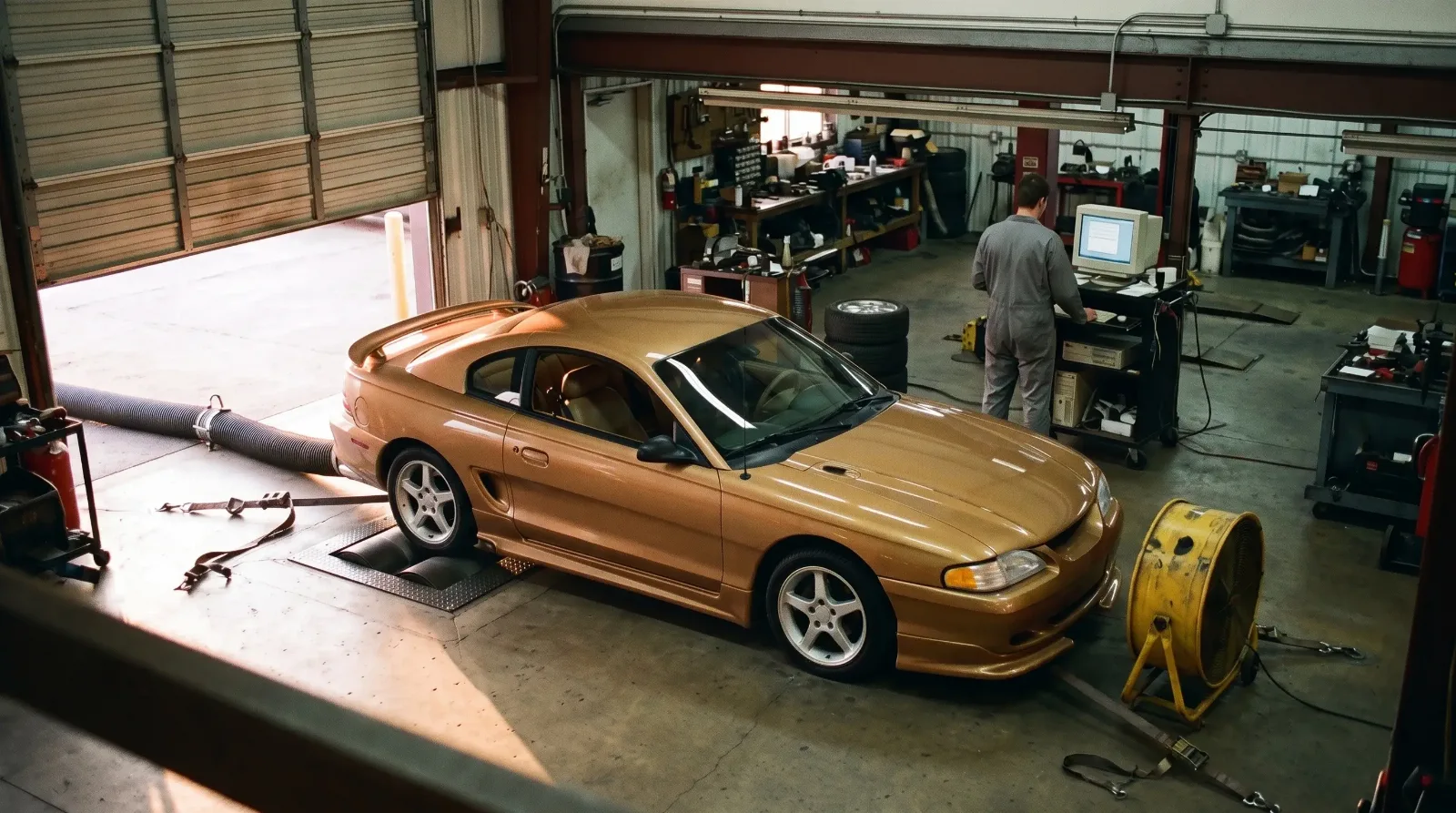
The 2000 Cobra R by the numbers: a 5.4 DOHC V8 rated at 385 hp, the first six-speed Mustang, 300 built, and which figures hold up.
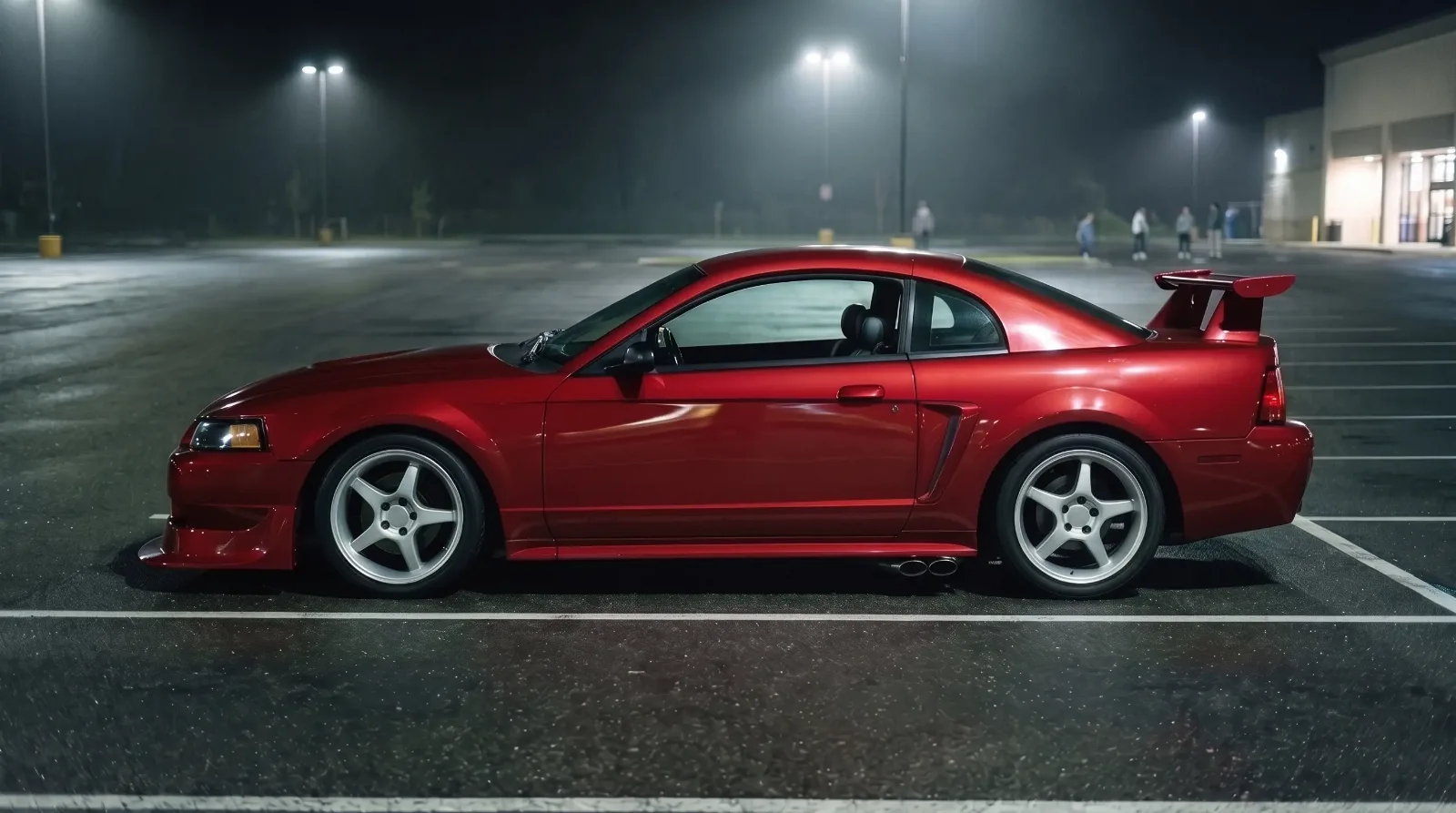
This piece sticks to the numbers: where they came from, which ones are solid, and which ones get repeated without a source. For the full family tree of SVT and Saleen cars around it, the Mustang SVT Cobra story covers the lineage from the SVO onward.
Why the 2000 Cobra R exists at all
The context explains the car. On August 6, 1999, Ford halted sales of unsold 1999 SVT Cobras and recalled the ones already sold, after owners' dyno tests showed about 285 hp against an advertised 320. The fix involved a new intake manifold, engine computer parts and the exhaust from the catalytic converters back. It was an embarrassing episode for a team whose whole reason to exist was credibility with enthusiasts.
There was no regular Cobra for the 2000 model year. The only 2000 SVT Cobras built were the 300 R-models. Ford's own later summary calls the 2000 car SVT's "third limited-edition R-model," following the 1993 and 1995 cars, and the "2000 5.4L-4V Cobra R" appears in the program list credited to John Coletti, who led SVT from 1993 to 2004. Two enthusiast sources also give Jack Roush a hand in the car's development, without saying which parts he worked on; Ford's own summaries do not mention him, so treat that credit as loose.
Read the timing plainly. A team that had just been caught short on a horsepower claim released, the following model year, a car whose headline number nobody has seriously disputed. Whether that was planned as a statement is not on the record. The effect was the same.
The engine: what the 5.4 actually is
The engine is a 5.4-liter (330 cubic inch) DOHC 32-valve V8, a Modular-family engine with a 3.55-inch bore and a long 4.17-inch stroke, 9.6:1 compression and a 6,500 rpm redline. The bore matches the 4.6 used in the regular Cobra and GT. The extra displacement comes from the stroke, and it shows in a torque figure that matches the horsepower number.
The output is 385 hp and 385 lb-ft. The rpm at which those peaks arrive is where the sources split: one reference gives 5,700 rpm for power and 4,500 for torque, another gives 6,250 and 4,250. With no Ford spec sheet on record to settle it, the honest statement is the pair of peak numbers without the rpm. You will also find "386 horsepower" in a 2009 Ford press release; every other source says 385, and the extra pony is almost certainly a typo.
Behind the engine sat a Tremec T-56 six-speed with 3.55 gears. There was no automatic.
Real power versus catalog power across the three R-models
The three SVT R-models make a clean progression, and laying them side by side shows how fast the numbers moved in seven years.
| Model | Engine | Rated output | Transmission | Built | Price |
|---|---|---|---|---|---|
| 1993 Cobra R | 5.0 V8 (same as street Cobra) | 235 hp | T-5 five-speed | 107 | $25,692 |
| 1995 Cobra R | 5.8 (351) Windsor V8 | 300 hp / 365 lb-ft | Tremec TR-3550 five-speed | 250 | $37,599 |
| 2000 Cobra R | 5.4 DOHC 32-valve V8 | 385 hp / 385 lb-ft | Tremec T-56 six-speed | 300 | $54,995 |
From 1993 to 2000 the rated output rose by 150 hp, about 64 percent. Price more than doubled. Do the arithmetic on the 2000 car and you get roughly 9.3 pounds per rated horsepower at curb weight.
Now separate the solid numbers from the soft ones. Output, displacement, bore and stroke, transmission, production and price all appear in multiple independent references and agree. Top speed is a little softer: 177 mph is the rated figure in one major reference, while another site gives 175.3 mph in its text and contradicts itself in its own spec box. Use 177 as the rating and treat it as a rating, not a test result.
Acceleration is the softest of all. The figures most often repeated online, 0 to 60 in 4.6 seconds and a 13.2-second quarter mile, circulate without a named magazine or test date attached. The test that does carry a name is Motor Trend's: 0 to 60 in 4.4 seconds and the quarter mile in 12.9 seconds at 110.8 mph, with a 109-foot stop from 60 and 1.01 g on the skidpad, as later quoted by Jalopnik and Autotrader. We did not find the issue date, so read those as one magazine's test day, not a factory rating.
"The 1999 Cobra taught everybody to bring a dyno sheet to the argument. The 2000 R is the rare case where the catalog number and the measured number never had to have that fight."
Dan Reeves
The hardware that made 385 hp usable
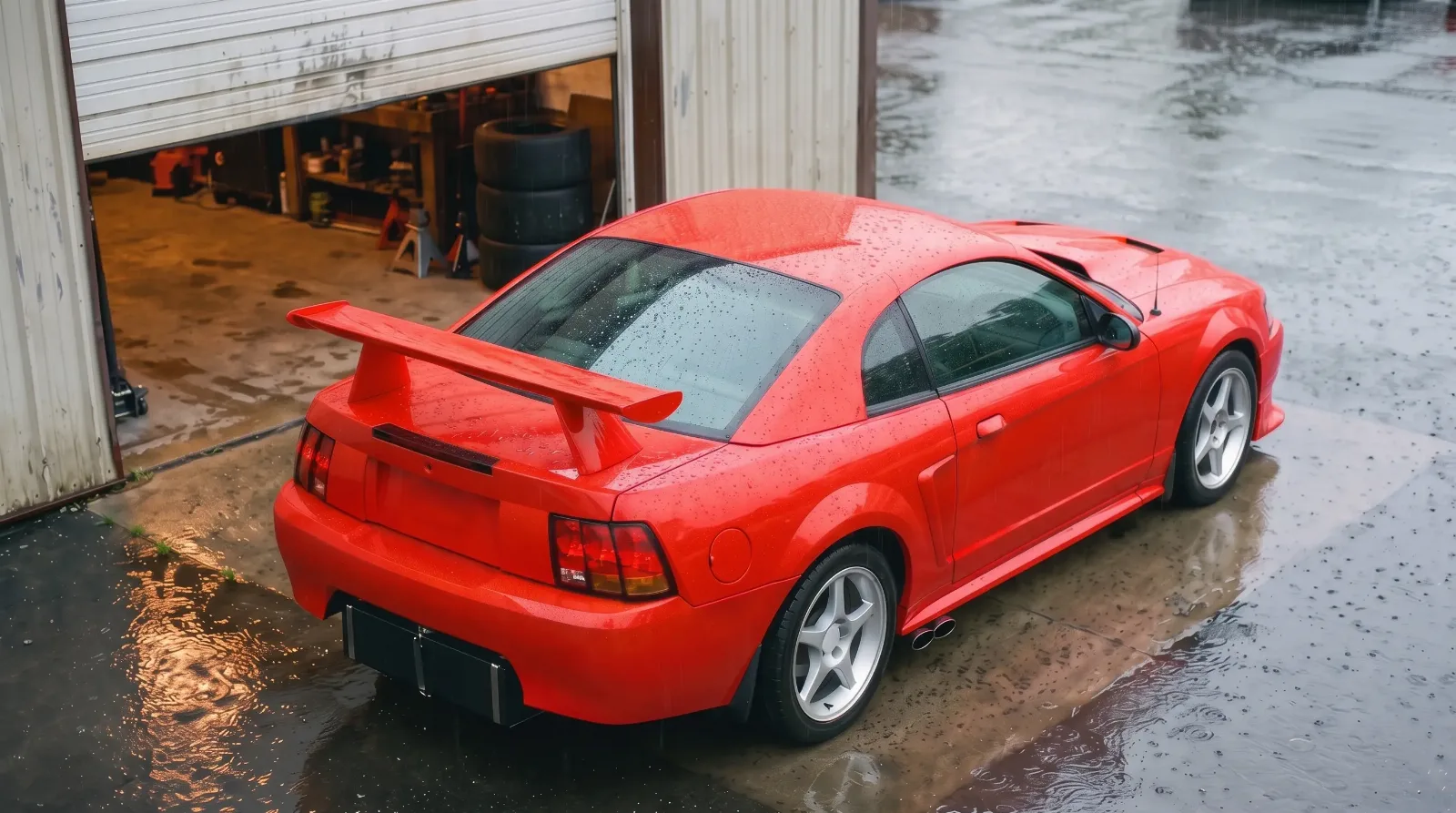
A big engine in a heavy car is only half a race car. SVT fitted Brembo 13-inch front discs with four-piston calipers, Bilstein dampers and Eibach springs that dropped the car 1.5 inches in front and 1.0 inch in the rear. The wheels were 18 x 9.5 with BFGoodrich g-Force KD tires in 265/40ZR18. A 20-gallon Fuel Safe fuel cell replaced the stock tank, and because the standard exhaust would no longer fit around it, the car got a Borla side-exit exhaust. A removable front splitter, a tall wing on the decklid and manually adjusted cloth Recaro seats completed the package.
Then came the deletions, the R-model tradition since 1993: no radio, no air conditioning, no cruise control and no rear seat. The car was meant for buyers who would race it, and the equipment list reads that way. If you want the platform story behind these cars, the SN95 generation and its 1999 New Edge update are laid out in this piece.
Limited-run, race-flavored Mustangs were not new in 2000. Two decades earlier, the McLaren Mustangs tried the same formula with a turbocharged four, a $25,000 price and a run of about ten cars. The R-models went further, with SVT engineering behind them and production counted in the hundreds rather than a handful.
What the numbers mean now
For a collector, the useful numbers are short. There were 300 cars, all in Performance Red with a dark charcoal interior. That uniformity is helpful: there is no rare color to chase and no option sheet to decode, so condition, mileage and documentation do the work of separating one car from another.
The broader production picture shows how small 300 is. Ford built 215,239 Mustangs for the 2000 model year by body-style tables, so the Cobra R accounted for roughly one car in 717. Anyone shopping current 2000 Mustangs will see V6 coupes and GT convertibles by the dozen; the R is a different conversation entirely.
As an epilogue, the regular Cobra returned for 2001 with 7,251 built. The 2000 R stayed what it was: the last and strongest of the classic-era R-models, and a clean answer to the 1999 controversy. To see where it fits in six decades of the car, follow the full history of the Ford Mustang.
Sources and notes
- Ford Mustang SVT Cobra (Wikipedia): 2000 Cobra R specification, fuel cell, weight and rated top speed
- MustangSpecs: 2000 Ford Mustang SVT Cobra R guide
- MustangSpecs: 2000 Ford Mustang production by body style
- Jalopnik: This is the greatest modern Mustang (Motor Trend test figures)
- Autotrader: a rare, brand new 2000 Ford Mustang Cobra R
- FordMuscle: 2000 Cobra R at VIR (Roush, splitter and spoiler)
Related Reading
Have a
Ford Mustang
for Sale?
Reach thousands of serious classic car collectors across the US.
Sell It Here →
Selling a classic? Here's how: where to sell your classic car online
Are You a Classic Car Dealer?
List your full inventory and connect with targeted classic car buyers.
Join as a Dealer →

About the author
Dan Reeves
Performance engine builder from North Carolina's motorsports corridor, focused on swaps, forced induction and making real, repeatable power.
Related Listings - Ford Mustang
More in Car Features
Comments
Be the first to comment on this article.