
Ford bronco engine sound character is not a spec you find on a build sheet. It is what makes a stranger turn their head in a parking lot before they even see the truck. Different engines under that boxy hood produce distinctly different notes, and the difference is not subtle once you know what to listen for.
Car Features
7 min read
The Sound and Character of Bronco Engines
From the utilitarian six-cylinder hum to the classic Windsor V8 rumble, a Bronco's engine choice and exhaust setup shape a sound that still turns heads.
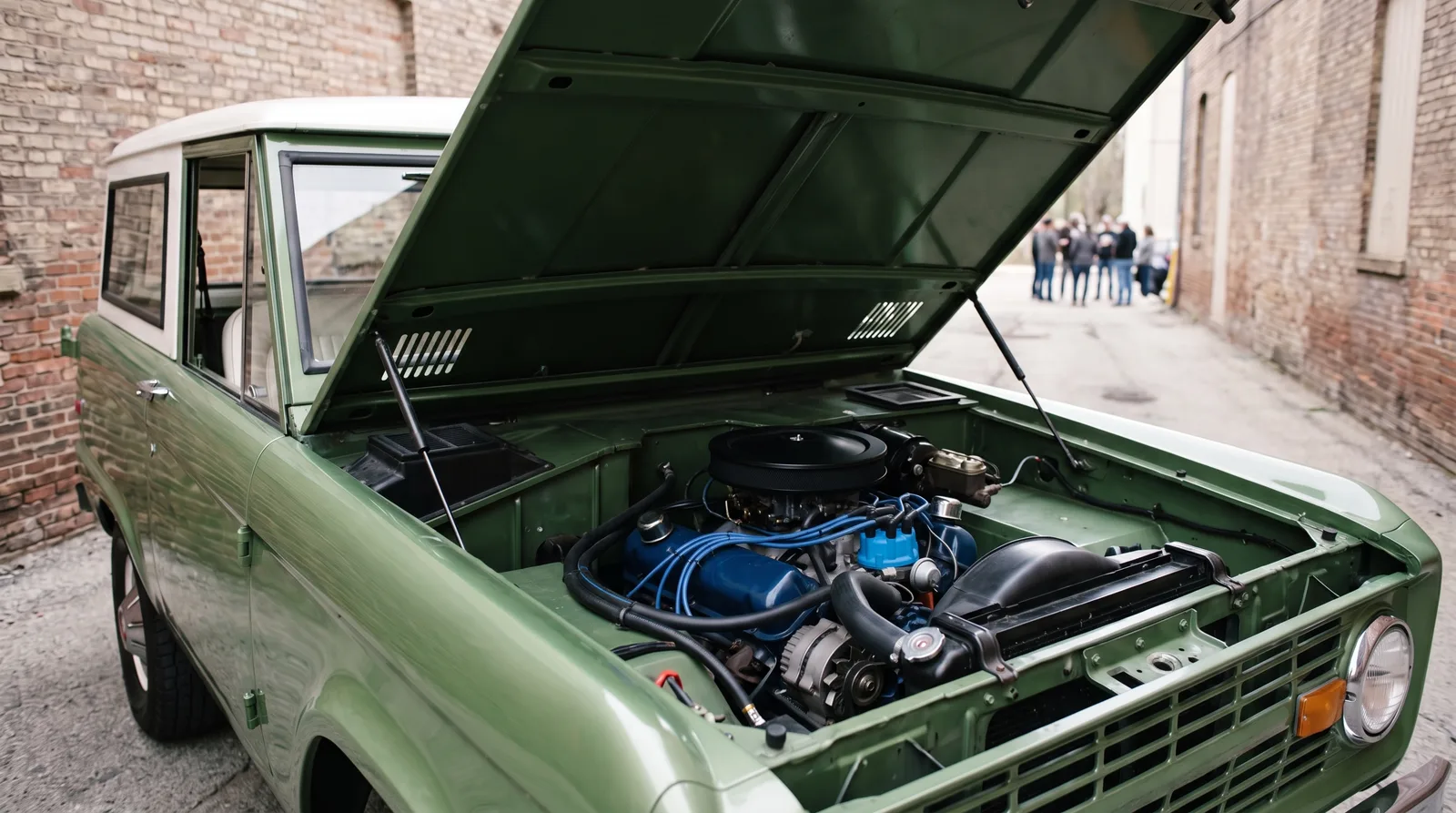
The six cylinder hum
Start with the base 170 and later 200 and 300 cubic inch inline sixes. These engines sound utilitarian, and that is not an insult. A straight six has an inherently smooth firing order, which means it runs with less inherent vibration than a V8 of similar output. On an early Bronco, that translates to a low, steady hum at idle and a flat, honest drone under load. It is not exciting. It is the sound of a farm truck doing farm truck things.
Plenty of original buyers picked the six specifically because it was cheaper to run and simpler to fix, and the sound matched that mission. Nobody bought a six cylinder Bronco to turn heads.
The V8 changes the conversation
Drop a 289 or 302 Windsor V8 into the same chassis and the whole character shifts. A V8's uneven firing pulses at idle produce that familiar rumble people associate with American muscle, even in a truck that was never marketed as fast. With a stock exhaust system and factory muffler, an early Bronco V8 idles with a mellow burble rather than an aggressive rasp, but open up the throttle and there is real bark to it, especially once the truck ages and the exhaust system loosens up a little.
That is the sound most people picture when they picture a classic Bronco, even though the six cylinder was the standard, lower cost engine for the truck's entire first year on sale, with the V8 arriving only as a mid year option.
Why the exhaust system does half the work
An engine's sound is not just the block and heads, it is everything the exhaust gases pass through on the way out. A factory single exhaust with a stock muffler tames a Windsor V8 into something civilized enough for a residential neighborhood. Swap in a less restrictive muffler or dual exhaust and the same engine sounds like a completely different animal, louder at idle and with a sharper edge under acceleration. This is why two Broncos with the identical 302 under the hood can sound nothing alike depending entirely on what is bolted to the back of the manifolds.
"Stock exhaust, stock cam, stock everything. That truck still sounds better than most modern V8s with a hundred more horsepower. Numbers do not always tell you what matters."
- Dan Reeves
The full size trucks and their bigger displacement options
Move into the 1978 and later full size Broncos and the engine lineup expands to include the larger 351M and 400 V8s on the earliest full size trucks and, from 1982 onward, the 351 Windsor, each with its own tonal signature. Ford never offered a true big block in the Bronco, since the 460 stayed reserved for its two wheel drive trucks. Bigger displacement generally means a deeper, lower pitched rumble at idle, since larger cylinders moving more air produce lower frequency pulses. A 351 idling next to a 302 is a noticeably different sound if you park them side by side, even before either driver touches the throttle.
That said, bigger is not automatically better if what you are chasing is a specific character. Some owners prefer the tighter, quicker revving feel of the smaller 302 over the heavier, torquier presence of a big block, and the sound preference tends to follow the driving preference pretty closely.
| Engine family | Idle character | Under load |
|---|---|---|
| 170/200/300 six | Smooth, steady hum | Flat, consistent drone |
| 289/302 Windsor V8 | Mellow burble, stock exhaust | Classic V8 bark when opened up |
| 351M/400/351 Windsor | Deeper, lower pitched rumble | Heavier, torque-forward growl |
How age changes the sound you hear today
A sixty year old exhaust system does not sound like it did when it left the factory, even if nobody ever swapped a single part. Gaskets settle, pipe joints develop small leaks, and mufflers lose some of their internal packing material over decades of heat cycling, all of which subtly change an engine's note without anyone doing it on purpose. That means the Bronco you hear at a car show today, even one described as fully stock, is producing a sound shaped partly by sixty years of natural wear rather than a factory fresh baseline.
This matters when you are trying to judge originality by ear. A slightly raspier idle than you expected from a supposedly stock exhaust is not automatically evidence of a modification, it might just be an old system doing what old systems do. Cross reference what you hear against a visual inspection of the exhaust hardware before drawing conclusions either way.
Sound as a buying consideration
If engine character matters to you as much as horsepower numbers on paper, listen to a truck run before you commit to buying it, ideally cold start through full warm idle. A rough, uneven idle on a V8 that should be smooth can point to a vacuum leak, tired valve seals, or worn ignition components, all of which are common enough on engines this old that they are worth budgeting for rather than treating as automatic dealbreakers. For the broader story of how these engines fit into the truck's overall development, our complete history lays out the full lineup year by year, and keep exploring if you want to see how body style choices affect what these trucks are worth today.
Whatever combination of engine and exhaust speaks to you, that sound is a big part of what makes owning one of these trucks feel different from driving something modern. If you are ready to go find that sound in person, there is classic Bronco for sale inventory worth a look right now.
What modification does to the equation
Plenty of Bronco owners over the decades have chased a specific sound on purpose, swapping headers, mufflers, or entire exhaust systems to get closer to what they picture in their head when they think about a classic V8 truck. That is a completely legitimate way to enjoy the hobby, and a well matched header and muffler combination can genuinely improve both sound and performance over a tired factory setup. The tradeoff is that a heavily modified exhaust moves a truck further from its factory original state, which matters if originality is part of what you value in a classic vehicle.
There is no wrong answer here, only a question of priorities. A truck built to sound exactly right for a Saturday cruise is a different project than a truck being preserved as close to factory condition as possible, and it is worth deciding which one you are building before you start swapping parts based on how something sounded in a video online.
The bottom line
Horsepower figures on these trucks were never impressive by modern standards, and most of the interesting hard numbers from the era deserve a skeptical eye before you repeat them as fact. What has aged perfectly is the sound. A well tuned Windsor V8 under a Bronco hood still turns heads sixty years later, and that has never needed a spec sheet to prove it.
Sources and notes
Related Reading
Have a
Ford Bronco
for Sale?
Reach thousands of serious classic car collectors across the US.
Sell It Here →
Selling a classic? Here's how: the best sites to sell a classic car
Are You a Classic Car Dealer?
List your full inventory and connect with targeted classic car buyers.
Join as a Dealer →

About the author
Dan Reeves
Performance engine builder from North Carolina's motorsports corridor, focused on swaps, forced induction and making real, repeatable power.
Related Listings - Ford Bronco
More in Car Features
Comments
Be the first to comment on this article.