
Every long running classic accumulates a layer of stories that get repeated so often they start to sound like fact, and the early Bronco has more than its share. Some of these claims are close enough to true that the distortion is minor. Others are simply wrong and keep circulating anyway because they make a better story than the documented reality. Sorting the ford bronco first gen myths from the record is worth doing carefully, because a surprising number of buying decisions still get made on the basis of stories that do not hold up.
Car Features
6 min read
Myths and Legends of the Early Bronco
Separating the documented record from persistent folklore in the ford bronco first gen myths that still circulate among buyers and collectors.
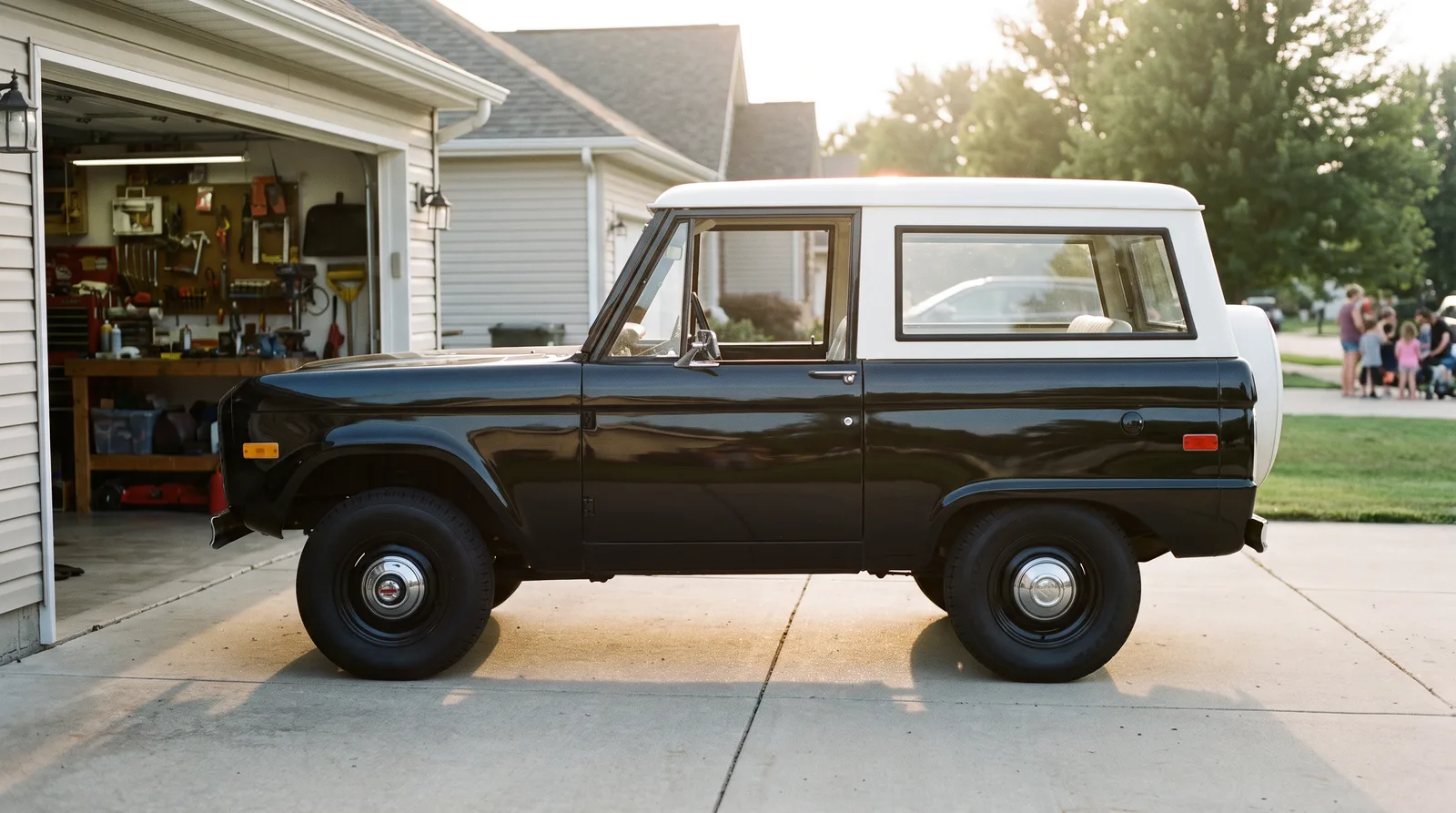
Myth: it shared a design team with the Mustang
This claim shows up often enough in casual conversation that it has taken on a life of its own, the idea that the same stylists who penned the original Mustang also shaped the Bronco, as though the two vehicles were siblings from one design studio moment. The truth is more mundane. The Bronco was developed by a separate product team focused specifically on the compact utility segment, working under product planner leadership rather than through the Mustang's styling group. Any resemblance in the era's general design language comes from both vehicles being products of the same company in the same decade, not from a shared design lineage. It is a nice story. It is not an accurate one.
Myth: every early Bronco came with a V8
Plenty of Broncos that show up at auction today run V8 engines, and that visibility has created an impression that the V8 was standard or even the most common configuration from the start. In fact, the truck launched with a straight six as its base engine, and the V8 option arrived after the model's introduction and was never universal across the production run. A meaningful share of surviving early Broncos, particularly plainer working examples that were not preserved as show trucks, were built with the six cylinder engine. The V8 population looms larger in the collector market today partly because those trucks were more likely to be kept and restored, which skews perception of what was actually common on dealer lots at the time.
Myth: the body panels are aluminum
This one surfaces occasionally among buyers trying to explain why a particular truck feels lighter than expected, or why a panel seems to resist rust in a spot where steel usually fails first. The early Bronco's body is steel, full stop, the same material used across the rest of Ford's light truck lineup at the time. Any lighter feel in a given panel usually comes down to gauge thickness or prior repair work rather than a different base material. Rust behavior that seems unusual is far more often explained by prior bodywork, filler, or a repaint that hid the truck's real condition than by any exotic material choice Ford never actually made.
"Most myths about this truck come from someone repeating what they heard at a swap meet twenty years ago, and nobody ever went back to check the original paperwork."
- Sarah Whitfield
Myth: the name came from a specific rodeo horse
The idea that Ford named the truck after a particular famous bucking horse is a persistent piece of folklore, but the name was chosen more generally, invoking the broader image of a wild, untamed horse as shorthand for rugged capability, in line with how Ford and other manufacturers of the period frequently reached for animal names to signal off road toughness. There is no verified documentation tying the name to one specific horse or rodeo event, and no published record of a formal naming committee decision has surfaced either. The generic branding explanation is the one supported by the available corporate history, even though the more specific version makes for a better campfire story.
Collectors sometimes apply a strict matching numbers standard to the early Bronco that was really developed around muscle cars, where a factory documented engine and transmission pairing has always been central to value. The early Bronco's own production and parts history was looser than that from the start. Engines were serviced and swapped through dealer networks during the truck's working life far more casually than a muscle car buyer might expect, and Ford did not track these trucks with the same numbers matching rigor that later became standard for collector documentation on performance cars. Demanding strict factory matching on every component of an early Bronco applies a standard the truck was never built or tracked to meet, and sellers who lean on matching numbers language should be able to explain specifically what records support the claim rather than using the phrase as a generic marketing term.
Why separating myth from record actually matters
None of this is pedantry for its own sake. Buyers who believe a truck is rarer, more original, or more historically significant than it actually is will pay accordingly, and sellers occasionally lean on these same myths, knowingly or not, when describing a truck for sale. Treating any dramatic claim about a specific early Bronco, whether about its engine, its provenance, or its supposed design pedigree, with the same scrutiny an appraiser would apply protects a buyer from paying a premium for a story rather than for the truck itself. For the documented version of how this generation actually came together, where this started lays out the verified history in full, and anyone ready to look at real examples rather than more stories can find a classic Bronco currently listed for sale.
None of this is meant to strip the truck of its character. The early Bronco does not need embellished stories to be interesting. Its actual documented history, the compressed development timeline, the range of drivetrains it actually shipped with, the genuine cultural adoption it earned without any marketing push behind it, holds up fine on its own. If anything, clearing away the myths makes the real story easier to appreciate, because you are no longer squinting at the truck through a layer of secondhand exaggeration. The genuine history, pieced together from build sheets, period advertising, and honest production records, is interesting enough to stand entirely on its own, and treating it with the same scrutiny you would apply to any other historical claim only strengthens the case for why this truck earned its reputation in the first place rather than weakening it. The next time someone at a car show repeats one of these claims with total confidence, it is worth asking, gently, where they actually heard it. More often than not the answer traces back to another swap meet conversation rather than a document anyone has actually seen, and a polite question like that has quietly corrected more misinformation at car shows than any published article ever will.
Sources and notes
Related Reading

Have a
Ford Bronco
for Sale?
Reach thousands of serious classic car collectors across the US.
Sell It Here →
Selling a classic? Here's how: the best sites to sell a classic car
Are You a Classic Car Dealer?
List your full inventory and connect with targeted classic car buyers.
Join as a Dealer →

About the author
Sarah Whitfield
Third-generation classic car collector specializing in pre-war American and European coachbuilt automobiles. Researcher and concours enthusiast.
Related Listings - Ford Bronco
Comments (1)
R
Russ G.
19 hours ago
Matching numbers mattered fine out here. Fella who bought my neighbor's '71 paid extra for the original 302 and the papers.
That is fair, and your neighbor's buyer paid for the right thing: an original engine backed by paper. My concern is the phrase used without the paper behind it. On these trucks the VIN records the engine type, so an original 302 can at least be shown to fit the build. Proving it is the original block takes the receipts.