
The Ford Bronco first gen vs Scout comparison rarely gets the attention the Bronco-versus-Jeep argument does, and that is a mistake, because International Harvester's Scout was arguably a closer match to the early Bronco than the Jeep CJ ever was. Both trucks launched within a few years of each other, both targeted a buyer who wanted genuine off-road ability without giving up a real cab and a real ride, and both companies built their reputations on farm and industrial equipment before either one built a 4x4. The overlap in mission makes the differences in execution worth a careful look.
Car Features
6 min read
Early Bronco vs International Scout, Rivals Reconsidered
International's Scout beat the Ford Bronco to market by five years and arguably shaped its whole format. Here is how the two rivals actually compare.
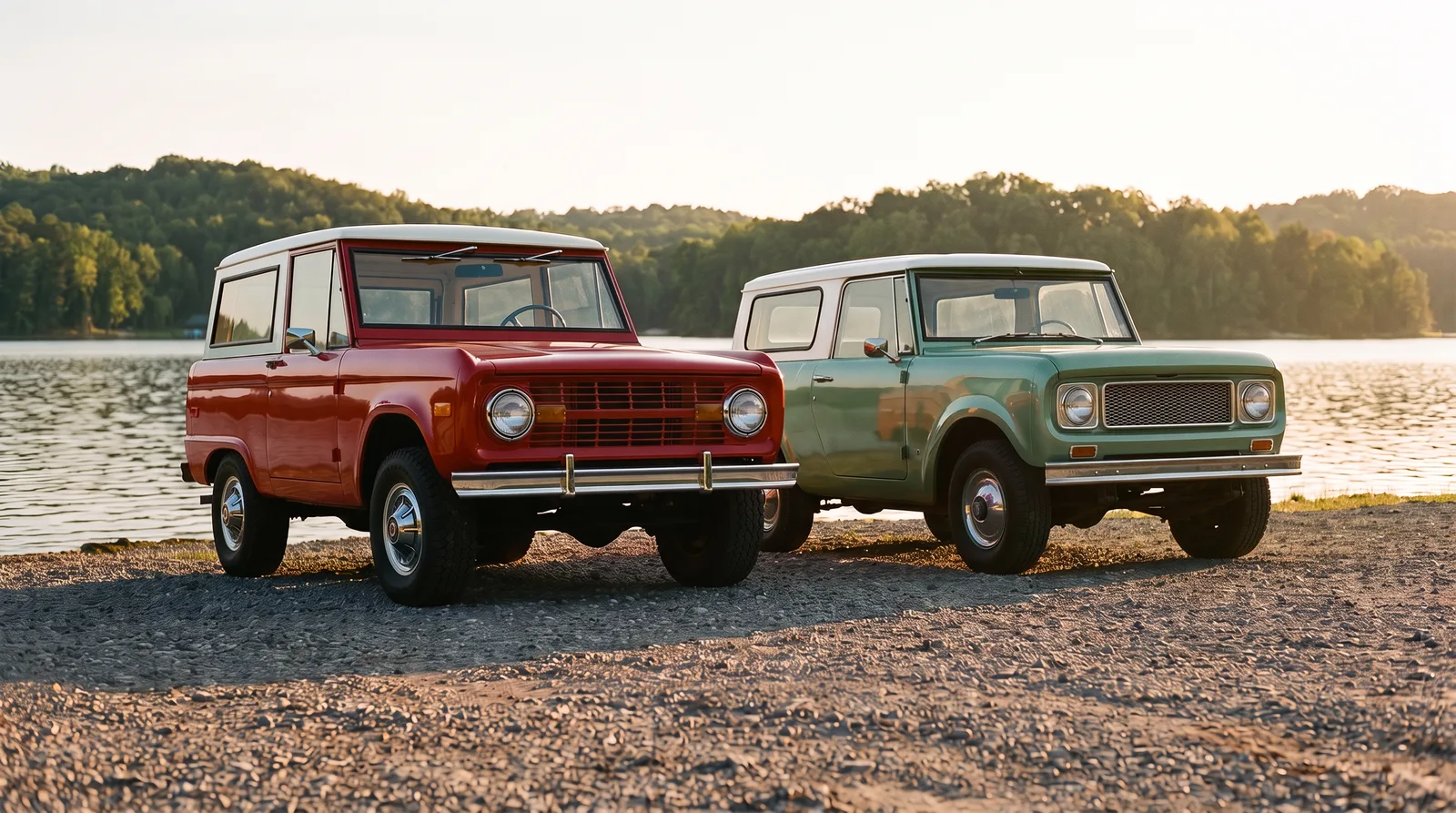
International got there first
International Harvester introduced the Scout in 1961, five years ahead of the Bronco, and the timing mattered. Scout established the template for a compact, boxy utility vehicle with a removable top and a bed that could be configured for hauling or passengers, and Ford's product planners studied it closely while developing the Bronco. The original Scout 80 rode an 100-inch wheelbase, longer than the Bronco's eventual 92 inches, and used a leaf-sprung front suspension in keeping with International's truck-building background rather than the coil-spring setup Ford would later engineer specifically for on-road comfort.
By the time the Bronco arrived in 1966, International had already refined the format with the Scout 800, adding options and trim levels that pushed the truck further toward a comfortable daily driver rather than a stripped farm tool. Ford entered a market that International had, in a real sense, already proven existed. For the full account of how Ford built its answer, including the Bronco's coil-spring front end and its three original body configurations, see the whole picture of the truck's 1966 launch.
Engine philosophy split the two trucks apart
International leaned on its own engine family, offering a 152 cubic inch four-cylinder at the Scout's debut and later adding a V8 option sourced from International's truck line. Ford, by contrast, offered its familiar 170 cubic inch inline six at Bronco launch and added the 289 V8 within the first model year, giving Bronco buyers a strong V8 option earlier in the Scout's competitive life than International's own V8 program matured. Horsepower comparisons from period road tests generally favored the Bronco's six over the Scout's base four, though enthusiasts who wanted real power in either truck typically waited for the V8 versions to become widely available.
Both companies eventually chased bigger and more powerful engines as the 1970s wore on, with International introducing the Scout II in 1971 and offering a 345 cubic inch V8, while Ford kept growing the Bronco's own V8 options through the 302. Neither truck was ever marketed as a performance vehicle. Both companies understood their buyers wanted torque for towing and low-range crawling, not top speed.
Production numbers reveal different fates
The Scout sold well through the 1960s and 1970s, and the Scout II carried the nameplate into the early 1980s, but International Harvester's financial troubles in the farm equipment business eventually pulled the company away from consumer trucks entirely. Scout production ended in 1980, a casualty of International's broader restructuring rather than any failure specific to the truck itself. The Bronco, backed by Ford's much larger consumer vehicle operation, kept evolving through the 1978-79 big Bronco and into the full-size 1980-96 generation, giving the nameplate three full decades on the market compared to the Scout's roughly two.
That difference in corporate staying power shapes the collector market today. Bronco parts support, reproduction sheet metal, and specialist restoration shops are more numerous simply because Ford stayed in the game longer and the customer base never fully dispersed. Scout owners face a smaller, tighter-knit community, and while that community is fiercely dedicated, sourcing certain trim pieces and body panels can take real patience.
| Spec | 1966 Ford Bronco | 1966 IH Scout 800 |
|---|---|---|
| Wheelbase | 92 in | 100 in |
| Base engine | 170 ci inline six | 152 ci four-cylinder |
| Front suspension | Coil-spring Mono-Beam | Leaf spring solid axle |
| Production end (era) | 1996 (full run) | 1980 (Scout II) |
Trim and marketing tell their own story
Ford and International Harvester marketed their trucks to noticeably different buyers even as the vehicles themselves converged in mission. Ford leaned on the Bronco's ride quality and versatility, running advertising that showed the truck moving fluidly between trail duty and family errands, a message aimed at a suburban and semi-rural buyer who wanted one vehicle for both roles. International's marketing stayed closer to the Scout's farm and industrial roots, emphasizing durability and payload capacity in ways that spoke more directly to working buyers who needed a truck for genuine labor rather than a lifestyle statement.
That marketing split shows up today in how the two trucks get restored. Bronco restorations more often chase a clean, presentable finish suited to shows and casual weekend driving, while Scout restorations, particularly among the truck's most dedicated owners, tend to preserve or even emphasize the working-truck character International originally sold. Neither approach is wrong, but they reflect two different original sales pitches that have aged into two different restoration cultures.
Which truck rewards a collector's patience
Scout values have climbed meaningfully in recent years as buyers priced out of the early Bronco market look for an equally authentic alternative with genuine period credibility. A clean Scout 800 or Scout II in original condition can still cost noticeably less than a comparable early Bronco, though the gap has narrowed. What has not narrowed is the parts and service infrastructure gap. A Bronco owner today can call on decades of aftermarket investment that Scout owners simply do not have at the same scale, and that reality shows up in restoration timelines and costs.
None of this makes the Scout a lesser truck. It makes it a truck for a buyer who values rarity and a smaller ownership community over convenience, much the way early Bronco buyers felt a decade ago before that market matured and prices climbed. The rivalry between the two trucks was never really about which one won. It was about two different manufacturers solving the same problem with different tools available to them, and both solutions aged into genuine American classics.
"The Scout got there first, and Ford knew it. What Ford brought to the fight was a coil-spring ride and a corporate parts pipeline that outlasted International's entire truck division."
- Tom Ramirez
Shopping the comparison today
Buyers who want to weigh a ford bronco first gen vs scout purchase in person should look past nameplate loyalty and focus on documentation, drivetrain originality, and how much of the truck's history is actually verifiable. Both trucks reward patient shoppers who resist the first clean-looking example they find. For those ready to start with the more widely available option, buyers can shop classic Bronco listings and compare wagons, half-cabs, and roadsters against whatever Scout alternative they have been considering, letting the trucks themselves settle an argument that has run for sixty years.
Sources and notes
Related Reading

Have a
Ford Bronco
for Sale?
Reach thousands of serious classic car collectors across the US.
Sell It Here →
Selling a classic? Here's how: where to sell your classic car online
Are You a Classic Car Dealer?
List your full inventory and connect with targeted classic car buyers.
Join as a Dealer →
#Ford Bronco
#International Scout
#classic 4x4 history
#early bronco
#Ford vs International Harvester

About the author
Tom Ramirez
Corvette researcher and historian based in Bowling Green, Kentucky. Two decades documenting Corvette production history from original factory records.
Related Listings - Ford Bronco
Comments
Be the first to comment on this article.