
Every Bronco club has one member who brings up the same story at the same point in every meeting, and at ours it is always the same conversation starter: someone new to the group asks why so many people, the moment you mention a "white Bronco," picture the exact same television image before they picture anything else. The ford bronco oj simpson chase is not a story we in the hobby chose. It found the truck anyway, on a June evening in 1994, and it changed how an entire generation of Americans first encountered the Ford Bronco nameplate, whether they knew a single fact about the vehicle before that night or not.
Car Features
7 min read
The White Bronco and the 1994 Chase, a Cultural Moment
How a 1993 Ford Bronco became one of the most recognized vehicles in television history, and how the club community talks about that legacy today.
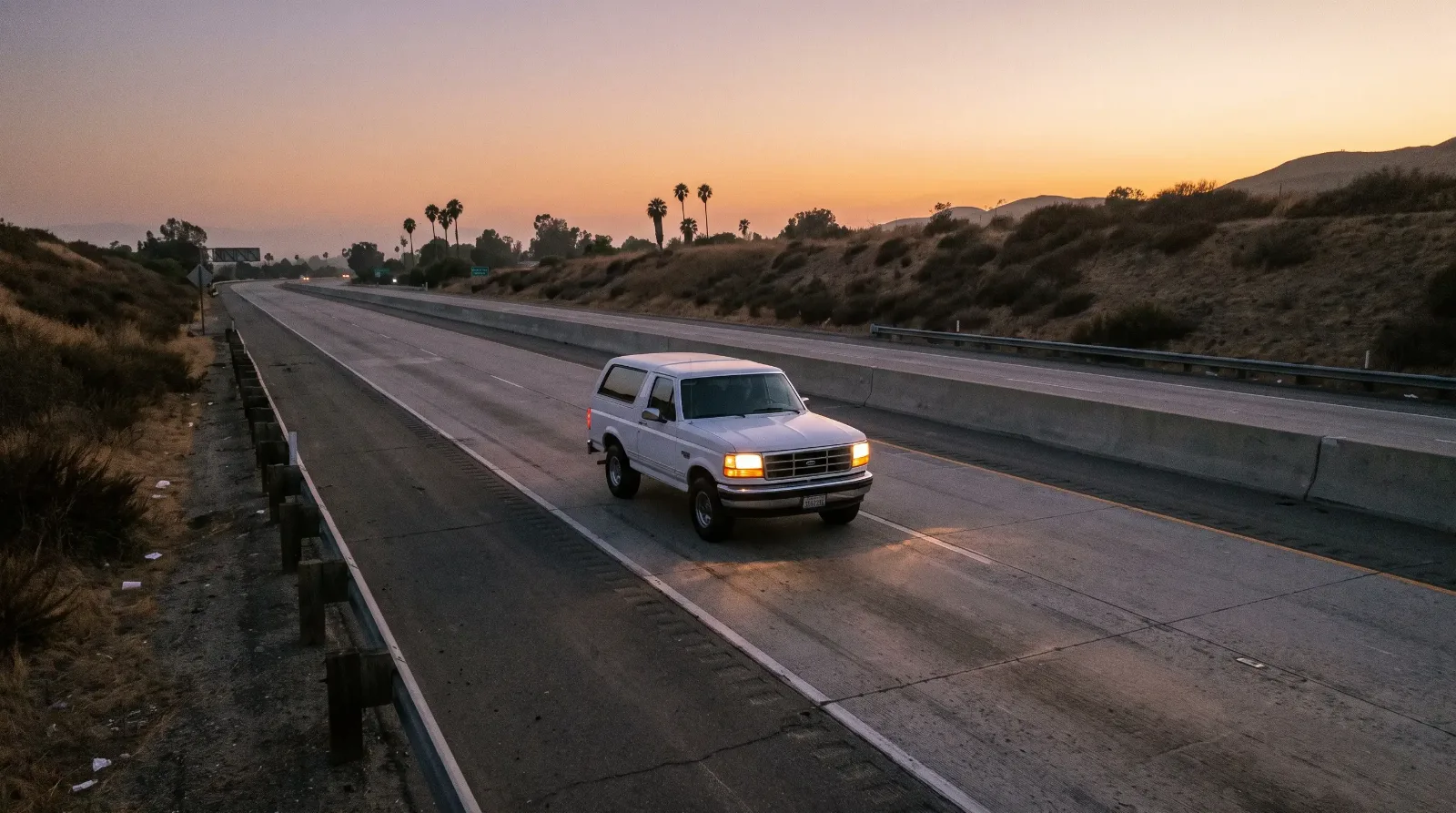
The vehicle at the center of the moment
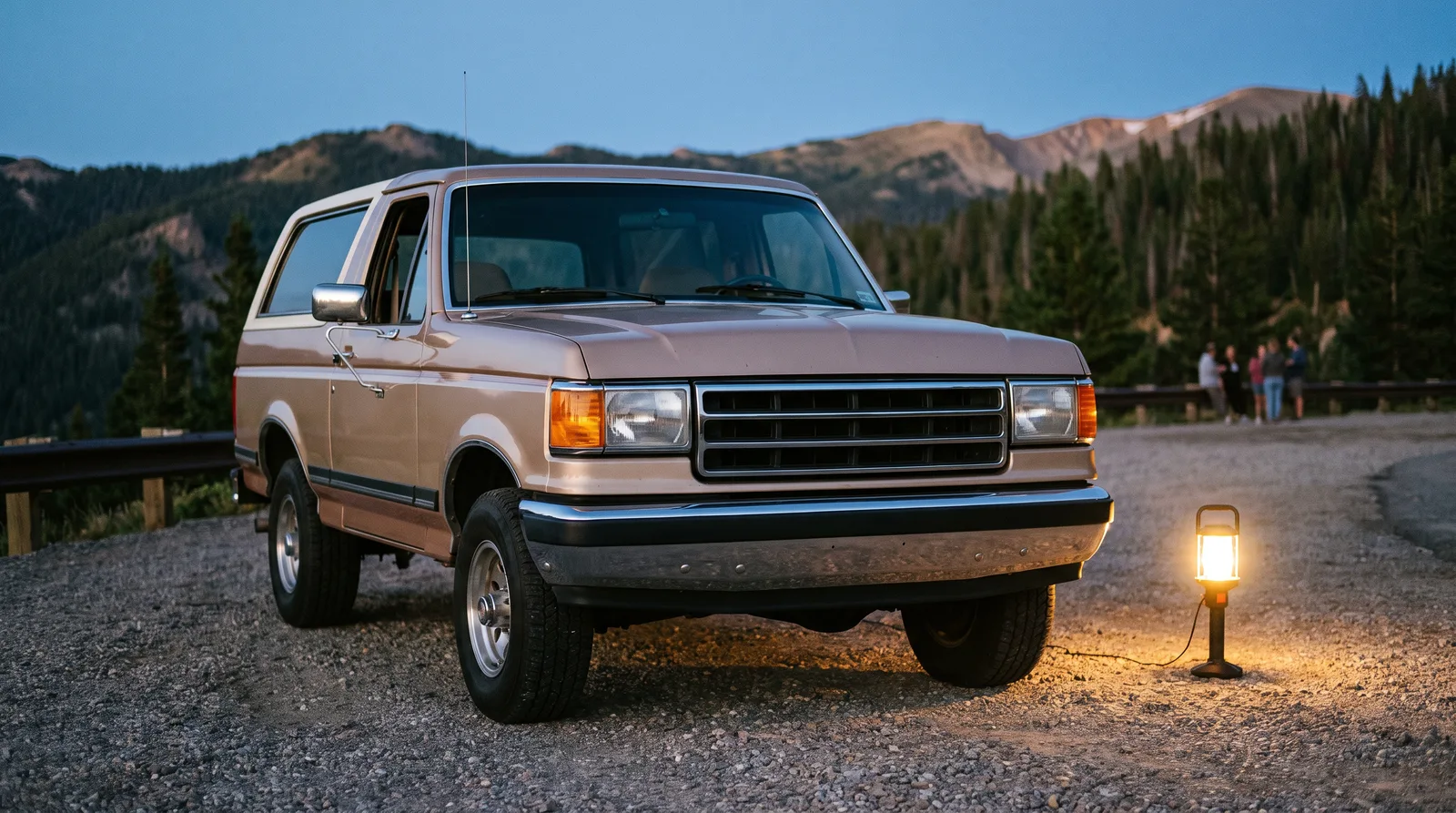
The truck involved was a 1993 Ford Bronco, part of the full-size, F-150-based line Ford built across three successive generations from 1980 through 1996, driven that evening by Al Cowlings with O.J. Simpson as a passenger during a widely televised slow-speed pursuit on Southern California freeways. Millions watched live as news helicopters tracked the white Bronco for hours, an image that became one of the most replayed pieces of television footage of the decade. For a truck that most Americans had never specifically noticed on the road before, it was an extraordinary, unwanted introduction to national attention.
Understanding why this particular truck shape became so instantly recognizable starts with the design itself, and where this started traces the Bronco nameplate back to its 1966 origins, well before the full-size trucks of the 1990s carried the name into a very different kind of spotlight.
Why a truck, of all things, became the fixed point
It is worth pausing on why the vehicle specifically is what stuck in public memory rather than any other detail from that period. Court proceedings that followed generated far more total hours of television coverage than the pursuit itself, and yet ask most Americans what image comes to mind first from that entire chapter of the mid 1990s, and the freeway pursuit with the white Bronco is very often the answer. Moving images have a way of outlasting testimony and argument in public memory, and a live helicopter shot of a single identifiable vehicle, tracked for hours on empty freeway lanes lined with spectators, offered a kind of visual simplicity that a courtroom could never match. The truck became the fixed point almost by accident of what the cameras happened to be pointed at that evening.
How the club talks about it, honestly
I will say plainly what most longtime members eventually admit out loud: this is a complicated piece of Bronco history to sit with. The event at the center of it involved real people and a real tragedy, and no Bronco enthusiast worth listening to treats the moment as a punchline. What the community does discuss, carefully, is the strange afterlife the specific vehicle took on once the news cameras moved elsewhere. That white Bronco became, almost against its own will, one of the most recognized individual vehicles in American television history, a status no marketing department could have engineered and no owner could have wanted.
What it did to the Bronco nameplate
Set the specific circumstances aside for a moment and look only at brand recognition, and the effect is undeniable. Before June 1994, the Ford Bronco was a well-regarded but not especially headline-grabbing nameplate, known mostly within truck and off-road circles. After that night, "Bronco" carried instant recognition across an audience that had never cross-shopped a truck in their life. Ford discontinued the full-size Bronco after the 1996 model year for reasons largely unrelated to the event, driven more by shifting SUV market trends and the rise of the Expedition. But the timing left the nameplate's final years permanently associated, in the broader public imagination, with that single televised evening rather than with anything the truck itself had actually done on or off road.
"New members always expect us to either avoid the subject entirely or lean into it as a joke. We do neither. We just tell them honestly what the truck was, what happened, and why it still comes up. That is usually enough."
- Wayne Coburn
Separating the event from the truck's own legacy
What gets lost when the chase dominates the conversation is that the full-size Bronco built across its three generations between 1980 and 1996 has its own legitimate engineering story, built on a proper truck frame with genuine off-road capability and a loyal following independent of anything that happened in 1994. The specific truck involved that night was, mechanically and historically, an unremarkable example of a well-regarded line. Its fame has nothing to do with its capability, its rarity, or its engineering, and everything to do with a single evening of news coverage that had nothing to do with the vehicle itself beyond its color and its shape.
What newer members ask when they first find out
Nearly every new member who joins a Bronco club eventually learns, sometimes to their surprise, that the truck they love has this specific chapter attached to its history whether they were alive for it or not. The most common first question is usually about the specific truck itself, whether it survived, where it ended up, and whether it is something a collector could theoretically acquire. Club members generally decline to speculate publicly on that, treating it as a private matter connected to real people rather than a trivia question to be answered for entertainment. The second most common question is broader and easier to answer honestly: did this event actually hurt the Bronco as a product? The consensus among longtime members is that it did not meaningfully damage sales or reputation among people who already understood trucks, but it did permanently attach a layer of unrelated cultural association to the name that no other Ford product carries in quite the same way.
What tends to surprise newer members most is how matter-of-fact the conversation usually is once it happens. There is no dramatic reveal and no attempt to shock anyone. It is simply treated as one true, well-known fact about the nameplate's history, mentioned once, answered honestly, and then set aside in favor of talking about the trucks themselves, which is where most members' actual interest and expertise lies. New members generally come away from that first conversation understanding something important about the hobby as a whole, that it takes its history seriously in both directions, the parts that are flattering and the parts that simply are what they are.
Why the club still talks about it
We talk about it because pretending it did not happen would be its own kind of dishonesty about how most of the country actually learned the Bronco name, and because the community has largely arrived at a mature, respectful way of holding both truths at once: a serious event involving real people, and a genuinely capable classic truck that happened to be the vehicle involved. Anyone drawn to the hobby specifically because that image stuck with them from 1994 usually finds, once they start attending meetings and reading up on the trucks, that there is a far deeper and more rewarding story waiting underneath it. Those ready to look past the headline and toward the trucks themselves can find a classic Bronco for sale and start learning what the nameplate actually built its reputation on.
Sources and notes
Related Reading
Have a
Ford Bronco
for Sale?
Reach thousands of serious classic car collectors across the US.
Sell It Here →
Selling a classic? Here's how: the best sites to sell a classic car
Are You a Classic Car Dealer?
List your full inventory and connect with targeted classic car buyers.
Join as a Dealer →

About the author
Wayne Coburn
Longtime Corvette owner, judge and club figure who knows the cars, the records and the people behind them.
Related Listings - Ford Bronco
Comments (1)
L
Larry D.
5 days ago
We had the little television over the pie case tuned to the Knicks and Rockets that night and the whole counter was arguing about Ewing when the picture switched to that white truck on the freeway, and nobody paid their check and nobody went home, and I remember a trucker on the end stool saying that was a Bronco just like his brother's, and he was the only man in the place who cared one bit what kind of truck it was.